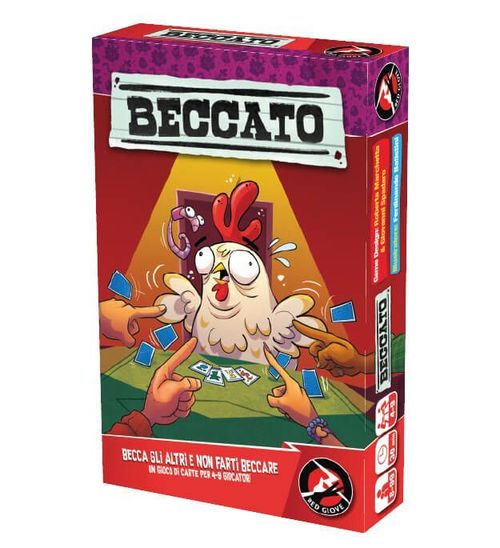
Beccato
Beccato Rulebook
Table of Contents
Table of Contents
Components
- 28 Chicken cards
- 33 Signal cards
- 28 Egg cards
- 8 Henhouse cards
- 1 Chick card
- 12 Guild cards
Goal of the Game
In Beccato! the players form Guilds (teams) in the hunt for precious and eccentric eggs to collect. To do so, on each turn they pass one of their chickens to the next player and receive one from the previous player, trying to form a set of three chickens of the same breed.
Here is the risk: when a player holds the winning set of three, they must signal it to their Guild mates, trying with the utmost "nonchalance" to perform a secret signal drawn at the start of the game or agreed with their teammates. Tension is at its peak, and the players of the rival Guilds are ready to catch even the slightest movement to "catch" them and steal the eggs right from under their noses. Bluffing, reflexes and plenty of "nonchalance" are the right tools to win the winning egg collection!
Setup
1. Form teams
Before playing a game of Beccato!, the first thing to do is to divide into teams. Depending on the number of players, you may agree and divide into teams of 2 or 3 players. Sit around the table alternating between players of different teams (use the diagram in the printed rulebook for the seating and turn order for each player count). At this point, each player takes a Guild card of their own team and places it in front of them, so that everyone can easily recognise which Guild they belong to.
Attention: for 5-player games there are special rules, found at the end of the rulebook. These rules introduce some changes to the setup and to how the game is played.
Cockerel's tip: if chaos reigns in your henhouse and you cannot decide how to divide into teams, you can use the Guild cards: for each Guild, take a number of Guild cards equal to the number of members who must be part of the team (e.g. a team of 2: two Guild cards with the $), shuffle them and deal them face down to the players. The players divide into teams according to the card they receive.
2. Choose a secret signal
Each team must decide on a secret signal to use during the game to communicate with its teammates without being "caught" by the opponents. To do this, shuffle all the Signal cards and deal one card to each team. All members of the team look at the card in secret: that will be the secret signal they must use during the game to communicate with one another. All secret signals are explained later in the rulebook.
3. Now the cards!
Take a number of Henhouse cards equal to the number of players minus one and place them in the centre of the table. Take the Chicken cards of the same breeds as the henhouses, add the 4 cards of the Serama rooster (see the printed rulebook for the image) and form a deck.
Shuffle the deck very well and deal 3 cards to each player and 4 cards to the dealer: the deck must run out. All unused Chicken cards can be returned to the Beccato! box.
Take all the Egg cards, form a deck, shuffle them and place one Egg card face up on each henhouse, in its space. Place the Egg deck face down in the centre of the table. At the end of setup, the game will look as in the printed diagram (e.g. a 6-player game).
Note on the deal: the printed rulebook says "3 cards to each player and 4 cards to the dealer". The deck composition in the printed 6-player diagram (3 of each of the 5 chicken breeds plus 4 Serama, 19 cards in total) matches 3 cards to each of the five non-dealer players and 4 to the dealer, so "each player" is read here as each of the other players.
Playing the Game
The dealer starts the game by choosing one of their four cards and passing it to the player on their left. That player receives the card, adds it to their hand, chooses one of their four cards to pass to the player on their left, and so on. The game continues until:
- a player exclaims Coccodé,
- or a player exclaims Beccato,
- or a player exclaims Chicchirichì.
The round then ends and a new round begins. The player after the dealer becomes the new dealer, collects all the Chicken cards, and deals 3 to every player and 4 to themselves.
Exclaiming "Coccodé"
As soon as a player has 3 cards of the same chicken in hand (the Serama rooster does not count), they are in a position to have their teammates exclaim Coccodé and score points. To do this, they must give the secret signal to their teammate, who, as soon as they recognise the signal, must exclaim "Coccodé". At that point, all teammates of the player who exclaimed Coccodé show their cards.
- If among them there is a player holding 3 identical cards that are not "Serama", the team has scored a point and draws the Egg card from the henhouse matching the chicken in the winning hand. Then a new Egg card is drawn to replace the one taken by the team.
- If none of the players on the team has 3 identical cards that are not "Serama" in hand, the player exclaimed "Coccodé" by mistake: in this case, each opposing team draws a face-down Egg card from the deck.
Example: Nicola, Claudia and Cecilia play against Simona, Federico and Mariano. Nicola passes a card to Simona, who in turn passes one to Claudia, and so on: the cards travel from player to player. Nicola is convinced that Claudia has winked at him, their secret signal, so he exclaims "Coccodé". Claudia and Cecilia show their cards: Claudia does indeed have three Orloff in hand. Nicola's team takes the Egg from the Orloff henhouse and adds it to its points.
Example: Same game as before, new round. The cards travel and, at one point, Mariano exclaims "Coccodé", convinced that Federico has given him their secret signal. Simona, Federico and Mariano show their cards, but nobody has a hand with three identical chickens! Mariano was mistaken: Federico, while trying to bluff, was touching his right ear instead of his left. The opposing team scores a point: Nicola draws a card from the top of the Egg deck and adds it to his team's points.
Exclaiming "Caught!"
Players must pay great attention while communicating with their teammates by their secret signal. If an opponent recognises the signal and notices it, they may exclaim "Caught!" pointing to the player they believe holds the hand of three identical chickens. That player reveals their hand:
- If the hand really is three identical chickens, the team of the player who exclaimed "Caught!" scores a point and draws an Egg card of their choice from those available on the henhouses or from the top of the Egg deck.
- If the hand is not made up of three identical chickens, the team of the player who was falsely "Caught!" scores a point and draws a card from the top of the Egg deck.
In any case, the round ends and a new round begins.
Example: Same game as before, new round. The cards travel and, at one point, Simona sees Cecilia who, absent-mindedly, winks at Nicola. Since she had already seen Claudia wink, she is convinced that this is their secret signal and exclaims "Caught!". Cecilia shows her cards and indeed has 3 Padovane in hand. Simona draws an Egg card and adds it to her team's points.
Tip: don't be a chicken, don't get caught!
As you will have understood from the rulebook, the secret signal you receive at the start of the game is very, very important. If the opponents work out which secret signal you are using, they can "catch" you almost every time and easily win the game. How do you avoid being caught? Here are some tips:
- It is often best not to play your cards right after your teammate has given you the signal. Letting some time pass between the signal and the play is always a good idea.
- Bluff. Give wrong signals to your teammates, pretending to have a set of three in hand. If you do this discreetly, your opponents may be taken in and call "Caught!" when you have nothing in hand, giving your team a point.
- The more signals you give (even wrong ones), the harder it will be for the opponents to work out which signal is the real one.
Exclaiming "Chicchirichì"
If a player, during their turn, has 4 "Serama" cards in hand, they may exclaim Chicchirichì and reveal their hand. In this case, they immediately draw a card from the top of the Egg deck and add it to their team's points. If the player exclaims Chicchirichì and does not have 4 Serama in hand, all opposing teams draw an Egg card. Then the round ends and a new round begins.
Warning: you cannot declare "Coccodé" with Serama roosters, so 3 Serama roosters are worth nothing.
Example: During the game Simona receives a card from Nicola. She checks and has 4 Serama in hand: she immediately exclaims "Chicchirichì" and draws an Egg card for her team.
End of the Game
The first team to reach 6 eggs ends the game. Then the points are counted: every egg that bears the same Guild symbol as your team is worth 2 points, otherwise it is worth 1 point. The team with the most points wins. In case of a tie, the team with more eggs of its own Guild wins the game.
Five-Player Game
If you play with 5 players, you will play with an "imaginary" chicken.
When you prepare the chicken deck, prepare it as if you were playing with 6 players. When you deal the cards, deal a hand of 3 cards to an imaginary player who sits to the right of the last player, as shown in the diagram by the egg with the "?" symbol. These cards remain on the table, face down, and no player may see them.
The player before the imaginary player places their card among the cards laid on the table and shuffles them. The player after the imaginary player draws a random card from the cards laid on the table.
Additional Rule: Signal Change
This rule may be added to allow signal changes during the game. A team that wants to change its signal gathers and decides on a new one (or draws a new one). To do this, one of the Egg cards collected during the game is turned face down and will not score points at the end of the game. If you are playing with the "Egg Pyramid" rule, the turned card scores no points and does not allow the Guild bonus to be completed.
Expert Variants
Here is a series of variants you may introduce after playing a few games of Beccato!. You may use one additional rule in a game, more than one, or all of them, as you prefer.
Free Signal
With this rule you will no longer use the Signal cards; you may put them back in the box. At the start of the game, each team gathers to decide which signal to use: each team may choose the signal it likes best, as long as it is an audible or visible signal (for example, a foot tap under the table or a silent message between phones is not valid). Try to choose a signal that is not too obvious, but also not too difficult to perform.
Calling Chickens (recommended for 4 or 5 players)
This rule changes the "Coccodé" call. When a player calls "Coccodé", they must also say which chicken their teammate has in hand, specifying its colour or, if they remember it, its name. If the player calls the colour of the chicken their teammate has in hand, they draw an Egg card as usual; otherwise the opponents draw it.
How do you work out which chicken your teammate has in hand? If you like adding some intuition to the game, you can guess which chickens your teammate holds by checking your own cards (which are certainly not in your teammate's hand) and the cards passed in previous turns; or you can agree, at the start of the game, on several signals to use, one signal for each chicken in play. Just remember which signal corresponds to which chicken and you will be able to call the right chicken.
Egg Pyramid
In this version it becomes very important to call the right henhouse. During setup, place the Chick card in the centre of the table. Each team will collect the Egg cards during the game, arranging them as a pyramid (3 cards at the base, 2 in the middle and 1 card at the top). Egg cards are placed from the base upwards. You may start from the left, from the right or from the centre, but you may go up one level only if both cards below it are present.
Example: Federico's team obtains a Cactus card that it wants to add to its pyramid. The card may go to the left (1) or to the right (2) of the pyramid, or on top (3), since both cards on the level below are present.
The first team to complete the 6-card pyramid ends the game and proceeds to the point count. Before counting, the players of the opposing team must use the three Guild cards of their own Guild to complete the pyramid, placing them in the empty spaces. If the three Guild cards are not enough to complete the pyramid, the team is automatically excluded from the point count.
As in normal games, each egg at the end of the game is worth 2 points if it bears the symbol of your own Guild, 1 point otherwise.
In addition, there is an extra "Level" bonus. If the cards of a level are all of the same Guild and the level is complete, the value of the whole level is multiplied by 2. Of course, the top of the pyramid, being made up of a single card, always has the "Level" bonus active.
The Guild cards placed inside the pyramid are worth 0 points but count towards the "Level" bonus.
So what is the Chick card we placed in the centre of the table during setup for? If a team manages to call "Chicchirichì" and has the Chick available as its last call of the game, it may take it and place it on the top of the pyramid. The Chick is worth 5 points which, multiplied by the Guild bonus, gives 10 points!
Examples (the Guild symbol of each team is a graphic that the text extraction did not capture, so it is shown here as "Guild ___"): The team of Simona (Guild ___) closes the game and totals: 1st level with Level bonus: (2+2+2) × 2 = 12; 2nd level: 1+1 = 2; 3rd level with Level bonus: 5 × 2 = 10. Total: 24 points. The team of Nicola (Guild ___) closes the game and totals: 1st level 2+0+1 = 3; 2nd level 2+0 = 2; 3rd level with Level bonus 2 × 2 = 4. Total: 9 points. The team of Federico (Guild ___) closes the game and totals: 1st level 2+1+1 = 4; 2nd level with Level bonus (2+0) × 2 = 4; 3rd level 0. Total: 8 points.
Signals Guide
The Signal cards show the following signals. The printed guide lists 24 signals in two columns (left and right); the table below keeps the rows as printed.
| Signal (left column) | Signal (right column) |
|---|---|
| Rest your right elbow on the table. | Touch your right eye. |
| Rest your left elbow on the table. | Touch your left eye. |
| Touch your nose with your left hand. | Tap the table with your right hand. |
| Touch your nose with your right hand. | Tap the table with your left hand. |
| Raise your left hand. | Talk about TV shows. |
| Raise your right hand. | Hold your cards so that only two can be seen. |
| Touch your chin with your left hand. | Hold your cards so that only one can be seen. |
| Touch your chin with your right hand. | Hold your cards so that the middle one is upside down. |
| Talk about games. | Mumble. |
| Talk about sport. | Hum. |
Summary
Setup
- Divide into teams.
- Draw a signal or decide on a signal.
- Set out the henhouses and their eggs.
Rounds
- The dealer deals 3 cards to every player and 4 cards to themselves.
- The dealer passes a card to the player on their right, who receives it and passes a card on to their right, and so on. (Translator's note: the printed summary says "right" here, while the main "Playing the Game" section says "left"; the source is kept as printed in both places. The direction of passing is the same in both: one fixed direction around the table.) The round stops when:
- a player exclaims "Coccodé": their teammates then show their hand of cards and, if one of them has 3 identical cards (not Serama), the team gains an Egg card from the henhouse. If the call is wrong: the opponents draw an Egg card.
- a player exclaims "Chicchirichì" and shows their hand of 4 cards, all Serama roosters. In this case, their team gains an Egg card from the deck. If the call is wrong: the opponents draw an Egg card.
- a player exclaims "Caught!" pointing at an opponent. The opponent shows their hand: if they have three identical cards, the caller draws an Egg card from the deck. If the call is wrong: the caught opponent draws an Egg card from the deck.
- The round then ends. All cards are collected and the new dealer starts a new round.
- If a team reaches 6 eggs, the game ends and the points are counted.