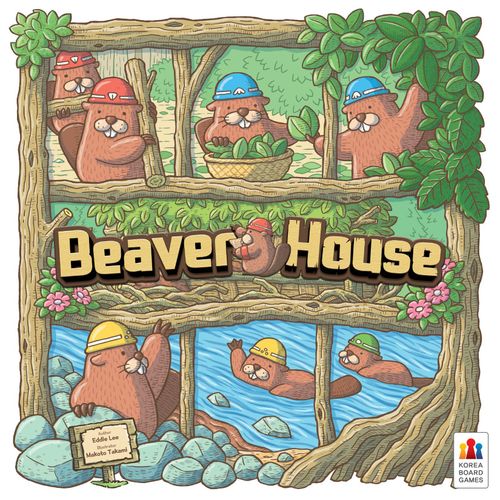
Beaver House
Beaver House Rulebook
Table of Contents
Table of Contents
Objective
Complete your construction board quickly while meeting the customer's conditions. The first player to complete their board accurately wins an order card. Collect 4 order cards to win the game!
Components
- Construction Board: Dam Board ×4 | Habitat Board ×4 (double-sided; Master side and Apprentice side)
- Material Tile ×40 (10 per color, 4 colors)
- Order Card ×30
- Beaver Meeple ×3
- Hourglass ×1
Setup
- Each player picks a color and takes the matching habitat and dam boards, as well as the set of 10 material tiles. Assemble the habitat and dam board as shown below. Use the Master side of the habitat board (if you find the game a bit difficult, check out the Apprentice mode on page 8). Place the dam board so that the little nook on the inside is pointing up. Place the material tiles next to the assembled construction board.
- Shuffle the deck of order cards, and place it as a deck face-down within reach of all players.
- Place the hourglass and the beaver meeples next to the deck. The meeples used will vary depending on the number of players:
| Number of Players | Meeples used |
|---|---|
| 2 | 1 meeple |
| 3 | 2 meeples |
| 4 | 3 meeples |
Beginner's Guide
As you know, we beavers are amazing builders. We create complex and large riverside structures, all without any of those powerful tools humans rely on!
We take pride in our thorough work, calculating even the location of flowers and using mud to secure the building.
But what actually goes on in our beaver building process? Let's have a look.
If we move over to the construction site on the top left, you will see that it's made up of the construction board and material tiles.
Material Tiles
Let's first have a look at the material tiles. Each player gets a set of 10 tiles, and each tile has 3 components you must keep in mind: the material type, the number of beavers, and how muddy the tile is.
- There are 3 material types: logs, rocks, and leaves.
- Each tile has between 1-4 beavers carrying the materials.
- Lastly, the tiles differ in how muddy they are. Some materials have specks of mud, some are lined with mud, and some are completely covered in mud!
Construction Board
Next, let's go to the construction board. There are 8 slots on the outside ring of the board. These slots have 2 terrain types: land (green) and water (blue). On top of these terrains, half the slots have flowers blooming, and the other half don't. Each round, you must place a material tile in each of the slots.
If you followed all that, you are now ready to be a master builder. Let's get building, shall we?
Building the Beaver House
- At the start of the round, the last player to win an order card reveals the top card from the deck. In the first round, the person who moved house most recently reveals the card.
- When the card is revealed, it's time for everyone to start building on their board. Complete your board as quickly as possible by placing a material tile in each of the slots while satisfying the order card's requirement. Since there are 8 slots, you will have 2 tiles left over this round.
Important! You must satisfy the condition of this round's order card as well as that of any order card(s) you already have!
Order Card Conditions
Order cards have one of two conditions:
- Certain tiles must not be next to one another.
- Certain tiles must be placed in a particular slot type on the board just once.
-
The first player to complete their board takes the hourglass and flips it. The remaining players have until the hourglass runs out to complete their board, with each player taking the lowest numbered meeple available when they are finished. Once you take the hourglass or a meeple, you can't make further changes to your board.
-
Once the hourglass runs out, players check their board to see whether they met the order card's condition in the order of completion (starting with the player with the hourglass).
A. If you met the condition for this round's order card as well as that of any order card(s) you have, you take the order card and place it in front of you.
B. If you got any of the condition(s) wrong, the player with the lowest-numbered meeple checks their board to see if they met the condition(s). If they got it right, they take this round's order card. If they got it wrong as well, the player with the next lowest-numbered meeple checks, and so on.
C. If no one got the order right, discard this round's order card.
Example
- The first beaver got the order wrong because the leaf tiles are next to one another.
- The second beaver got the order wrong as well, because he failed to meet the condition on the order card he had already (he doesn't have a log tile on water!).
- The third beaver also got the order wrong, because one of his slots is empty.
- The last beaver got both the conditions of this round's order card and the one he already had, so he wins this round's order card!
Next Round
- The next round begins until someone collects 4 order cards.
Before you begin the next round:
- Rotate the habitat board by 1 turn clockwise.
- Remove the two tiles that the beavers on the habitat board are pointing at, and place them next to the board.
- Begin the next round!
Note: All 10 tiles, including the two tiles removed here and the two unused tiles this round, are available for the next round.
Game End
The game ends when someone collects 4 order cards and wins the game. Congratulations, you managed to satisfy a most finicky customer and proved yourself a master builder!
Apprentice Mode
Not yet ready to be a master builder? Use the Apprentice side (with a frog!) of the habitat board with the flower locations and terrain types arranged for an easier construction project. All rules apply as usual, but you only need to collect 3 order cards to win.