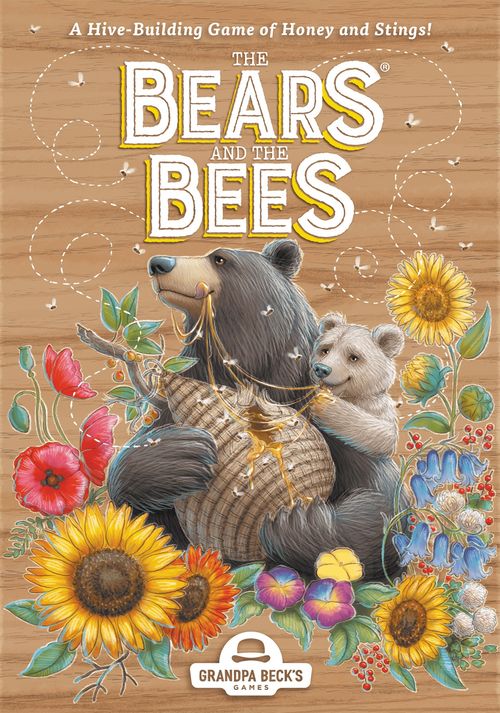
The Bears and the Bees
The Bears and the Bees Rulebook
Table of Contents
Table of Contents
Overview
In The Bears and the Bees, your goal is to go out first by playing all the cards in your hand by connecting them to the hive you'll be building together. To place a card, you must connect it with 2 or more cards already in play by matching the colors on all the sides that touch.
Tally points for any cards left in your hand at the end of each round. At the end of 3 rounds, the beekeeper with the lowest score will be crowned the Queen Bee. Buzzah!
Beekeeper's Buzz: Short on time? Just play a single round and whoever goes out first, wins. Remaining players can continue to play to compete for second and third place.
Contents
- Queen Bee (1)
- Honeycombs (70)
- Drones (10)
- Worker Bees (15)
- Flowers (5)
- Bears (3)
- Card Player Aids (2)
- Turn Player Aids (2)
Card Types
Before we get into setup, it's important you understand the different types of cards you'll be playing with in the field. These player aids will help you remember.
Standard Cards
Queen Bee (1): The Queen is the center of the hive. All of her sides are honey, which is wild. Special cards (Drones, Worker Bees, Flowers, and Bears) must not connect with the Queen's sides.
Honeycombs (70): Honeycombs are the most common cards. The colors on their edges represent the 5 different kinds of Flowers you'll find in the deck. These are the only cards that may connect with the Queen's sides.
Special Cards
Drones (10): Half of the 6 sides of a Drone card are honey (wild), and the other half are a single color. There are 2 cards of each of the 5 colors in the deck.
Beekeeper's Buzz: With their 3 wild sides, it's seldom hard to find a spot to play a Drone. That makes them the best type of cards to have in your hand as you near going out.
Worker Bees (15): Worker Bees have a different color on each side, including a wild side. After playing a Worker Bee, force one player of your choice to draw one card.
Beekeeper's Buzz: Worker Bees are the best tool at your disposal for preventing another player from going out as they are easy to play and they deliver a targeted sting.
Flowers (5): After you place a Flower, force all other players to draw one card each. (Note: If playing with just 2 players, your opponent must draw two cards.)
Beekeeper's Buzz: Flowers are the most powerful cards. However, they are also the toughest cards to play! If one is in your hand, make playing it your top priority.
Bears (3): After you play a Bear, give one player of your choice one card from your hand. Bears must connect with a honey side of a Drone or Worker Bee and at least one other card. The side(s) not touching honey, can connect with any color. After a bear is placed, no new cards can connect with it.
Beekeeper's Buzz: Be thoughtful when you place your Drones and Worker Bees. Any honey sides that you leave exposed could be used by an opponent to play a Bear.
Setup
Round Preparation
- The person stung most recently by a bee is the dealer.
- Place the Queen Bee at the center of the table.
- Place a set of player aids on either side of the table.
- Shuffle the deck (you may mix the cards on the table).
- For 2-3 players, deal 9 cards each. With 4+ players, deal 8. This will be your hand. You may look at these cards.
- The remaining cards will be the draw pile. Place this at the edge of your table, within easy reach.
Begin Play
The first card played for the round will come from the draw pile. Reveal the top card and follow the rules below:
- If it's a Special Card, discard this card beside the deck and draw a new card. Repeat this, if necessary.
- If it's a Honeycomb, connect it at the top of the Queen.
Beekeeper's Buzz: If you have a glossy table, the cards will be more prone to sliding around. To prevent this, put down a tablecloth and/or leave a small gap between the cards.
Example 4-Player Setup
The example setup diagram shows: a Discard Pile and a Draw Pile in one corner; a set of double-sided Player Aids in the opposite corner; each player's face-down draw stack arranged around the table; the Queen Bee placed at the center of the table; the first Honeycomb card connected to the Queen (with a note that honey is wild); and each player's hand of cards fanned out in front of them.
Beekeeper's Buzz: Remember that your busy bees need room to buzz. If a card you place overhangs the edge of the table, it can't be played.
Rules
Takin' Turns
On your turn, you may play one card. If you don't play a card then you must either draw one card from the deck or discard one card from your hand and draw two cards.
Beekeepers Buzz: Struggling to find a spot for a Bear or a Flower? It might not be a bad idea to discard it.
To place a card, you must connect it with 2 or more cards already in play by matching the colors on all the sides that touch. Red connects with red, blue with blue, yellow with yellow, and so on. Honey sides (wild) are the exception, as they can pair with any other color.
Beekeepers Buzz: Remember, only Honeycomb cards may touch the Queen, and Bears must be placed next to honey.
Example: You play a Honeycomb card. The red side of your card connects with the red side of a Honeycomb card. The green side of your card connects with the (wild) honey side of the Queen Bee. (A healthy growin' hive!)
Bonus Plays
When you play a card that connects with 3 or more other cards, you'll earn a bonus play, which allows you to play a second card. If the second card you play also connects with 3 or more cards, you'll earn another bonus play. You can string together bonus plays for as long as you are able to.
The Bears are the only cards that cannot earn bonus plays. (No rewards for honey thieves.)
Example: You play a Flower that connects with three cards. This forces all other players to draw a card, and it also earns you a bonus play. That's some flower power!
The Buzz Rule
Players are taking their sweet time? You can implement this optional rule to speed things along.
How it works: If you're taking forever on your turn, another player can start to buzz, like a bee. Others can join in when they agree.
Once every player is buzzing, your turn ends. Be sure to draw if you've yet to play a card.
Going Out
The first person to play the final card in their hand goes out, immediately ending the round. They score no points. All other players receive points for the cards left in their hands, as follows:
- 5 Points: Honeycombs
- 10 Points: Drones, Worker Bees, and Flowers
- 15 Points: Bears
Beekeeper's Buzz: Worker Bees and Flowers always force drawing a card, even if one is the last card played in a round.
After scores are recorded, the player who went first in the previous round becomes the new dealer. Gather all the cards, except for the Queen Bee, and mix them up. Then, deal everyone a new hand and begin a new round.
At the end of 3 rounds, the player with the lowest total score is crowned the Queen Bee and is admired by all for their sweet victory!
Beekeepers Buzz: In the event of a tie, the youngest tied player wins. Age grants wisdom, youth grants spoiling.
Advanced Rules
Once you've got the basic rules down, you can add in these advanced rules that increase strategy and skill. They're best suited for ages 10+. It's up to you whether you incorporate all of the advanced rules or just some of them.
Added Bonuses
In the normal rules, you can only earn one bonus play with each card you place touching 3 or more cards.
With Added Bonuses, with each additional side you connect, beyond 3, you'll earn an additional bonus play. Connect with 4 cards? You'll earn 2 bonus plays. 5 cards? You'll earn 3. If you manage to play any card (except a Bear) that connects on all 6 sides, discard your hand and end the round!
One more thing to note. Bonus plays can add up during your turn, as shown in the example below.
Example: You play a card connecting with 4 other cards, earning 2 bonus plays. The first you use to make another 4 sided connection, earning you 2 more bonus plays. So, now you have 3. You use bonus to place a honeycomb card, but you can't find any place to play another card, so you pass, ending your turn.
Beekeeper's Buzz: Here's an easy way to track bonus plays. Grab 4-5 pennies (look under your cushions) and put them on the table. On your turn, grab a penny for each bonus play you earn and return a penny for each bonus play you use.
Added Stings
When you play a Worker Bee or Flower, the more sides connect, the more cards other players are forced to draw.
Worker Bees: For each additional side you connect a Worker Bee with, beyond 2, one more card will have to be drawn by someone else. If 2 or more cards need to be drawn, you can force one player to take them all, or divide them between multiple players. Sharing is caring!
Example: You play a Worker Bee connecting with 4 other cards, so 3 cards must be drawn. You force your dad, who was down to his last card, to draw 2. You make your brother, who teased you earlier, to draw the third. Plus, there's more. You've also got 2 bonus plays to use. You're really humming!
Flowers: The same principle applies to the Flowers. For each additional side you connect a flower with, beyond 2, one more card will have to be drawn by all other players.
Example: You play a flower connecting with 4 cards. This forces all other players to draw 3 cards. Plus, you also earn 2 bonus plays. That's how you use petals to nettle!
Connected Play
With this rule in effect, each player, by default, may place 2 cards each turn, instead of 1. The second card is called your Connected Play, which is different from a bonus play. As the name implies, to place a second card, it must connect with the first card you played on that turn.
A couple more rules:
- You may not use a Connected Play on your first turn.
- If you intend to use your connected play, you must do so before taking any bonus plays earned by your first card.
Example: Your first card connects with 3 cards. You then make a Connected Play by placing a second card connecting with the first, plus 3 others! You earned 1 bonus play from your first card, and 2 more with your second card, meaning you now have 3 at your disposal.
About Grandpa Beck
This is Grandpa Beck. Not the Grandpa Beck who makes games, but his Grandpa, Joe Beck, who was a barber, gardener, and beekeeper.
Joe lived a simple and happy life in a small town in Utah. He was sometimes gruff like a bear but he lovingly cared for his family, flowers, and bees. Grandpa Beck still tells stories of Joe's short buzz cuts and his tall buckets of honey.
Have a Question?
Grandpa is eager to hear from you.
- Email: [email protected]
- Call or text him directly: 206.498.1959
Frequently Asked Questions
Visit our website to see our helpful resources: www.gbecks.com/bnb-FAQ
Follow Us
- Instagram: @grandpa.becks.games
- Facebook: www.facebook.com/GrandpaBecksGames