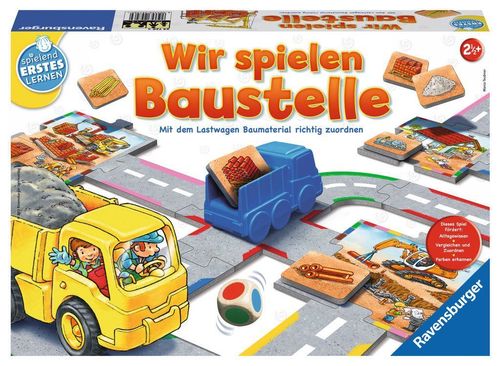
Wir spielen Baustelle
Wir spielen Baustelle Rulebook
Table of Contents
Table of Contents
Contents (Inhalt)
- 1 colour die (Farbwürfel)
- 2 lorries (Lastwagen)
- 24 road pieces (Straßenteile): 6 straight, 12 curves, 3 crossroads, 3 roundabouts
- 6 building sites (Baustellen)
- 12 building material tiles (Baumaterial-Plättchen): 2 pipes (Rohre), 2 gravel (Kies), 2 bricks (Ziegelsteine), 2 wood (Holz), 2 roof tiles (Dachziegel), and 2 paints and brushes (Farben und Pinsel)
The illustrated build steps printed in the rulebook are captioned as follows:
- Step 1: The drainage pipes are laid.
- Step 2: The gravel fills the building pit.
- Step 3: The brickwork is built.
- Step 4: The roof frame is built.
- Step 5: The roof is covered.
- Step 6: The painting work takes place.
Before the First Game
Take the entire game material out of the box first. Carefully punch out the cardboard parts from their punch sheets, and dispose of the leftover punch sheets.
Safety note (printed in the original in German, French and Italian; the English below is the translator's): Please make sure that the edges of the cardboard parts and the loose cardboard remnants do not get into children's hands. They are not toys and must be disposed of.
If Your Child Is Still Very Small
Free Play and Exploring the Theme
Before the first game, it is important that your child becomes familiar with all the game materials. You need enough space on the table or floor for this. The puzzle pieces and lorries are especially exciting and invite the child to put together, drive, load and unload.
When exploring the theme, the main thing for your child is to understand the order in which the individual construction steps follow one another. This works best if you lay out the 6 building sites next to each other so that the individual construction steps follow on from one another.
Let your child be creative when playing builder. Through their own trying out and putting puzzles together, the child experiences success and trains their fine motor skills.
Tip box: Take enough time to explain the building sites, construction materials and vehicles, and to name them correctly. While you explain and name the details of the building sites, you support your child's everyday knowledge and expand their vocabulary.
Building a Road Network (Wir bauen ein Straßennetz)
Here the aim is to put together a "game board" like a puzzle. For this you need all the building sites, road pieces and both lorries. The dice and building material tiles can stay in the box.
Step 1: Build the Game Board
First show your child in advance how the puzzle pieces can be joined together. All road pieces and building sites can be rotated and used with either the front or the back side up. This way the matching piece can always be found.
Illustration labels: "Vorderseite" (front side) and "Rückseite" (back side), showing a road piece turned over.
Step 2: Drive Along the Roads
Once a road network has been built, it naturally needs to be tried out and driven along with the two lorries. This is great fun for the children.
Tip box: Make the lorry noises together with your child. This supports language skills.
What Goes Where? (Was gehört wohin?)
For 1 to 2 players.
Aim of the game: To help the builders and bring the building material tiles to the correct building site. That is: the "wrongly delivered" building material is loaded one piece at a time onto the lorry and taken to the building site where it is missing.
Setup (Vorbereitung)
Depending on the children's stage of development, you can gradually increase the difficulty. First play with only 3 building sites and the corresponding 6 building material tiles. The placement area in the left corner shows which material belongs where. Lay out the 3 building sites with some distance between them so that they are all easy to reach. Later the remaining building sites and tiles can also be added.
Note: On each building site, 2 "wrongly delivered" building material tiles are placed. They form a small stack to the right of the building site. It is important that the building materials do not lie on the building site they belong to at the start. Only through the children's help are the building materials correctly assigned. For example, the wood therefore lies with the painting work, and the bricks at the roof frame.
Next, each player chooses a lorry and places it on any building site.
Now play goes around in turn. The youngest player (Player A) begins and loads the top building material tile onto their lorry. Then ask the player: "What kind of material is this? Where does it belong?" If the child has discovered which building site is missing "their" material, they drive the lorry there.
The lorry is parked and the tile is placed on the matching placement area, because the builders are waiting to continue their work. Then Player B takes their turn loading and matching. Only one tile is loaded per trip.
Note: The placement areas also serve as a self-check for the players.
Let's Go (Los geht's)
The players connect the building sites all around with a road network. As many pieces may be used as the little "builders" like. The order of the building sites plays no role in this variant.
Starting the turn: Each player starts their turn from the building site where they last delivered building material. If their "own" building site has no building material left, they drive on to a building site where "wrongly delivered" building material still lies.
End of the Game (Ende des Spiels)
As soon as all building materials have been brought to the correct building sites, the game ends and the players have won together.
On the Way with the Colour Die (Unterwegs mit dem Farbwürfel)
Printed above this section: "If your child is a little older." For 1 to 2 players.
Aim of the game: To bring the building material tiles to the correct building site. The colour die decides how fast your own lorry moves forward.
Setup
"On the Way with the Colour Die" is prepared similarly to "What Goes Where?". There are two differences: because the players are already little building pros, play starts with all 6 building sites from the beginning. In addition, the colour die is now used.
Let's Go
Build a road network all around the 6 building sites. Then each player chooses a lorry and places it on any building site. The youngest player begins and loads the top building material tile onto their lorry.
Then the die is rolled. The colour shown says up to which next road piece the lorry may drive. Note: each road piece has its own colour. If the lorry has reached the rolled colour, it stops. Then the next player takes their turn.
Note: Several lorries may park next to one another on each building site and each road piece.
Tip box: If the children still have some difficulty matching colours, practise a little beforehand. Lay out any number of different road pieces and let the child roll the die. Then the task is to find a piece with the same colour. Repeat this exercise as often as it is fun.
Special function of the building sites: The building sites have a special function: all 6 colours apply to them. For example, if blue is rolled but there is no blue road piece between the lorry and the building site, the lorry may drive directly to the building site and deliver the building material.
Who Becomes the Construction Site King? (Wer wird Baustellen-König?)
Winner and loser variant for 2 players or small groups.
"On the Way with the Colour Die" also works as a winner and loser variant for 2 players or small groups: play against each other. For small groups, form two teams. Each team chooses one lorry colour. Then they roll and move in turn (see "On the Way with the Colour Die"). The correctly matched building material tiles are not placed on the building sites, however, but collected by the team. The team with the most tiles wins.