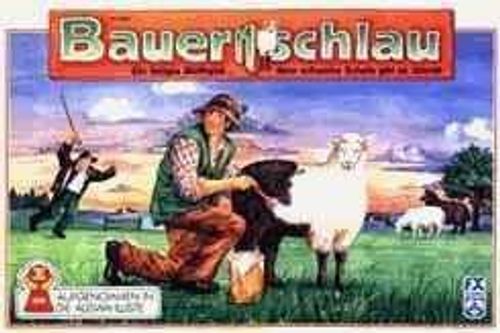
Bauernschlau
Bauernschlau Rulebook
Table of Contents
Table of Contents
Object of the Game
The aim of the game is to finish fencing in your own area and to occupy all the pasture fields in it with as valuable a flock of sheep as possible.
Components
1 game board, 52 sheep tiles, 1 wooden dog, 60 wooden fence pieces.
Setup
- The game board is unfolded. The dog is placed on the central middle field. Around that field lie the six coloured farm fields. The remaining fields are pasture fields. The players now agree on who gets which farm. With 3 or 4 players these farms should be distributed symmetrically. The farms lying in between that are not assigned remain neutral.
- The sheep tiles are mixed face down, i.e. with the brown side up, and placed ready next to the board.
- The fence pieces are distributed to the players according to the following scheme:
- 2 and 3 players receive 16 fence pieces each;
- 4 and 5 players receive 12 fence pieces each;
- 6 players receive 10 fence pieces each.
- A starting player is determined; play then proceeds clockwise.
The Moves
- In the first round each player takes one sheep tile from the pile, looks at it secretly and then places it face down on any pasture field.
- From the second round on, the players have four alternative moves. Only one of these moves may be carried out each time.
- Place a hidden sheep, i.e. take one from the pile, look at it secretly and place it on any pasture field.
- Reveal a sheep where it lies, i.e. turn a face-down sheep tile on its pasture field face up.
- Scare sheep with the dog, i.e. bring a face-down sheep tile with the dog from one pasture field to another and reveal it there.
- Build fences, i.e. place one fence piece on one of your two fences.
1. Place Hidden Sheep
- A sheep tile is taken from the pile, looked at secretly and then placed face down on any free pasture field.
- The sheep have different values. White sheep count positively and have the values 1, 2, 3 and 5. Black sheep count negatively and have the value -3.
- Which pasture field the face-down sheep tiles are placed on is left to the player. He should just remember it well! Only one sheep may be placed per pasture field. The seven fields in the middle remain free.
- Any free pasture field is possible.
- White geese on the pasture fields have a special significance in the final scoring: 2 geese double the point value of the sheep, 3 geese triple the value.
- Sheep placed face down do not count for the time being. They count only when they are turned face up by any player.
- Bluffing when placing! Skilful bluffing and a good memory when placing the sheep are of great importance. White sheep do not have to be placed in your own area, and black sheep not always in a foreign area. What matters is who reveals them on which field!
No hidden sheep: special move on request
If not a single face-down sheep tile can be found on the pasture fields, the player may, instead of his normal move, make a special move. He may take as many sheep tiles from the pile, look at them and place them face down on pasture fields, as there are players taking part.
2. Reveal Sheep Where They Lie
- A face-down sheep tile on any pasture field is turned face up immediately. This sheep then remains unmoved lying there until the end of the game and counts its printed point value in the scoring.
- Black sheep are doubly mean. For the owner of the pasture field they count minus. But whoever reveals a black sheep has an advantage: he may make two additional moves of his choice, e.g. place two fence pieces, or reveal a sheep and place a fence piece.
3. Scare Sheep with the Dog
- To scare, the dog is taken and placed on any face-down sheep tile. The dog and the tile are then moved together by this player to any other free pasture field. Only there is the sheep revealed, and it remains lying until the scoring at the end of the game.
- The dog is a shared playing piece for all players. Normally it is placed back on the central middle field after scaring. It may, however, also be placed on any free pasture field. In this way one can, for example, block high-value goose fields for oneself or for opponents. The dog stays on this field until the next scaring by a player.
- Farmer-smart players thus bring black sheep onto the pasture fields of the others and fetch white sheep to themselves. In doing so it is possible, as far as possible, to see through the tactics of the other players when placing face-down tiles and then to thwart them. But caution! Whoever fetches tiles placed by others too riskily, or misremembers the values of the tiles he placed himself, can experience nasty surprises.
4. Build Fences
- In each case two neighbours build together on one fence. These fences separate your areas, whose starting point is your own farm.
- The first fence piece is in each case placed on the dividing line between two farm fields. With fewer than six players, the farms lying in between are neutral. Which two farms the first fence piece lies between in this case is decided by the player who makes this move.
- The move consists of laying one fence piece from your own supply. It is attached directly to a preceding fence piece. The embossed lines between the hexagonal farm and pasture fields mark the possible course of the fence.
- The course of the fences depends very much on the differing wishes of the respective neighbours. Black sheep want to fence off everything, of course, and to add high-value white sheep on goose fields to their own area. The following rules must be observed:
- a) A fence may not be led back in the direction of the coloured farm fields. Laying parallel to their outer edges is allowed, however.
- b) No fence may be connected to another or cut off its path.
- c) Branchings are not permitted.
- d) Each player may only build on the two fences that bound his area.
- A fence is finished as soon as a fence tip has reached the green edge of the playing field. Only areas fenced in completely can win!
- The size of the area is not necessarily decisive for victory. In a large area many black sheep can lie, many pasture fields can remain free, or the fences may not be finished. Large area or small area? Both strategies have their charms and pitfalls and depend on the actual course of the game.
Board diagram legend (fence rules illustrated)
- 1st fence piece between the farms.
- Do not connect.
- Do not cut off a path.
- No branchings.
- Only build on your own fences.
- Do not lay towards the middle.
End of the Game
The game ends immediately as soon as both of the following conditions are fulfilled for one player:
- Both fences of his area must be completed, i.e. have reached the green edge.
- All pasture fields in this area must be occupied. It makes no difference whether the sheep tiles have already been revealed or not. A pasture field blocked by the dog also counts as occupied.
Scoring
- Only areas fenced in completely count. The players then receive the point value of all revealed sheep in their area.
- Every sheep lying face up counts its printed point value; black sheep naturally count minus. Face-down tiles are not included in the scoring.
- The goose fields double or triple the point value of the sheep lying on them, e.g. -3 x 3 = -9.
- Unused fence pieces each count one minus point.
- Areas not completely fenced in are not included in the scoring. Their owners lose automatically. If several rounds are played, they receive 10 points fewer than the player who achieved the lowest score with a completely fenced-in area.
- The player wins who has achieved the most points in his completely fenced-in area.