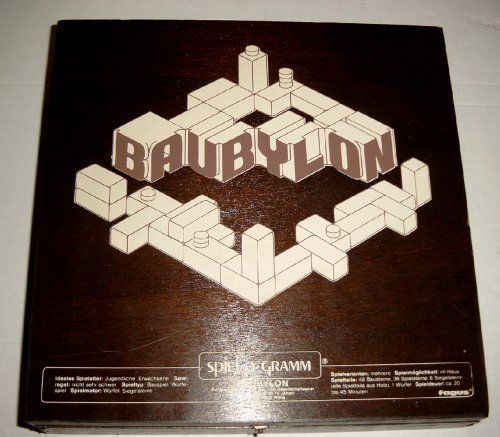
Baubylon
Baubylon Rulebook
Table of Contents
Table of Contents
Building
At the start, build one of the structures pictured in the rulebook, so that you learn the rules and the building tricks. After that, your inventiveness sets no limits. Naturally, not all blocks need to be used when building.
The Stones
Each player receives the six stones of one colour. The red stones are shared seal stones (see below).
Object of the Game
Whoever first reaches the highest level of Baubylon with one of their stones wins.
Moving
Players take turns rolling the die and, if possible, moving.
When moving horizontally (within a level), the short end face of a block counts as one space and the long sides of a block count as two spaces each.
Every change in height by the height of a game piece also costs one die pip, both when climbing up the structure or down it, and also when moving onto or over other stones. Opposing stones may be occupied (blocked) or captured (captured stones must start again). Your own stones may also be occupied.
Occupying stones can build towers, which may be up to 5 game pieces high.
Climbing down may not capture. A black stone in the lower picture on the page can therefore not be captured at that moment, only occupied.
The moves in the pictures are counted step by step: the numbers show the steps taken during one move, and each picture shows the starting point and the final position of the moving game piece. The examples beside the text are best tried out with some blocks and game pieces.
Seal Stones
The red seal stones are placed on any spots of the structure before the game begins. It is not necessary to use all of them. They can be occupied, climbed over and captured like normal game pieces.
A captured seal stone is placed immediately on another spot, for example to make your own way easier, or on an opponent to seal (block) them in place.
Sealed (Blocked) Stones
Stones blocked by seal stones, or by foreign stones, can only be freed with a roll of "1". The blocking foreign stone is then shaken off and thrown out of the structure, or, if it is a seal stone, it is won for immediate new placement. The freed stone remains in its place.
In a tower, the topmost stone is shaken off, or won as a seal stone, when a player who has blocked stones rolls a "1" and does not want to make any other move.
The more different stones are combined in one tower, the more the topmost stone is at risk.
Starting the Game
Once the structure has been built and the seal stones have been distributed on it, the players agree who begins.
The starting spaces are the flat-lying blocks that stick out of the Babylonian structure (in the title picture, four). You need at least a "3" to climb onto a starting block. If there is more than one starting block, each player may use any of these entrances.
Notes on the Community Translation
The following points come from the community English translation (Tesera, 2012) and are not stated in the German rulebook. They are listed here for transparency and are not part of the rules text above.
- Components. The translation lists 48 blocks, 6 red seal stones, 6 stones in each of 6 colours, and 1 die. The German rulebook does not print a component list; it says that each player receives the six stones of one colour.
- Vertical cost. The German text says a change in height by one game-piece height costs one die pip. The translation gives 2 pips for climbing a short side and 4 pips for a full block length, and its figure captions show step numbers consistent with that. The German wording is kept above; the translation's figures are offered as the usual reading.
- Setup guidance. The translation advises that there be a clear highest point, some entrances at one level above the table, no vertical jump higher than one block length (4 spaces), and that every space be reachable with at least a 5. The German text gives no such limits and says that after the first structure "your inventiveness sets no limits."
- Fifth stone in a tower. The translation says that if a fifth piece lands on a stack, it pays the cost to climb 4 pieces and replaces the top stone, which is thrown off the structure and returned to its owner. The German text only says that towers may be up to 5 game pieces high.
- Leaping off a stack. The translation says there is no penalty for leaping off a stack of pieces. The German text says every height change costs one die pip, both up and down, so this is not carried into the rules above.
- Re-entering seal stones. The translation says a knocked-off seal stone may re-enter from an entrance on a future turn. The German text says a captured seal stone is placed immediately on another spot, which is the version used above.
- Forfeit. The translation says that if the exact number cannot be moved, the turn is forfeit. The German text says the die is rolled and the piece moved "if possible", which the transcriber reads as the same rule.