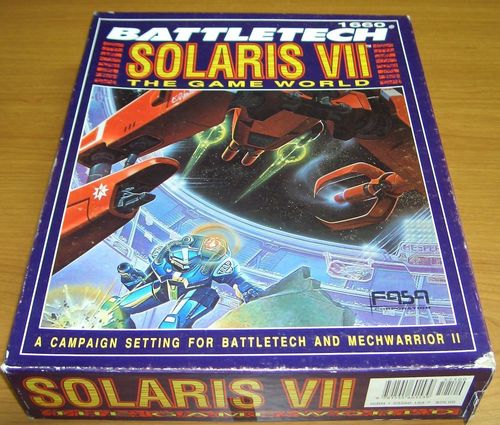
BattleTech: Solaris VII – The Game World
BattleTech: Solaris VII – The Game World Rulebook
Table of Contents
Table of Contents
Components
The reader should first check the contents of the box against the following list to be sure all the components are present. These components are designed to simulate combat in the arenas of Solaris City. The components are, however, multi-purpose and may be useful to simulate terrain in other MechWarrior or BattleTech scenarios or campaigns.
- 1 players' book (MechWarrior's Guide to the Game World)
- 1 gamemaster book (Solaris VII Gamemaster's Guide)
- 1 stat book
- 3 double-sided 24" x 36" mapsheets
- 1 counter sheet
- 12 BattleMech trading cards
- 1 poster map of the Inner Sphere
Counters
The die-cut counters provided with this boxed set represent both new and previously described terrain features. These terrain features simulate the various conditions in the six major arenas in Solaris City. Each feature occupies an entire hex; two counters placed next to one another are considered to be contiguous, i.e., part of the same terrain feature.
Clear Tunnel: This counter is printed with the word "Clear" and its placement indicates that no hazard is present in that tunnel hex.
Floor: The floor counter indicates on what level an elevator is located in the arena known as The Factory.
Indicator: These counters are used on the Delay Track of the 'Mech Duel Record Sheet to show that a weapon cannot yet be fired. When the Delay period is up, the weapon is again available for use. See rules.
Jump Destination: These counters are used with the special rules in 'Mech Duels to indicate the destination hex into which a pilot intends to jump his 'Mech.
Machinery: An arena may include pieces of junked equipment or small buildings. Each has a Construction Factor (CF). The counter shows both the CF and the Elevation.
Mines: Several arenas (The Factory, The Jungle, Davion Arena) may be rigged with mines.
Obstruction: Obstruction counters indicate that a tunnel is obstructed in the arena known as Ishiyama.
Pits: Some arenas feature pitfalls, either placed intentionally by arena management or as a result of structural collapse. Each Pit counter shows a number indicating the depth.
Pylon: Pylon counters indicate the position of pylons in the Steiner Stadium arena.
Walls: Steiner Stadium features permanent walls that can block line-of-sight and provide cover. The arena master can raise or lower the walls at random. The wall counter shows the word "Up" to indicate that a wall is raised.
Wreckage: A Wreckage counter represents scrap metal, industrial debris, and other similar obstacles. Treat Wreckage as a Rubble hex, with the additional restriction of being impassable to Hover units.
Mapsheets
Six 24" x 36" mapsheets are included with this boxed set. One map represents downtown Solaris City. Each of the other five represents one of the major arenas in Solaris City. Some of the arenas have special terrain features, which the counters represent. The maps use standard BattleTech markings, and these counters serve to modify the layout of these terrains.
Record Sheet
A special record sheet is included for use with the Dueling System. Permission is granted to photocopy this sheet for personal use only. The Dueling Sheet is used to keep track of TICs, Weapon Delay and Heat. Players may either use the counters included for this purpose or some kind of erasable writing instrument such as pencil or sheet protectors and dry-erase markers.
Running Adventures
This section includes material useful to gamemasters running adventures and campaigns on Solaris VII, the Game World. In addition to plot ideas and roleplaying suggestions, some new game mechanics are also presented here. These rules cover building a reputation, finding a patron, getting bookings, getting a 'Mech, generating opponents, determining the match purse, and other important matters related to the fight game.
Roleplaying Hints
Though the Gamemaster's Guide does contain a number of tables, take care not to turn a Solaris campaign into an exercise in die-rolling. The tables are intended to help develop the plot or to help the gamemaster liven things up in a pinch, not as a replacement for roleplaying. The gamemaster and players are the ones who should flesh out the details and bring to life the events described in the tables.
For example, when a MechWarrior is looking for a stable, and the gamemaster rolls dice to determine the stablemaster's economic position and other statistics, use the outcome of the roll to suggest roleplaying situations. If a stablemaster is poor, this might suggest a good-natured soul who cannot provide much in the way of support, but who is generous with his contracts. On the other hand, a wealthy stablemaster will be better-known, able to pick and choose among the finest MechWarriors on Solaris. A MechWarrior must make a strong impression to have a chance with this prospective employer.
If a player is unwilling to roleplay his initial encounters with a stablemaster, the gamemaster is free to let the stablemaster reject him and make the character wait a few more weeks for a possible ride. Similarly, negotiations for contracts and terms are a good time to make the discussions come alive. The initial die roll is only a starting point. Depending on the roleplaying, further discussion could raise or lower the MechWarrior's pay rate.
NPC opponents, far from being faceless strings of statistics, offer both gamemaster and players another opportunity for good roleplaying. A high-rep opponent could be an arrogant, annoying SOB who deserves to be taken down a notch or two. A lesser opponent could be a young man with a ready sense of humor, who the player character may feel guilty defeating. Other possibilities might include a dead or injured opponent's friends, family, or stable coming after a player character for revenge.
Keep in mind, too, that the game does not end after the arena battle. A stable is supposed to provide repairs and supplies, but may be reluctant to do so if the MechWarrior's performance was below par. Imagine a tired, sweaty, defeated warrior returning to the 'Mech bay only to find that his stable has financed only half the necessary repairs. He can spring for the remainder out of his own pocket, or go into battle with a damaged BattleMech, or even complain, although such conduct will not further endear him to his employer.
Solaris Adventures
Solaris is a magnet for the disaffected from all across the Inner Sphere. Arriving on Solaris every day are out-of-work mercenaries, broke warriors, criminals fleeing justice, world-weary individuals seeking to forget their tragic pasts, and dispossessed MechWarriors hoping to regain their lost honor in the arenas. Any one such individual is an excellent starting point for a Solaris campaign.
Numerous adventure possibilities exist on Solaris VII. The following plot ideas are described separately, but several could easily be combined. These suggestions are by no means exhaustive. Gamemasters are encouraged to invent their own.
Arena battles might also serve simply as a backdrop to the bigger story. Intrigue, mysteries, crime, and other adventures could form the main portion of the campaign, with 'Mech combat used to break up the monotony or even coming up at inconvenient moments, forcing player characters to choose between possible victory in the arena and an important personal matter.
The Games
The most obvious adventures or campaigns involve the player characters in the rough-and-tumble world of the 'Mech games. A player character's goal is to increase his (or her) Reputation Rating until he becomes undisputed champion of Solaris. Because this is neither easy nor particularly likely to occur, such a campaign can go on as long as players and gamemaster desire.
All it requires is a steady supply of opponents for the player characters, regular arena set-ups, and a continuing cast of NPCs. A rival stable or two, along with their respective complements of MechWarriors, would make for good week-to-week challenges, particularly if the opposing NPCs are especially reprehensible, arrogant, or downright evil. Ideally, such a campaign should climax with the final showdown between the rival stables.
Intrigue
Solaris VII is a hotbed of intrigue and espionage. Governments spy on governments, corporations on corporations, stables on stables, crime families on crime families, and all of these, at some point, on each other. Player characters might be recruited by any of these to engage in a wide variety of covert missions. Espionage adventures fall into a number of broad categories.
Infiltration: The player character(s) must join an opposing stable, corporation, government, or crime family, pretend to be a loyal employee, and funnel information back to his or her employer. This is probably the most difficult form of espionage, as it requires guile, quick-thinking, and intelligence. The possibility of discovery always exists, with consequences ranging from imprisonment to unpleasant death.
Information-Gathering: The agent must enter an enemy installation or building and obtain information. The many ways to do this range from entering a location disguised as an employee to covert breaking and entering. Information-gathering missions require stealth skills and usually manual dexterity and agility as well.
Surveillance: The agent is required to covertly observe an opposing individual, group, or organization, then report back on movements, performance, and such. Surveillance requires skills such as stealth and security systems, and often involves the use of covert listening or observation devices.
Sabotage: The player character(s) must secretly destroy or damage an enemy 'Mech, vehicle, or installation. On Solaris, this often involves disabling an opposing 'Mech before a big fight or perhaps destroying the 'Mechs of an enemy stable in retribution for a double-cross. Although sabotage is a dangerous mission, it can have the most satisfying payoff. It requires skills such as stealth, security systems, and demolitions.
Assassination: Professional assassins consider Solaris prime territory. Though feuds between stables can get nasty, they rarely come to assassination, as such violence would tend to attract unwanted publicity. Murder for hire is more common among the city's criminal class, with skilled (and even unskilled) killers always in demand. Note that player characters who become involved in such activity tend to come to nasty ends, although accepting a murder contract may offer the only way out of a debt or other difficulty.
Gang Wars
Most criminals understand one thing only: force. Competition for territory and profit leads to violence, usually covert actions of individuals and small groups. The kind of all-out war that would attract the attention of the authorities is rare, though it does occur from time to time.
Gangs require enforcers, agents, and operatives. Only the most foolhardy player characters would want to work for one of the Solaris gangs. It is more likely that the player characters will be caught in the crossfire of the numerous gang wars of Solaris City.
Player characters could get involved in a variety of ways. As stated, they might be caught in the middle of a gun battle and mistaken for rival gang members. Or, an innocent courier mission might turn out to be a job for a major triad. Then again, perhaps a corrupt stablemaster is in the pay of a gang or even a gang lord. A player character or important NPC might be kidnapped and require rescue from one of the many gang fortresses throughout Solaris City. Gang enforcers could lean on a player character, trying to persuade him to throw a fight, threatening dire consequences if he refuses.
Media
Solaris VII is a center of news activity; reporters from trivid and print media from all the Successor States are present. Ace reporters consider Solaris a prime news-gathering location, and not just for sports news. Intrigue and espionage between major corporations or the Successor Houses is rampant, as are brutal gang wars, corruption, violence, and crime. Pure meat and potatoes for enterprising investigative reporters.
Even if the player characters are not correspondents, media people make excellent contacts or NPCs. A single media character in a player's team of MechWarriors and techs can provide access to locations and events normally denied to the general public.
Getting Started
A MechWarrior has two options in Solaris City: he can go freelance or join a stable. By far the easiest option is to join a stable, though this considerably limits a MechWarrior's independence and freedom to accept matches.
Freelancers exist on Solaris, but they are rare. Successful freelancers are rarer still, for in addition to competing with other MechWarriors, a good freelancer must also deal with the established stablemasters, who think that too many independents are unhealthy for business. The best option for beleaguered freelancers is to join an independent 'Mech cooperative such as the Black Lions, but even these groups come under pressure from organized crime and established stables.
Neither course is entirely risk-free, but despite the odds against a new MechWarrior making a name on Solaris, eager young warriors continue to flock there, hoping to find the limelight and stand proudly with the elite at Valhalla or Hangar 66.
Reputation Rating
The Reputation Rating is a new statistic, applicable only to the Game World of Solaris VII. For the purposes of this game, reputation refers only to the positive MechWarrior ideal, not to having a bad name. MechWarriors may get a chance to improve their Reputation Rating any time the gamemaster decides they have done something worthy of attention and admiration.
Reputation affects such matters as attracting a patron, obtaining 'Mechs and spare parts, and getting bookings at desirable arenas. In many ways, a character's Reputation Rating is a measure of his standing in MechWarrior society, as summarized in the table below.
Reputation Ratings
| Rating | Standing |
|---|---|
| 0-2 | Virtually Unknown |
| 3-5 | Promising Newcomer |
| 6-8 | Minor League |
| 9-11 | Contender |
| 12-14 | Big League |
| 15-17 | Champions |
| 18+ | Legend |
To find out how much effect a character's reputation has on the accomplishment of some goal, the player character makes a Reputation Roll. The Base Target Number is 18 – his Reputation Rating. (Printed as shown. The worked examples on the following pages use the Base Target Number equal to the character's Reputation Rating, e.g., a Reputation Rating of 6 gives a Base Target Number of 6.) Reputation is treated as a skill, with the gamemaster adding modifiers according to the situation. As stated above, player characters may make Reputation Rolls for numerous reasons, ranging from impressing the ladies to landing a job.
Initial Reputation Rating
The formula for determining a character's initial Reputation Rating is: [6 + Charisma] – Gunnery and Piloting Skill Target Numbers.
For example, a player character with Charisma 4, Gunnery Skill Target 4, and Piloting Skill Target 5 starts with a Reputation of 1 (6 + 4 – 4 – 5 = 1). A character with Charisma 5, Gunnery Skill Target 3, and Piloting Skill Target 4 starts with a Reputation of 4 (6 + 5 – 3 – 4 = 4).
Any result below 0 is treated as 0. It is possible for a character to start with a Reputation Rating of 0. It means that when he arrives on Solaris, no one knows who he is or what he can do.
Improving Reputation Rating
To improve his Reputation Rating, the MechWarrior rolls 2D6. If the result is equal to or better than his current Reputation Rating, the character's Reputation Rating increases by 1 point. This roll is modified, as explained below.
Several factors affect the outcome of the character's roll to improve his reputation. Three of the modifiers reflect the conditions of combat, two affect the outcome of the contest, and the last gives the gamemaster a chance to reward or penalize the player character's performance in the arena.
The modifiers given below assume that the MechWarrior is trying to improve his reputation through arena combat. (Other possibilities also exist, e.g., appearing on holovid. In those cases, the gamemaster assigns a modifier from –5 to +5, depending on the situation.)
Situation Modifiers
Reputation Modifier: The MechWarrior subtracts his opponent's Reputation Rating from his own and applies the difference as a modifier.
BattleMech Modifier: The MechWarrior subtracts the tonnage of his opponent's 'Mech from his own and applies 1/10th the difference as a modifier (round up).
Arena Modifier: Apply the class of the arena as a bonus, e.g., fighting in a Class Three arena is worth a –3 bonus.
Outcome Modifier: Depending on the outcome of the contest, apply one of the following modifiers:
| Outcome | Modifier |
|---|---|
| Decisive Victory | –3 |
| Victory | –2 |
| Marginal Victory | –1 |
| Marginal Defeat | +1 |
| Defeat | +2 |
| Decisive Defeat | +3 |
BattleMech Condition Modifiers: Depending on the condition of the player character's 'Mech when the contest is over, apply one of the following modifiers:
| Condition | Modifier |
|---|---|
| No damage | –3 |
| No internal damage | –2 |
| No critical hits | –1 |
| 'Mech shutdown | +1 |
| 'Mech disabled | +2 |
| 'Mech destroyed | +3 |
Performance Modifiers: The gamemaster may assign an additional bonus or penalty from –5 to +5 for the MechWarrior's performance in the arena. Showmanship, conspicuous bravery, and mercy deserve a bonus, while cowardice, brutality, and "dirty tricks" merit stiff penalties.
As an example of how these modifiers work, a MechWarrior with a Reputation Rating of 6 piloting a 30-ton Javelin has a match against an opponent with a Reputation Rating 4 in a 40-ton Clint in a Class Three Arena. In the first turn, the Javelin pilot gets lucky and blows the head off the Clint, but his Javelin remains unscathed.
After the battle, the MechWarrior tries to improve his reputation. He has a Reputation Rating of 6, so his Base Target Number is 6. Referring to the tables, he receives a +2 penalty for fighting an opponent with an inferior reputation = 8, a –1 bonus for fighting a superior 'Mech = 7, and a –3 bonus for competing in a Class 3 Arena = 4.
In addition, he scores a decisive victory with an undamaged 'Mech, both of which are worth a –3 bonus (4 – 6). This would bring the total to –2, but the gamemaster assesses a +3 penalty for killing his opponent. It would be higher, but the death was obviously accidental. This makes the warrior's final Target Number a 1. Because it is impossible to roll less than 2 on 2D6, the player character automatically gains a point of Reputation, bringing his total to 7.
Not bad for a beginner.
Finding a Patron
Most 'Mech pilots on Solaris require the backing of a patron, usually the head of an established 'Mech stable. Beginning MechWarriors, however, may have a hard time attracting patrons, forcing them to go solo for awhile.
Each month of game-time, a MechWarrior may attempt to obtain a patron by rolling 2D6 against the following table and adding his or her Reputation Rating. If a group of MechWarriors is seeking a single patron, use the average Reputation Rating of the group as a modifier. This roll generates a patron, his or her resources, and a Status Modifier, which is used to modify die rolls relating to the stable's influence.
A die result of 2 always indicates that no patron is available, regardless of the character's reputation and any other modifiers that might apply.
Patron Table
| Die Roll | Patron | Status Modifier |
|---|---|---|
| 2-8 | No Offers | – |
| 9-11 | 'Mech Cooperative | 0 |
| 12-14 | Poor | 1 |
| 15-17 | Average | 2 |
| 18-20 | Wealthy | 3 |
| 21-23 | Very Wealthy | 4 |
| 24+ | Sinfully Wealthy | 5 |
These rules assume that a MechWarrior has put the word out and is waiting for potential employers to approach him. If a MechWarrior seeks out a specific patron, stable, or cooperative, he must make a Reputation Roll, applying the potential patron's Status Modifier as a penalty. If the roll is successful, the character gets an interview. Whether or not he gets hired depends on the outcome of the interview, which should be roleplayed, with the gamemaster taking the part of the patron.
'Mech Cooperatives
Cooperatives differ from the other patron types, which represent individuals. In a cooperative, a group of ragtag MechWarriors have banded together for mutual protection. Cooperatives such as the Black Lions are a constant thorn in the side of established stables.
With the regular stables and crime syndicates constantly exerting pressure, often in the form of intimidation, cooperatives have learned to become tough, professional, and protective of their members. If a MechWarrior joins a cooperative, he or she can count on full support from the other warriors, but must also expect to deal with constant intimidation, violence, and insults from members of established stables.
Monthly Salary
A stablemaster must pay his MechWarriors a certain amount for housing, food, and other monthly expenses. The amount offered depends on the stablemaster's financial condition and the character's Reputation Rating. Roll 2D6, add the stablemaster's Status Modifier, and multiply the result by 10 times the MechWarrior's Reputation Rating. The result is the character's monthly stipend, in C-Bills. A beginner is lucky to get 250 C-Bills a month, but a champion can pull down 2,000 bills or more.
If a MechWarrior is successful, his patron will very likely increase his salary as time passes to keep the warrior from seeking representation elsewhere. After any match that results in an increase in the MechWarrior's reputation, the player character may roll dice for his salary again, using his new Reputation Rating as the multiplier. If the new rate is better than his current salary, he gets a raise.
Terms
Each stablemaster takes a percentage of a MechWarrior's winnings. The exact cut depends on the stablemaster. It might seem that more influential stables with larger cash reserves could afford to offer their MechWarriors more generous terms, but the exact opposite is true. Smaller stables are the ones that must offer generous terms, while larger stables can afford to offer less because they have more reliable financial reserves.
The major stables described on pp. 15-22 have been assigned standard terms. To determine the pay rate for any other stable or patron, assume the rate to be five times the patron's Status Modifier.
Refusing a Contract
Note that if a player does not find a patron's terms acceptable, his character may turn down the contract. Players may make only one Patron Roll per month, however, with the character fending for himself in the meantime. In addition, a MechWarrior who gains a reputation for being "difficult" may have a hard time finding a suitable patron. On each subsequent Patron Roll, subtract 1 point for every previous patron the player character has turned down.
Changing Patrons
Once a month, a player may roll to see if a new patron approaches his MechWarrior character with a better offer. Should this occur, the character may drop his old patron and start with a new one, but the gamemaster must keep in mind that a former patron can become a powerful and sometimes deadly enemy.
The Fight Game
Once a MechWarrior has either found representation or decided that he will go solo, he must start looking for a match. This can be difficult for an untried MechWarrior, especially if he is not yet connected with a stable that can act as a booking agent. On the other hand, once he builds a rep, the same warrior will be able to pick and choose matches that will further his career.
This section describes how to go about getting a match, fighting the duel itself, and the aftermath of gladiatorial combat. These rules are intended only as guidelines on which the gamemaster can fall back when inspiration runs dry. If the player characters are involved in a storyline that would lead to a showdown in the arena, let the match take place as planned without worrying about this section.
Arena Classes
Solaris City originally had the only arenas, but soon many smaller towns such as Xolara, Nowhere, and Sophia built small 'Mech arenas and sponsored their own games between local MechWarriors. Seeing this as a way to expand the influence and interest in the Solaris City games, the big promoters devised a system that would include combats in other cities, while reserving greatest prestige for those in Solaris City.
All arenas were assigned a class based on their facilities. The lower classes of arena would serve as a kind of training ground for the more prestigious arenas. As most small towns could only field contestants in industrial exoskeletons, these matches were designated Class One, the lowest level possible. Recruits from smaller towns were allowed to progress to Class Two, or light BattleMechs, and so on.
This system kept the focus on the Class Five arenas of Solaris City, while allowing the smaller arenas to become an element in the overall structure of the games. Once this scheme went into effect, the current dueling circuit was born.
Arena Classifications
| Class | 'Mech Type |
|---|---|
| 1 | Exoskeleton |
| 2 | Light |
| 3 | Medium |
| 4 | Heavy |
| 5 | Assault |
| 6+ | Open |
These categories are less strict than they might appear. An arena may host fights of any class as long as the nearest facility of that class gives permission. Despite the fact that higher-rated arenas have the right to deny this permission to other arenas, they rarely do so.
The characteristics of an arena limit the type of fights that may take place there. A 100-meter-square clearing on the edge of Vacaville, for example, is a poor venue for an assault 'Mech fight, and would probably only feature matches between exoskeletons. The Open-Class arenas of Solaris City, however, can and do sponsor fights of every class.
The road to Solaris City and the Open Class is a long one, often taking a decade or more. Those few who breathe the rarified air of Valhalla or Hangar 66, two well-known haunts of accomplished MechWarriors, are the unquestioned elite of the Solaris circuit, easily on a par with the best military MechWarriors of the Inner Sphere.
Today, the corporate sponsors of old are gone, replaced by noblemen, wealthy merchants, and the idle rich, who sponsor entire stables of MechWarriors. The names Oonthrax, Zelazni, Blackstar, Tandrek, and DeLon are all legendary for their skill and luck in selecting talented fighters.
Getting a 'Mech
In order to fight in the 'Mech games, a player character needs a 'Mech. If he has no 'Mech or is unwilling to risk his own in the arena, a patron must provide one. A MechWarrior with a patron may roll dice once a month to see what 'Mechs are available to him.
To determine the maximum tonnage of the BattleMech the patron is willing to assign the MechWarrior, add 1D6 to the MechWarrior's Reputation Rating and multiply the total by 1D6 plus the patron's Status Modifier ([Reputation + 1D6] x [Status + 1D6]). Round the result down to the nearest multiple of 5. If the result is less than 20, the patron has no 'Mechs available that month.
For example, MechWarrior Sharon Lewis asks her stablemaster for a 'Mech she can pilot against her arch-rival in the arena. The warrior is a Minor Leaguer with a Reputation Rating of 8; her stablemaster is a wealthy patron with a Status Modifier 3. Rolling 1D6, Lewis gets a 3, which she adds to her Reputation Rating, for a total of 11. She rolls the 1D6 again and gets a 4, which she adds to her stablemaster's Status Modifier, for a total of 6. Multiplying the two totals together, she gets 66, which rounds down to 65. This means the stablemaster is willing to loan MechWarrior Lewis a BattleMech weighing 65 tons or less.
After determining the maximum tonnage, consult the Random Mech Assignment Table on page 20 of the revised MechWarrior rules, using the column most appropriate for the patron to determine the specific BattleMech made available (i.e., a patron with Davion affiliation rolls on the F-C: Davion Column). Either choose a 'Mech of the maximum allowable tonnage or roll against the table where the maximum tonnage appears until a 'Mech equal to or less than the maximum tonnage is obtained.
Most of the 'Mechs used in the games are of 3025 vintage. These 'Mechs are now obsolete and no longer as prized as previously. The arenas of Solaris are a perfect place for dealers to unload what has effectively become surplus. In 3051 the new technology makes up-to-date 'Mechs more expensive and harder to obtain, so they are usually reserved for special attractions and the Class Five arenas. If a MechWarrior wants a state-of-the-art 'Mech, the maximum tonnage is reduced by 10 tons.
Getting a Match
MechWarriors may check once a month to see if they get a match. This requires a Reputation Roll with a bonus equal to the patron's Status Modifier (if any) and one-tenth the tonnage of the BattleMech they will pilot (rounded up). If the roll is successful, the MechWarrior is offered a match.
If the MechWarrior succeeds at his roll by 2 or more, he may roll again at a +2 penalty to see if a second match is offered. If he succeeds at this roll by 4 or better, he may roll again at a +4 penalty to see if a third match is offered, and so on.
When a MechWarrior receives multiple offers for matches, an opponent, BattleMech, and purse should be determined for each so that he can choose which one he will fight. With the stablemaster's (and gamemaster's) approval, a warrior may fight more than one match per month, but this rarely occurs because it is so difficult to properly exploit more than one match at a time.
Tag Team Matches
Tag team matches are an interesting phenomenon, and, to date, little more than a novelty. All tournaments are strictly one-on-one fights, but the recent success of the O'Bannon sisters has attracted great interest in the tag team format.
Essentially, tag team matches pit two teams of two MechWarriors each against one another. Only one MechWarrior from a team may fight at a time; the other remains in the starting area until "tagged" by his or her partner.
These antics delight crowds, but make 'Mech game purists cringe. So far, no tournament has approved tag team matches, and the format remains a non-championship one. Time will tell if the style will become more officially acceptable.
Opponents
The first step in generating an opponent is to determine his Reputation Rating. This is based largely on the Reputation Rating of the player character who offers the challenge. To determine an opponent's Reputation Rating, roll 2D6, add the player character's Reputation, and subtract 7. This will usually produce an opponent who has the same Reputation Rating, but can also create ratings as much as 5 points lower or higher.
Having determined the opponent's Reputation Rating, his BattleMech must be assigned. The BattleMech will usually be of the same tonnage as the player character's, but can be 5 to 10 tons lighter or heavier if there is a difference in the Reputation Ratings of the two MechWarriors. If the gamemaster wishes to randomly determine the opponent's 'Mech, he can roll against the random assignment tables in MechWarrior (p. 20) using the table for the appropriate class of 'Mech.
Finally, the opponent's Gunnery and Piloting Skill Targets must be determined. The gamemaster rolls 2D6 against the table below, adding the opponent's Reputation Rating to determine his Piloting Skill Target and again to determine his Gunnery Skill Target. If the gamemaster wishes to give the challenger more personality, he can build a character around these scores.
Opponent Skills
| Roll | Piloting | Gunnery |
|---|---|---|
| 5 or less | 6 | 5 |
| 4-6 | 6 | 4 |
| 7-9 | 6 | 4 |
| 10-12 | 5 | 4 |
| 13-15 | 5 | 4 |
| 16-18 | 4 | 3 |
| 19-21 | 4 | 3 |
| 22-24 | 3 | 2 |
| 25-27 | 2 |
The Purse
Every match has a purse, which is divided between the winning MechWarrior and his patron (see above for determining the patron's cut).
To determine the purse, multiply the Reputation Ratings of the two combatants, then multiply the result by 1,000 C-Bills. Thus, if a MechWarrior with a Reputation Rating 6 defeats a MechWarrior with a Reputation Rating 7, the purse is [6 x 7] x 1,000, or 42,000 C-Bills. If the victorious MechWarrior's stablemaster demands, say, a 15 percent cut, the pilot's final winnings are 35,700 C-Bills.
Major Stables
Dozens of small and large stables exist throughout Solaris VII. Only a few, however, have attained legendary status, all of them located exclusively in Solaris City. Status and influence may fluctuate from year to year, yet a handful of stables have continued to maintain their general high standings.
Descriptive Categories
Each of the twelve major stables are presented in a standard format that uses various categories to describe and classify the stable. Some of the categories are self-explanatory. Others are defined below.
Colors/Badge: The color combination registered by the stable and, if applicable, the badge or arms worn by members of the stable.
'Mechs: Number of BattleMechs employed by the stable.
MechWarriors: Number of MechWarriors employed.
Top 20: If the stable employs any of the current Top 20 MechWarriors, they are listed here, along with their current standings.
Standard Contract: Average or standard monthly salary and percentage taken by the stable.
Rating: Warrior, a magazine for Solaran MechWarriors, maintains data files on all major stables, publishing yearly ratings that list the relative merit and stability of each one. The rating system is alphabetic, as follows:
AA Rating: Excellent, all-around stable. MechWarriors can expect good contracts and generous treatment, though contracts are sometimes strictly enforced.
A Rating: A good stable, although occasional problems may arise because of equipment shortages or troublesome stablemasters. These problems are minor, however.
B Rating: An average stable. Contract terms are fair, but not generous. A B stable is not usually on sure financial ground.
C Rating: Below average. A difficult stablemaster, occasional charges of cheating, bad contract terms, or poor financial condition make such a stable a poor bet for long-term involvement, although some MechWarriors may have no other option.
D Rating: Poor. Proven cases of fraudulent contracts, dishonesty, and cheating, bad financial conditions, or a particularly unpleasant stablemaster. Not recommended for anyone. The D rating is generally reserved for smaller, fly-by-night operations; major stables rarely fall this far, but if they do, they rarely rise again.
Personnel: All stables have certain positions in common. The senior tech is responsible for maintenance of 'Mechs, and the instructor is responsible for keeping the MechWarriors in fighting trim. Certain other positions, such as Master of Weapons and Master of Assassins, exist in some stables and not others.
Facilities: All stables maintain storage and training facilities. Large and extensive by necessity, most of them are located outside Solaris City. It is here that MechWarriors live and train during the season. This is also where MechWarrior sparring matches take place, often observed by the stablemaster and invited guests.
White Hand Stables
Stablemaster: Fiona Loudon Affiliation: Davion Colors/Badge: Black/silver; silver hand, palm up, against a black field 'Mechs: 38 MechWarriors: 46 Top 20: Elizabeth and Tanya O'Bannon (#1); Manfred Holm (#3) Standard Contract: 20 percent cut; 1,000 C-Bills/month Rating: AA. Though contracts are strict, they are also generous. To date, no MechWarrior has complained of his treatment by White Hand Stables.
Personnel
Senior Tech: Abel Trent is known as one of the most accomplished techs on Solaris, with an intimate knowledge of even the latest weapon systems. Some of his technical readouts appear to have originated in the ComStar ROM division, but no one knows how he got them. Trent's personality is a bit abrasive, and he continually complains when "ignorant" MechWarriors mistreat his precious 'Mechs. All the same, he is tolerated for his topnotch work.
Instructor: Regina "Queenie" McDowell retired from active duty with Hansen's Roughriders after the War of 3039, during which she lost her right arm. Her bionic replacement is just as efficient as the original arm, but McDowell wanted to quit while she was ahead. Unable to stay away from the world of 'Mechs, she found work as head trainer for Fiona Loudon. She is a demanding taskmaster, but can be a friend to a MechWarrior in a slump. Queenie knows that slack discipline can cost a MechWarrior his life, and so she rarely lets up on her charges while they are training.
Facilities: Loudon maintains a major training facility at Wolf Creek, 200 kilometers south of Solaris City. In this pleasant wooded setting of extensive grounds, shelters, and storage facilities, MechWarriors live and work during the grueling six-week annual training camps. Under the firm but kind hand of Queenie McDowell, a MechWarrior's day is filled with training, simulations, and war games, culminating in a live-fire test during the last week. Loudon's Wolf Creek simulators are some of the best; rumor has it that the Davion government provides her with the latest in simulator technology.
White Hand has several other smaller training centers located throughout Solaris. These are often used by MechWarriors on tour or by younger MechWarriors still in the smaller, limited-class circuit.
Comments: Administered from Loudon's luxurious mansion, Callista's Bluff, White Hand Stables is successful, and has no outstanding feuds with any other stables. Contract terms tend to be generous, and successful MechWarriors are pampered with luxury. In exchange, however, White Hand's contracts are long-term and virtually unbreakable, and warriors are expected to attend yearly training camps at the Wolf Creek facility. Loudon's staff is ruthlessly efficient. A MechWarrior who does not measure up may find himself shipped off to backwoods blood pits, or otherwise swept under the rug.
Blackstar Stables
Stablemaster: Drew Hasek-Davion Affiliation: Davion (questionable; see below) Colors/Badge: Black/copper; black compass star against a copper field 'Mechs: 28 MechWarriors: 20 Top 20: Jason Bloch (#2) Standard Contract: 20 percent; 1,000 C-Bills/month Rating: A. Though a major and highly successful stable, Hasek-Davion's mercurial temper and tendency to terminate MechWarriors without notice have kept Blackstar from being a AA-rated stable.
Personnel
Senior Tech: Gordon Willner is a quiet, retiring man, who shuns the boisterous companionship of MechWarriors, preferring the predictability of BattleMechs and their components. Hasek-Davion and his warriors ignore Willner's quirks, because his technological expertise is unquestioned.
Instructor: Vincent Cooper (First Aragon Borderers, Ret.) formerly served as a colonel under the late Michael Hasek-Davion, and remains staunchly anti-Federated Commonwealth. Now a venerable 96 years old, Cooper has lost none of his skill and expertise. He continues to train MechWarriors, hobbling around the Donner Lake Compound with the aid of a cane, continually pointing, criticizing, issuing orders, barking terse commentary, and (occasionally) favoring MechWarriors with a few words of praise. Strangely enough, Blackstar's MechWarriors harbor a deep affection for the old man, and their loyalty to him may be greater than toward their stablemaster.
Weapons Master: With times and technology changing so rapidly in the Inner Sphere, Weapons Master Erin Consbruck is trying to keep up. A bright, talkative, and occasionally annoying man, Consbruck specializes in the maintenance of new weapons such as ER lasers and XL engines. He also has an extensive database on Clan weapons, which he hopes will aid him in modifying Blackstar's weapons to simulate their effectiveness. Drew Hasek-Davion is well-aware that any major weapon breakthroughs could be turned against the hated House Davion.
Facilities: Hasek-Davion's main training facility is at Donner Lake, several hours north of Solaris City. Though the setting is lovely, the facilities are grim and institutional, and MechWarriors are expected to train there only when actively competing. Hasek-Davion attempts to offset the camp's grim appearance by sponsoring numerous parties and private 'Mech training battles for his friends there.
Comments: Hasek-Davion injects a goodly amount of politics into the administration of Blackstar Stables, directing his MechWarriors against loyal Davion MechWarriors with great intensity. Although his 'Mechs are well-maintained and kept in constant repair, living allowances for MechWarriors tend to be low, and Hasek-Davion has been known to terminate unsuccessful warriors at the drop of a hat.
Starlight Stables
Stablemaster: Tran Ky Bo Affiliation: Davion Colors/Badge: Silver/blue; silver comet trailing stars against blue field 'Mechs: 19 MechWarriors: 21 Top 20: Bassem Dichari (#4) Standard Contract: 20 percent; 750 C-Bills/month Rating: AA. Tran is fair, and not vindictive toward unhappy MechWarriors.
Personnel
Senior Tech: Tomoya Oga is a reserved, unemotional tech who is unrelentingly polite, even when a MechWarrior has annihilated a 'Mech or system that he has slaved over for weeks. His hobby is kendo, or Japanese fencing, which helps him work off some of the internalized stress and frustration.
Instructor: Michael Romney was Solaris champ in 3048, then retired in 3050. Since then, he has realized that he is only happy when working with 'Mechs, which is how he came to be chief trainer for Starlight Stables. Though beginning to show his years, Romney continues to disport himself like a college fraternity boy, training his charges hard during the day and partying until the wee hours afterward.
Facilities: Starlight Stables Ranch is located on the seacoast west of Solaris City. The barracks, which resemble a luxury hotel, house up to a dozen warriors, while a small arena is big enough for good-sized 'Mech battles. 'Mech bay and maintenance facilities are underground, where Oga and his technicians toil.
Comments: Tran is a staunch Davionist and Hasek-Davion's chief rival. Now that his stable's fortunes have begun to rebound after a long decline, the next champion may come from Starlight.
Tran is a fair man, and his warriors are generally happy. Complaints and other difficulties are resolved quickly, and any MechWarriors disappointed with their cut or pay rate may resign gracefully without fear of retribution.
Bromley Stables
Stablemaster: Thaddeus Bromley Affiliation: Marik Colors/Badge: Orange/gray; orange weight scales against a gray field 'Mechs: 30 MechWarriors: 40 Top 20: Jeanette Mason (#8) Standard Contract: 25 percent; 800 C-Bills/month Rating: B. Bromley's personal style, combined with recent reverses, have kept the stable from an AA or A rating.
Personnel
Senior Tech: Jarvo Purvis, once a tech for McCarron's Armored Cavalry, is now Thaddeus Bromley's chief 'Mech specialist. Few are fond of this acerbic, sarcastic man, but his skill at 'Mech repair keeps him employed. Even Bromley does not much like Purvis, but has yet to find anyone better.
Instructor: Former 'Mech Sergeant David Saleski has not forgotten his years as a drill instructor for House Marik. His style is harsh and uncompromising, offering little sympathy for slackers.
Master of Assassins: Victoria Emmet and Bromley laugh off her title, which is an archaic remnant of old Successor State traditions, but many believe it is no joke. No one disputes that Emmet is icily efficient, as reserved and unemotional as she is beautiful. None can confirm rumors that she is responsible for the disappearance of Bromley's rivals and disaffected MechWarriors, but most Solarans accept them as truth.
Facilities: Bromley maintains two major training facilities—one in the desert far to the south, the second on an island off the coast. Both are excellent, featuring barracks, small combat fields, and full maintenance facilities, but are so isolated that MechWarriors complain of being deprived of the comforts of civilization. The harsh regimen has prompted some MechWarriors to request release from their contracts or, worse still, to buy themselves out. Bromley usually lets such individuals go, as long as he is confident another stable has not bought the pilot off.
Comments: Thaddeus Bromley's stable is the most successful Marik stable, but recent reverses have cut down on the total number of BattleMechs. Bromley treats his warriors fairly, but will not tolerate failure or treachery. Some say that MechWarriors who withdraw allegiance from Bromley simply disappear. Bromley is also a vocal opponent of 'Mech cooperatives, taking any opportunity to defeat, embarrass, or damage them.
Fitzhugh Stables
Stablemaster: André Fitzhugh Affiliation: Marik Colors/Badge: Purple/white; snarling white cat's head against purple field 'Mechs: 27 MechWarriors: 21 Top 20: James Marcoe (#5) Standard Contract: 20 percent; 1,000 C-Bills/month
Personnel
Senior Tech: Gordon Mack is a graduate of the Draconis Combine's Hachiman Technical Institute, and well-known for his ability to improvise, scrounge, and scavenge. A friendly, outgoing tech with an honest love of his work, Mack is able to keep 'Mechs running at peak efficiency on a limited budget.
Instructor: Fitzhugh divides the stable's training duties among a number of former Free Worlds small-unit commanders, some of whom occasionally fight for the stable.
Facilities: Fitzhugh's main training compound, located near the seacoast town of Chiba, has a large practice field, with remote-viewing facilities for Fitzhugh's guests and observing MechWarriors. A recent accident crippled Fitzhugh's repair facilities, forcing him to resort to outside services. There is talk that Thaddeus Bromley is responsible for the damage, and that Fitzhugh is currently plotting revenge.
Comments: A fanatic Andurien, Fitzhugh is a major rival of Bromley, and the hatred between the two is no secret. A somewhat less harsh taskmaster than Bromley, Fitzhugh cultivates a close relationship with his MechWarriors. He generally imposes a stiff penalty on any who wish to break their contracts, however. Fitzhugh also likes to antagonize Bromley from time to time by helping out the 'Mech cooperatives that Bromley has targeted for harassment.
Silver Dragon Stables
Stablemaster: Anna Nevil Affiliation: Kurita Colors/Badge: Silver/green; rampant silver dragon against green field 'Mechs: 31 MechWarriors: 35 Top 20: Kathleen Eckert (#14); Walid Joujou (#16) Standard Contract: 15 percent; 750 C-Bills/month Rating: AA. Nevil's contracts are surprisingly generous, and her good treatment of MechWarriors is legendary.
Personnel
Instructor: Former Major Phillipe Anders (Seventh Sword of Light, Ret.) leads Anna Nevil's MechWarriors as if they were his old regiment. He expects the best possible conduct and performance from "his" MechWarriors, rewards success, and attempts to correct failure. Anders does not follow regimental traditions regarding fraternization with enlisted men; after hours he often socializes with his men, telling war stories and giving advice.
Facilities: Silver Dragon Hill is a heavily guarded facility near Xolara, where Nevil's MechWarriors practice on highly sophisticated simulators and engage in war games with training 'Mechs. Live-fire exercises at the Hill are rare, for Nevil and her staff value their equipment. Repair and warehousing is in Xolara itself, also heavily guarded.
Comments: The Silver Dragon banner is now borne by some of the best-known MechWarriors, although the true identity and background of the stable's matriarch, Anna Nevil, remains shrouded in mystery.
Nevil usually deals with MechWarriors through intermediaries, and though generous, her contracts are ironclad. MechWarriors can be a mercenary and changeable lot, but most of Nevil's grant the stable their unwavering loyalty, which Nevil repays with scrupulously fair treatment.
DeLon Stables
Stablemaster: Thomas DeLon Affiliation: Kurita Colors/Badge: Black/white/red; dagger with a rose vine entwined around the blade against a black field 'Mechs: 25 MechWarriors: 20 Top 20: Theodore Gross (#9); Robert Hopton (#15) Standard Contract: 25 percent; 1,000 C-Bills/month Rating: A
Personnel
Senior Tech: Harold Malone is a long-time DeLon family employee, as was his father. He has always been a Solaris tech, and has never worked in the military. Malone is nonetheless one of the best in the business, and he knows it. He sometimes hires out to offplanet mercenary units, returning to Solaris with remarkable battle booty, much of it immediately incorporated into DeLon BattleMechs.
Instructor: Chief trainer Paul "Dutch" Guire knocked around Class Two and Three arenas for many years before discovering that his true aptitude was in training rather than actual combat. He immediately went to work for several smaller stables, gaining a reputation as a competent, intelligent drill leader. He began to work for DeLon six years ago, building his reputation ever since. He is a large, bearded, red-haired man with a fierce countenance and a loud voice, which he uses to good effect during training.
Facilities: DeLon's training arena is a large expanse of low, concrete structures and walled, roofless arenas for 'Mech combat. It is located near the town of Mitchell, southeast of Solaris City. Accommodations for MechWarriors are comfortable, but not as luxurious as those of some other stables. The MechWarriors' main complaint is about the food, which they say must be field rations rejected by Smoke Jaguar Elementals.
Comments: Accused by many of links to the Mafia and yakuza, DeLon Stables continues to field a talented group of MechWarriors, treating them in a friendly and professional manner. Like many other stablemasters, however, DeLon has little tolerance for those who break contracts or defect to other stables, often expressing his anger through the services of Bertoli gremlins or yakuza thugs.
Oonthrax Stables
Stablemaster: Vito Oonthrax Affiliation: Steiner Colors/Badge: Gold/red; gold crane against red field 'Mechs: 19 MechWarriors: 19 Top 20: Victor Vandergriff (#17); Glenn Edenhoffer (#20) Standard Contract: 15 percent; 750 C-Bills/month Rating: A
Personnel
Senior Tech: Maria Utley, besides being an accomplished tech, is a talented watchmaker. Viewing the two tasks as similar, Utley treats her BattleMechs like fine timepieces. She has little tolerance for those who abuse her charges, however, and will give a careless MechWarrior a furious dressing-down. She is an imposing woman, stocky and strong, and MechWarriors quail before her outbursts.
Facilities: The stable's facilities are on the outskirts of Solaris City, in a vast region that was once a major shopping mall. The parking lot has been converted to a training field, while the shops and offices now house MechWarriors and administrative personnel. Parking garages serve as bays for 'Mech storage and repair. "The Oonthrax Mall," as many MechWarriors call it, is a popular tourist spot, and daily tours of the grounds always draw a crowd. Tourists are, of course, never allowed near truly sensitive areas, and tours are heavily guarded.
Comments: One of the oldest stables on Solaris, Oonthrax has experienced both the highs and lows of the 'Mech games. Currently on a downslide, Oonthrax has not had a champion in nearly ten years, and its current MechWarriors are not considered the best. Hot newcomer Glen Eddenhoffer (spelled as printed here; the Top 20 spells it Glenn Edenhoffer) may turn the trend around, however, perhaps putting Oonthrax back on the road to prominence.
Oonthrax has recently been offering especially generous contracts to attract new MechWarriors, although many stay away because of the stable's current poor reputation. Once a MechWarrior has signed, Vito Oonthrax is reluctant to let him go, but he has been persuaded to let an unhappy MechWarrior buy out his own contract.
Lion City Stables
Stablemaster: Vernon Singh Affiliation: Steiner Colors/Badge: Blue/green/white; single-headed white lion with three bodies against a blue and green field 'Mechs: 18 MechWarriors: 19 Top 20: Ervin Rebelke (#12) Standard Contract: 25 percent; 1,000 C-Bills/month Rating: B. Financial reverses have made Singh's rating drop. Should it ever fall to a C, the stable may be doomed.
Personnel
Instructor: Jack "Biff" Gordon cut his teeth in a number of mercenary units, and is now working for Lion City because the life is so much safer. He is an efficient, hard worker, who has high standards for his MechWarriors. When off duty, the barrel-chested, black-haired man is pleasant, if somewhat rowdy, and enjoys knocking back a few with MechWarriors and aerospace pilots.
Facilities: "Lion City" is the nickname for the training grounds located to the west of Solaris City. Its grounds were carefully landscaped decades ago, and most of its structures are ornate and colorfully painted. Temple dogs, dragons, lions, and other traditional oriental motifs are scattered throughout the location. Recent financial difficulties have forced Singh to slack off on maintenance, resulting in a certain shabbiness to some of the grounds and buildings.
Comments: Well-known but recently unsuccessful, Lion City has had a run of bad luck, and many suspect that another stable has set out to ruin Singh for some reason.
Singh has redoubled security to deal with the situation, and is currently looking for undercover agents and guards. He is also at a point of having to accept virtually any MechWarrior with talent who wants to apply. A personable, friendly man, Singh is easygoing and inclined to give good contract terms. Currently somewhat frazzled, he is seeking MechWarriors and other employees whom he can trust.
Overlord Stables
Stablemaster: Rhianna Murray Affiliation: Steiner Colors/Badge: Green/gold; two gold acorns above a gold cauldron, against a green field 'Mechs: 30 MechWarriors: 26 Top 20: Craig Orme (#6); Adam Wiley (#13) Standard Contract: 20 percent; 1,000 C-Bills/month Rating: AA. Spotless reputation for honesty and fair treatment
Personnel
Senior Tech: Albert Grimes, head of Murray's tech crew, seems to have no life away from BattleMechs, and spends more time sleeping in the Clio Lane repair center than in his quarters. Most outsiders consider him a boring man, who never talks about anything but BattleMechs and their problems. MechWarriors do not mind, however, for Grimes' skills are unparalleled.
Facilities: Murray's main training facility is Clio Lane, a vast, hilly estate near the city of Aerlan. More like a country club than a 'Mech facility, the place has rambling, ranch-style quarters for MechWarriors. Practice and mock battles take place in low, unobtrusive combat arenas half-sunk into the ground. An extensive network of tunnels and underground storage facilities runs beneath the seemingly placid hills.
Comments: Considered one of the most honest stables on Solaris, Overlord has a reputation for fairness and excellent working conditions. Getting an interview with Murray is difficult, however, for she is exacting about who she will employ.
Tandrek Stables
Stablemaster: Roger Tandrek Affiliation: Liao Colors/Badge: Yellow/red; flaming sword against yellow field 'Mechs: 37 MechWarriors: 30 Top 20: Wynn Goddard (#3); Kelley Metz (#18) Standard Contract: 25 percent; 750 C-Bills/month Rating: A. Rumors of underworld connections make many MechWarriors cautious.
Personnel
Senior Tech/Instructor: Edward Stoudemeir has had a long and varied career as a MechWarrior, artillery man, civilian pilot, and tech. His current position is unusual in that he serves Tandrek as both senior tech and instructor. By turns introspective and outgoing, Stoudemeir can be friendly or taciturn, depending on his workload. In his capacity as trainer, his manner is as forceful and efficient as that of the toughest Liao drill instructor.
Facilities: Tandrek maintains several training facilities throughout the continent. All feature pleasant living quarters and excellent technical-support facilities.
Comments: Tandrek is noted for the excesses of his lifestyle, which he eagerly shares with his MechWarriors, who also enjoy generous contracts. His rumored underworld connections make most reputable MechWarriors wary of him, but his stable is still considered both strong and reliable.
The current conflict between the Tandrek and Zelazni stables has drained much of Tandrek's resources. When his warriors began to complain of poor repairs and shortages of supplies, Tandrek had no choice but to cut back on his challenges to Zelazni.
Zelazni Stables
Stablemaster: Victor Zelazni Affiliation: Liao Colors/Badge: Blue/copper; blue BattleMech against copper field 'Mechs: 31 MechWarriors: 33 Top 20: Mandole Mgwane (#10); Michael Karufel (#19) Standard Contract: 20 percent; 1200 C-Bills/month Rating: A. Recent bad blood between Tandrek and Zelazni has lowered Zelazni's ratings.
Personnel
Senior Tech: Jay Rivo was formerly a tech for the Waco Rangers. Some of Zelazni's MechWarriors have complained about Rivo's tendency to experiment with radical design modifications without letting anyone know. This has sometimes led to bizarre results, although the Capellan military has adopted some of his more successful modifications.
Facilities: Zelazni Training Center, on the river west of Solaris, is considered one of the best on Solaris. Zelazni's simulators are high-quality (some believe they may have been stolen from the Federated Commonwealth), and his repair facilities are always well-stocked with spare parts. The location is also beautiful, with green grass, groves of conifers, and a nearby marsh and meadow. Zelazni and his friends often spend time here for vacationing or relaxing.
Comments: Suave, calm, and cold-bloodedly efficient, Victor Zelazni maintains high standards in his stables, offering good contracts and fair treatment. His feud with Roger Tandrek has affected his stable's performance, however, tying up numerous BattleMechs and warriors in meaningless grudge matches that drain resources away from championship fights.
Major Cooperatives
The neo-feudalism of the stables grates on the independent soul of many MechWarriors. Though the alternatives are precarious, many favor them: MechWarrior cooperatives. Dozens exist on Solaris, including the Black Lions, the Dispossessed, the Renegades, and the Hangmen. Bands of independent MechWarriors who owe allegiance only to each other, these cooperatives provide mutual assistance and protection. They are, in effect, employee-owned stables.
Life in a cooperative is not easy. Cooperatives have difficulty getting bookings at major arenas, which can put them in a tight cash-flow situation. Fearing the competition or that their own MechWarriors may leave for the freer lifestyle of the independents, established stables also put pressure on cooperatives. Criminal syndicates often see stables as easy pickings for protection and extortion, demanding a cut of profits or that the group throw a major contest. Some cooperatives give in to this pressure, and moonlight by doing odd jobs for syndicates.
All the same, MechWarrior cooperatives continue to eke out an existence. Their 'Mechs are usually poor, their members generally ragged and ratty, and their incomes low. But, as their members are fond of saying, they are at least free men and women, holding their heads high, unfettered by the chains of the stable system.
Black Lions
Number of MechWarriors: 40 Number of 'Mechs: 30 Initiation Fee: 1,000 C-Bills Percentage Fee: 25%
The Lions are the best-known and most enduring cooperative on Solaris. After nearly two decades of being buffeted about by stables, crime families, and rival cooperatives, the Lions hang on, their stoic, independent attitude the envy of all the other cooperatives. New members must have a sponsor and be approved by a majority of existing members.
MechWarriors who join the Lions can expect fair treatment and to become part of a band of brothers who will stand by in the greatest of crises. The Lions are everything that a cooperative should be, and if their MechWarriors may never get rich, and occasionally go hungry, they do so with pride.
The Dispossessed
Number of MechWarriors: 30 Number of 'Mechs: 19 Initiation Fee: 750 C-Bills Percentage Fee: 20%
Currently a rather hot cooperative, the Dispossessed is only a few years old, but has already made its reputation. The Dispossessed are on good terms with other cooperatives, and the current leader, Daniel Morrison, himself a fine MechWarrior, is trying to persuade the cooperatives to form an association for mutual protection and to challenge the stables for leadership of the 'Mech games. Needless to say, the stables consider Morrison a dangerous man.
Admission to The Dispossessed is relatively easy, as one needs only pay the initiation fee and be approved by a majority vote. Despite that, The Dispossessed are respected as a skillful group of MechWarriors.
Hangmen
Number of MechWarriors: 18 Number of 'Mechs: 18 Initiation Fee: 750 C-Bills Percentage Fee: 20%
The Hangmen are currently on a downslide, which may or may not be reversible. After losing a series of fights against Silver Dragon Stables, the Hangmen are frantically trying to find a way to repair their 'Mechs and keep their warriors from starving.
In these straits, the Hangmen are not choosy about who they admit. Anyone with the initiation fee of 750 C-Bills can now join, except that few want to these days. Time will tell if the Hangmen can survive this run of bad luck.
Renegades
Number of MechWarriors: 21 Number of 'Mechs: 17 Initiation Fee: 500 C-Bills Percentage Fee: 20%
Though scrounging and always broke, the Renegades take pride in always giving their 'Mechs top care. To a man, the Renegades are tough as nails and ready to fight at the least excuse. It is difficult to become a member, as each prospect must have a sponsor and be approved by a two-thirds vote. After admission, however, a warrior finds that the Renegades offer a rough-and-tumble family atmosphere that is fully supportive.
The Top 20
The current top MechWarriors on Solaris are a motley lot, ranging from suave professionals to brash newcomers. The top two, the infamous O'Bannon sisters, continue to serve as co-champions, a situation unique, to say the least. Below them, a horde of eager MechWarriors continues to toil, hoping to unseat them someday. The following list describes the top 20 Unlimited Class MechWarriors, as chosen by a monthly poll of leading Solaris City oddsmakers and sportswriters.
Room at the Top
If the player characters become sufficiently accomplished to earn a shot at the big time, the gamemaster can let them have a crack at one of the Top 20. It is best for a MechWarrior to start near the bottom and challenge his way up.
The Top 10 will seldom accept a challenge from someone who has not yet made it to the Top 20. It is rare for a MechWarrior to break in and rise as quickly as the notorious Justin Xiang. It usually takes years and dozens of challenges to move up the ladder.
For the Top 20 MechWarriors, the gamemaster can either choose an appropriate archetype from MechWarrior, Second Edition or else construct the character from scratch. This is left to the gamemaster's discretion so that he can balance the abilities of the top MechWarriors to the power levels of his campaign.
If the gamemaster wants the Top 20 to be unassailable, these NPCs should be very powerful, indeed, with Base Skill Targets at least 2 points lower than the player characters'. If, on the other hand, he wants the player characters to be the hottest MechWarriors in the Inner Sphere, they should have no problem until they hit the Top 10.
1: Elizabeth and Tanya O'Bannon
Age: Elizabeth (22)/Tanya (23) Height: 1.66 m (Elizabeth)/1.7 m (Tanya) Stable: White Hand BattleMech: Marauder II (both)
Tactics: The sisters' tactics would be suicidal for anyone less talented. Mobile, violent, and unpredictable are all characteristics of Elizabeth and Tanya's arena style. Their ability to adapt tactics to suit their enemies is almost uncanny. With conservative fighters, they fight risky, high-heat battles, while anyone who takes similar risks with them invariably finds himself in trouble.
Comments: The hottest current MechWarriors are sisters who share the Solaris championship. They achieved this distinction by advancing through their respective semifinals, ending up facing one another in the championship bout. Rather than fight it out, the sisters agreed to a draw without doing battle. Confused Solaran authorities debated the matter, but finally declared the sisters co-champions, a position they have maintained ever since.
2: Jason Bloch
Age: 28 Height: 1.96 m Weight: 140 kg Stable: Blackstar BattleMech: Atlas
Tactics: Bloch favors wearing his opponent down with long-range fire, avoiding close combat until certain that his enemy is damaged and in heat trouble. This conservative style proved to be his downfall when fighting the flashy and uninhibited Elizabeth O'Bannon.
Comments: Bloch is a brawling bear of a man with a mop of dark hair and a thick beard, resembling the Atlas he pilots. He is determined to defeat the sisters and become the first non-consecutive champion since the great Oliver Two Horse.
3: Wynn Goddard
Age: 29 Height: 1.68 m Weight: 88 kg Stable: Tandrek BattleMech: Stalker
Tactics: Goddard is notorious for being reluctant to waste ammo on difficult shots, preferring his lasers for long-range combat, then switching to his SRMs when at optimum range. He usually keeps his LRMs in reserve for particularly promising shots. At best, this means that his massive, slow-moving 'Mech can slowly chip away at an enemy, while not risking high heat build-up. At worst, Goddard's tactics can backfire if his opponent has good long-range weapons or exceptional luck. With only a few exceptions, Goddard's tactics have been successful, however.
Comments: A bitter rival of Jason Bloch, Goddard seems destined for a championship match, but no one knows whether it will be with Bloch or the O'Bannons.
4: Bassem Dichari
Age: 25 Height: 1.8 m Weight: 95 kg Stable: Starlight BattleMech: Mauler
Tactics: Dichari is a cautious MechWarrior who uses terrain and speed to foil his opponents' fire. At close quarters, he prefers short-range laser fire to hand-to-hand combat. He couples this with exceptional piloting skill and an intimate knowledge of other major MechWarriors' tactics and their 'Mechs. Despite his sophisticated planning, however, Dichari has occasionally run into unexpected trouble at the wrong moment, bringing his schemes to naught.
Comments: Dichari, darling of the Starlight Stables, has reached the semifinals three years running, but bad luck has always gone against him in the end. Dichari will not give up, believing that skill can overcome the worst of luck.
5: James Marcoe
Age: 25 Height: 1.88 m Weight: 110 kg Stable: Fitzhugh BattleMech: BattleMaster
Tactics: Marcoe's military training serves him well. His opponents never seem to know where he will appear next. Ambush and stealth, even in an 85-ton BattleMaster, are his favorite tactics. The secrets to Marcoe's success are his mastery of terrain and camouflage, plus his intimate knowledge of each arena and its quirks. They have served him well so far.
Comments: A former mercenary, Marcoe is a major rising star, piloting a blue BattleMaster. His origins are uncertain, though he definitely fought for McCarron's Armored Cavalry and in the regular armies of several Periphery States. Not a particularly likeable man, Marcoe is rarely civil, restricting his company to that of his stablemates and close friends. He does not engage in the bombastic boasting of other MechWarriors, but instead treats his opponents to icy silence and deadly battle tactics.
6: Craig Orme
Age: 22 Height: 1.72 m Weight: 87 kg Stable: Overlord BattleMech: Victor
Tactics: Orme's boisterous, outrageous style suit both his BattleMech and his tactics. He likes to make extensive use of the Victor's jump capabilities, bounding over obstacles, jumping behind enemies, and even occasionally engaging in hazardous Death from Above attacks. His exceptional piloting skills have so far kept him out of trouble, but many fight pundits believe he will eventually run out of luck.
Comments: A young firebrand of the kind familiar to all 'Mech-duel aficionados, Orme has announced to the world that he intends to be the Solaris champion within three years. Only time will tell whether he is a great 'Mech pilot or just another flashy braggart from a Solaran lumber town, one of the many mayflies who come and go while the games never die. Orme's personality is a puzzle. Sometimes he is friendly and outgoing, then surly and hostile at other times. His fiery speeches broadcast by SBC and other networks have attracted considerable attention, both positive and negative. He is also a womanizer who has left a trail of broken hearts (and at least one paternity suit) behind him.
7: Manfred Holm
Age: 32 Height: 1.7 m Weight: 102 kg Stable: White Hand BattleMech: Banshee
Tactics: The Banshee began life as a relatively unsuccessful design, but Lyran technicians have since improved it. Indeed, Holm's success with the 'Mech offers valuable tactical lessons to future Banshee pilots. Holm is a crack shot, often scoring devastating hits at medium and long range well before his opponents have even gotten a fix on him. He avoids close combat, but can handle himself in hand-to-hand fights if necessary.
Comments: Another relative newcomer, Holm is considerably less outgoing than Orme, intent only on honing his skills before advancing to championship levels. Most observers think he is ready, which may indicate that Holm will make the challenge for the ultimate prize within the next two to three years. The man speaks little, but those who know him say he is personable and pleasant, if somewhat quiet. His unique BattleMech, a still-rare Steiner variant Banshee-S, has brought him considerable success, doing much to resuscitate the reputation of this much-maligned 'Mech.
8: Jeanette Mason
Age: 26 Height: 1.55 m Weight: 68 kg Stable: Bromley BattleMech: Stalker
Tactics: Though still relatively inexperienced at the helm of a Stalker, Mason is a formidable talent nonetheless. Her tactics differ from those of MechWarriors who take a cautious approach. Shunning the cover of terrain, she takes opportunity shots with her LRMs, hoping that her 'Mech's heavy armor will protect her. Then she immediately attempts to move to close quarters, where she can use her lasers and SRMs to devastating effect.
Comments: Mason has kicked around lower-level 'Mech arenas for several years and has finally gotten a decent ride from Bromley Stables. She seems capable of giving the leading warriors a run for their money.
9: Theodore Gross
Age: 32 Height: 1.92 m Weight: 160 kg Stable: DeLon BattleMech: Katana
Tactics: A relatively new 'Mech (or, rather, a new version of an old one), the Katana is still something of an unknown factor in the Solaris arenas. Gross' use of jumping tactics has baffled more than a few opponents, often giving him enough time to deliver a knock-out punch. With the parallel success of the fiery Craig Orme (a personal rival of Gross), these jump tactics have become less decisive, forcing Gross to turn to the Katana's impressive armament to bring him victory.
Comments: Once a leading competitor for the championship, Gross has lost some of his reputation, but continues to be a contender nonetheless. His brand-new Katana may offer promise for a rebirth of his career. If early reports are any indication, Gross could be on the comeback trail. He is a friendly man, but with a tendency to lapse into stories about his successes of several years back. Gross has also helped struggling young MechWarriors with money and advice, although recent financial reverses have limited the former.
10: Mandole Mgwane
Age: 23 Height: 1.7 m Weight: 86 kg Stable: Zelazni BattleMech: Zeus
Tactics: Mgwane seems blessed with an instinctive sense of his opponents' weaknesses, timing his attacks for the moment when an enemy is most vulnerable. His tendency to hold his fire, ceding the first move to his opponent, makes him frustrating to fight, and his outstanding gunnery skills tend to put a quick end to most of his matches.
Comments: Currently working for the Zelazni Stables, Mgwane is in the midst of a string of surprising victories. Some oddsmakers have selected him as a possible competitor for the championship, despite his being a relative unknown.
11: Daniel Wilson
Age: 23 Height: 1.85 m Weight: 115 kg Stable: Black Lion Cooperative BattleMech: Marauder (modified?)
Tactics: Wilson is a puzzle to many Solarans. His 'Mech seems to run quite cool, able to continue firing long after heavier 'Mechs would be threatening shutdown. In addition, his Marauder's speed and agility seem to have been greatly enhanced, suggesting that it may be equipped with some form of advanced technology, such as Clan engines or heat sinks. Protective as ever, the Black Lions keep all outsiders away from Wilson and his 'Mech, but many a stablemaster would pay plenty of C-Bills to learn his secret.
Comments: A mysterious MechWarrior from the Periphery, Wilson is noted for his cool professionalism and his purple headband, which he wears constantly. His Marauder, named Ella, seems to be an old machine that has been extensively rebuilt. Through sheer skill, Wilson can outfight 'Mechs that outweigh Ella by 20 tons or more. Currently a member of the Black Lion Cooperative, Wilson continually turns down contracts offered by leading stables, and refuses to fight in any 'Mech except Ella. What he could do with a true assault 'Mech is anyone's guess.
12: Ervin Rebelke
Age: 21 Height: 2 m Weight: 105 kg Stable: Lion City BattleMech: Atlas
Tactics: Rebelke's tactics are as simple and straightforward as his personality. An Atlas is built to take punishment, and Rebelke often wades straight into an enemy firestorm if it might mean scoring hits on his opponent. This is not to say that Rebelke is foolhardy, however; he often holds onto a strong position for hours, silently daring enemies to come after him. Though he has yet to crack the highest levels of BattleMech competition, Rebelke shows enormous potential.
Comments: Tall and blond with a perpetual wide-eyed expression, this gangling, likeable young man seems bewildered by all the attention he has received. Many observers believe that he is a natural MechWarrior, who could become a Top 5 competitor if he does not burn out or make any serious mistakes.
13: Adam Wiley
Age: 27 Height: 1.78 m Weight: 110 kg Stable: Overlord BattleMech: BattleMaster
Tactics: Wiley's tactics have matured since his days as a Class Three warrior, but his approach shows a certain brutality belied by his quiet demeanor. He seems to prefer hand-to-hand combat, luring his opponents into confined terrain where ranged weapons are less effective. His favorite venues are, needless to say, The Jungle and The Factory. Wiley seems equally adept at ranged combat, but his reluctance to engage in it may explain why he is not more highly rated.
Comments: Wiley is a grimly handsome man, with an unkempt mop of black hair and a face with apparently permanent black stubble. Quiet and taciturn, Wiley does not grant interviews or share his opinions with many outside his small circle of friends. His talent as a MechWarrior is unquestioned, however. He was Class Three champion for two years running before accepting his current ride with Overlord Stables.
14: Kathleen Eckert
Age: 26 Height: 1.78 m Weight: 69 kg Stable: Silver Dragon BattleMech: Hatamoto-Chi
Tactics: Eckert is not considered an exciting fighter, for she tends to use terrain and hold her fire until her opponent is a sure shot. But having won several fights against the odds, she has attracted the attention of the Solaris media. Despite these recent successes, many oddsmakers believe that Eckert's natural caution prevents her from winning more victories. Her aggression and risk-taking have increased of late, which could indicate that she is now on the way up.
Comments: Eckert's looks are striking: she is tall and slender, with a shock of silver-white hair. Though her manner is outwardly cool, she has a circle of good friends and is popular with her stablemates. She does not gloat over victories, and will even analyze the outcome of a match with a MechWarrior she has defeated.
15: Robert Hopton
Age: 28 Height: 1.89 m Weight: 110 kg Stable: DeLon BattleMech: Stalker
Tactics: Hopton is well-versed in the capabilities of modern BattleMechs, and varies his tactics accordingly. Favored tactics include long-range sniping to harry and confuse his opponents, ambush, and feigning heavy damage in order to draw his opponent closer. He has met with mixed success so far, but many feel that he will improve with experience.
Comments: Hopton may seem to be brash and somewhat obnoxious, but some of his sports commentaries have revealed a man of rare sensitivity and understanding of a MechWarrior's trials. He also has a bright sense of humor, and enjoys socializing with other MechWarriors. A former Class Four champion, Hopton has not achieved similar successes in the Unlimited arenas. All the same, he is well known, and is a popular commentator on Solaran 'Mech trivid shows.
16: Walid Jojou
Age: 30 Height: 1.8 m Weight: 95 kg Stable: Silver Dragon BattleMech: Shogun
Tactics: No one knows where Silver Dragon obtained Jojou's Shogun, a rare 'Mech even in the best of cases. The unusual 'Mech often gives Jojou an advantage, for few are familiar with its capabilities. He uses the combination of short- and long-range weapons and jump capabilities to excellent effect. Jojou is enjoying a string of victories that may soon lead him to championship-level competition. His flaws include a tendency to overheat his machine and a similar fondness for women that has many times distracted him from training.
Comments: Slender, bearded, and darkly handsome, Jojou has won a considerable female following. A leading MechWarrior for Silver Dragon Stables, Jojou has not been as successful as he might because of the tendencies to overheat his 'Mechs and to waste ammunition.
17: Victor Vandergriff
Age: 29 Height: 1.62 m Weight: 100 kg Stable: Oonthrax BattleMech: Goliath
Tactics: The only major 'Mech competitor to use the strange and, in many ways, inappropriate, four-legged Goliath, Vandergriff has nonetheless achieved an amazing string of victories, few of which he was expected to win. The 'Mech's better-than-average speed, combined with Vandergriff's piloting skills, help keep his enemies off-balance long enough for him to bring its Gauss rifle and LRM loads into play. Many a MechWarrior who expressed contempt for Vandergriff's unusual machine has rued the day he encountered it in a 'Mech arena.
Comments: Vandergriff is a charming man with a narrow, aristocratic face and a soft voice. Although he claims to be a gentleman who engages in 'Mech contests only as a hobby, most Solarans think that Vandergriff is deadly serious. A fierce fighter, Vandergriff has steadily improved his victory rate over the years, until he is now considered one of the best on Solaris. Though he denies any desire to win the championship, no one counts him out.
18: Kelley Metz
Age: 19 Height: 1.56 m Weight: 60 kg Stable: Tandrek BattleMech: Charger (1A9)
Tactics: The Charger's enormous (for an assault 'Mech) speed and jump capabilities, coupled with its new weapons-load, make the 'Mech far more effective than previously. The 'Mech's former reputation as a fast, underarmed 'Mech with few practical applications has also led some inexperienced MechWarriors to underestimate Metz's chances. She often likes to follow up her furious weapons volleys with charge attacks and vicious hand-to-hand actions, which she wins with great regularity.
Comments: Sharp, efficient, her voice and manner clipped and to the point, Metz betrays her heritage in her actions. She started as a member of the Davion military, then resigned her commission because she could not accept the Davion-Steiner unification. She now operates as an independent mercenary, periodically leaving Solaris for missions, which keeps down the number of matches in which she can fight. If she ever decides to spend more time on Solaris, Metz could become a truly great MechWarrior.
19: Michael Karufel
Age: 18 Height: 1.6 m Weight: 98 kg Stable: Zelazni BattleMech: Awesome
Tactics: Karufel likes to use his Awesome's speed to gain a superior position on his opponents, then attempt to finish them off using difficult maneuvers such as Death from Above or rear shots. These tactics backfire on occasion, but Karufel has survived to learn from his errors.
Comments: Another brash newcomer, Karufel has had a string of successes. Whether or not they will continue is in question. His skill is not in doubt, but Karufel also tends to be overconfident and prone to mistakes. Time and experience will improve these tendencies if Karufel can survive long enough to benefit.
20: Glenn Edenhoffer
Age: 21 Height: 1.9 m Weight: 120 kg Stable: Oonthrax BattleMech: Stalker
Tactics: Edenhoffer's tactics are completely unpredictable. This alone has at times been sufficient to throw off opponents long enough for him to win quickly. Sometimes, however, his razzle-dazzle tactics fail him, especially in matches against a cautious, thinking opponent. Fortunately for Edenhoffer, most of his opponents have succumbed.
Comments: Totally unknown only a year ago, this former art student's skill and speed in the Unlimited Class have caught the attention of many fans. Though he still loses an occasional match, even in defeat Edenhoffer shows a talent that may someday bring him greater fame. Edenhoffer still cultivates an "artistic temperament," sometimes engaging in such eccentric behavior as dressing in outlandish clothes, condemning fans as "vultures," and attacking the stable system, despite his current employment with Oonthrax. This eccentricity has not been serious enough to win him enemies, but many fans are still not sure what to make of him.
Solaris Encounters
As they adventure in Solaris City, player characters will encounter numerous individuals, both friendly and hostile. The following tables help gamemasters generate random encounters and events that might be useful to spice up or complicate existing adventures or as the kick-off to more intriguing scenarios.
Generating Encounters
The gamemaster usually rolls 2D6 for one encounter each hour. First, he determines in which area the players' team will be when the encounter occurs, e.g., high-class, middle-class, low-class, or in an arena. Consult the Master Encounter Table for the appropriate area and then match the die result to the encounter type. For example, on a roll of 4 in a high-class area, the team will encounter a tech.
After determining the general nature of the encounter, the gamemaster makes a die roll to determine its specifics. For this he will use one of the tables representing the eight types of random encounters indicated on the Master Encounter Table. In the example given here, the gamemaster rolls 1D6 against the Tech Encounters Table. The outcome of the roll directs him to one of the specific encounters, which is fleshed out a bit more to help the gamemaster set the scene.
Master Encounter Table
High Class Areas
| Roll | Encounter |
|---|---|
| 2-3 | Police |
| 4 | Tech |
| 5 | Nobleman |
| 6 | Aerospace Pilot |
| 7 | MechWarrior |
| 8 | Tourist |
| 9-10 | Stablemaster |
| 11-12 | Media |
Middle Class/Residential Areas
| Roll | Encounter |
|---|---|
| 2-3 | Police |
| 4 | Nobleman |
| 5 | Tech |
| 6 | MechWarrior |
| 7 | Aerospace Pilot |
| 8 | Stablemaster |
| 9-10 | Criminal |
| 11-12 | Tourist |
Low Class/Slum Areas
| Roll | Encounter |
|---|---|
| 2-3 | Gang |
| 4 | Police |
| 5-6 | MechWarrior |
| 7 | Criminal |
| 8-10 | Tourist |
| 11-12 | Media |
Arena Encounters
| Roll | Encounter |
|---|---|
| 2 | Nobleman |
| 3-4 | Stablemaster |
| 5 | Criminal |
| 6-7 | MechWarrior |
| 8-9 | Tourist |
| 10 | Media |
| 11-12 | MechWarrior Wannabe |
Gang Encounters
1. You see a crowd of young toughs wearing leather jackets that bear identical symbols. Catching sight of you, they break into a run and begin to shout. They look like they mean business.
Quotes: "It's the Orphans!" "You're dead, Orphie!" "You've trespassed for the last time, frakhead!"
Notes: A group of 2D6 gang members assumes the player characters are members of a rival gang, and they attack immediately. They are enraged and probably under the influence of chemicals. They will flee if half their number are killed or incapacitated.
2. A bunch of disreputable-looking types in gang colors steps out into your path, weapons at the ready. They are not in a good mood.
Quotes: "Hey! Whatcha doin'? Sightseein'?" "This tour's gonna cost ya, tumor."
Notes: The player characters are confronted by 3D6 gang members insisting that the group is "trespassing" on their territory. The gang members demand payment for safe passage. If the team refuses and does not turn back immediately, the gang members will attack.
3. From across the street, you see a ragged crowd of toughs in gang colors. As soon as they catch sight of you, they start yelling.
Quotes: "Yo! Somethin' sure smells bad around here!" "Hey! You're ugly and your mama dresses ya funny!" "You better git while the gettin's good!"
Notes: Gang members (3D6) harass and insult the player characters from a distance. The gang members will not do more than hurl insults and make crude gestures unless they are attacked.
4. Ragtag gang members wearing their colors appear from around a corner, but they only glance at you as they move past.
Notes: These gang members (2D6), currently on their way to a rumble, will not attack unless someone tries to stop them.
5. Some punks in gang colors are hanging around the doorway of a nearby building. They stare at you sullenly, but say nothing. They have weapons.
Notes: There are 3D6 gang members. They do nothing unless attacked.
6. You see a crowd of gang toughs wearing their colors. To your surprise, they act friendly.
Quotes: "Brothers! How's your PPC?" "Wanna have a party?" "Wanna drink?"
Notes: These 2D6 gang members actually behave pleasantly. If treated well, the gang members respond in kind, offering assistance, information, or advice to the players' team. This encounter could lead to profitable long-term contacts in the gang world.
Police Encounters
1. A small group of police officers appears, showing their guns and badges. They seem to want to speak to you. Now.
Quotes: "Are you (name of character or NPC)? We have a warrant for your arrest." "Come along quietly and there'll be no trouble." "Okay, move along, move along. Show's over. Nothing to see here. Move along, please."
Notes: A squad of 1D6 police or security officers claim to have a warrant for a player character's arrest. If the character offers no resistance, they take him or her off to headquarters. The other player characters are not invited to come along, and are not welcome. The gamemaster decides whether or not the warrant is legitimate. If attacked or offered bribes, the police will call in reinforcements and attempt to arrest all the player characters.
2. The cops seem to have taken an interest in your affairs. They approach with blood in their eyes and insults on their lips. You get the definite impression that it would be a bad idea to actively oppose them.
Quotes: "You got some business here, spudboy?" "You keep hanging around here and we're liable to bust you on suspicion of being ugly." "Where were you on the night of January the fifth?"
Notes: A few (1D6) bored cops try to provoke the characters into giving them some action. They will not attack or attempt an arrest unless the characters are belligerent or uncooperative.
3. A lone policeman approaches you. He doesn't seem to be interested in you specifically, but he means business.
Quotes: "You must leave the area immediately." "I don't want any backtalk out of you." "This is my last warning. Leave this area immediately, or face arrest."
Notes: If the characters refuse to follow orders, the policeman will call for reinforcements and attempt to arrest the team.
4. A grim-looking man in a suit approaches you, flashing a badge. It sure looks legit.
Quotes: "Special Officer Calhoun. I'd like to ask you a few questions." "Do you recognize this man?" (holds up a photograph). "Do any of you know anything about the (robbery, murder, assault) that took place here last night?" "Well, I'll look into your story. But none of you leave town for awhile."
Notes: The policeman is just doing his job. If the player characters do not cooperate, he will not hesitate to run them in for questioning. Otherwise, he will not suspect the team unless they say something suspicious, or were actually involved in a crime recently.
5. A pair of policemen in a ground car drive by slowly. They give you a look that suggests you are only slightly more palatable than maggot-infested meat.
Notes: The policemen look the players' team over, but do nothing unless the characters behave in a suspicious manner. They will offer assistance if someone seems to be in trouble.
6. A pair of policemen approach on foot, smiling and looking as relaxed as patrolmen ever look. You wonder what's wrong.
Quotes: "Hello. Enjoying this fine (morning/evening)?" "Is everything all right?" "Have a nice day."
Notes: These cops are unusually polite and friendly, and will render assistance if asked.
Criminal Encounters
1. The scream is loud, but cuts off in mid-shriek. Rounding the corner at a run, you see a short, nondescript man with a smoking gun standing over the still-twitching body of his victim.
Notes: The team catches a hit man in the act. The man immediately attempts to kill the characters. If outnumbered, he flees and will try to pick off the team later.
2. Walking down one of the randier streets in Solaris City, you are soaking up the atmosphere, including the colorful night-life. Like the small gang of thugs that suddenly appears in front of you, weapons drawn. God, but you love this town.
Quotes: "Okay, gents. Hand it over." "Hey, we're not kidding here." "What's your problem? Tired of breathing?"
Notes: Criminals (1D6) attempt to mug the party. If clearly outnumbered or outgunned, they will lurk in the shadows and wait for another opportunity, or else flee.
3. You run into a group of colorful Solaris natives—employees of some crime family or other, you'll wager—jabbering at you in their quaint native tongue.
Quotes: "Hey, you. Da boss wantsta see youse." "Now, come quietly or dere's gonna be trouble." "Whachamatta? Ya deaf or somethin'?"
Notes: This group of 1D6 bullyboys have orders from their boss to collect the player characters and bring them in. The gamemaster may have this lead to a blackmail attempt, a warning, or an offer of employment.
4. Surprise, surprise! A guy with a gun, holding up a citizen. And you've walked right into the middle of it. What now, hero?
Quotes: "What the—" "Beat it or the lady gets it!" "I'm serious, man! Don't mess with me!"
Notes: The player characters walk in on a mugging-in-progress. The mugger will either attempt to hold his victim hostage or else flee. The grateful victim may offer the team money or information, or may insist on reporting the crime to the police.
5. He looks tough, but stupid. Too stupid for anything but a life of crime. He seems interested in talking to you. Wow, the little wart's capable of speech. Will wonders never cease?
Quotes: "I got a message for ya. That fight next week? You take the fall, got it?" "Lay off askin' about the yakuza if you know what's good for you." "Do it and you'll stay healthy. Otherwise...Get the picture?"
Notes: A syndicate thug delivers a warning to a player character, telling him or her to throw a fight, desist from a current line of inquiry, stop stepping on someone's toes, and so on. Should the character refuse, more thugs may arrive to deliver the warning even more forcefully.
6. This one looks a cut or two above the average mob thug. But he's still a thug, no matter what kind of monkey suit he's wearing. It's a good thing he looks friendly.
Quotes: "Gentlemen, I bear a message from a certain individual who wishes to avail himself of your special skills." "I am authorized to offer you one thousand C-Bills in exchange for your services." "It's a simple job. No complications. Just do it, and the money's yours."
Notes: A syndicate runner delivers to a player character an offer of employment with a major crime family. It may be a delivery, a muscle job, guard duty, transportation, or some other crime-related tasks. Of course, no job is as simple as it sounds, and complications from the authorities, other gangs, and rival criminals will invariably arise. Though the player characters may need the money, it could be wiser to turn down the generous offer.
Noble Encounters
Please note that although the male gender is used in all the following noble encounters, the NPC could just as easily be female.
1. He's a nobleman, or at least making a good effort at pretending to be one. He looks bored. His eye alights on you, and you see hatred. When he waves a hand and a squad of hired goons appears, you wonder what the hell's going on.
Quotes: "Good evening. I imagine that you've forgotten me by this time. Well, you'll remember me now." "At them, boys." "That will teach you to respect your betters."
Notes: The nobleman believes that the player characters insulted him at some point in the past. Whether this is true or not is up to the gamemaster. In any event, he will order his 2D6 bodyguards to attack the characters.
2. The nobleman looks bored. He and his gaggle of toadies look you up and down with contempt. He makes your blood boil even before he speaks.
Quotes: "My god, Quiggins. They'll let anyone in here!" "I scarcely think that this is a suitable place for you, fellow." "Good gracious, if you continue to behave in this manner, I'll have my manservants give you a good stiff thrashing. Don't think I won't."
Notes: The nobleman is slumming along with 1–3 companions and 2D6 bodyguards. He hopes to provoke a fight, but if one erupts, he will be the first to leave if it seems to be going against him.
3. A well-dressed man, probably noble, and his entourage of glittering toadies and thick-necked gremlins flounces by, shouldering you aside, ignoring you completely.
Notes: The nobleman will brook no impertinence from his social inferiors. If interfered with, he will order his 2D6 bodyguards to "thrash the peasants."
4. The man is impeccably dressed, with the crest of a noble house embroidered on his breast pocket. Accompanying him is a quiet, dangerous-looking man, obviously a bodyguard. He approaches you in what he apparently thinks is a friendly manner.
Quotes: "I've a job for a few selected adventurers. Do you think you fit the bill?" "I'm offering top C-Bill." "I assure you, it will not be dull."
Notes: The nobleman will offer the player characters employment as mercenaries, guards, spies, etc. The offer may be legitimate or it may be part of a scam, depending on the gamemaster's whims. If legitimate, the nobleman may return as a continuing patron or contact.
5. The nobleman is quite well-dressed, but—strangely—has no bodyguard in evidence. He sits down nearby and speaks in a relaxed manner.
Quotes: "Good evening, my good (man/woman). Care for a spot of refreshment?" "Are you new to Solaris?" "It's a lovely evening, isn't it?"
Notes: The nobleman is a genuinely friendly fellow who has no ulterior motives for his actions. His friendliness may spring from extroversion, the loneliness of wealth, or a simple good-natured outlook. If the player character responds properly, this may lead to a friendship, an offer of employment, or a romantic overture.
6. The guy looks so sharp he'd cut your hand if you touched him. He approaches and addresses you in a brisk, somewhat condescending tone.
Quotes: "My employer (a prominent nobleman) has heard of your recent exploits, and wishes to invite you to a small social gathering at his home this evening." "Oh, I suppose your friends could be included." "It's not formal, but do dress well. As it is, you look like the bottom of an old teakettle."
Notes: The party is legitimate, but the nobleman's idea of a "small social gathering" could vary greatly. If the player characters behave themselves and commit no major social blunders, this may lead to valuable contacts, offers of employment, or involvement in a complicated bit of intrigue.
Aerospace Pilot Encounters
1. The man is wearing a leather jacket and aerospace patches. He seems pretty down on you.
Quotes: "God! MechWarriors! Buncha slime, if you ask me." "Yeah? What's your problem, 'Mech jock?"
Notes: The reaction to these comments is up to the players' team and the gamemaster.
2. The aerospace pilot looks as if he's been around. He also seems eager to talk to you.
Quotes: "You fellas in need of transport? I've got one of the finest DropShips in the province." "Price is negotiable." "Hey, what can I say? We need the work."
Notes: The pilot claims to have his own small DropShip. This could provide the player characters with reliable transport on and off Solaris. Alternately, it could be part of a con game to steal the player characters' money, and the DropShip totally nonexistent.
3. He's a pilot, he's got a drink in his hand, and he seems friendly. What's his problem?
Quotes: "Just got in from Arc Royal. There's some local bigwig in town. Seems interested in starting a stable." "I got a nice shipment of those new double heat sinks. It's possible that one or two of them might get lost, if you know what I mean." "I heard the guy on my last run was a pretty hot MechWarrior. Want to meet him?"
Notes: The pilot offers information on incoming shipping, traveling nobles, arriving MechWarriors, and so on for 1D6 x 100 C-Bills. The gamemaster determines whether the information is accurate and how useful it is.
4. The pilot says that he has a free space on his plane and offers to fly the characters anywhere on Solaris for 1D6 x 100 C-Bills each.
5. An aerospace pilot appears, grinning with warm familiarity. He's wearing the patch of a major mercenary unit.
Quotes: "I've been authorized to offer you boys a little freelance subcontract work." "We've got a tight situation back along the Clan frontier, and we need some extra muscle." "Don't worry, we'll have you back in time for the tournament. Assuming you live that long."
Notes: The pilot is friendly, offering the player characters a job with a well-known mercenary unit. The mission will take them off Solaris for a time, but he will transport them back when they're finished with the job.
6. The pilot looks run-down and broke. He speaks in a quiet, depressed voice.
Quotes: "I've had it. I'm through." "You wanna buy a used fighter (or DropShip)? It ain't pretty, but it does the job."
Notes: The pilot offers to sell the players' team an aerospace fighter or small DropShip for an excellent price. The vehicle's condition is up to the gamemaster.
MechWarrior Encounters
As MechWarriors are a common sight on Solaris, there are more possible encounters. Roll 2D6 to determine which one occurs.
2. Holy frak! It's that hotshot new MechWarrior you've been seeing on all the trivid sports shows. He and his toadies are approaching, and none of them look too happy. What's their problem?
Quotes: "So you're the DOA twerp who's been bad-mouthing me!" "Don't try to squirm out, dogmeat. You're mine!" "You name the time and place, frakhead! It's gonna be your funeral!"
Notes: The hotshot MechWarrior seems to think that a player character has insulted him. This may or may not be true. If not, it could all be a publicity stunt dreamed up by the hotshot's manager. If the player characters fail to mollify the MechWarrior, the target of his anger will have to meet him in the arena or face a serious loss of prestige (–1D6 from his Reputation Rating).
3. You hear his voice before you see him. He's a MechWarrior, well-dressed in the livery of a rival stable, and he's been drinking more than is strictly healthy. By his speech, he doesn't seem too fond of your stable or cooperative.
Quotes: "I've always thought that jockeys from (player character's stable or cooperative) were a bunch of farm boys. Look! There's living proof!" "Hey! Frakhead! Wasamatta? Truth hurt too much?" "Oh yeah? You and what RCT?"
Notes: The MechWarrior may really be drunk, in which case he is simply looking for a fight and can be dealt with easily. On the other hand, his stablemaster may have ordered him to start a fight with rivals in order to finish it in the arena.
4. Though his clothing is tattered, his face haggard, and his manner desperate, he has the look of a MechWarrior. He approaches you, darting nervous glances over his shoulder.
Quotes: "Are you (player character name)? I was told you could help me." "I'm in trouble, brother. I got debts. I got enemies. I'm dead unless you help me." "I can make it worth your while."
Notes: The MechWarrior is broke, dispossessed, and on the lam, pursued by creditors, a syndicate, a vengeful stablemaster, or all of the above. He needs assistance or a place to hide. He may be legitimate and become a friend or contact, or he may be a con man seeking to fleece gullible player characters.
5. You've never seen him before, but you know the type. A flash in the pan, a mayfly, a Knievel—in short, a young, brash MechWarrior trying to make his way in the world. Unfortunately for him, he's picked you as his target.
Quotes: "Hey, I understand you're pretty hot stuff in the arena." "Yeah? Well, I got news for you. Your days are numbered." "Just remember my name, frakhead. The name of the guy that's gonna put you away."
Notes: He's just what he seems—a punk looking for a fight. He may pick out a player character, attempting to be his nemesis. If the player character finally gives in and agrees to fight him, he may have an easy time (and do his ego some good) of it, or he may discover that the kid really is a worthy opponent.
6. You've met him a few times. He's a competent MechWarrior who seems to be making a decent living, but you know that he doesn't have what it takes to be a real champion. He's a pleasant enough fellow nonetheless.
Quotes: "So what's the score, brother?" "You heard about Blackstar Stables?" "I understand there's some major tension going on there."
Notes: The MechWarrior will offer some useful gossip or rumors in conversation. Any major details will cost.
7. A fellow MechWarrior walks by. You've met him a few times, but you don't know too much about him.
Quotes: "Hi."
Notes: The MechWarrior is on his own business, and doesn't know the player characters too well. If they follow up and engage him in conversation, the gamemaster must determine whether he is friendly or hostile.
8. Approaching you is a MechWarrior in a somewhat tattered uniform showing the crest of a prominent 'Mech cooperative. He looks depressed.
Quotes: "Hi. I'm in trouble." "You guys look like you could help me." "You wanna buy a used BattleMech cheap?"
Notes: The price and condition of the 'Mech, and the MechWarrior's honesty are up to the gamemaster.
9. A MechWarrior appears. You know him from seeing a short segment on his fight with one of the O'Bannon Sisters last week, and it made you think he might be a guy to watch.
Quotes: "Hi, don't I know you from Rhianna Murray's party last week?" "I'd heard your stable had some openings."
Notes: The guy is trolling for a new ride. If the player characters help him, their stable or cooperative might be interested in stealing him from his current employer. This will, of course, not go over well with the MechWarrior's present stable, who may declare war on the player characters and their own stable.
10. This guy's been getting a lot of press lately. He looks like he thinks he's pretty hot stuff. And he's talking to you. Wow.
Quotes: "Hi. You guys 'Mech jocks?" "Nice to meet you." "Can I treat you guys to some grub?"
Notes: He's being friendly, but he's also investigating prospects for his stablemaster. If all goes well, he may arrange an interview or investigate further.
11. The MechWarrior's tunic is threadbare, and he has a lean, dangerous look to him. On his shoulder is the patch of a major 'Mech cooperative.
Quotes: "You looking for a ride, guys?" "Stables? Those bloodsuckers? I'm from a cooperative." "You want to be your own man? Join a cooperative. To hell with those stablemaster vampires."
Notes: The advantages and disadvantages of belonging to a 'Mech cooperative were discussed earlier in this book. Whether or not the characters accept the offer is up to them.
12. This guy's important. Didn't they say so on the news? You try to act cool, however. No sense letting him think you're too eager.
Quotes: "Hello. We've been reading about you guys. I've had a talk with my stablemaster, and he'd like to meet you." "There's a get-acquainted party at the estate tomorrow night. Be there."
Notes: The offer is legitimate. Now the characters will have to impress the stablemaster, but how hard can that be?
Tech Encounters
1. It's the same old story. The tech tells his friends a horror story about how bad his last MechWarriors treated him, and now he's down on all 'Mech jocks. Pretty petty, you think.
Quotes: "Jeez, MechWarriors! How many techs did you stab in the back today?" "Don't work for these bozos, whatever you do." "You guys got a problem? Well, I'm sick of looking at your damned sneering faces. Wanna take this outside?"
Notes: The tech has just had a bad experience and is hostile toward MechWarriors. He insults any MechWarrior player characters and challenges them to a fight.
2. A tech sits down nearby. He nods casually.
Quotes: "Mech-man! How's everything?"
Notes: The tech strikes up a conversation with a character. He is at first neutral, but if treated well, he may offer employment or information.
3. The tech seems friendly. A little too friendly, as a matter of fact.
Quotes: "I just happen to be the hottest 'Mech tech in the system. You are fortunate enough to catch me between jobs." "My rates are very reasonable." "Oh, come on, cut me some slack. I need the money."
Notes: The tech is looking for work. He may be a bungler who was fired for incompetence or a technical wizard simply down on his luck. If there are no tech player characters in the party, he may make a valuable NPC employee.
4. The tech approaches you with an eager glint in his eye, as if he has something you want.
Quotes: "Guess who just got the new technical readouts on the ER PPC?" "Want to know where you can score some ammo cheap?" "I just heard that a certain prominent MechWarrior has been sabotaging his opponents' 'Mechs. You interested in knowing who?"
Notes: The tech offers information for 1D6 x 100 C-Bills. The value and validity of the information is up to the gamemaster.
5. The tech approaches you in a professional, straightforward manner. This sort of thing always makes you nervous.
Quotes: "Got any spare parts for a struggling young tech? I'll pay top C-Bill." "Well, that's top C-Bill to me." "Hell, it's the best I can do. Take it or leave it."
Notes: The tech offers to buy any surplus or unwanted equipment from the player characters for a decent price. If the deal goes well, the tech may become a permanent contact for selling salvage or plunder.
6. The tech sits down and buys you a drink. Strange behavior.
Quotes: "Just got a couple Gauss rifles in. You interested?" "Yeah, the price is kind of high, but they're worth it." "Why? Well, my boy, these are not just ordinary Gauss rifles. They're Clan Gauss rifles." "How'd I get them? Best not ask that question."
Notes: The tech offers to sell expensive or rare equipment for a bargain price. The equipment may be in excellent shape or it may be virtual scrap, depending on the tech's honesty.
Stablemaster Encounters
1. It's a major stablemaster, accompanied by his thugs. And, for some strange reason, he doesn't seem to like you.
Quotes: "MechWarriors like you give our whole profession a bad name." "What's the matter? Afraid of a fair fight?" "I've got two MechWarriors in the hospital because of you."
Notes: The stablemaster, accompanied by 1D6 bodyguards, approaches the player characters and insults them, claiming that they are known cheaters. If the characters resist or respond, the bodyguards will attack. This may be a case of mistaken identity, or the stablemaster may be trying to salvage some reputation after a player character beat one of his or her MechWarriors.
2. A well-known stablemaster appears nearby, but actively ignores you. So what else is new?
Notes: If the player characters decide to approach the stablemaster, roll again on this table applying a –1 modifier.
3. A stablemaster appears nearby, but does not notice you. Par for the course. Maybe you should make your presence known. What's the worst that could happen?
Notes: If the characters approach the stablemaster, roll again.
4. Will wonders never cease? A stablemaster is actually being polite to you.
Quotes: "Good evening. I was wondering if you gentlemen would like to chat. Drinks are on me."
Notes: If all goes well, the stablemaster may invite the characters to his home or even offer them employment.
5. The stablemaster is dressed in grand style, accompanied by hangers-on and bodyguards to spare. It looks like a show put on just to impress you. If it is, it's working.
Quotes: "Hello, I'm (name of a major stablemaster). I saw the article about you in Sporting News last week. I was wondering if you'd like to come to my house tonight. We're having a small get-together, and you might enjoy it."
Notes: The party will be quite a show. The stablemaster is, of course, trying to recruit or steal the player characters from their current employers. At the very least, this is an opportunity to make contacts.
6. As the stablemaster approaches you, his bodyguards hang back. He hands you his card with a flourish. Something is up, you know it.
Quotes: "I've heard of you, gentlemen. I was wondering if you'd like to discuss joining my organization." "I'm an extremely generous employer." "We can meet somewhere to discuss it. How does The MechWarrior sound? Tomorrow night at eight. Be there."
Notes: The characters are definitely under the magnifying glass here. Although their conduct toward the stablemaster will be important in determining whether they are eventually offered employment, their respective combat records are the crucial factor. The gamemaster decides whether or not the stablemaster decides to hire the team.
Tourist Encounters
1. Oh, goodie. Tourists. The bane of the MechWarrior. They're dressed like an Australian aborigine's nightmare, and they're heading toward you. Oh, well, the price of fame. Get ready to sign autographs. Wait a minute...they don't look friendly. What the...
Quotes: "Hey, aren't you (player character's name)?" "I saw your fight at Ishiyama last week. God, you stunk!" "What the hell did you think you were piloting? A forklift? If you want my advice, you'd better work on your fire rates or you're gonna get creamed again."
Notes: Proverbial armchair MechWarriors, the tourists are fans who think they can do a better job than the real thing. If ignored, they will tag along, making pests of themselves. They may even show up after the next battle, saying either, "I told you so," or "So ya took my advice, huh? Good job."
2. A tourist, huh? Well, they have a right to exist, like small rodents and bacteria. You try to ignore them, this happy family of a red-faced dad, blowsy mom, and whiney children. You try even when they whip out a trivid camera and start snapping away.
Quotes: "Come on, hold that pose." "Look, honey, a real MechWarrior." "Daddy, I have to go to the bathroom."
Notes: More annoyances in the form of a snoopy shutterbug and his family. They'll keep following, snapping pictures, until compelled to cooperate. Even then, they'll be obnoxious and reluctant to leave. Keep in mind that smashing cameras is a crime.
3. Oh, boy. A fan. From offplanet, you'd wager. Maybe it's the loud shirt and the straw hat. Or maybe it's just a wild hunch. Ye gods, he's whipping out an autograph book.
Quotes: "Can I trouble you? I mean, my wife thinks you're great. It would mean a lot to her." "Just write, 'To my close friend, Leonard.'" "Yeah, Leonard's a strange name for a woman." "What was your name again?"
Notes: Autograph hounds will pursue almost anyone, on the off-chance that the person might be famous someday. If the player character complies with the fan's request, it may have good or bad consequences. The fan may be a wealthy person inclined to give support to a favorite MechWarrior. On the other hand, he may never quit asking for autographs and become a real pest.
4. A tourist approaches. He looks friendly and eager, and you just know it's an autograph he's after.
Quotes: "Hi, aren't you (player character's name)." "I know this sounds corny, but I'm your biggest fan." "Well, it was nice meeting you."
Notes: Just the usual run-of-the-mill fan. On the other hand, this encounter could be ominous. The fan could be the obsessive type, particularly if the MechWarrior is of the opposite sex. He could also be a major fan who will bequeath the MechWarrior a huge inheritance when he dies in a DropShip accident. As usual, it's up to the gamemaster, and how sadistic he's feeling.
5. It's another nest of tourists—mom, dad, and the kids. They've got all the appropriate equipment: cameras, T-shirts, souvenir bags. The works. And such enthusiasm, too.
Quotes: "Hey, it's (player character's name)!" "We think you're great back on Cameron." "We know you're busy, but would you do us the honor of having dinner with us? We're buying."
Notes: The least the player character will get is a decent dinner and a heavy dose of adulation. On the other hand, if some of his enemies show up during dinner, things could get out of hand. Also, the tourists may have some valuable contacts. It never hurts to be pleasant to the fans.
6. He's a tourist, sure. You can tell. You can also tell from that fancy limousine he's stepping out of and his fine clothes that he's well off. His family's with him, and they're pretty sharp, too. Interesting.
Quotes: "(Player character's name)? I've always wanted to meet you." "Your stable seems to be doing rather well lately." "I've always loved the 'Mech games. Do you think I could talk to your stablemaster? I might be interested in investing or participating in some way."
Notes: This could be a good opportunity. If the player character can arrange a meeting, the tourist may become a patron or recurring NPC. On the other hand, it may all be a con or a setup, in which case the MechWarrior will be in serious trouble.
Media Encounters
1. Lights, camera, action...a trivid news team appears out of nowhere, shoving a microphone in your face, violating your personal space. What's their problem?
Quotes: "Mister (player character's name), we were wondering if you'd comment on allegations that you threw your last fight." "Should I say that you have no comment?" "Hey! We're protected! Haven't you ever heard of freedom of the press?"
Notes: A team of investigative journalists has decided that the player character is a cheat, in the pay of the mob, or any number of other offenses. These charges may be true (in which case the MechWarrior is in trouble), or it may be part of an elaborate frameup. Or, the journalists may simply be mistaken. If the report airs, the MechWarrior will lose 1 point of Reputation.
2. Uh-oh. It's the media. And they look like they're out for blood.
Quotes: "We understand that your associate, Janine Smithers, has been accused of cheating. Have you any knowledge on that topic?" "We can make it worth your while." "Hey! We gotta eat just like everyone else, frakhead!"
Notes: The journalists want dirt on another MechWarrior. This may mean betraying a friend (and the pay offered is substantial) or getting even with a rival. Either way, trouble is sure to follow from irate fans, stablemasters, and other MechWarriors.
3. It's a media team, eager for an interview. You pat down your hair, straighten your collar, and let them approach.
Quotes: "So, what did you think of that fight at Steiner yesterday?" "Thanks, that's all we need."
Notes: The media boys obviously don't recognize talent when they see it, taking the character for just another man in the street. Of course, the MechWarrior could straighten them out, but the media guys may not appreciate it.
4. Some media guys approach, wearing jackets with network logos on the breast pockets. They've got a smarmy look you've seen before. It means they want something. Oh well, what harm could it do?
Quotes: "We were quite impressed with last week's semifinal. We were wondering if you'd consent to a short interview." "Oh, sure, we pay scale." "Don't knock it, jock. You need all the publicity you can get."
Notes: This encounter will result in a short (1–2 minute) report on the trivid news that evening, which may help the MechWarrior to attract more attention and opponents. The MechWarrior will have a chance to increase his Reputation by 1 point (roll to improve, with a +3 modifier).
5. It's that cute talk show host! Wanting to talk to you! Jeez, you must be making the big time! Maybe you could ask for a date.
Quotes: "My producers and I would like to discuss having you on the show tomorrow night as a guest." "I suspect you'll be the lead-off segment. After all, word is that you're a major rising star." "I'm sorry, I'm booked up for the next two years. But call me after that, okay?"
Notes: Talks shows can be minor little fluff pieces with easy questions or sweat-it-out hotseats with fiery, abusive hosts who think they know it all. A good performance on a talk show, on the other hand, can do wonders for a MechWarrior's reputation, allowing a chance for a 1-point increase (die roll with a –3 to +3 modifier, depending on the MechWarrior's performance).
6. Ooh. He looks important. He hands you an SBC business card. It says, "Executive Producer." Interesting.
Quotes: "We're planning a one-hour special featuring several of the top young MechWarriors on Solaris." "We'd like to discuss including you and your team on the show." "Let's do lunch."
Notes: This is the big time. The MechWarrior better be ready to shine, or things could go bad in a hurry. The MechWarrior players involved may try and increase their Reputations by 1 point, but if they fail, they lose 1 point.
MechWarrior Wannabe Encounters
Wannabes include both male and female 'Mech groupies. Many have valuable inside information and gossip and are members of extensive fan networks. Some others, on the other hand, like to provoke fights or attempt to propel "their" MechWarriors to greater glory, even if the risk is great. A MechWarrior associates with wannabes at his own risk.
1. You see a fellow MechWarrior, one featured in that recent big pictorial spread in the News. It would be no big deal, except that he's got a couple of real lookers hanging on either arm. And the redhead is the one you snubbed last week. Looks like she remembers you, too. Oh frak.
Quotes: "Hey, look, Rip. It's that guy who was rude to me. Kill him for me." "Hey, don't mess with me...this guy's very important and he's a very special friend." "Ooh, wow. Two guys dueling for me in the arena. How romantic."
Notes: The wannabe will egg her champion on until he challenges the player character to a fight. Of course, the two MechWarriors may reach a mutual understanding and decide to dump the troublesome groupie. Then again, maybe not.
2. She has the kind of body you only read about. She's wearing a BattleMech T-shirt, and she looks friendly. Things are definitely looking up.
Quotes: "You a MechWarrior? I really like MechWarriors." "You busy Friday?" "Hey, wait a minute. Who are you?" "I like MechWarriors, but I hate phonies, creep. Buzz off."
Notes: This particular wannabe mistakes the MechWarrior for someone else, then seems offended when he turns out not to be who she thought he was. It's best not to have a wannabe mad at you, though—they have an amazing network for spreading stories.
3. A bevy of wannabes approaches. You've heard they enjoy the company of MechWarriors. Whether you would enjoy theirs is questionable. You decide to wait and see.
Quotes: "Who's he?" "I dunno, never seen him before." "Isn't he the guy was on the news last night?" "Is he a MechWarrior?" "Yeah, I think so." "Hey! You a MechWarrior?"
Notes: This encounter can lead anywhere. Either the MechWarrior can strike up a friendship with one or more of the wannabes, or he can decide that it's not worth the risk. Further developments are up to the gamemaster and the character.
4. She's well dressed, but she still has that wannabe look about her. She looks friendly, but that could mean big trouble.
Quotes: "Hi. I'm Sandra. I've been hanging around with Chris Sheldon, you know, the Thunderbolt pilot?" "Yeah, he's talked about you a lot." "You know, he's getting to be a real drag lately. Wanna get together sometime?"
Notes: She's bored with her current free ride and is looking to move up. On the other hand, Chris (or whatever name the gamemaster chooses) will not be too thrilled with the situation. But then, maybe she's really just trying to make him jealous.
5. A wannabe detaches herself from the entourage of a well-known MechWarrior who's passing by. She's pretty. What's up?
Quotes: "Jeff's throwing a party tonight. Wanna go?" "My friend Kim said she wanted to meet you." "Eight o'clock. Be there or be square."
Notes: One of the wannabe's friends really does want to meet the player character. Whether he wants to meet her is his business. The party should be interesting, whichever way the situation goes.
6. She's the quintessential MechWarrior wannabe—young, attractive, and obsessed with MechWarriors. She's got the look of total devotion in her eyes.
Quotes: "Hi. I saw you in the arena last Saturday." "I'm free tonight. Or any night."
Notes: It should be obvious exactly what she is offering. By this time, the benefits and drawbacks of long-term friendship with a wannabe should also be obvious. Good luck.
'Mech Duel Rules
"Victory on the battlefield is dependent upon the strategies of those who lead. In the arena, a warrior stands alone and is judged according to his own merits. On Solaris I have struggled to bring honor to my name and have found fulfillment at last." —MechWarrior Garett Moore, Class Three Champion, 3049–50, shortly before his death
These rules provide a system for resolving small-scale BattleMech confrontations like those in the Solaris arenas, giving greater attention to detail than necessary in tactical-level conflict. Though these rules for 'Mech duels apply primarily to conflicts in the arena, the gamemaster may also find them useful for any individual-scale combat, as, for example, in battlefield challenges.
Scale
These rules use a quarter-scale system to simulate the moment-to-moment decisions required in arena fighting. In contrast to playing BattleTech, where decisions such as weapons fire and heat management have been generalized, the 'Mech duel system makes the MechWarrior "ride the red" and drive his BattleMech harder and faster than ever before.
Quarter-scale applies to both the time scale and the physical scale. In other words, there are four dueling turns to one BattleTech turn, and there are four dueling-scale hexes for every BattleTech hex. This means a dueling turn is approximately 2.5 seconds long and a dueling hex is 7.5 meters across (roughly 25 feet).
Integrating MechWarrior Rules
The dueling system uses rules from BattleTech and MechWarrior, Second Edition. It also borrows some of the concepts from the Personal Combat section of MechWarrior, especially the idea of Incidental, Simple, and Complex Actions. Those not familiar with MechWarrior will need to review its basic mechanics before trying to use the 'Mech duel system.
The gamemaster may wish to allow his players to play fast and loose with the rules, letting them describe their actions as they please, and then assigning modifiers as appropriate. Abstraction is a good way to speed up 'Mech combat in MechWarrior. Instead of laying out a mapsheet, the gamemaster can simply describe the approaching 'Mechs to his players and then estimate ranges and terrain modifiers.
Possible Actions
In the BattleTech game, a 'Mech can move and fire all its weapons during the course of a turn. The smaller scale of the dueling system breaks these actions down and gives MechWarrior players more control over timing and heat management.
As in MechWarrior, the action system applies to the person at the controls of the BattleMech, and so the 'Mech can only do as much as the pilot in its cockpit. Some of the more common actions of BattleMech combat are listed below. Italicized entries refer to optional rules. The asterisk after an action indicates that a new rule for this action appears later in this section.
BattleMech Actions
Simple Actions
- Walking
- Running
- Jumping
- Standing Up
- Dropping to Ground
- Fire 1 Weapon
- Fire 1 TIC (Targeting Interlock Circuit)*
- Eject ammunition from 1 weapon
- Physical attack
- Override delay circuit
- Disengage field inhibitor from a PPC
- Set LRM to fire hot loads
Complex Actions
- Charging
- Sprinting*
- Reconfigure 1 TIC*
- Evade*
New Action Rules
Evade
Evade is a Complex Action that combines a running move with evasive action, allowing the MechWarrior to maneuver his 'Mech out of the way of incoming attacks. An evading 'Mech may be targeted at an additional +1 Fire Modifier, which is cumulative with the movement modifier for that turn only.
For example, a Blackjack evades and runs for 6 hexes, which yields a Base Fire Modifier of +2, with an additional +1 for the Evade maneuver for a total modifier of 3.
Sprinting
Sprinting is a new movement mode available only to BattleMechs.
When sprinting, a 'Mech can move farther in a turn than by running, but it must sacrifice everything for speed. The MP cost for a sprinting 'Mech is equal to twice its current walking MP. During the Movement Phase, the player controlling the sprinting 'Mech may spend up to this amount of MP, subject to the same movement costs as Walking units.
The downside is that a sprinting 'Mech is off-balance, and suffers a +2 Piloting Modifier. As this affects the 'Mech's overall stability, it limits its ability to operate in terrain that requires a Piloting Roll to traverse. In addition, a sprinting 'Mech cannot move backward, nor may it enter water hexes of Depth 1 or more.
A sprinting 'Mech is ungainly and less responsive to the demands of its pilot, making evasive action difficult. As a result, a sprinting 'Mech takes a –1 Fire Modifier to any ranged attacks against it. A sprinting 'Mech still receives the movement modifier for the number of hexes traversed. The –1 is an additional modifier over and above the movement modifier.
The effects of a Sprinting maneuver are cumulative with the benefits of MASC technology, and so a sprinting 'Mech employing MASC travels at 2.5 times its Walking MP. Note that these speeds are far beyond the design parameters of most 'Mechs and thus require a Piloting Roll every turn (with the +2 penalty for sprinting). Otherwise, the 'Mech will simply fall over in the hex where it starts its attempted sprint (all normal effects of falling apply).
Sprinting generates more heat than running (3 points per turn).
For example, the pilot of a Blackjack needs to get to cover as quickly as possible. A Blackjack has Walking MP 4 and Running MP 6, neither of which is fast enough for what the MechWarrior needs to do, so he decides to sprint. Sprinting movement costs twice a 'Mech's Walking MP, so the Blackjack can sprint at a rate of 8 MP. During the Movement Phase, the pilot makes an all-out run, traversing the full 8 hexes. Normally, this would give a +3 modifier to any enemy fire directed against him, but sprinting imposes a –1 modifier, effectively lowering the Movement Modifier to +2. Fortunately, the MechWarrior reaches cover before any opponents can open fire.
Weapon Delay
Most weapons require some time to cool down, recharge, and/or reload. On the BattleTech scale, these times are negligible, but in the arena, they are a crucial factor.
For this dueling system, weapons have been assigned a Delay Value from 0 to 3. Once the pilot has fired a weapon, Delay is the number of turns he must wait before he can safely fire that weapon again. (The optional rules section, p. 49, give rules for dealing with redline operation).
To use the 'Mech Duel Record Sheets, place an indicator counter on the Weapons Delay Track when the weapon is fired. This counter moves 1 step down at the end of every full turn during which the weapon was not fired during the End Phase of that turn. When Delay is reduced to 0, the counter is removed and the weapon is ready to be fired again.
Note that a few weapons such as machine guns have a Delay Value of 0. This means they may be fired every turn.
The Blackjack in our example fires one of its ER large lasers. As these weapons have a Delay of 3, the player puts a counter on the 3 box of the Delay Track. At the end of the next turn, he moves the counter to the 2 box, and then to the 1 on the next turn. Finally, on the third turn after firing, he removes the counter and the weapon is ready to be fired again.
TICs (Targeting Interlock Circuits)
Without the aid of TICs, a MechWarrior would only be able to fire one weapon per turn by manually triggering an individual weapons system. Fortunately, BattleMechs are equipped with sophisticated battle computers able to interlock the circuits of the targeting systems of the various onboard weapons systems. This permits simultaneous fire of weapons so linked.
All 'Mechs have 3 TICs, designated A, B, and C. Any or all of a 'Mech's weapons may be linked into any or all of the TICs. Instead of triggering a single weapon, a MechWarrior may trigger a TIC, firing all the weapons linked to that circuit.
Weapons fire is still subject to all the usual restrictions, especially firing arcs and delay times. When a TIC is triggered, the battle computer takes any weapons not in the proper firing arc or not ready for firing temporarily off-line so they cannot be triggered.
At the start of a duel, all combatants must set their initial TIC linkages. The 'Mech Duel Record Sheet has a box for each of the TICs next to each of the weapons. Each player will check one or more of the boxes to indicate which weapons are linked into which TIC. If the MechWarrior plans to reconfigure his TICs during combat, he may use counters instead.
For example, the pilot of the Blackjack is configuring his weapons in preparation for a match. In the 3050 era, his Blackjack has 2 ER large lasers and 4 Streak SRMs. Looking over his heat-sink capabilities and the new heat-scale benchmarks, he decides to put all his weapons on the A circuit, all 4 Streak SRMs on the B circuit, and the 2 ER large lasers on the C circuit.
Because the A circuit will build up a lot of heat, the pilot will probably only use it in emergencies. On the other hand, he will probably use the B circuit frequently, because the nature of Streak missiles lets him just trigger the lot and hope for a lock-on. The C circuit is useful against targets in his forward arc, but with the lasers mounted one on each arm, it will be of little use against targets on either flank. It will also build up a lot of heat. The heat buildup will not be as great as for the A circuit, but it will be enough to make the pilot hesitant to use it every time his big guns come on line.
Careful Aim
Careful aim is a Simple Action that a pilot may take once per turn if his 'Mech does not move and has a target within LOS in order to accumulate a firing bonus. Careful aim is considered part of the Weapon Attack Phase, so a 'Mech can take careful aim and fire in the same turn.
For each turn a character executes a Careful Aim action against the same target, he receives a –1 bonus to the To-Hit Number for weapons fire, to a maximum bonus of –3. Once he makes the attack, the bonus is used up and the character may begin the process all over again.
If the character's aim is interrupted before he can make the shot, all accumulated bonuses are lost. If the aiming character switches targets, fails a Piloting Roll, or the target moves out of LOS before the shot is fired, the careful aim is interrupted and any bonuses are lost.
Careful aim is particularly useful against jumping targets who will be in LOS for a predictable number of turns. It is a simple matter for the character to track a jumping opponent as he arcs across the arena and then squeeze off a shot with a bonus just before he lands.
Aimed Shots
In the 'Mech duel system, a MechWarrior may attempt more specific targeting than in BattleTech. Without a Clan targeting computer, such attacks are difficult, but not impossible. Aimed shots may not be attempted against targets with Partial Cover.
For a +4 Fire Modifier, the character may attempt a high shot, low shot, or left or right shot. These are attempts to target specific areas of the 'Mech. A high shot uses the Punch Location Table, p. 31, BattleTech Compendium, a low shot uses the Kick Location Table, p. 32, and the left and right shots use the Left Side and Right Side Columns on the Hit Location Table, p. 27. A character may only attempt a left or right shot if he would normally roll for the shot against the Front/Back column (i.e., it is not possible to target the right side when standing on the left, and vice versa).
Also for a +4 Fire Modifier, a character may target a visible critical location such as a weapon, but a hit is not automatic. If the attack is successful, the hit location is determined normally, and if the shot hits the area that contains the critical location, that location is disabled by the attack. This rule allows a MechWarrior to disable an enemy's weapon, but not to cause an ammo explosion, because an ammo bay would never be exposed to enemy fire.
The two types of aimed shots can be combined for a total bonus of +8, but only the best of the best would take a shot at those kinds of odds.
Integrating BattleTech Rules
The 'Mech duel system uses standard BattleTech rules, with a few modifications to accommodate the change in scale. This section assumes that all players are familiar with the rules presented in the BattleTech Compendium. If a player plans to be a MechWarrior character who intends to fight in the games, he must familiarize himself with the the following rules before his first match.
Sequence of Play
The turn sequence is the same as that used in BattleTech, with the following exceptions.
Initiative Phase: Dueling uses the Initiative system from MechWarrior instead of the straight 2D6 system of BattleTech, giving MechWarriors with exceptional Reflexes (REF) a definite edge in the arena.
Reaction Phase: In a one-on-one engagement, it is expedient to dispense with this phase entirely. Simply consider torso-twisting an Incidental Action which occurs at the start of the Weapon Attack Phase.
Weapon Attack Phase: Remember that a BattleMech can no longer fire all its weapons in the same turn. During the Weapon Attack Phase, a MechWarrior may use a Simple Action to fire a single weapon or to trigger a TIC (more fully described below. There are also restrictions on how often a weapon may be fired. Refer to the sections describing TICs and Weapon Delay, p. 44.
Physical Attack Phase: All physical attacks require a Simple Action. The MechWarrior rules state that a character may take only one action of a given kind (i.e., movement, attack, and so on), which means a 'Mech may not fire a weapon and make a melee attack during the same turn in the dueling system.
Heat Phase: In the dueling system, a BattleMech's heat sinks act as buffers that absorb their rating every turn. Any heat generated in excess of a 'Mechs Heat Sink Rating is accumulated and carries over to the next turn.
It is important for players to account for their heat in this manner, because 'Mechs will run much hotter in the dueling system. Simply adding the heat and subtracting the heat sinks at the end of the turn could create confusion and could result in dangerous heat spikes.
End Phase: Any miscellaneous actions such as dumping ammo or reconfiguring a TIC take place during the End Phase. Whenever a question arises as to the timing of an action in the turn sequence, assume that it takes place during the End Phase.
Movement
'Mech duels use all the movement modes available in BattleTech, plus Evade and Sprinting. There are also some clarifications and modifications in regard to the Dropping to Ground, Standing Up, and Stacking rules.
Jumping
Of the BattleTech movement modes, jumping is the most affected by the change in scale. Unlike BattleTech, where all jumps take only one turn, a jump can take as many as four turns in the dueling system. That means the 'Mech will sometimes spend a turn or more airborne.
Beginning a jump requires a Simple Action. When a 'Mech starts a jump, the player places a jump indication counter on the map to indicate his destination. The maximum jumping distance in the 'Mech duel system is equal to four times the 'Mech's BattleTech Jumping MP.
Every turn, including the turn on which the 'Mech begins its jump, the 'Mech moves a number of hexes equal to its BattleTech Jumping MP in as direct a line as possible toward the destination counter until the destination is reached. During Jumping movement, the 'Mech's facing may change at no cost.
During a multi-turn jump, the destination counter may be moved up to half the 'Mech's Jumping MP (round down) at the start of the Movement Phase, so long as the counter is not moved farther away from the 'Mech.
During a jump, the MechWarrior must use a Simple Action every turn to guide the jump. If the 'Mech jumps equal to or less than its Jumping MP, it completes the jump in one turn, and the pilot will use his second Simple Action to land. This allows short hops that take only one turn to execute. If the jump takes two turns or more, the player has a second Simple Action each turn that he may use however he likes.
A jumping 'Mech lands automatically when it reaches its destination counter, requiring no additional actions beyond the simple Jumping action required for the move that turn.
Jumping costs 1 Heat Point per hex jumped, with a minimum cost of 12 Heat Points. These points are generated on the first turn of the jump, when the jets are firing the hardest.
In the running example of the Blackjack, the 'Mech has Jumping MP 4, which gives him a maximum dueling jump of 16 hexes. If the pilot jumps 4 hexes or less, he uses one Action to begin the jump, spending 12 Heat Points to do so, because 4 points is considerably under the minimum. He places a jump counter in the hex of destination and moves as much as 4 hexes toward it, stopping where he placed the counter. When he reaches the counter, he immediately executes a landing, completing the jump.
A longer jump works in much the same way.
On Turn 1, the Blackjack pilot needs to jump 11 hexes. He places his jump destination counter, expends the heat for the jump (12 points minimum), and moves 4 hexes in a direct line toward his destination. The pilot decides to change his facing toward his opponent, and uses his second Action to open fire. Since the Blackjack is firing in the same round it jumped, the pilot makes any shots at a +3 for the jump and a +2 for being airborne, for a total Fire Modifier of +5.
On Turn 2, the Blackjack is still airborne, so the pilot must automatically use a Simple Action to guide the jump. During the Movement Phase, he moves 4 hexes closer to his destination, turning again so that he is still facing his opponent. He wants to open fire once more, but his opponent's 'Mech is in the Blackjack's dead zone, so he cannot.
On Turn 3, the Blackjack again begins the turn airborne, which means the pilot must use a Simple Action to guide the 'Mech on its course, moving up to 4 hexes toward the destination counter. The Blackjack requires a movement of only 3 hexes to reach its destination, and so the pilot lands and uses his remaining Simple Action to fire.
Airborne Attacks
A 'Mech can make ranged attacks while airborne at a +3 penalty for jumping.
Although an airborne 'Mech may change its facing every turn, it is somewhat limited in its ability to fire straight down. This is simulated by a dead zone whose radius is equal to the number of turns the jump will require and whose center is the hex directly beneath the airborne 'Mech. A Jumping 'Mech cannot fire at any target in its Dead Zone.
Dropping to Ground
As summarized in the BattleMech Actions Table at the start of the chapter, Dropping to Ground is now a Simple Action. In all other respects, the action is the same as in the standard rules, p. 17, BattleTech Compendium.
Standing Up
Instead of requiring an expenditure of MP, Standing Up is now a Simple Action. It still requires a Piloting Roll, and a failed attempt still means the 'Mech has fallen. In the 'Mech duel system, an attempt to stand up generates 4 Heat Points per attempt. Standing Up is considered a movement, and so may only be attempted once per turn and may not be combined with other movement actions.
Stacking
Because of the small scale used in the dueling system, 'Mechs may not move through friendly units. This situation would seldom be relevant, as most duels are one-on-one. When it does occur, however, players must remember that, in contrast to standard BattleTech rules, the 'Mech takes up most of the hex in which it stands.
Combat
With the exceptions of the Action restrictions just discussed, the 'Mech duel system makes few changes in how combat resolution works. The rules for LOS, partial cover, and range modifiers have, of course, been adapted to better simulate the dueling scale and the arena environment. The only major change is that attacking multiple targets is not allowed at this scale.
LOS and Partial Cover
To determine line-of-sight (LOS) in a 'Mech duel, trace a line from the center of the firing 'Mech's hex to the target hex. If LOS is completely blocked, the attacker may not fire. If the line touches any part of the hex in which the target is standing, the target has partial cover.
As in BattleTech, partial cover provides a +3 To-Hit Modifier. Unlike BattleTech, the Punch Location Table is not used. Roll against whatever Hit Location Table would normally be appropriate. If the resulting location would be blocked by the partial cover, roll again. If the second location is also blocked, the attack inflicts damage on whatever obstacle was providing cover.
This system is more realistic, but requires judgment calls best made by a gamemaster. If players are dueling without a gamemaster, they may use the standard LOS and partial cover rules, p. 21–22, BattleTech Compendium, unless all players agree to abide by a consensus.
For example, MechWarrior Yates launches his Blackjack into a sprint, managing to put an obstacle between him and his opponent. The obstacle is a huge pylon that is raised and lowered hydraulically from the stadium floor. During the Weapon Attack Phase, his opponent opens fire. Drawing a line from the center of the attacker's hex to the Blackjack, the player find that Yates has only partial cover. The attacker fires and hits, despite the +3 modifier for partial cover.
The attacker rolls a 6 against the Front/Back column of the Hit Location Table, resulting in a hit to the right torso. Examining the arena, the gamemaster decides that the pylon would block the right torso, so the attacker rolls again. The second roll is a 10, resulting in a hit to the left arm. The gamemaster decides that the obstacle does not block the 'Mech's arm, and so the Blackjack takes the damage in that location. If the second location was also blocked, the damage of the attack would have applied to the pylon's Construction Factor.
Range Modifiers
The standard BattleTech rules use base to-hit modifiers. In MechWarrior and, by association, in the 'Mech duel system, it is easier to think of these values as base target numbers and range modifiers.
The base target number for a MechWarrior character is equal to his Gunnery Base Skill Roll Target. When using BattleTech, this number would be used for short range, which has an effective modifier of +0. Attacks at medium range would be made at a +2 modifier, and attacks at long range at +4.
Because of the smaller scale of 'Mech duels, the ranges have been divided into six levels instead of the normal three to provide a smooth progression of +0 to +5. This should be helpful when determining a weapon's performance at close range. These new ranges are summarized on the 'Mech Duel Weapons Table at the end of this section.
Minimum Range Modifiers
As with the range modifiers, the minimum ranges of all weapons in the dueling system have been multiplied by 4 to reflect the change in scale. This means that there is a +1 penalty for every 4 hexes inside the minimum range (or fraction thereof) instead of the +1 per hex in BattleTech.
For example, if a MechWarrior fires his PPC at a target 5 hexes away, he is 7 hexes inside his Minimum Range of 12, which means he receives a Fire Modifier of +2.
Multiple Targets
A MechWarrior can only target one opponent in a dueling turn. One gunner cannot possibly attack multiple targets in a single turn; targeting a single opponent is hard enough.
Physical Attacks
Physical attacks are more important in the close quarters of the arena than in BattleTech. This is particularly true of Charging maneuvers. Players unfamiliar with the standard physical attack rules will need to review them before their first match (see pp. 30–34, BattleTech Compendium).
Because of the new action structure, only one attack is possible during any given turn. If a 'Mech has made a weapon attack, it may not make a physical attack. In addition, 'Mechs may only punch once in a dueling turn.
The procedure for executing physical attacks is somewhat modified, as explained below.
To-Hit Rolls
In BattleTech, each physical attack has its own base to-hit number. The dueling system uses the MechWarrior's Piloting Skill Level instead, with modifiers according to the type of attack attempted, as summarized below.
Physical Attack Modifiers
| Attack | Modifier |
|---|---|
| Punching | –1 To-Hit |
| Clubbing | –1 To-Hit |
| Pushing | –1 To-Hit |
| Kicking | –2 To-Hit |
| Charging | –0 To-Hit |
| Death From Above | –0 To-Hit |
As with charging in BattleTech, physical attacks are modified by the relative Piloting Skill Levels of the two combatants. When calculating the to-hit roll for any physical attack, compare the MechWarriors' Piloting Skills. The difference between the two skill levels becomes a modifier to the Attack Roll. If the defending MechWarrior's skill level is lower, subtract the modifier from the to-hit number; if the attacker's Piloting Skill is lower, add the modifier to the to-hit number.
For example, a MechWarrior with a Piloting Skill 5 punches a 'Mech whose warrior has a Piloting Skill 3. Because he is punching, his Piloting Skill is at a –1, for a Base To-Hit Number of 4. Because the difference between the combatants' Piloting Skill Levels is 2 points in the defender's favor, the attacker receives a +2 penalty, for a Modified To-Hit Target 6.
Charging
Charging is not an action in and of itself, but counts as a Simple Action which must be combined with a movement action. This means that if a 'Mech charges, it may take no other actions that turn. Charges are executed in the same manner as in the standard rules, p. 32, BattleTech Compendium.
When charging, a 'Mech may use any mode but Evade or Sprinting.
Death From Above
This attack is only possible if a 'Mech takes a one-turn jump, in which case the target 'Mech is the hex marked with the jump destination counter. As with charging, Death from Above is not an action in and of itself. The 'Mech need only end its jump in a hex occupied by another 'Mech to make the attack. All other rules and restrictions apply, per pp. 33–34, BattleTech Compendium.
Heat
Heat plays an even greater role in the 'Mech duel system than in standard BattleTech. To be successful, a MechWarrior must manage his machine's heat effectively or else risk dangerous buildup. Even the most cautious pilots will find temporary buildup unavoidable, however, and so must learn to fight most of their duels on the heat scale. This is called "riding the redline" and is a fact of life in the arena.
Building Up Heat
The heat costs for most actions have been increased because a 'Mech recovers from actions four times faster in the dueling system than in BattleTech. The end result is that certain weapons such as large lasers and PPCs will build up so much heat that the pilot will have to spend the next few turns evading in order to dissipate enough heat to fire again. The new heat costs are summarized below and explained in the section that follows.
Dueling Heat Costs
| Action | Heat Cost |
|---|---|
| Walking | +1 per turn |
| Running | +2 per turn |
| Sprinting | +3 per turn |
| Jumping | +1 per hex (minimum of 12 per turn) |
| Standing Up | +4 per attempt |
| Weapons Fire | 4 x BattleTech Cost (per Duel Weapons Table) |
| Heat Sink | –1 per operational heat sink |
| Heat Sink | –2 per operational double heat sink |
| Heat Sink | –1 additional per heat sink underwater (6 max) |
| Heat Sink | –2 additional per double heat sink underwater (6 max) |
| 1st Engine Hit |
Movement: The heat costs for movement are the same as in the standard rules, p. 35, BattleTech Compendium, save that the minimum cost for jumping is 4 times greater and that the new movement mode of Sprinting has a heat cost of 3.
Weapons: The heat costs for all weapons used in 'Mech duels have been multiplied by 4 because a 'Mech can dissipate heat 4 times as fast at this scale. These changes are reflected on the Duel Weapons Table.
Effects of Heat
The dueling system assumes that the combatants will either use the heat track on the 'Mech Duel Record Sheet or else keep track of their heat levels as a running total on a sheet of scratch paper.
The various heat effects and the levels at which they occur are summarized below and on the record sheet. When a 'Mech's heat level equals or exceeds one of these benchmarks, the effects listed at that level take effect.
Heat Benchmarks Table
| Heat Level | Effect |
|---|---|
| 120 | Shutdown |
| 112 | Ammo Explosion (Avoid on 8+) |
| 104 | Shutdown (Avoid on 10+) |
| 100 | –5 MP |
| 96 | +4 Fire Modifier |
| 92 | Ammo Explosion (Avoid on 6+) |
| 88 | Shutdown (Avoid on 8+) |
| 80 | –4 MP |
| 76 | Ammo Explosion (Avoid on 4+) |
| 72 | Shutdown (Avoid on 6+) |
| 68 | +3 Fire Modifier |
| 60 | –3 MP |
Optional Rules
BattleMechs are engineered to be as safe as possible, but MechWarriors are a competitive lot who often recklessly "push the envelope," regardless of the dangers involved. Most of the following rules are provided for characters who desire more control over the risks they take. None of these rules should be used without the gamemaster's prior approval. Be forewarned that though these options can improve a 'Mech's performance in the arena, the dangers involved can bring down a BattleMech as easily as enemy fire.
Disengaging PPC Field Inhibitor
One of the reasons for the minimum-range penalty on PPCs is the field inhibitor, a device that restricts the feedback of charged particles. To disengage the inhibitor on a PPC is a Simple Action. When the device is disengaged, the weapon no longer takes a minimum-range penalty, but the pilot must make a Feedback Saving Roll every time he fires the PPC.
The target number for this roll is the difference between the minimum range and the target's location. That is, if the minimum range is 12 and the target is 8 hexes away, the Feedback Target Number is 4. If the roll fails, the PPC explodes, destroying all three of the weapon's critical locations and inflicting a single 10-point hit to the location where the weapon was mounted.
Expanded Initiative
When using this option, eliminate the Initiative Phase. Instead, the combatants roll at the beginning of every phase. Under this rule, attacks are not considered simultaneous. The MechWarrior who wins the Initiative makes his attacks and resolves all damage first during that phase. If his opponent is still able, he may counterattack. This system allows for more detailed timing, but makes Initiative more important than ever.
Hot-Loading LRMs
One of the reasons for the minimum range of LRMs is the time required for a missile to lock-on in flight. It is possible to negate this penalty by "hot-loading" a flight of missiles. Hot-loads are armed in the launcher and are set to fire on a straight trajectory, like rockets.
Hot-loading requires a Simple Action during the End Phase and affects only the next flight of missiles. Hot loads do not take a minimum-range penalty, but are less accurate. To determine the number of missiles that hit, roll 3D6 and use the lowest two dice. This leaves the to-hit modifier unaffected, but fewer missiles will connect with the target.
If a hot-loaded launcher takes a critical hit before the missiles are launched, the missiles explode. The explosion destroys the remaining critical locations, inflicting a single hit equal to the maximum damage for the flight to the location where the launcher is mounted (i.e., an LRM 10 does 10 points of damage). To make matters worse, the pilot must make a save of 6+ to avoid an ammo explosion.
Interlocking Streak SRMs
This optional rule allows Streak SRMs on the same TIC to be targeted together, requiring only one to-hit roll for all Streaks on that circuit. Because of the complexity of interlocking multiple launchers, the To-Hit Number takes a +1 penalty for every additional launcher after the first. If the roll is successful, all the SRMs on the circuit hit.
Overriding Delay
From time to time, a MechWarrior may wish to bring a weapon on-line before it would normally be available. He can accomplish this by manually overriding the delay mechanism. Overriding the delay on a single weapon is a Simple Action. Such weapons may be fired at any time.
Firing a weapon before it has had a chance to cool down properly will generate far more heat than normal. To determine the effects of prematurely firing a weapon, keep track of Delay normally; when the weapon is fired, it builds up additional heat once for every turn remaining on the Delay track.
Overriding Delay can also damage the weapon. Every time a weapon is fired prematurely, the MechWarrior must make an Override Roll equal to 2 + (the number of Delay turns remaining) + 1 for each time the weapon has been fired prematurely in that combat. If the roll fails, the weapon is destroyed. Ballistic or missile weapons require an additional Override Roll of 6+ to avoid an ammo explosion.
For example, "Rowdy" Yates fires his large laser, nearly crippling his opponent. On his next turn, he decides to press his advantage, so he overrides his delay and fires again. A large laser has a Delay of 2 and builds up 32 Heat Points. Thus, Rowdy must spend 32 Heat Points as normal, and 64 additional points because two turns remain before the weapon would have been ready to fire, for a total of 96 Heat Points. After firing, he must make an Override Roll to avoid damaging the laser. The Base Target Number is 2+, with an additional +2 for the number of Delay turns remaining, for a modified Target Number of 4+. Rowdy rolls a 3, which means that his laser is reduced to molten slag, but then again, so was his enemy.
'Mech Duel Weapons Table
Column headings as printed: Ht = Heat; Dm = Damage; Mn = Minimum Range; DI = Delay Value (the Delay column of the Weapon Delay rules). Range columns [+0] through [+5] give the range in hexes for each Fire Modifier. The asterisks (* and **) in the Dm column for missile weapons are printed as shown on the table; their footnote text does not appear on the scanned page.
| Type | Ht | Dm | Mn | DI | [+0] | [+1] | [+2] | [+3] | [+4] | [+5] |
|---|---|---|---|---|---|---|---|---|---|---|
| Energy Weapons | ||||||||||
| ER Large Laser | 48 | 8 | – | 3 | 1–14 | 15–28 | 29–42 | 43–56 |
'Mech Duel Record Sheet
The printed Record Sheet is a component of the box and is described here by its printed labels. Permission is granted to photocopy it for personal use. The sheet's printed heat scale is transcribed as printed below; where it differs from the Heat Benchmarks Table earlier in these rules, both readings are kept and the difference is noted.
Header: NAME; MECH; PLAYER.
Weapon grid: Eleven numbered rows, each with a Circuits box (A, B, C), a Weapon Type box with columns for Heat, DMG, MIN, and Delay, a Ranges box with columns +0 through +5, and a Delay track with boxes 1, 2, and 3.
Heat scale (as printed on the sheet):
| Heat | Effect |
|---|---|
| 120 | Auto Shutdown |
| 112 | Ammo Explosion • avoid on 8+ |
| 104 | Shutdown • avoid on 10+ |
| 100 | –5 Movement points |
| 96 | +4 Fire Modifier |
| 92 | Ammo Explosion • avoid on 6+ |
| 88 | Shutdown • avoid on 8+ |
| 80 | –4 Movement points |
| 76 | Ammo Explosion • avoid on 4+ |
| 72 | Shutdown |
| 68 | +3 Fire Modifier avoid on 6+ |
| 60 | –3 Movement points |
Source discrepancies, left as printed: the rules' Heat Benchmarks Table gives 120 as "Shutdown" and 72 as "Shutdown (Avoid on 6+)", while the sheet gives 120 as "Auto Shutdown" and 72 as "Shutdown" with no avoid roll, and puts "avoid on 6+" on the 68 +3 Fire Modifier entry. The sheet's heat-cost box also lists heat-sink underwater penalties as "–2/HT Submerged" and "–2/DB HS Submerged," where the rules text gives "–1 additional per heat sink underwater (6 max)" and "–2 additional per double heat sink underwater (6 max)." The sheet's box reads:
- Walking +1/Turn; Running +2/Turn; Sprinting +3/Turn; Jumping +1/Hex (12 minimum)
- Trying to Stand +4/Try; Weapon Fire 4X B-Tech Heat Cost
- Heat Sinks –1/OP HS; –2/OP DB HS; –2/HT Submerged; –2/DB HS Submerged
- 1st Engine Hit +20/Turn; 2nd Engine Hit +40/Turn Total
- Walking Thru Fire +8/Hex; Standing in Fire +20/Turn
The sheet also carries a heat track of boxes numbered 0 through 9 in three columns, used to mark the current heat level.
Arena Combat
Solaris VII includes maps for each of the five arenas run by the Great Houses of the Inner Sphere. This section contains rules for combat among the special features of each arenas, plus optional rules.
Davion Arena
Though the Davion Arena can simulate many environments, the arena map provided with the game depicts only an arctic environment. These rules refer to the terrain shown on that map.
Map Set-Up: No special set-up is required unless the players will be using the optional rules for simulating other terrain. In that case, the gamemaster or combatants must decide on the type of terrain in which they will duel and which map or maps will represent it.
Special Features: Fighting in an arctic environment offers a challenge to even the most experienced MechWarrior, making it one of the arena's most popular simulations. The hazards of the arctic terrain are described below.
Cold: The arctic environment is usually run at –40 C. See Extreme Temperatures, p. 57, BattleTech Compendium, for rules governing combat in freezing cold.
If the gamemaster or both combatants so desire, temperatures can be adjusted to a low of –60 C or a high of –20 C.
The Crevasse: The most prominent feature on the Davion arena map is the crevasse at the base of the hill. The crevasse is usually filled with Depth 3 water that has frozen over (see below).
If the gamemaster or both combatants so desire, the crevasse can be drained and deepened to a Level 6 drop, with rough terrain at the bottom. This is especially perilous because of the ice all around and the skidding rules in effect.
Ice: Most of the Davion map is ice-covered. For rules on the effects of ice on 'Mech combat, see p. 58, BattleTech Compendium. The only hexes not covered in ice are those at the bottom of the crevasse and those occupied by rock outcroppings.
Rock Outcroppings: Here and there the rock penetrates up through the ice. These outcroppings are irregular, uneven, and treacherous. For movement purposes, treat the rock outcroppings on the map as rubble.
Optional Rules: The Davion Arena is a technological marvel able to simulate a wide range of environments. Indeed, the arena may effectively duplicate many of the special features and conditions described for the other Solaris City arenas or in the BattleTech Compendium.
When using the arena to simulate an environment other than arctic terrain, the game requires a different map. Any of the maps produced for BattleTech are readily adaptable for this purpose.
The Davion Arena may also occasionally duplicate the terrain and conditions of one of the other arenas, in which case the map for that arena is used.
The description of the Davion Arena in the MechWarrior's Guide to the Game World gives a fuller description of the arena's capabilities. As always, the gamemaster's discretion or consensus among the players should prevail if a question arises about what the arena can or cannot simulate.
The Factory
Two structures dominate the area of The Factory portrayed on the arena map. The larger of these is a two-story building. The smaller is a three-story building. The main map shows the ground level of both buildings, with the additional levels printed to the side.
Map Set-Up: The map is marked with three identical pairs of letters that indicate potential starting positions. To begin, both players roll for Initiative. The player who rolls the highest result wins the Initiative, and places his 'Mech in any of the starting hexes marked with a letter. His opponent must then begin in the starting hex marked with the same letter.
Special Features: The multi-level map for The Factory has some special features, which are described below.
The Bridge: A bridge joins the two buildings on the map, on the second level of each building. This bridge is strong enough to support the weight of a 'Mech, and provides an excellent firing position.
Elevators: The map shows two elevators, marked with arrows to indicate the directions in which they may travel. The elevators are both strong enough to support a 'Mech's weight and are designed so that a MechWarrior can operate either of the elevators from within his machine's cockpit.
To operate an elevator requires a Simple Action, which will make the elevator go up or down one level. Floor counters are used to mark the current position of the elevators.
Pits: Each building has holes in its floors that are deep enough to be considered pits.
Ramps: A 'Mech may walk up a ramp as though it were on level ground, which means they can climb elevations at no additional movement cost.
Tanks: The two small tanks are at Level 2 height, but will not support a 'Mech. The larger tank is also Level 2, but is open on top and in several places along its sides.
Ishiyama Arena (Iron Mountain)
The map for Ishiyama Arena, or Iron Mountain, is modular, consisting of four double-sided map sections. These map sections are printed on two mapsheets and must be cut apart before use.
(Map diagram, printed with the instruction: "Cut along dotted line.")
Map Set-Up: Both combatants roll for Initiative. The player who wins the Initiative by making the highest die roll is referred to as Player One and his opponent as Player Two.
Player One begins by choosing one of the eight possible Ishiyama maps and placing it near the center of the playing surface. Player Two then selects one of the other maps and places it next to the first map; this can be anywhere as long as the edges of both maps touch along their entire lengths and the hex grid is not offset.
Player One may then place his 'Mech in any clear hex along the outer edge of either of the mapsheets. Player Two must then place his 'Mech in any clear hex directly opposite the edge occupied by his opponent's 'Mech.
Once both maps have been laid out and both 'Mechs placed, the battle may begin.
In the basic game, the initial two mapsheets are considered the full extent of the arena. Any 'Mech that exits the outer edge of either map is considered to have defaulted and automatically loses the match.
Special Features: The dangerous underground environment of Iron Mountain consists of a complex tunnel system full of obstructions, mines, and pits. These perils are described below.
Tunnels: The close quarters of Ishiyama's tunnels are a major reason that MechWarriors dread fighting there. The following rules simulate movement and combat in the tunnels.
BattleMechs partially block the tunnels as they move. Two BattleMechs may squeeze past one another during movement, provided they are on the same side. Each 'Mech pilot must make a Piloting Roll or fall, using the standard Falling Rules, p. 19, BattleTech Compendium.
If a 'Mech falls during movement, roll for fall direction, per the usual rules. If the 'Mech falls along the tunnel, it takes falling damage as normal. If it falls against a wall, it takes an extra point of damage per ten tons.
Turning around in the tunnel is difficult. If a player wishes to turn his 'Mech 180 degrees in a single turn (to face an enemy 'Mech, for example), he must make a Piloting Roll to avoid falling, taking damage as above.
Obstructions: When a 'Mech moves within LOS of one of the Draconis Combine symbols printed on the map, the player rolls 1D6. A result of either a 1 or a 6 means that hex is obstructed, and an obstruction counter is placed in the hex. On a roll of 2 to 5, the blank side of any counter is placed on the hex to show that it is unobstructed and that the obstruction roll was made.
Mines and Pits: When a 'Mech moves onto one of the hexes marked with the Kurita Dragon, he rolls 1D6. A result of 1 means that the hex is mined. A 6 indicates the presence of a pit. In either case, the appropriate counter is placed on the map to indicate their position. On a 2 to 5, the hex is clear, and a clear tunnel counter is placed in the hex. Once a clear tunnel counter is placed, no additional rolls are required.
After it has been determined that a hex is mined, use the Conventional Minefield rules, p. 60–61, BattleTech Compendium, to determine hits and damage. Mines are impartial; they will damage either side if encountered.
When a 'Mech moves through a hex containing a pit, the player must make a Piloting Roll to avoid falling. A failed roll means that the 'Mech fell into the pit, taking damage according to the standard Falling Rules. All pits are considered Level 2.
Optional Rules: The basic game assumes that the two mapsheets chosen by the combatants are the extent of the playing field. In actuality, duels in Ishiyama are often running battles during which the combatants traverse great distances in attempts to gain momentary advantages over one another. The following rules simulate such a running battle.
When a 'Mech moves within LOS of the map edge, the player may ask for the placement of an additional mapsheet if he wishes to go in that direction. His opponent chooses the new sheet and places it so that the map continues in the desired direction.
All maps remain in play until a new mapsheet is required but none remain available. At that point, the player who must place a map takes one of the boards in play off the playing surface, turns it over, and places it where required in the new location. Mapboards may not be removed if a 'Mech is on them or if they are the only link between the two combatants.
When moving between mapboards, a 'Mech is considered in play as long as only ONE full mapboard is between the two 'Mechs. If for any reason a 'Mech moves to a position that separates it from its opponent by MORE than a single mapboard, the pilot has left the arena and forfeits the match.
The Jungle
This map portrays three possible arenas. Guidelines split the map into three areas, and an arena consists of two of these. The boundary beacons of the map delineate which area is being used as the arena. The arena being used is marked with beacons that define the map on the BattleMech's scanners and transmit a warning if the 'Mech is about to leave the arena. Leaving the arena is considered a default that results in an automatic loss.
Map Set-Up: If a gamemaster presides over a duel in The Jungle, he will decide which two-thirds of the map to use as the arena. If not, both players roll for Initiative, with the player rolling highest given the choice of which map to use. BattleMechs may start at any point along opposite map edges.
Special Features: For the most part, The Jungle consists of familiar BattleTech terrain. Consult the BattleTech Compendium for the movement costs and effects of the terrain depicted on the arena map.
The Falls: A 'Mech standing under the falls is considered submerged, for purposes of heat dissipation, but may not fire any of its weapons and must make a Piloting Roll every turn to avoid falling over. On the other hand, a 'Mech standing in the falls may be fired upon, though it has cover equivalent to heavy woods.
Steiner Stadium
A relatively straightforward arena, Steiner Stadium uses obstacles to break up its relatively small area.
Special Features: Walls and pylons are the two types of obstacles featured in the Steiner Stadium. These obstacles are raised and lowered by means of a powerful hydraulic system operated by the arena master. At his direction, the walls and pylons are raised and lowered at random throughout the match.
Walls: The walls are indicated on the Steiner Stadium map by illustrations of the various wall sections.
Each section is marked with a white number that is used when randomly determining which wall section will be raised or lowered.
The position of the wall sections is determined by the use of wall counters. When a wall section is raised, place a wall counter on the map. All sections without wall counters have been lowered.
Lowered wall sections are flush with the arena floor and are treated as clear terrain.
Raised wall sections are Level 3 elevations that block line-of-sight and have a Construction Factor (CF) 50.
The arena walls are thick enough to support the weight of a 'Mech standing on them.
Any 'Mechs standing on a lowered wall section when it is raised must make a Piloting Roll. If the roll fails, the 'Mech falls. If the roll succeeds, the 'Mech ends up standing on the wall.
Pylons: The position of the twelve pylons are indicated on the Steiner Stadium map by a black number. These numbers are used when randomly determining which pylons will be raised or lowered. The pylons are raised and lowered in groups, which are identified by matching numbers.
The position of the pylons is determined by the use of the pylon counters. When a group of pylons is raised, a pylon counter is placed on the map in each of the hexes marked with the number for that group. When a group of pylons is lowered, the counters are removed.
Like walls, lowered pylons are flush with the arena floor and are treated as clear terrain. Raised pylons are Level 3 elevations that block LOS and have a CF 50.
Unlike walls, pylons are not thick enough for a 'Mech to stand on. Any 'Mechs standing on a lowered pylon when it is raised will automatically fall.
Map Set-Up: Before the battle begins, each player rolls a 1D6 twice. The outcome of the first roll indicates which wall section is raised; the outcome of the second indicates which group of pylons is raised. Because both players roll, two wall sections and two groups of pylons are raised when the battle begins. If the second player rolls a wall section or group of pylons that are already raised, that obstacle is lowered, which means it is possible to start with a featureless arena.
During the End Phase of every turn, both players roll 1D6. A die result of 1 means a wall section is raised or lowered, and a result of 6 means a group of pylons is raised or lowered. In either case, the players make a second 1D6 roll to determine which wall section or group of pylons changes position. If that obstacle is currently lowered, it is raised; if it is raised, the obstacle is lowered.
Optional Rules: In a duel where no 'Mech is jump-capable, the obstacles may be set to raise no higher than Level 2 elevation. This option may be used at the gamemaster's discretion; lacking a gamemaster, the option is used if both players agree.
The 'Mech bay is not part of the arena proper, but the gamemaster may use it as part of a scenario, if desired. In that case, the gamemaster must invent what features the 'Mech bay includes and what they do.