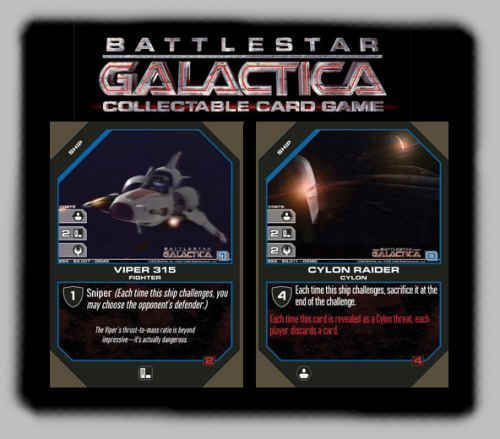
Battlestar Galactica Collectible Card Game
Battlestar Galactica Collectible Card Game Rulebook
Table of Contents
Table of Contents
Introduction
You lead a group of powerful individuals attempting to gain control of the Colonial fleet. Operating from your base, you convince important persons to join your cause. You then use these key personnel to challenge the agendas of opposing factions. Victory is measured in influence.
Two or more players can play the Battlestar Galactica™ collectable card game. Each player must bring a 60-card deck, one base card, and a method for keeping track of his or her influence (such as a 20-sided die or paper and pencil). If you haven't played the quick-start game yet, you should do so first before reading through these complete rules.
Glossary. As you read through these rules, if you see an unfamiliar term or one you don't understand, consult the glossary on page 20.
Starter Set Components
- Quick-start rules
- Two 31-card fixed decks, including five premium foil cards
- Complete rules
Important Concepts
Victory Conditions
There are two ways to win the game and one way to lose the game. Ties are possible. The game ends immediately when any player wins.
- You win when your influence reaches 20 or more.
- You win when all other players have lost.
- You lose when your influence is reduced to 0.
Game Zones
There are five zones in the game where cards are played.
- Fleet: This is where base, mission, personnel, and ship cards are played. Your fleet has three areas: A. Alert (your missions and units that are alert) B. Reserve (your missions and units that have been committed or not yet readied) C. Resource (your base, assets, and face-down supply cards)
- Deck: This is a face-down, single stack of cards. Cards in a player's deck can't be viewed, and their order can't be arranged. Any player can count the number of cards in a player's deck at any time.
- Discard pile: Discarded, defeated, and sacrificed cards go here. Cards in discard piles can be viewed, but their order can't be arranged.
- Hand: Your starting hand size is determined by your base card. There is no maximum hand size.
- Removed from the game: Abandoned cards, killed personnel, and destroyed assets go here. This zone is not used in the first set.
General Rules
- You are the owner of all the cards you bring to the game. Other players may gain control of cards you own, but those cards are returned to you when the game ends.
- Whenever the cards contradict the rules, the cards take precedence.
- When one card says you can do something and another card says you can't, the one that says you can't takes precedence.
- Any time you are allowed to search your deck for a card, there is no penalty if you don't find the card or don't want to take it. Always shuffle your deck after you search it, and then offer it to the opponent on your right to cut.
Card Types
Base Card
Your base isn't part of your deck. It is revealed and put into your resource area before the game begins. Your base is your first resource stack. In addition to its power, resources, traits, and abilities, your base determines your starting hand size and influence.
Event Card
A card that generates an immediate game effect.
Personnel Card
A card that represents a character from the Battlestar Galactica universe.
Mission Card
A card that represents a task your fleet can attempt.
Ship Card
A card that represents a spacecraft from the Battlestar Galactica universe.
Card diagram labels. The rulebook's card diagrams label the following parts of a card: card type, cost, rarity, card number, subtitle, title, traits, power, resource, mystic value, ability, red Cylon threat text (on personnel cards), flavor text, and Cylon threat.
Playing Cards
Resources
There are three different resource types: persuasion, logistics, and security. Each turn during the ready phase, you can play one card at no cost to your resource area as an asset or a supply card.
Asset. Play a card that has a resource printed on its bottom edge face up from your hand to your resource area as an asset (creating a new resource stack).
When you play a personnel or ship as an asset, that card loses its card type and gains the card type of "asset." Other properties of that asset are ignored, except for the type of resource it produces.
Supply card. Play any card from your hand face down beneath your base or an asset as a supply card. A supply card adds 1 extra resource of the type of resource generated by the asset each time you spend that resource stack.
When you play a card as a supply card, that card loses its card type and gains the card type of "supply card." Other properties of that supply card are ignored. Supply cards are not restored.
Generating Resources
Your base and each asset in your resource area can generate one resource of the type printed at the bottom of that card. Each supply card provides an additional resource of the type provided by the base or asset it is beneath. To spend a resource stack, flip the base or asset on top face down. To restore a resource stack, flip the base or asset on top of the stack face up.
Example: When this Galactica resource stack is spent, 3 security are generated: 1 from the Galactica base (the asset) and 1 from each of the two supply cards beneath it.
Paying Costs
When you play a card, you pay its cost by spending one or more of your resource stacks. To pay the cost of a card you are playing, note its cost printed on the card's left edge. Spend a resource stack that generates one or more resources of the proper type.
If that stack pays the entire cost of that card, you can't spend another resource stack. If the stack you spend generates excess resources, those resources are lost. If the first stack doesn't generate enough resources to pay for the card, spend another resource stack, and continue in this way until the full cost is paid.
Meeting Requirements
When you play a card, you must meet all the requirements for playing that card. These may be found in the ability of the card you are playing or on another card in play.
When you play a card, you make all choices indicated by that card's ability unless otherwise specified.
Target. A phrase using the word "target" means that the player who played the card or ability makes a choice. Such choices are made when the card or ability is played.
An ability that requires your opponent to make a choice is written like this: "Target opponent chooses—
Example: An event says, "Commit target unit." When you play this card, you choose which alert unit will be committed. (It can be a unit controlled by any player.)
Example: An event says, "Target opponent chooses—He or she loses 1 influence; or you draw a card." You choose which opponent, but then that player makes the other choice.
Effects
When you play an event card, resolve a mission, or play an ability, the result is an effect. Some cards have continuous effects that apply as long as they are in play. Some cards have triggered effects that happen only when a certain condition triggers them.
An effect lasts until the end of the current phase unless otherwise specified.
When you have to make a choice for an effect, you must choose something you can do, if you can. When an effect requires you to do something you can't, do as much as you can and ignore the rest.
Fleet Defense Level
Before the game begins, players add up the powers of all base cards in play to get the fleet defense level that will be used throughout the game. Whenever the total of all Cylon threats of face-up alert or reserve cards is greater than the fleet defense level, Cylon attacks occur (see Cylon phase, page 15). In a multiplayer game, when a player leaves the game, deduct the power of that player's base from the fleet defense level.
Example: Your base has a power of 5, and your opponent's has 7. The fleet defense level is 12, and Cylon attacks occur when the total Cylon threats of all face-up alert and reserve cards is more than 12.
Moving Cards in the Play Area
Ready vs. Commit
To ready a card you control is to move it from your reserve area to your alert area. You can't ready a card that's not in your reserve area.
The opposite is to commit a card—to move it from your alert area to your reserve area. You can't commit a card that's not in your alert area.
Exhaust vs. Restore
To exhaust a card you control is to flip that card from face up to face down. You can't exhaust a card that's not face up. (Exhausting a resource stack is also called spending.) Except during a challenge, an exhausted card retains its card type and title, but loses its subtitle, traits, ability, and other statistics.
The opposite is to restore a card—to flip it from face down to face up. You can't restore a card that's not face down.
First Player
Throughout the game, players must know who is first to act
- at the start of the game,
- during the ready phase,
- at the start of the execution phase, and
- at the start of the Cylon phase.
The first player is always the player who has the lowest influence. In the case of a tie, the previous first player remains first player. At the start of the game, if two or more players tie for the lowest starting influence, determine the first player randomly. Once the first player has acted, turn order continues with the next player to his or her left and so on around the table.
During a challenge, the challenging player acts first, and then play continues in turn order. Any time there are multiple effects responding to a single trigger, resolve them starting with the first player (or the first applicable player to the left of the first player in turn order), and then continue in turn order.
Example: In a three-player game, two players (neither of whom are the first player) have a persistent mission that says to draw a card when the ready phase begins. The player to the left of the first player draws, and then the other player.
Revealing a Mystic Value
During challenges (and other times when required), players reveal mystic values. To do so, reveal the top card of your deck and show its mystic value to all players. Then put the card into your discard pile. Revealing a mystic value is mandatory when required.
Playing the Game
Setup (All Players Simultaneously)
- Shuffle your deck and present it to the opponent to your right to cut.
- Players simultaneously reveal their base cards. Put your base card face up into your resource area.
- Players determine the fleet defense level for the game by adding together the powers of all bases.
- Players simultaneously draw starting hands equal to their hand sizes.
- Beginning with the first player, each player can decide whether to shuffle his or her hand back into his or her deck, present it to the opponent on the right to cut, and then draw a new hand. Each player can redraw his or her hand only once each game in this way.
Turn Structure
Battlestar Galactica is played in a series of turns. Each turn is divided into phases. All players take actions during each phase.
- Ready phase
- Execution phase
- Cylon phase
Ready Phase
Ready phase steps (in order):
- All players ready face-up units and face-up missions in their reserve areas.
- All players restore any exhausted cards.
- All players draw two cards from their decks.
- Beginning with the first player, each player can play one card from hand to his or her resource area, or pass. Each player can play only one card in this way each turn.
- Beginning with the first player, each player can reorder any unit stacks he or she controls.
Execution Phase
In the execution phase, starting with the first player and continuing in turn order, each player performs an action. Repeat this procedure until all players consecutively pass.
When you may act in the execution phase, choose one of the following actions. You can choose the same action more than once in the same execution phase. (Exception: "Resolve a Mission," p. 13.)
- Play a card
- Play an ability
- Resolve a mission
- Challenge
- Pass
Play a Card
When you play a card from your hand, reveal it to all players and announce its name. Then show that you meet all requirements needed to play the card. Then spend one or more of your resource stacks to pay for the cost of the card.
- If it's a unit or mission, put it into play face up into your reserve area.
- If it's an event, its game text takes effect, and then it is put into your discard pile.
Overlaying cards. When you play a singular card, if you already have a card that has the same title in play, you must overlay that card and make a unit stack.
To play such a singular card, pay all its costs and put it on top of the stack of cards with which it shares a title. The ability, traits, and other statistics of only this top card of the stack can be used. When a card is overlaid, if its stack is alert, it remains alert; if any of the cards in the stack are exhausted, restore them.
In the ready phase, you can change the order of any stack you control and choose which one to use for the rest of that turn. If a singular card is defeated, all of the cards in its stack are put into their owners' discard piles.
Example: You have Apollo, Commander Air Group in play, and Apollo, Political Liaison in your hand. You can't play the Liaison card as a separate personnel, but you can overlay it on top of the CAG card. The game text on the Liaison card will be used until the next ready phase (because it is the newest card on the stack), when you may choose to change the order of the unit stack.
Play an Ability
Some cards have abilities prefaced with a word and a colon—such as "Commit:" and "Exhaust:"—that can be played as an action in the execution phase. When you use such an ability, you must meet its costs or requirements just like when playing a card.
When you have a unit stack, whenever you can play an ability (such as during the execution phase or during a challenge), you can sacrifice one of the cards in that stack (except the top one) to give the top unit +1 power until the end of the phase.
Red Cylon threat text. Many units that have the Cylon trait have an ability printed in red. This red Cylon threat text comes into effect only when that card is revealed as a Cylon threat.
Resolve a Mission
If you have a face-up mission in your alert area, during the execution phase you can use an action to resolve that mission. You can resolve only one mission during each execution phase.
In order for a mission's ability to take effect, you must meet all the requirements listed after its "Resolve:" text. These requirements usually consist of traits or card types, although other kinds of requirements are possible. You must control the correct number and type of face-up alert units meeting all required card types and traits to resolve the mission. No unit can be counted more than once to fulfill a mission's requirements.
Example: A mission requiring "1 Officer and 1 Politician" needs two personnel, even if one personnel you control is both an Officer and a Politician.
Unless the mission specifies otherwise, it is put into its owner's discard pile after it resolves. A mission with the Persistent keyword (see p. 18) is put into your resource area when it resolves instead of being put into its owner's discard pile.
You can commit or exhaust a challenging or defending unit you control in order to generate an effect, such as using its ability, during that challenge. Challenging or defending units that become exhausted during a challenge retain all their card properties until the end of the challenge.
If the challenger leaves play before the challenge is resolved, the challenge ends. Don't commit the defender. If the defender leaves play before the challenge is resolved, the challenge is still defended and the defending player does not lose influence equal to the power of the challenger. Commit the challenger, and the challenge ends.
Challenge
By challenging your opponent, you can make him or her lose influence. Your opponent may choose to defend with one of his or her units. A challenge is resolved based on the power of units involved in that challenge.
Challenge Procedure
- Choose a face-up alert unit you control to be the challenger, and then choose one of your opponents. That player may choose a face-up alert unit he or she controls of the same type (a ship if your challenger is a ship, or a personnel if your challenger is a personnel) to be the defender of the challenge.
- Starting with the challenging player and proceeding in turn order, each player can play an event or ability, or pass. Repeat this procedure until all players consecutively pass.
- If there is no defender, the defending player loses influence equal to the power of the challenger. Commit the challenger, and the challenge ends.
- Otherwise, each player reveals a mystic value and adds it to the respective power of his or her challenger or defender.
- Resolve the challenge by determining the total power of each player's challenger or defender. The player with the highest power wins (the challenger wins ties). Commit the winning unit, defeat the losing unit, and the challenge ends.
Pass
When you can't or don't want to do anything else this phase, you must pass. Unless all players pass consecutively, you can perform a nonpass action later in this phase.
Cylon Phase
Players first total the Cylon threats of all face-up alert and reserve cards in order to get the overall Cylon threat level. If the Cylon threat level is greater than the fleet defense level, Cylon threats occur; otherwise, there are no Cylon threats, and the Cylon phase ends.
Resolving Cylon Threats
- All players reveal the top card of their decks and put it face up in the fleet between all players. Each of these cards represents a single Cylon threat. The power of that threat is equal to the Cylon threat of that card. All other characteristics of that card are ignored, except red Cylon threat text, which triggers at this time in turn order if more than one is revealed.
- If all revealed Cylon threats have the Cylon trait, then the fleet must jump away. Each player chooses and sacrifices an asset or a supply card he or she controls. Then put all Cylon threats into their respective owners' discard piles, and the Cylon phase ends.
- If the fleet hasn't jumped away, put any cards that have a Cylon threat of 0 into their owners' discard piles. If no Cylon threats remain, the Cylon phase ends.
- If Cylon threats remain, players (beginning with the first player, and proceeding in turn order) each choose one of the following options:
- Pass and lose 1 influence.
- Choose any one of the Cylon threats to be the defender and a face-up alert unit he or she controls to be the challenger. The player to this player's left becomes the "Cylon player." These two players use the "challenge procedure" described earlier to determine who wins the challenge. (Exception: The challenger and defender don't have to be units of the same type.) If the challenger wins, the challenging player gains 2 influence. (Exception: In a game with three or more players, gain 1 influence instead.)
Players continue to pass or challenge until there are no more Cylon threats remaining, or all players consecutively pass. Then all remaining Cylon threats are put into their owners' discard piles, and the Cylon phase ends.
When the Cylon phase ends, the current turn ends and another turn begins. Players continue until one or more players win the game.
Other Important Rules
Depleting Your Deck
When you are required to draw or reveal a card from your deck and there are no cards in your deck, shuffle your discard pile and turn it face down; it becomes your new deck. Continue to draw and reveal cards using this new deck.
Deckbuilding
Each player needs one base card and a deck of at least 60 cards. The base card does not count toward the 60-card minimum deck size. No more than four of any one card can be included in the deck. For this purpose, a card is identified by its card name, including title and subtitle.
Example: A player can have four copies of Apollo, Political Liaison and four copies of Apollo, Commander Air Group in her deck.
Tip: You'll probably want to include 30 or more total ships and personnel, because those are the only cards that you can play as assets to produce resources.
Keywords
Expedite
A card with this keyword can be paid for using excess resources that you have left over from paying another card's cost. Play both cards at the same time, and then resolve them in order.
Example: You spend a resource stack that generates 3 security. You use 2 of that security to pay for a personnel, and you may also play an event in your hand that says, "Expedite (When you pay a cost and have excess resources, you may play this card.)" Resolve the personnel first, and then the event.
Manipulate
When a card with this keyword challenges and there is no defender, you may gain influence equal to its power instead of your opponent losing influence.
Example: You challenge with a power 2 ship that has the Manipulate ability. Your opponent chooses not to defend. Normally, your opponent would lose 2 influence, but you choose to use the Manipulate ability to gain 2 influence instead.
Persistent
A mission with this keyword is put face up into your resource area instead of into your discard pile as part of its resolution. A persistent mission isn't an asset and isn't a supply card. The effects of persistent missions are cumulative.
Example: You resolve a persistent mission that gives all Fighters +1 power. You already have a copy of that mission in your resource area, so now all Fighters get +2 power instead.
Sniper
When a unit with this keyword challenges, if the challenged player chooses to defend, the challenger's controller may choose the defender (instead of the defending player choosing). The defender must be a face-up alert unit and of like type; for example, when you challenge with a ship that has Sniper, you may choose only a ship to defend.
Example: You challenge with a ship that has Sniper. Your opponent chooses to defend, and you choose her power 1 ship to defend. She would have chosen her power 3 ship, but using Sniper you decide which ship defends.
Scramble
A unit with this keyword can defend as though it were the other type of unit; that is, a personnel can defend a challenge by a ship, or a ship can defend a challenge by a personnel. Other requirements for defending a challenge, such as being a face-up alert unit, remain the same.
Example: Your opponent challenges you with a ship. You have no ships to defend with, but you can choose an alert personnel that has Scramble to defend.
Vision
A personnel with this keyword can't challenge or defend.
Glossary
- ability: Game text of a card that explains what that card does, what its requirements may be, or what it can do and when it can do it.
- alert: A card in your alert area is an alert card.
- asset: A personnel or ship card in your resource area on the top of a resource stack that you can spend to generate resources.
- commit: Move a card from your alert area to your reserve area.
- Cylon threat: Indicates the degree to which a unit provokes Cylon attacks.
- defeat: Put a card from the play area into its owner's discard pile.
- discard: Put a card from your hand into your discard pile.
- exhaust: Flip a face-up card face down.
- fleet defense level: Indicates the degree to which the entire fleet prevents Cylon attacks.
- mystic value: Indicates the impact of the scriptures on game events.
- name: A label that includes the card's title (if it has one) and subtitle.
- overlay: Play a singular unit card on top of another that has the same name.
- The conflict value of a card. The power of your base card helps to determine the fleet defense level.
Sequence of Play
Reference sheet printed at the end of the complete rules.
Ready Phase
- All players ready face-up units and missions in their reserve areas.
- All players restore exhausted cards.
- All players draw two cards.
- Each player plays an asset, plays a supply card, or passes.
- Each player reorders any unit stacks he or she controls, or passes.
Execution Phase
- Each player plays a card, plays an ability, resolves a mission, challenges, or passes.
- Repeat step 1 until all players consecutively pass.
Cylon Phase
- Determine the total Cylon threat level of all face-up alert and reserve cards.
- If the total Cylon threat level is greater than the fleet defense level, each player reveals a Cylon threat.
- Each player challenges a Cylon threat, or passes and loses 1 influence.
- Repeat step 3 until no Cylon threats remain, or all players consecutively pass.