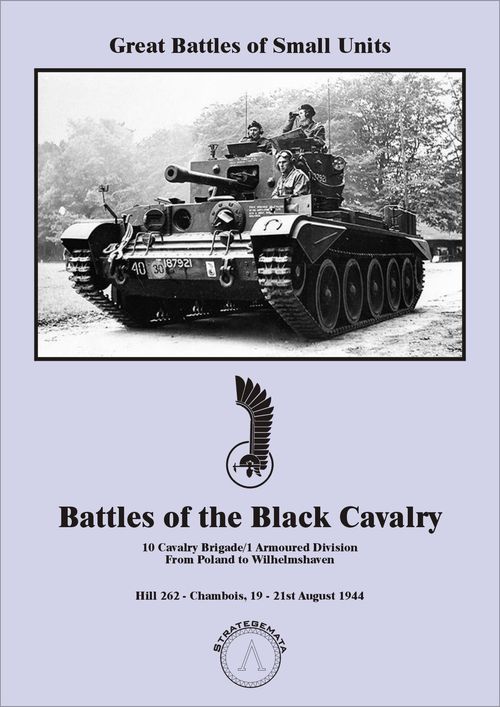
Battles of Black Cavalry: 10 Cavalry Brigade/1 Armoured Division from Poland to Wilhelmshaven – Hill 262: Chambois 19-21st August 1944
Battles of Black Cavalry: 10 Cavalry Brigade/1 Armoured Division from Poland to Wilhelmshaven – Hill 262: Chambois 19-21st August 1944 Rulebook
Table of Contents
Table of Contents
1.0 Components
A complete game includes:
- a rulebook;
- scenario card and player's aid card;
- a map;
- a countersheet;
All random events are resolved by classic deck of 52 cards, which must be supplied by players themselves.
Game scale. Counters represent units which fought in a battle. There are also individual guns or AFVs (Support Weapons), which presence had been significant on the battlefield.
2.0 Definitions
- Size of unit. III - regiment; II - battalion; I - company; ••• - platoon; •• - section; • - squad.
- Type of unit. Non-motorized: Infantry, Cavalry, Headquarters, Machine Guns, Signal, Anti-Air, Anti-Tank, Engineers, Airborne, Glider Infantry, Mountain. Motorized: Tanks, Headquarters, Motorized Infantry, Mechanized Infantry, Motorcycle, Reconnaissance.
- Formation. Denotes to which headquarters particular unit belongs. Units with the same color have the same formation.
- Identifier. Denotes historical organisation of particular unit.
- Firepower. Rating on a counter that represents ability of inflicting losses. The higher, the higher chance of successful fire.
- Range. Distance counted in hexes within which fire can be resolved. Target hex should be counted, but firer hex should not.
- Morale. Rating on a counter that represents training and resistance of a given unit to hardships of combat. The higher, the better unit it is.
- Movement Allowance. Rating denotes, how many clear hexes a unit can move (see 5.0 Movement). Number with a black background is used to denote a motorized unit, number on blue background is used to denote a non-motorized unit.
- Steps. Each counter has a front and back side to account for possible losses.
- Losses. Unit suffers Losses which reduces its steps. Counter should be flipped over. If flipped already or it doesn't have a reverse side, unit is removed from a play and it is considered to be eliminated.
3.0 Gameplay
-
[3.1] Before starting the game, unit counters must be set up on map spaces designated by a scenario card. Units entering the play at a later stage (reinforcements) must be put on appropriate turn track space.
-
[3.2] Deck of cards should be shuffled. Scenario decides how many cards each player begins with. The player who has more cards draws first. In case of equal card number Allied player draws first.
-
[3.3] In the next step initiative suits should be decided. Scenario card gives information how many cards one side draws - this action is performed only before the very first turn. Drawn cards' suits give the initiative to the drawing side. Remaining suits give initiative to the opponent.
-
[3.4] In Initiative Phase counter representing drawn suit should be flipped to the other side and then moved to the next space of Turn Track along with other counters.
Example: Primosole Bridge, First scenario. Initiative: Germans 3 cards. Let's assume that following cards were drawn: [card pictures omitted]. On first space of Turn Track following counters should be placed: [counter pictures omitted]. Let's assume that during Initiative Phase in first turn 2 Spades was drawn. On the second space of Turn Track following counters should be placed: [counter pictures omitted].
-
[3.5] Game is divided by several Turns. Current Turn and initiative side is denoted by Initiative counter, which should be placed in proper space on the Turn Track.
-
[3.6] Each Turn is divided into three phases:
- Reinforcements - players set up on map, in proper hexes, units which were on Turn Track;
- Initiative - one of the players is to draw a card from deck. It's suit decides who receives initiative during this turn. Using counters with suits on Turn Track, players should denote which suits will give initiative to which side [see 3.4]
4.0 Activation
-
[4.1] Player with Initiative can automatically activate all units with the same formation. All Support Weapons stacked with activated units can be also activated.
-
[4.2] Activation of units with different formation. Player can declare that he wants to activate units with differing formation. This is done using following procedure:
- a) calculation activation rating. Player has to add activation values which are listed below:
-
- 1 for each Support Weapon occupying separate hex;
-
- 2 for each formation
-
- 2 for each Artillery Fire [see 6.7]
-
- 2 for each Air Strike [see 6.8]
-
- b) card draw - from hand or from deck
- c) if card has value equal or higher than calculated activation rating, all chosen units can be activated. If not, no units can be activated and turn is finished.
Example: German Player wants to activate all units and one Artillery Fire. Activation rating is 2 (1 MG) + 2 (1 sig.) + 1 (AT 2) + 2 (AF) = 7. [map diagram omitted]
- a) calculation activation rating. Player has to add activation values which are listed below:
-
[4.3] Activated unit can perform one action (exception: close combat, see 9.0) from the following:
5.0 Movement
- [5.1] Each unit has specified amount of Movement Points (MPs). This amount is specified on each counter.
- [5.2] In Terrain Table players will find cost of movement points for entering any type of hex or crossing hexside features.
- [5.3] Unit can move one adjacent hex, even if it doesn't have enough MPs. After such a move, movement of the unit is finished. Unit cannot enter impossible terrain in this case.
- [5.4] Unit doesn't have to expend all MPs, but it also cannot save them for later or transfer them to other units.
- [5.5] Movement of each unit must be done separately - there is no movement in stacks.
- [5.6] Entering a hex occupied by friendly units does not cost additional MPs.
- [5.7] Entering a hex occupied by enemy unit or stack cost additional one MP. This enables Close Combat [see 9.0].
- [5.8]. Improved Position (IP). By paying all Movement Points non-motorized units can improve defense of occupied hex. Terrain Chart shows which terrain can be improved. IP raises Defense of a hex by 2. When unit vacates the hex, IP marker is removed from map.
6.0 Fire
-
[6.1] Fire can be conducted by all units with Firepower rating greater than 0.
-
[6.2] Each unit fires separately (exception: Support from HQ unit [see 6.6]) and only at one target. Player with initiative makes decision in each case (exceptions: Artillery Fire [see 6.7], Air Strike [6.8], Defensive Artillery Fire [6.9], Defensive Fire [7.3]).
-
[6.3] In particular turn particular unit can be fired at several times.
-
[6.4] Fire is resolved with following procedure:
- Calculation of Defense value. Player adds Morale rating of the target unit to Cover Rating of terrain occupied by target (see Terrain Chart).
- Calculation of Fire value. Player adds to doubled Firepower value all of the following:
- a) Gun/Armor Rating [see 6.5], if firer and/or target are tank or anti-tank units. See also [6.5.1] and [6.5.2],
- b) HQ Support [see 6.6]
- c) card value chosen from hand or drawn from deck [see 6.10]
- If Fire value is higher than Defense value, target should receive "Disorganized" marker. Additionally, if Fire value is two times above Defense value, target unit suffers a loss.
-
[6.5]. Gun/Armor Rating. Tank and anti-tank units have additional ratings - two values from 1 to 4 (G/A). G(un) value is used, when unit is firing and A(rmor), when it is being fired at. Gun/Armor rating is a difference between G of a firer and A of a target.
7.0 Reaction to Enemy Movement
- [7.1] Inactive units which belong to the side without Initiative and are not Disorganized, may react to enemy movement. They can perform two actions: Retreat or Defensive Fire.
- [7.2]. Retreat. A unit is moved by one hex - to increase distance when enemy enters adjacent hex. Retreat space must be free of enemy units. Retreat is impossible if inactive unit already shares hex with enemy unit.
- [7.3]. Defensive Fire (DF). First, number of possible Defensive Fires must be decided. Defensive Fire is resolved when enemy unit is within Range and is visible.
-
[7.3.1]. When first enemy unit enters a hex within Range and visibility of inactive unit, card must be drawn from the top of a deck. Ammo value level should be deducted. Players should then consult the table below.
card value - ammo DF limit 0 or less no 1-4 1 5-7 2 8-10 3
-
8.0 Disorganisation and Reorganization
- [8.1] Unit can become Disorganized because of Random Event, Fire, Air Strike or entering Mine Field. This status reduces unit's capabilities:
- a) unit cannot move, improve position or creating smoke screen;
- b) unit cannot Fire;
- c) unit cannot react to enemy movement;
- d) during Close Combat unit plays only one, face down, card drawn from the top of a deck [see 9.2];
- e) Morale is lowered by 1;
- f) HQ unit cannot Support attacks [see 6.6];
- g) special units lose their special abilities.
- [8.2] If unit with Disorganized marker would be Disorganized once again, it must leave its current hex and increase its distance to enemy units. If it is impossible, unit suffers a loss and remains in hex.
- [8.3]. Rally. Unit must be activated. Player must draw a card from the top of a deck or play one card from his/her hand. If card value is lower than Morale, Disorganized marker is removed and unit functions normally. It is finished for this turn.
9.0 Close Combat
- [9.1] Close Combat is a form of combat happening during movement. Activated units enter hexes occupied by enemy and combat ensues. Each side must adhere to stacking limits [see 2.0].
- [9.2] For each unit player has to calculate Close Combat value (first for side without Initiative) according to following procedure:
-
a) draw a card from the top of a deck and leave it facing down for a moment;
-
b) player without Initiative (defender) draws a second card from the top of a deck or plays it from hand, facing up;
-
c) player with Initiative (attacker) draws a second card from the top of a deck or plays it from hand, facing up;
-
d) combined arms - if one side has both tank and infantry units participating in Close Combat in which enemy has only one type (exception: infantry with anti-tank guns in defense), it can draw one card more, facing up;
-
e) coordination - player with Initiative can draw from the deck more cards facing up (or play from hand) if his units entered Close Combat hex from several hexes. Number of cards drawn are equal to number of hexes from which attacking units entered, minus one.
Example: Units enter Close Combat hex from three adjacent hexes. Player can draw or play from hand two additional cards.
-
f) players turn over cards facing down and add to their value Firepower of participating units. In case of tank units Firepower should be doubled
-
g) compare the results - the side with a greater total, wins. In case of ties, player with Initiative wins.
-
- [9.3]. Counterattack. If player without Initiative loses Close Combat but difference from [9.2g] is lower than Morale of the best participating unit on his side - counterattack is possible. Procedure of counterattack resolution:
10.0 Support Weapons
- [10.1] Support Weapons can be activated separately or with other units. If latter, one need to add 1, when Support Weapon occupy separately hex [see 4.2].
- [10.2] Support Weapons can move as other units. Appropriate symbol denote type of the unit.
- [10.3] Regardless of Fire attack value performed by Support Weapon, target can only be Disorganized and never suffer a loss.
- [10.4] If Support Weapon is a target of enemy Fire, normal procedure applies.
- [10.5] During Close Combat only one card facing up is played for each Support Weapon. If Support Weapon is Disorganized, played card is facing down [see 9.2]
11.0 Special Rules
- [11.1]. Signalling units. When checking accuracy of Artillery Fire or Air Strike [see 6.7.4a], if target hex is visible by a signalling unit - player can play a card from hand.
- [11.2]. Engineers. If engineer unit is on a minefield [see 11.6], units that later enter that hex can ignore mines.
- [11.2.1]. Engineers, expending all movement points, can clear minefield - counter "Mines" is then removed from map.
- [11.3]. Anti-aircraft artillery. They influence accuracy of Air Strike, if there are in Air Strike hex. When checking accuracy of Air Strike, two cards must be drawn from the deck or played from hand [see 11.1, signalling units]. Attack is accurate if suit of both cards matches the suit of target hex. If not, opposite player makes decision when Air Strike lands - choice is between suits of two cards.
- [11.4]. Night. During night turns visibility is limited to adjacent hexes.
- [11.5]. Low Ammo level. At the beginning of game, marker "Ammo" has value of 0 - it should be kept out of Turn Track. If during Close Combat or Fire card was drawn from deck or played from hand with value of 10 - marker should be moved to next space on Turn Track.
- [11.5.1]. If Low Ammo level is reached - given side cannot Fire when having Initiative.
- [11.5.2]. Low Ammo does not influence Close Combat.
- [11.5.3]. Current Ammo level can influence defensive Fire limit [see 7.3.1].
- [11.5.4]. Above rules are not used in regard to Artillery Fires, Air Strikes and Minefields.
12.0 Random Events
- [12.1]. When any of the cards listed below are drawn from deck, random event should be resolved. Event should be ignored if card was played from hand or drawn during deciding Initiative. Game is continued after resolution of the random event.
- [12.2]. Possible events. The cards are shown here by rank and suit.
- Sniper (any of the four Jacks: jack of diamonds, spades, clubs, hearts). Player with Initiative can Disorganize enemy non-motorized unit, if it occupies the same suit as suit of drawn Jack and is not in Close Combat hex.
- Change of orders (queen of hearts or queen of spades). Player with Initiative can discard any number of cards and draw replacements from deck.
- Change of orders (queen of clubs). Player without Initiative can discard any number of cards and draw replacements from deck.
- Additional orders (king of hearts or king of spades). Player with Initiative can refill his hand, but only up to a limit given by scenario card.
- Additional orders (king of clubs). Player without Initiative can refill his hand, but only up to a limit given by scenario card.
- Quick rally (king of diamonds). Player with Initiative can automatically Rally any one of his units (without using cards from deck or hand).
- Extra ammo (queen of diamonds). Player with Initiative can move "Ammo" marker by one space to the left, but not further than 0.
13.0 Victory conditions
- [13.1] Victory conditions are always specified on scenario card.
- [13.2]. Hex control. Hex is controlled by player if his units were the last to enter them or cross them.
14.0 Examples of play
-
[14.1]. Close Combat Resolution. [Diagrams and card pictures of this example are omitted; the card values are given in the text.]
- British Player has Initiative. Let's assume that 3 British units were activated (see [4.2]), which are to enter Close Combat with two German units. Defensive Fire was unsuccessful and units entered hex occupied by Germans.
- German Player, the one without Initiative, draws one card for each of his units from deck as first and leaves them facing down for now.
- British Player, the one with Initiative, draws one card for each of his units from deck and leaves them facing down, also.
- Let's assume that both players have no cards in their hands. German Player, without Initiative, draws second card from deck, this time facing up. He does this for each participating German unit. When card with value of 10 (clubs) appears, "Ammo" marker should be moved onwards on Turn Track by one space (see [11.5]).
- British Player with Initiative draws one card for each of his units from the top of deck, facing up.
- British Player has to draw one more card because of combined arms rule (see [9.2d]) and additional two other, because he entered Close Combat hex from three different hexes (see [9.2e]). Just after revealing Queen of Diamonds appropriate event should be resolved (see [12.2]). Total value of cards pictured above is 11.
- German Player reveals cards facing down and calculates total for each unit. Final result is 41.
- British Player does the same. After Jack of Clubs is revealed, appropriate event should be resolved. British Player calculates his total and adds value from step 6 of this example. Final result is 34 + 11 = 45. British Player has won Close Combat. Difference is 4 (45 - 41 = 4) and is lesser than Morale of German unit - here it doesn't matter which one as both have the same rating of 6. Let's see what will happen when German Player declares counterattack (see [9.3]).
- German Player draws one card facing down and one facing up.
- British Player draws two cards facing up and adds difference from step 8 (see [9.3b]).
- Result of German counterattack is calculated after revealing hidden card (see [9.3c]).