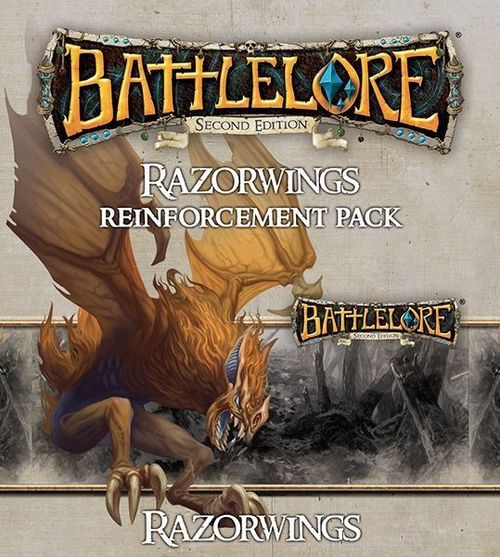
BattleLore: Second Edition – Razorwings Reinforcement Pack
BattleLore: Second Edition – Razorwings Reinforcement Pack Rulebook
Table of Contents
Table of Contents
Expansion Overview
Razorwings Reinforcement Pack is an expansion for BattleLore Second Edition. It introduces the Razorwings, a new unit that you may call upon to fight in any army. New lore cards and a unique terrain tile give you even greater options on the battlefield. The components in this pack are designed to function smoothly with the core game, allowing you to begin playing immediately.
Expansion Icon: Each card in this expansion is marked with the Razorwings expansion icon, which makes these cards easy to tell apart from cards in other expansions and from cards in the base set.
Components
- 3 Razorwing miniatures with 3 stands
- 3 lore cards
- 1 unit reference card
- 1 deployment card
- 1 terrain tile
- 3 stun markers
- 1 neutral marker (black and white, double-sided)
Using This Expansion
This section describes how to incorporate the Razorwings Reinforcement Pack components and rules into the core game.
Neutral Units
Neutral units do not belong to any faction, and can be mustered as part of any player's army.
Included in this expansion are three lore cards, each marked with the Razorwings expansion icon and a unique identification number.
Before playing with neutral units, take the deployment cards for all neutral units (from both players) and combine them to form a draft pool. The draft pool may contain more than one deployment card for a particular unit.
Drafting Units
At the start of the "Muster Armies" step of setup, players may spend muster points to purchase the deployment cards of neutral units to include in their armies. The first player starts by choosing one of the available neutral units to muster, or passes if he does not wish to muster any neutral units or is unable to. Then, his opponent chooses up to two neutral units from the remaining ones, or passes. After that, the first player chooses one neutral unit. Then the second player may do the same.
If a player passes immediately after his opponent passed, the choice of neutral units ends. When this step is complete, players muster their armies as normal, using their remaining muster points.
- Drafted units belong to a player's own faction until the end of the game.
- The three lore cards belonging to each drafted unit become available to the player to include in his lore deck (see below).
Lore Customization
While mustering armies, players have the option of customizing their lore decks by replacing a number of cards from their lore deck with other lore cards.
During the "Muster Armies" step of setup, each player may secretly remove up to five lore cards from his lore deck and replace them with the same number of lore cards belonging to the neutral units included in his army. After replacing cards, he reshuffles his lore deck and returns it to the play area. Then, he returns all of his unused lore cards to the game box without showing his opponent.
[Uncertain rendering: the printed text limits the replacement cards to lore cards of neutral units in the player's army. The second Russian translation and the English Great Dragon Reinforcement Pack rulesheet instead define the pool as unused lore cards of the player's chosen faction plus lore cards of neutral units in his army. The printed text is followed here; check the wording against the physical rulesheet before relying on the narrower reading.]
- A lore deck cannot contain more than two copies of any lore card with the same name.
Golden Rules
The rules described here expand on the rules of the core game and the reference book, and take precedence over them. If there is a contradiction between the rules, the rules from this expansion are to be used.
However, if the text of a card or other game component contradicts the rules, this is always resolved in favour of the cards and components.
New Terrain
The Razorwings expansion adds a new terrain type that alters the battlefield. When a player adds Razorwings to his army, he may replace a hill on his side of the board with a cave.
Cave (Terrain)
A unit occupying a cave hex (including units with the Flying ability) can be attacked only by adjacent units.
During the Attack step, a Razorwing unit that has been given an order, if it occupies a cave hex and did not move during the March step, may move to one adjacent hex and make an attack. This attack cannot be countered. After this, instead of advancing, the Razorwing unit may return to the cave hex.
- After the position cards are revealed, starting with the first player, players may replace a hill on their side of the board with a cave hex, one hill for each Razorwing unit in the army.
- A cave may count as a hill only for special rules of a scenario. Otherwise, a cave is not considered a hill.
- Caves are blocking terrain.
- A unit that moves into a cave hex must immediately end its movement. During the same turn it can move again if the unit has the appropriate ability, or if an appropriate effect triggers, for example if the unit advances.
- A unit forced to retreat into a cave hex cannot continue retreating in that combat. Each unapplied retreat effect deals 1 damage to the unit. During the same turn, the unit may retreat out of this hex if the retreat is caused by a different combat.
New Markers
This section describes the new markers included in this expansion and their effects.
Neutral Markers
If both players are using neutral units, these markers identify which player each neutral unit belongs to.
After deploying armies and placing units, the first player places a neutral marker with the white side up in each hex occupied by his friendly neutral units. Then, his opponent does the same for each of his neutral units, using the black side of the neutral marker.
- When a neutral unit moves, move the neutral marker with it. When a neutral unit is eliminated, remove the neutral marker from the game board.
Rules Clarifications
This section provides additional details on the new rules introduced in this expansion.
Claw Sweep (Unit Ability)
[Uncertain English name: the Russian is "Взмах когтями"; "Claw Sweep" is used here as the English name.]
After a unit with the Claw Sweep ability goes on the advance, it may stun one adjacent unit.
Flying (Unit Ability)
These rules expand on the rules for Flying in the core game and apply to all units with that ability.
- "Non-Flying" refers to any unit that does not have the Flying ability.
- A unit with the Flying ability that performs a melee attack against another unit with the Flying ability rolls the normal number of dice in its combat rolls, that is, not one die fewer.
Pre-Built Scenario
Included in this expansion is a pre-built scenario, found on page 4 of this rulesheet. Instead of using scenario cards, players may choose to play a pre-built scenario. The rules for using pre-built scenarios are below.
Setting Up a Pre-Built Scenario
To set up a pre-built scenario, players follow the "Complete Setup" section beginning on page 14 of the core rulebook. However, instead of drawing, revealing and resolving scenario cards during setup, players place the units and terrain tiles as shown on the scenario map, and follow the "Setup" section of the scenario.
The scenario includes an image of the game board showing the location of terrain tiles, terrain tokens, banner markers and preset units. The map also shows in red and blue the hexes on which units of the corresponding factions may be placed. Any exceptions are described in the "Setup" section.
Players cannot use command tents when playing a pre-built scenario.
Playing a Pre-Built Scenario
A pre-built scenario is played with the same phases and steps as a normal game. Some pre-built scenarios have a "Special Rules" section, which may change the normal rules. If something in the "Special Rules" section contradicts the normal rules, the special rules take precedence. Unless noted otherwise, special rules apply to both factions.
Winning a Pre-Built Scenario
The "Objective" section of a scenario's instructions describes how each player can win.
A player also wins a pre-built scenario if all of his opponent's units have been eliminated. This happens immediately, regardless of the number of victory points each player has.
Scenario: Dash into the Darkness
[Uncertain title: the printed title is "Бросок во тьму", rendered here as "Dash into the Darkness". The second translation gives "Вспышка в темноте" ("Flash in the Darkness") for the same scenario.]
The battle has drained our strength. We tried to hold formation while we retreated to our stronghold. Now only a great field lies between us and our refuge. Unfortunately, an enemy patrol has spotted us. The crossing will take many days, and I fear most of us will fall. The night will be the true test, for we know the stories of the savage creatures that dwell in these lands.
Setup
This scenario simulates day and night using the first player token.
The Daqan player is always the first player, regardless of which player holds the first player token. The Daqan player starts the game with the first player token.
Daqan Setup: The lore deck cannot contain the "Portal" card [card name as rendered from the Russian "Портал"]. The Daqan player receives 3 lore tokens.
Uthuk Setup: The Uthuk player replaces one of the hills with a cave tile. Then he musters an army of 24 muster points (not counting preset units) and places each of those units on any hex marked in red. The Uthuk player receives 1 lore token, to a maximum of 5, for each unspent muster point.
Players cannot place Razorwings, Legend units or terrain tiles. The Uthuk player may add Razorwing lore cards to his lore deck when customizing it.
Special Rules
Each time a Daqan unit enters a blue hex, the Daqan player immediately gains 1 victory point and removes that unit from the board.
When a Daqan unit destroys a Razorwing unit, the Daqan player gains 1 victory point. The Daqan player cannot gain victory points from lore cards.
While the Daqan player holds the first player token, it is day. When the Uthuk player receives this token, night falls.
When night falls, the Uthuk player places a friendly, fully healthy Razorwing unit on a cave hex (or on an adjacent hex if the cave is occupied). During the night, these units may attack only adjacent units. When day comes, the Razorwing units are removed from the board.
Daqan Victory Point Step
If the Daqan player holds the first player token, he passes it to his opponent. If the Daqan player does not hold the first player token, he takes it from his opponent.
After the active player's draw step, he may spend 2 lore tokens to discard all of his maneuver cards, and then draw the same number of cards from the maneuver deck.
[Uncertain renderings: "Этап победных очков Дакана" is rendered as "Daqan Victory Point Step"; "карты манёвров" as "maneuver cards".]
Objective
Daqan Victory: If the Daqan player has 4 victory points, or destroys all Uthuk units (not counting Razorwing units), he wins immediately.
Uthuk Victory: If the Daqan player needs more victory points to win than the number of units he has left, the Uthuk player wins immediately.
Card Notes
Unit Reference Card and Deployment Card
The rulesheet lists the unit reference card and deployment card as components but does not print their stats or abilities in the text. The Razorwing unit's own card governs.
Lore Cards
The three lore cards are shown on the rulesheet only as images, so their rules text is not reproduced in the primary text. The table below is taken from the second Russian translation (rules-alt-ru.pdf), which gives the card text. The English card names in parentheses are that translator's renderings and should be checked against the printed cards.
| Cost | Name | When to play | Effect |
|---|---|---|---|
| 4 | Night Hunter | During your turn, after declaring an attack target that was in indirect line of sight of the attacking unit at the start of your March step. | Stun the target unit. If the target unit is already stunned, deal 1 damage. |
| 5 | Hidden Threat | After your March step. | During this turn, add dice to the combat roll of each friendly unit, depending on the terrain hex the unit occupies during combat: forest or hill: 2; building: 3; cave: 4. |
| 6 | Falling Skies | After a friendly unit is destroyed. | A friendly Razorwing unit may move up to 2 hexes and attack. Add [icon, shown on the card table but not named in the text] to the results of this attack's combat roll. |
[Uncertain: the Hidden Threat terrain names "лес/холм" (forest/hill) and "строение" (building) are rendered as printed; "строение" may mean a settlement or structure terrain.]
Translator's Notes
- The primary rulesheet's scenario map (page 4) is the source for the scenario layout. The map itself was not transcribed beyond the printed text.
- Terms rendered in English without confirmation of the official English name: "Claw Sweep", "Daqan Victory Point Step", "maneuver cards", "Portal", "stun" and "stun markers" (Russian "ошеломить" and "маркеры оглушения"), and "Cave (Terrain)".
- The lore customization rule is marked above where the printed text and the second translation disagree.
- The printed rulesheet's Russian names "Дакан" and "Утхук" are rendered as Daqan and Uthuk, matching the sibling expansion's English names.
- The printed Russian text has typographical errors (for example "Бриквокрылов", "Подкотовка", "Ухтук"); the English is written from the intended meaning.