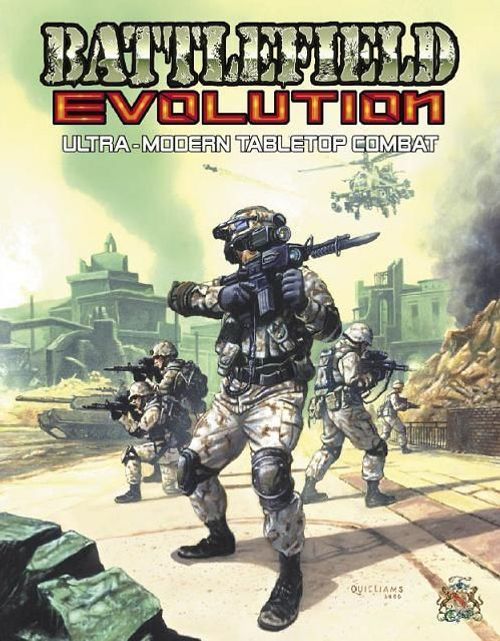
Battlefield Evolution: Ultra-Modern Tabletop Combat
Battlefield Evolution: Ultra-Modern Tabletop Combat Rulebook
Table of Contents
Table of Contents
Miniatures Gaming
Miniatures gaming is a hobby whereby players collect armies of model soldiers and vehicles, and then take part in games against like-minded opponents. Played on a table arranged with terrain ranging from open fields to burnt out city streets, miniatures gaming allow you to act as a general, directing your forces in a cunning battle plan designed to bring you total victory!
You can think of it as chess but;
- With freeform movement – you are not restricted to squares.
- With random elements - troops pinned down by enemy fire may be in real trouble, but the might surprise you and start fighting back.
- With far prettier models!
Using the rules of a miniatures game, and aided by a few models, some dice and a tape measure, you will be able to lead your armies across the battlefield, dodging a hail of incoming fire, before unleashing your finest troops against your enemy.
Battlefield Evolution
The Battlefield Evolution miniatures game is based on supposition and projection of real world armies in the near future, featuring new technologies that are just around the corner – you will be among the first to experience how such weapons and equipment can affect the modern battlefield from the point of view of a soldier. There are several different armies to collect, each with a wide range of units and tactical abilities.
Battlefield Evolution is usually played by two people over a table, with each in command of a single army, such as the Middle Eastern Alliance, European Federation Task Force, People’s Liberation Army or the United States Marine Corps.
Before the Battle
Once you have your army and an opponent, there are just a couple of things you need to do before battle can commence. You will need a flat playing surface, such as a kitchen or dining room table – though many players invest in a dedicated gaming table, complete with modelled terrain. You can find examples of such tables on our web site. You will also need several six-sided dice and at least one ten-sided dice.
Your playing surface should have plenty of terrain placed upon it – again, you can use piles of books or boxes to simulate buildings, walls and hills, though many players soon progress onto model houses, woods, factories, and so on.
Once the table is ready for play, you and your opponent should roll one dice each, re-rolling any ties. The winner chooses a long table edge and must then choose to set his army up first, and take the first turn, or set his army up second and take the second turn.
When setting up an army, each unit is placed no more than 12” from the long table edge.
This assumes the 6 ft. x 4 ft. gaming table. If you are playing on a table of a different size, the two armies should be no closer than 24” apart.
Playing the Game
A battlefield is a confusing place, with many things happening at once. In order to make sense of things, games of Battlefield Evolution take place over several turns. The player who set up his army first will take the first turn. In your turn, you will have a chance to move and fight with each unit you have on the table. Once you have finished, your opponent then has his turn to move and fight with his units. This continues until the battle is complete and a victor is declared!
Note that you may always ‘pre-measure’ distances in Battlefield Evolution, allowing you to check to see if an enemy is within range before making the decision to fire, for example.
Building an Army
An army can be as small as a single squad or feature over a hundred soldiers, supported by trucks, tanks and helicopters. Every unit in the game is assigned a points value, as shown on the unit card that it comes packaged with. As you collect units, add their points values together, as this will show you just how large and powerful your army is.
The points value of your army must be agreed on with your opponent before the game begins, with the value of your combined units adding up to no more than this amount. We recommend your first battles are played with forces of no more than 250-500 points each, though you can quickly scale up once you become used to the rules. Battlefield Evolution can be played with thousands of points on each side, making it a true battle game!
Unit Cards
Card Front
- Title: The name of the unit
- Faction: Which army the unit belongs to
- Unit Options: Any options the unit can take are listed here, along with any changes in its Value
- Value: The points value of the unit
- Materiel: Which models are included in the unit as standard
- Move: How far each model in the unit can move in a single Move action
- Close Combat: How many dice each model in the unit rolls when engaged in close combat. (2xD6, for example, means roll two six-sided dice, but do not total the result – each dice is treated separately)
- Size: The Size score of each model in the unit
- Armour: The number that must be rolled if a model in the unit is hit by an enemy
- Target: The number an enemy has to roll when making an attack against a model in this unit
- Kill: If this number is rolled when an enemy makes an attack against a model in this unit, the model is immediately removed, whether it has armour or not!
- Unit Type: This is used with the Battlefield Evolution Advanced Rulebook and can be ignored for now
Card Back
- Range: The maximum distance across which a weapon can be used to attack an enemy model
- Damage: The dice rolled when a weapon is used
- Special Rules: Many unit have special rules that allow them to do things in the game that other units cannot even attempt. Special rules allow you to do things not normally permitted in the rules!
Unit Leaders
Every unit in the game has a unit leader, as listed on its unit card. All models in the unit must end every action within 6” of their unit leader. If a model is ever more than 6” away from its unit leader, or if the unit leader is killed, then it will be out of command, losing its next two actions. Models that are out of command may only make reactions (see below). After two actions have been missed, you may nominate another model in the unit to become unit leader, so long as the original unit leader has been removed from the table. A unit leader of one unit may not act as unit leader of another.
Actions
Whenever you decide to do something with a unit in your army, it will have two Actions – every model in the same unit will perform the same action. There are four types of Action in Battlefield Evolution;
- Move: Allows the unit to walk, run or otherwise travel across the battlefield.
- Shoot: Allows the unit to begin gunning down the enemy!
- Charge: Allows the unit to rush into close combat to tear the enemy apart!
- Ready: Allows the unit to prepare itself to do something unusual, like take aim with a sniper rifle or plant a bomb. These require special rules found on your unit cards where applicable.
A unit can do any combination of two Actions. For example, a squad about to be overrun by the enemy might choose two Shoot Actions. Their friends trying to flank the enemy might choose two Move Actions, while another squad near the frontline might choose a Move Action followed by a Shoot Action. A unit must complete both of its actions before you can start making actions with another unit.
Let’s look at these Actions a little more closely.
Move Actions
Every unit in Battlefield Evolution has a Move score which shows how far it’s models can travel across the table, in inches, with a single Move Action. A model need not move in a straight line and can make any number of turns to face in any direction you wish. A British Army soldier, for example, can move 4”. Of course, if he takes two Move Actions, he can travel a total of 8” in a turn.
Terrain
Terrain in Battlefield Evolution is anything that is placed on the table that is not a model – this can be anything that is part of the landscape, such as buildings, woods, rivers, and hills. You will quickly find that the more terrain you use, the better the game, as your units will have a chance to leap behind walls and dodge behind buildings in an effort to avoid incoming fire. If you just play on a flat ‘desert’, you will soon discover your troops get mowed down by the first machine gun that gets fired!
Units moving through terrain will find their progress hindered. Whenever a model moves across terrain, halve its Move score (you may, optionally, agree with your opponent that some terrain, such as tall cliffs and high-rise buildings, is impassable and may not be moved through at all).
Shoot Actions
Simply moving about will not win you a battle – you have to destroy the enemy as well, and guns are always a good way of doing that!
Fire Zones and Line of Sight
Before you can shoot at an enemy unit, the models in your unit must have a Line of Sight to the intended targets. In all cases, Line of Sight is traced as a straight line from the centre of each of the firing models to the centre of what is called the Fire Zone (this need not be an enemy model, and can in fact be open ground, if it is advantageous in fitting more enemy models within the Fire Zone). A Fire Zone is simply a 6” radius – when you roll Damage Dice for your unit’s shooting, you can only attack models completely or partially within this Fire Zone that are also within Line of Sight.
All models in the unit must use the same Fire Zone.
Line of sight has three possible categories.
- Clear: No terrain (or terrain that does not block line of sight, such as a river or swamp) exists between attacker and target. No effect.
- Obscured: Terrain interrupts Line of Sight but both models can still partially see one another (that is, terrain hides part of the target model). The target gains a +1 bonus to its Target score.
- Blocked: Terrain interrupts Line of Sight so neither model may see the other. No Line of Sight possible.
Note that attacking models within the same unit will never block or obscure Line of Sight for each other – effectively, you can shoot ‘through’ models in the same unit, as it is assumed they will manoeuvre out of the way of one another. However, models not in the same unit can block or obscure Line of Sight.
Every model with a weapon can use it to attack any enemy that it can see and is within range (range is measured to the centre of the Fire Zone, not to each enemy model within the Fire Zone). Each model can only use one weapon in a Shoot action, no matter how many weapons it possesses.
The standard L85A2 assault rifle of the British Army, for example, has a range of 24”. Every gun also has a set number of Damage Dice, which are rolled to see if a target has been hit – the L85A2 uses one six-sided dice (some very powerful weapons, such as machine guns or cannon use several six-sided dice or even ten-sided dice!).
Cover
Cover in Battlefield Evolution is any piece of terrain that models may move through and still have Line of Sight drawn to them. This includes low walls, woods, hedges and ruins.
Cover will help your units survive incoming fire by making them harder to hit. A model has to be touching (on the opposite side of the terrain to the firing model) or within suitable terrain to take advantage of Cover. Otherwise, the terrain can only obscure or block Line of Sight (see above).
For the purposes of Line of Sight, a firing model may ‘see through’ any Cover within a number of inches equal to its Size score. It may also ‘see through’ any Cover within a number of inches to the target model that is equal to the target model’s Size score. Models, if within terrain, may always claim Cover rather than just have an obscured Line of Sight.
Cover grants a +2 bonus to both Target and Kill scores against shooting attacks. A model can benefit from Cover or obscured Line of Sight, never both.
Shooting
Roll Damage Dice for your entire unit. Discard all Damage Dice that roll a natural ‘1’. These represent missed shots or ammunition jams.
The highest scoring Damage Dice must be allocated to the nearest model within the Fire Zone, the next highest scoring Damage Dice to the next nearest model, and so on. If all models within the Fire Zone have been allocated a Damage Dice, then you are free to allocate any remaining Damage Dice to models as you see fit.
Note that friendly models within a Fire Zone are potential targets as well! However, a model may never be caught within a Fire Zone that it helped create itself (in other words, models cannot shoot themselves!).
All models have two scores which you need to aim for when attacking them – a Target score and a Kill score. If you roll equal to or greater than the model’s Kill score, it is automatically removed from the battlefield. You have dealt it a grievous injury or even killed it outright!
If you merely roll equal to or more than a model’s Target score, then it will have a chance to use its Armour to protect itself. Your opponent must roll one six-sided dice and score equal to or greater than his model’s Armour score in order to survive. A roll of 1 for Armour is always a failure.
Suppression
Another important factor in modern warfare is Suppression. When the bullets start flying, even the most hardened troops have a tendency to keep their heads down!
If a unit is allocated at least as many damage dice in a single Shoot action as it had models then it will immediately lose its next action, and may only Move as a reaction. If this happens more than once during a single turn, it will lose a total of two actions. A unit may never lose more than two actions from Suppression.
Charge Actions
If an enemy is in Cover, he can be very hard to defeat – sometimes, you might find it useful to simply charge and root him out with close combat!
When a Charge action is made, you move your models up to their Move score towards an enemy unit. If you succeed in touching an enemy model with one of yours, they immediately fight in close combat.
Roll your model’s Close Combat dice, as shown on its unit card. You can potentially attack as many enemy models as you have Close Combat dice, so long as your model is touching them. As with shooting, if you beat your enemy’s Target score, you will force an Armour roll. If you beat its Kill score, you will destroy it outright. Discard all Close Combat dice that roll a natural ‘1’.
After close combat has been completed, move the model with the smallest Size score 2” directly away from the other. If both models are the same Size, move the model that was attacked 2” directly away. The model that was attacked, if it survives, may now react as normal.
Reactions
What makes Battlefield Evolution different from many other miniatures games is that units get to react to enemies who get too close. After all, if you saw several enemy soldiers charging towards you, you would not wait around to get beaten up, and if you are playing a game, you don’t want to hang around for twenty minutes or more while your opponent moves all his models – you want to play as well!
Reactions in Battlefield Evolution allow you to take an active part in your opponent’s turn, and they may just save a few of your units from certain death. Whenever an enemy unit completes an action within 10” of any model in one of your units, the entire unit may immediately make a free Shoot or Move action. You may move in any direction but any shooting must be aimed at the unit that caused the Reaction.
You may also react when you get shot at! Whenever an enemy unit completes a Shoot action against one of your units, that unit may make an immediate Move or Shoot action. If a Shoot action is taken, it must be against the enemy unit that triggered the reaction.
A unit may only make one Reaction in every turn, no matter how many times an enemy moves close by or shoots it. If a unit is in cover and is reacting to a Charge action, it may make the Reaction after the target has moved but before any Close Combat dice are rolled.
Finally, you can never react to a Reaction!
Facing
The majority of units on the modern battlefield are fast-moving and agile. In most cases, you do not need to worry about which way a model is pointing when you move it, as it is assumed it can turn quickly enough to face any threat.
Some models (such as armoured vehicles) have special rules that require you to know how it is facing. You will find that some units can only fire weapons into one facing. If a unit has a weapon that is Front facing, for example, it cannot target models that are to its Rear or Sides. Alternatively, if an enemy is within the Side or Rear facing of an armoured vehicle, he may be able to take advantage of weaker armour. Your unit cards will tell you whether this applies to any of your units. Each of the facings is a 90 degree arc measured from the centre of the model.
Victory and Defeat
Once an army has been reduced to a quarter of the number of models it started with (rounding down to a minimum of one), it is immediately Shattered. When working out whether your army has been Shattered, you may only count models that are actually on the table – models that have not yet been deployed (normally because of special rules that apply only to them) are not counted. Models carried by other models that are on the table such as in transport vehicles) are counted as normal.
A Shattered army has lost the battle, and its units can be assumed to either be wiped out or fighting hard to retreat. The opponent gains bragging rights.
Advanced Rules
If you have enjoyed playing Battlefield Evolution using this rules sheet, be sure to look out for the Battlefield Evolution Rulebook – a meaty hardback that continues lots of advanced rules, including more detailed terrain, full platoon army lists, artillery, aircraft, scenarios and much more.