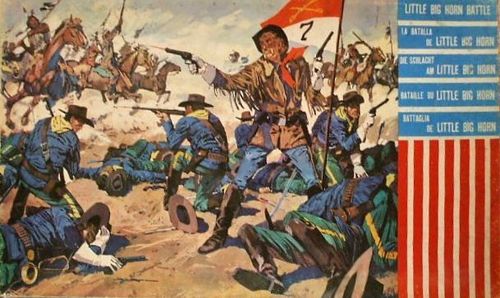
The Battle of the Little Big Horn
The Battle of the Little Big Horn Rulebook
Table of Contents
Table of Contents
- 1. Battlefield
- 2. Placement of the Combatants
- 3. Start of Play
- 4. Movement
- 5. Squares Threatened by the Enemy
- 6. Squares Occupied by the Enemy
- 7. Battle
- 8. Retreat in Combat
- 9. Obstacles Protecting from Enemy Fire
- 10. Combatants Holding an Advantage in Combat
- 11. Successive Turns
- 12. End of the Battle
1. Battlefield
The game board is divided into squares (cases) across which the combatants move in any direction, engaging in combat when they come within range of the enemy.
The board shows: the battlefield proper, with woods, rocks, parapets formed at the centre of the field by dead horses and wagons (caissons), and a river (fordable and non-fordable). Places on the river where there is no ford can never be crossed or occupied by the combatants. Infantry may move over all other squares. Indian cavalry may move only over squares that bear neither woods nor rocks, and over the fords of the rivers.
Each square contains a triangle indicating its starting position.
2. Placement of the Combatants
At the start of the game the combatants are placed on the triangles, one per square for the initial move:
- The Long Knives and the flag are placed on the blue triangles.
- The Plains Indians are placed on the red triangles, and each of the Indian cavalry is placed on a red triangle marked with a horse's head.
After the start, each square may at any time be occupied by:
- Three, two or one infantryman (except on squares of the non-fordable river).
- Two or one cavalryman (except on rocks, woods and the non-fordable river).
- A cavalryman and an infantryman together on the same square.
At no time during the game may there be more combatants on a square than the numbers indicated above.
3. Start of Play
Once the two opposing groups are placed in combat position on the battlefield, the Long Knives begin the game.
4. Movement
The player whose turn it is may move in any direction all or only part of his combatants, according to the following rules:
- Infantry may move onto any adjacent square, except squares on the non-fordable river (they may never advance more than one square at a time).
- Cavalry may advance three, two or one adjacent squares, one after another (except onto woods, rocks and the non-fordable river, squares on which cavalry may not be placed).
Where a player judges a move inopportune, he is not obliged to move any troops.
Remember: all the soldiers of a clan may be moved during the same turn, and movement is always over adjacent squares, that is, squares that touch one another at any point.
Movement of the Flag
The flag may be moved only by a soldier, and may never be moved alone.
5. Squares Threatened by the Enemy
Combatants may advance even within firing range of enemy weapons, but they must stop on any square adjacent to a square occupied by the enemy, and engage in combat during the combat phase that follows the movement phase, once the movement phase is finished.
6. Squares Occupied by the Enemy
These squares may be occupied only through combat, according to the result of the dice which determines each individual encounter (see the chapter "Individual Combats").
7. Battle
A player may engage in combat once the movement of his troops is finished, if some of his combatants hold the enemy within firing range with their weapons. Combat then proceeds as follows:
Firing Range
Firearms can reach any enemy located 3 squares away from the shooter.
Indian cavalrymen armed with tomahawks can reach only enemies on an adjacent square.
General Custer and his officers, whose firepower is greater than that of the other combatants, may fire two consecutive shots each turn when they have the enemy within firing range.
Individual Combats
All combatants who, during the same turn, are within range of their respective weapons may fire, throwing the dice that decide the result of each individual encounter.
The player who made the last movement of troops designates the opponent at whom each of his soldiers opens fire. It is recommended to turn one's back to the enemy, and to the soldiers as they fire, so as to know which ones must still open fire.
Under no circumstances may a soldier open fire twice in succession during the same turn. On the other hand, several soldiers may fire one after another at the same enemy; that enemy may return fire only once, and in all other cases the outcome is left to the dice.
Those who are in melee (corps à corps) have priority in engaging combat, that is, those located on two adjacent squares. Their outcome must be decided first, and only afterwards that of the enemies located on more distant squares (but always within firing range).
In a melee, the victor may occupy the square of the vanquished (cavalry may never occupy woods or rocks).
It is only compulsory to respond to an attack or to enemy fire in the case of melee. When fire is opened at a distance (that is, at 2 or 3 squares), the player may hold the fire of his combatant for a moment he judges more propitious. However, if the enemy, opening fire, has obtained with the die the sufficient number of points (6), that enemy eliminates the combatant, or may make him fall back (with a 5 or a 4).
Once all the combatants of the same player who made the last movement have fired, the combatants of the other player who have not yet opened fire may fire in their turn, if that player judges it opportune.
How to Determine the Winner of an Individual Encounter (under equal conditions)
Each player rolls the die, and the one who obtains the higher number of points is the winner.
- With a 6, the winner eliminates the enemy on the spot.
- With a 5 or a 4, the winner pushes the enemy back onto an adjacent square of the winner's choice.
In the case of a tie, the pieces of the opponents do not move.
When the results obtained by the two players are 3, 2 or 1, the players are considered to have missed their shot, and the situation remains unchanged.
Remember: if the enemy fired upon is not in a position to reply, the outcome of the encounter depends on the result obtained by the die of the side that opened fire.
8. Retreat in Combat
A retreat is always made onto an adjacent square opposite the direction of the shot that caused it (it is enough that only one point of that square is slightly further back than the one previously occupied).
Where there is a choice between several squares, the victor decides the square onto which the vanquished must fall back.
If the combatant obliged to retreat is not able to do so, because he cannot enter any available square, he is eliminated immediately from the game.
A combatant who is obliged to retreat in combat may not take the flag with him.
9. Obstacles Protecting from Enemy Fire
Combatants are under cover from enemy fire when a square of rocks or of woods stands between them, such that any shot would necessarily strike the obstacle in vain. In that case no fire is possible (pas de tir possible).
In other cases, one may fire, for example over the river, whether it is fordable or not, counting the river as one additional square.
10. Combatants Holding an Advantage in Combat
If combatants hold bonus points, each player adds them to the number obtained by rolling the die, and the total decides the outcome of the encounter between the two opponents.
Bonus Points
- Cavalry in melee (corps à corps): 1 point.
- Infantry in a small wood (bosquet): 1 point.
- Infantry in rocks: 1 point.
- Infantry on squares serving as parapets inside the camp: 1 point.
Remember: it is the totals that decide. For example, a die roll of 2 plus 1 bonus point gives 3; a roll of 3 plus 1 gives 4; a roll of 5 plus 1 gives 6.
11. Successive Turns
Once a combat turn is finished, the game continues with a movement turn, which is in turn followed by a combat turn, and so on.
If there is no combat, the movement turns simply alternate.
12. End of the Battle
The game is won:
- By the Long Knives, either if they succeed in eliminating the three Indian Chiefs (that is, the cavalrymen armed with a rifle), or by placing the flag on either of the two squares indicated by a blue arrow.
- By the Peaux-Rouges, either by eliminating General Custer and his officers, or by conquering the flag, that is, by entering the square on which it stands (it being understood that no American soldier is on that square).
Any other result gives rise to a draw (match nul).