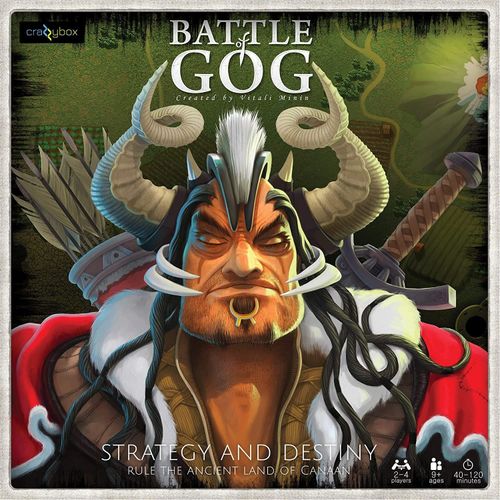
Battle of GOG
Battle of GOG Rulebook
Table of Contents
Table of Contents
Contents
Battle of GOG contains the following components:
- Treasure cards x24
- Barn cards x4
- Ability cards x9
- City dice x12
- Soldier dice x40
- Map tiles x36
- Scrolls x5
- Resources x84
- Aid cards x4
- Rolling dice x2
- Gog figure
- Angel figure
Winning the Game
Battle of Gog is played over a series of rounds until at least one of the three winning conditions has been achieved by any player:
- Variant 1: Conquering all other player's cities. Variant 2: Conquering the last city of any of the players.
- Placing a soldier at each of the 4 corners of the map. A city in the corner considered a soldier.
- Obtaining all 5 Scrolls.
The game ends immediately as one of these conditions is met.
Game Setup
In Battle of Gog, the bottom of the box is used as the game board.
- Open the box and remove all components and the black foam separator (leave the plastic tray inside).
- Close the box back and flip it over - that is the game board.
- Shuffle the map tiles and place them face down.
- Shuffle the treasure and ability cards separately and place them face down near the game board in 2 decks.
- Set the barn cards and the resources near the game board.
- Each player chooses a color to play, taking all the respective dice and an aid card.
- Each player choses a corner of the board to start from (in 2 player's games, each player choses two corners).
- Randomly determine the first player.
- Starting with the first player and going clockwise, each player takes one map tile and places it according to the following rules:
- Within the grid marked on the board.
- If the tile has water slots, it must be placed so the water slots is touching another tile's water slots (not diagonally). If such a thing is not possible, ignore this rule. This continues until the entire map is assembled.
- Each player places 3 level one soldiers on the 3 slots nearest to their corner (in 2-player's games, players can distribure their 3 soldiers among their two corners as they see fit).
The starting player places Gog and the Angel on 2 of the 4 slots at the center of the map in whatever way they decide.
Starting position example for 2 players (figure in the rules leaflet).
Playing the Game
Battle of Gog is played turn by turn, starting with the first player and continuing clockwise until a winning condition is met. The active player follows 4 phases in the following order:
- Gathering and trading resources
- Buying upgrades
- Playing treasure cards
- Rolling the dice
In the first few turns of the game, there will be no cities, so no resources can be collected. Hence, skip the first three steps and go to phase 4 - Rolling dice.
Phase 1 - Gathering and Trading Resources
After a player has founded at least one city, that player begins collecting resources each turn in this phase. There are 3 types of resources you can get from the map's slots: gold, food or wood. Level 1 cities have a 3X3 gathering area and level 2 or above cities have 5X5 gathering area around them.
All connected forest slots (including diagonals) are considered just as one wood source. Any resource located in the gathering area of 2 or more friendly cities at the same time will only count as one resource.
Resources from slots outside the gathering area and occupied by friendly soldiers are gathered as well. Soldiers occupying a slot within the enemy gathering area will collect the resource and prevent the enemy player from collecting it.
All eligible resources must be collected during this phase. A player may never have more than 5 resources of each type (unless they have an upgraded barn card, increasing the limit to 6 or 7 respectively).
The leaflet's Phase 1 icon key shows which map slot icons yield each resource (the icons are shown as pictures; their words here are descriptive, read from the artwork):
- Food: bison, grain, fish, game bird
- Gold: gold nugget
- Wood: forest
Phase 2 - Buying Upgrades
The active player can spend resources as following:
- Buy a soldier = 2 food (must be placed next to a friendly city)
- Upgrade a soldier to Level 2 = 2 wood
- Upgrade a soldier to Level 3 = 2 gold
- Upgrade a soldier to Level 4 = 2 food
- Upgrade a soldier to Level 5 = 2 wood
- Upgrade a soldier to Level 6 = 2 gold
- Upgrade a city = 2 food + 2 wood + 2 gold
- Upgrade barn to 6 or 7 = 2 food + 2 wood + 2 gold
- Buy a scroll = 5 gold
- Buy an ability card = 2 food + 2 wood + 2 gold (or 1 scroll)
A high-level soldier can be purchased according to the total price of all levels in one purchase, for example: a player can buy a level 3 soldier for 2 Food + 2 Wood + 2 Gold.
Phase 3 - Playing Treasure Chest Cards
If a treasure chest is located in one of the friendly cities` gathering areas, or one of the friendly soldiers is standing on a treasure chest slot that is outside of a city area - the player may draw a treasure card for each instance of the above. After draw a treasure card, the active player must roll one die. If the outcome is odd - the player chooses to apply the effect of the card on him or herself, but if the number is even - then the card affects all other players.
An example: if a player draws a "Scroll" Treasure Card and then rolls a dice with an even number - all other players will receive a scroll. (If there are not enough scrolls, they will be distributed according to the direction of the turns). However, if the player who draws the treasure card rolls an odd number they can can choose to accept or cancel the effect of the card if they wish (to avoid negative effect on themselves).
Phase 4 - Rolling the Dice and Moving Soldiers
Each small die represents a soldier. At the beginning of the game each player can move 7 steps in total. Once a player has established their first 3 cities, the amount of steps they can take in each subsequent turn is determined by throwing dice. The sum of the dice is the maximum number of steps players can move.
If player got a double it triggers a special action:
- 1:1 or 6:6 - Gog - (also move Gog).
- 2:2 or 5:5 - The Angel - (also move the Angel).
- 3:3 or 4:4 - Ability card - (draw an ability card).
The player can choose to roll the dice again to improve the outcome, but then must stay with the second result. Soldiers are allowed to walk in any direction including diagonally.
The main task of the first 3 soldiers is to found 3 cities (as detailed in the city foundation rules). Before a player founds 3 cities, their soldiers are allowed to walk on any slot including water slots. After the foundation of a players third city, only Level 3 soldiers and above are allowed to walk on water slots.
Founding a City
Selecting the location of the cities is strategic and significant, since resources can be collected from surrounding slots. A city is founded by guiding a soldier to a desired location, declaring the foundation of a new city and replacing the small soldier die with a large city die.
Cities can only be found in non-water squares with no resources and icons. Cities also need to be 2 or more squares away from other cities (diagonals included). Cities must be at least 2 slots away from other cities (diagonals included).
City level defines it`s defensive powers. Any soldier at any level can found a city, but the city will always be founded as a level 1 city.
Fighting
A soldier moving to a slot with an enemy soldier will battle it. The winner remains on the square, while the loser is removed from the board.
If the soldiers are at different levels, the higher level soldier wins, and its level is reduced by the level of the losing soldier. For example: a level 5 battling a level 3 becomes a level 2.
If the soldiers are at the same level, both players roll a die. The highest rolling player wins and gets to stay on the slot keeping the same level.
After the battle, the winning soldier cannot move. The player can make the remaining moves with other soldiers.
Treasure Cards
When a treasure card is drawn, its effect is resolved as described in Phase 3. The treasure deck is made up of the following cards:
Upgrade soldiers
- Upgrade 3 soldiers 3 levels up.
- Upgrade 3 soldiers 1 level up.
- Upgrade soldier 5 levels up.
- Upgrade soldier 1 level up.
Return resources and soldiers
- Return 1 soldier to the stock.
- Return 1 of each resource to the stock.
- Return 3 of each resource to the stock.
- Return 3 soldiers to the stock.
Barns and cities
- Get a Barn 6 card or upgrade to Barn 7.
- Upgrade a city 1 level up.
- Downgrade a city by 1 level.
Movement
- Send a soldier to one of the corners.
- Move Gog or Angel 7 steps. (Two cards.)
- Send 3 soldiers to forest.
If a card sends a soldier to the forest or to the corner of the map and this slot is already occupied by an enemy soldier then a battle will take place.
Gaining resources
- Get 1 food.
- Get 3 food.
- Get 1 gold.
- Get 3 gold.
- Get 3 wood.
Ability cards, scrolls and cards from other players
- Return one ability card to the stock.
- Take one card from one of the players.
- Get one ability card.
- Get a scroll.
Conquering a City
In order to conquer an enemy city, 3 soldiers with the same level as the conquered city level must surround the city at the same time.
Every soldier that took part in a conquest of the city will be go up 1 level. A player immediately loses if all his cities are destroyed, even if he has soldiers left on the board. The conqueror player takes a scroll from the stack. If there are no scrolls remaining in the stack, he takes one from another player.
Gog
Gog can be moved if the dice rolls at 1:1 or 6:6. For example, if 6:6 is rolled, the player can take up to 12 steps with Gog, and in addition take 12 steps with the soldiers. As part of the steps, the player aims to move Gog so that he touches one of their own cities. If successful, they will be able to fill all resources to there current maximum, and Gog will also be able to protect the city from the Angel or city occupation. When Gog touches the city it cannot be conquered.
Angel of Retribution
Angel of retribution can be moved if the dice rolls at 2:2 or 5:5. For example: If a 5:5 is rolled, the player can take up to 10 steps with the soldiers, and in addition he can take 10 steps with the Angel. As part of the steps, the player aims to move the Angel so that he touches one of the enemy players' cities. As long as the Angel remains standing near the city, resources cannot be collected from it. There are 2 ways to neutralize the effect of the Angel:
- If a player rolls 5:5 or 2:2, then moves the Angel away from the city.
- If a player has been able to move the Gog and touch the same city, the effect of the Angel will be countered and neutralized.
Gog or Angel also can be moved if a Gog/Angel treasure card is drawn.
Scrolls
Scrolls are the key to victory, and can be obtained in the following ways:
- Resolve a treasure card with a scroll effect.
- Buy a scroll in Phase 2.
- Conquer a city.
Every time a player obtains a scroll, they take one from the stack. If there are no scrolls remaining there, they take it from another player of their choice. If the scroll slot is player`s city gathering area, the player will receive one scroll that cannot be taken from him. Only if the city is destroyed - the scroll will be returned to the stock.
Special Slots
- Camel squares occupied by soldiers or located inside players gathering area, allow their player to exchange resources with the stack during Phase 1 (one exchange per camel per turn).
- Ruin squares occupied by soldiers make their level count as +1 (up to a maximum of 6).
- Volcano squares occupied by soldiers are immune to battles. Enemy soldiers cannot move there.
- Water squares occupied by soldiers suffering a level drop to below 3 eliminate them. Remove eliminated soldiers from the board.
Ability Cards
Ability cards give players special abilities, and can be obtained in the following ways:
- Resolving a treasure card that gets you an ability card
- Buying an ability card in Phase 2
- Rolling a double 3 or 4 in Phase 4
- Winning the first battle (once per player)
The ability cards are:
- Defense: Increases the defense of cities. To conquer player
s city, enemy troops will be required to be at least 1 level higher than the city level. For example: if players city is at level 2 - it will take 3 soldiers at level 3 to conquer it (instead of 3 soldiers at level 2). - Wisdom: Allows the player to spend resources regardless of their type, as long as it is within the required quantity.
- Magic: Allows the player to move Gog or the Angel up to 7 additional steps when moving them.
- Ambush: Allows the player to add a soldier anywhere on the board, rolling a die to determine its level. Once used, this ability card returns to the bottom of the deck.
- Abundance: Allows the player to collect one additional resource of each type during Phase 1.
- Water: Allows soldiers at any level to walk on the water slots with unlimited steps (no matter how many water slots they move it still count as the same one step they made to get on the first water slot). When moving from water back to the ground, you can continue the remaining amount of moves.
- Power: Raises all the player's troops one level, plus when buying a new soldier - it will be one level higher than paid.
- Strategy: Allows the player to conquer an enemy city with only 2 soldiers.
- Speed: Allows the player to move their soldiers up to 5 additional steps during Phase 4.
Barn Cards
- Barn 6 allows player to accumulate up to 6 resources of each type.
- Barn 7 allows player to accumulate up to 7 resources of each type.