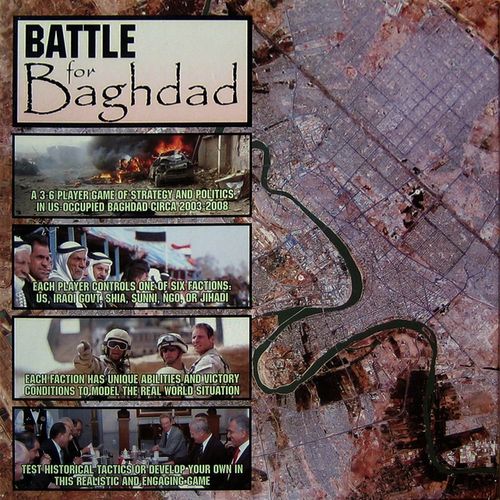
Battle for Baghdad
Battle for Baghdad Rulebook
Table of Contents
Table of Contents
Introduction
Description
Battle for Baghdad is a game for three to six players, each controlling a Faction vying for control of the city of Baghdad. Players have a wide range of military, political and infowar resources which they use to fight each other and seize their objectives. The game takes approximately two to four hours to play.
Components
Faction Screens
Each Faction has a screen. This is a tent-like structure that presents the Faction name on the front, and the special rules and abilities of the Faction on the back.
Take the Faction screen for your respective Faction, and place it in front of you, with the front towards the map, and the back towards you, for easy reference.
The numbers of cards, counters, or markers possessed is open for all players to inspect at any time.
Each player has a hand of Arms Bazaar cards. While all players are permitted to know how many Arms Bazaar cards form the hands of the other players, they may not see the types of these cards unless a game effect gives them this ability.
Faction screens contain all of your special rules and victory conditions, and are available for review by any player at any time.
Players should fold their respective Faction screens in the fashion shown in the rulebook diagram. The screens sit on the table in front of their owners like nameplates. Players may wish to use paperclips to pin together A and B as shown in the diagram, if needed, to help their screens stand up. This shouldn't be necessary, but makes a more rigid structure.
Faction Colors
- Shiite Iraqis (Blue)
- Sunni Iraqis (Red)
- Iraqi Government (Purple)
- United States (Green)
- Jihadists (Black)
- NGOs (Gold)
Command Cards
Each Faction begins with five Command cards. Each Command card represents a specific headquarters and its respective infrastructure. The color of a Faction's Command Cards match the Faction's color. Each Command card has a numeric Command value and a Command Type (Conventional or Unconventional).
If a Faction engages in combat, it must allocate one of its Command cards to the combat, if it has one.
If a Command card is allocated to a Combat, its Command Value is added to the value of any forces that Faction also committed to the combat.
Command cards can be Neutralized by the successful play of an Offense card by the enemy in Combat.
Map of Baghdad
Place the map of the city of Baghdad in the center of the table. The map is composed of 23 Zones. Each Zone has a Political Point value and a name.
Each Zone name is printed in a color matching the color of a specific Faction. Some Zone names are grey. These are contested and have no basic loyalty to any Faction.
If a Zone's name appears in a Faction's color, that Zone is affiliated with that Faction. This has occasional impact on play, including where a Faction can spawn units and what Zones a Faction must control for Victory.
Some also have symbols to indicate whether the Zone is an Airport, whether it is Fortified, or whether it is a Sanctuary.
If the United States, NGO, or Iraqi Government player controls an Airport Zone, that Faction can use Airborne Movement. Other Factions may never use Airborne Movement.
Units defending the Fortified Zone are increased in combat power.
Forces may never combat each other in the Sanctuary Zone. Otherwise, all Zones are open to combat.
Cheat Cards
The six Cheat cards provide helpful reminders for players. The Combat sides are used by Factions involved in battle and provide a checklist of how to resolve combat.
The other sides are used to provide reminders of what the other Faction's special Victory Conditions are. Players are encouraged to pay attention to this to help prevent a sneaky opponent from too easily pulling out a win.
Arms Bazaar Cards
Arms Bazaar cards compose players' respective hands. Each Arms Bazaar card has at least one function, described in a paragraph of text on the card itself.
The maximum number of Arms Bazaar cards that a Faction may possess is recorded on the back of that Faction's screen.
If an Arms Bazaar card instructions contradict other rules in the game, then the Arms Bazaar text takes precedence.
Some Arms Bazaar cards have symbols in the upper right-hand corner. Bullets represent Offense and Shields represent Defense cards. Offense and defense cards may only be played in combat.
Some other Arms Bazaar cards contain the Connections, Hearts and Minds symbols in the upper-right hand corner (see the Glossary).
Played individually, cards containing these symbols have no special effect on the game, other than what is printed on them. Played in specific combinations, they have very powerful alternative effects. Combination effects replace individual card effects.
The combination effects shown on the rulebook page are:
- Play during your Movement step. Select an opposing player to show you all the Arms Bazaar cards in his hand. Pick two of that player's Arms Bazaar cards and place them in your hand.
- Played at the start of the Initiative Phase. Instead of the normal Initiative bid, you take it automatically. In addition, immediately draw an extra Arms Bazaar card. If multiple players conduct a Political Maneuver, the last play wins. It's a game of Chicken.
- Play during your Movement step. Create a Defection. See the Defection rules in the Glossary for more information.
Generally, whether played singly or in combinations, Arms Bazaar cards are discarded when played. See the Combat rules for an exception. Note that wording on the cards is gospel. At any time when there is an opportunity to gain new Arms Bazaar cards, cards from a player's hand can be discarded to make room if that player desires. Maximum hand size may never be exceeded.
Arab Street Cards
Arab Street cards describe the challenges faced by the Baghdad population, and the resulting Political opportunities for assisting the local populace in meeting those challenges for the Factions.
Most Arab Street cards place Political Points into specific Zones on the map. This placement represents the growth of unrest in that Zone caused by unmet needs for security, water, electricity, etc. Specific instructions are written on each card.
Other Arab Street cards represent special events such as Elections.
Twenty-Sided Dice
The game uses 20-sided dice.
Unlike most wargames, the dice are not rolled to generate random numbers. Players use these to show force commitment levels in combat from 0 to 19. The "20" face represents a zero, and indicates a commitment of no units.
Faction Counters
Each Faction begins with approximately 30 counters of their respective color. The actual number varies between Factions.
About half of the counters are Security forces and half are Infrastructure.
Security units costs two Political Points each to Recruit, and can move around the map. Each Security unit can collect one Political Point in any Zone it occupies that also contains Political Point markers during any Civic Action phase.
Infrastructure units cost one Political Point each to Recruit. Infrastructure units may not move. Each Infrastructure unit can collect three Political Points in any Zone it occupies that also contains Political Point markers during any Civic Action phase.
Political Point Markers
The white markers with numbers from one to five printed on them represent Political Points, and act as currency in the game.
They are typically placed upon the map via Arab Street cards, but are also rewarded to the victor in combat, or for play of certain Arms Bazaar Cards.
Once placed on the map, Political Point markers may not move, though players can collect them, trade them, and use them for other specified game functions.
The Glossary
Many important game functions and terms are explained in the Glossary at the end of the rules. Players should read the Glossary thoroughly before beginning play of the game. Note that there are a few rules there not found anywhere else.
Game Setup
Map
Place the map face-up in the middle of the playing surface.
Shuffle the Cards
Shuffle the Arab Street cards and place them in a single stack in the appropriate box on the map.
Shuffle the Arms Bazaar cards and place them in a separate stack in the appropriate box on the map.
The Bank
Set all of the Political Point markers in a pile (the Bank) alongside the map. Players can take Political Point markers from the Bank or place Political Point markers in the Bank in accordance with the rules. Political points that have been expended are placed back in the Bank.
Select Factions
Select Factions from the table, below. The Factions that play are based upon the number of players.
| Number of Players | Factions in Play |
|---|---|
| Three Players | Shiite, Sunni, Iraqi Government |
| Four Players | Add United States |
| Five Players | Add Jihadists |
| Six Players | Add NGOs |
Players randomly select which Factions they will play. Take one counter from each Faction in play, and conceal them in a cup. Each player randomly draws one, and takes control of the Faction represented on the counter.
Alternatively, players may deliberately select which Factions they will play.
When a player determines his or her Faction, that player then takes possession of that Faction's counters, Command cards, and Faction screen.
Seating and Play Order
Note that faction order and seating order are not necessarily the same. Some game functions are performed in faction order, some are performed sequentially around the table, counter-clockwise.
Starting Forces
Each Faction begins the game with some units on the map, some Political Points in their possession, and some Arms Bazaar cards in their hand. All specified starting units must start on the map.
Each Faction places its Starting Forces units on the map in Affiliated Zones, in the order that the Faction appears in the Select Factions table, above. (The Shi'ite player always places all units first, followed by the Sunni, Iraqi Government, US, Jihadist, and finally the NGO player.)
Arms Bazaar cards are drawn randomly.
How to Play
Sequence of Play
The game is played in series of Turns. Each turn is composed of a specific number of discrete phases carried out in a specified order.
General Course of Play: During the first phase of each turn, players ascertain which Faction has the Initiative. The player controlling the Faction with Initiative selects one Faction to act first in each Phase for the remainder of the current turn. The player may choose any Faction, including his own.
Players execute each Phase in the Sequence of Play before moving to the next Phase. Phases may not be executed out of sequence or skipped.
After the First Player acts during each Phase, the remaining players take their actions, one at a time, in counter-clockwise order around the table.
The Sequence of Play appears on the Map for ease of reference.
Initiative Phase
In Battle for Baghdad, winning Initiative does not mean that you act first per se. It does mean that you choose who acts first. You can choose yourself, but do not have to.
On the first turn, the Shi'ite player bids first for Initiative with the other players following. On the second and subsequent turns, the player who won the Initiative on the previous turn bids first.
To determine initiative, the first player verbally bids a number of Political Points from zero to the total he possesses. The player to his or her right can then pass (making no bid), or bid more than the current highest bid.
This process repeats itself around the table as many times as necessary until all players but one have consecutively passed. A player may pass in one round then bid in a subsequent round. To win initiative, all players must have had the opportunity to bid and have passed on the high bid.
Every player must pay to the Bank the number of Political Points he bid. Those who passed every time pay nothing.
The player who bid the highest wins the Initiative.
If no one bids for Initiative, the first player who could have bid wins the Initiative at no cost.
The player who wins Initiative selects one player to be First Player for the rest of the current turn. That player acts first in every Phase of that turn.
In a given Phase, play passes counter-clockwise around the table.
Arab Street Phase
One player turns face-up three Arab Street cards. This can be any player. It does not make a difference.
Cards are drawn from the top of the Arab Street deck.
Cards are turned up one at a time, slowly, and resolved completely before the next card is drawn. Some Arab Street cards, and the play of select Arms Bazaar cards, can stop further Arab Street card draws.
In most cases, each Arab Street card places Political Points in one or more Zones. In this case, take the designated number of Political Points from the Bank and place them in the designated Zone.
Other Arab Street cards direct players to take specified actions.
Arms Bazaar Phase
Each player has a maximum hand size printed on his Faction panel. If taking a card will put a player over the limit, the player must discard a card to make space.
The First Player (as determined by the player who won Initiative during the Initiative Phase) draws a number of Arms Bazaar cards from the top of the deck equal to the number of players.
The First Player examines the cards without showing them to the other players. He then selects one, places it in his hand, and passes the rest to the player to the right.
That player selects one card, places it in his hand, and hands the rest to the player to the right.
This process continues until all players are able to select a card. A player is never required to take a card. Discard cards not taken.
If the last card of the Arms Bazaar deck is taken, reshuffle the deck and resume play.
Coalition Phase
During the Coalition Phase, players may make deals that involve the exchange of cards, Political Points, or other arrangements such as alliance to accomplish some specific goal. We have left this vague on purpose in order to allow players a free application of creativity here. So long as the rules are no violated, players may make any agreement that they wish. Any agreement made during this phase is considered binding until the next Coalition Phase.
Action Phase
Every player's Action Phase is composed of a Recruit Step and a Move Step.
Recruit Step
The acting player may purchase as many units and/or Arms Bazaar cards as he can afford and in accordance with the rules below.
The player pays one Political Point per Infrastructure unit, and two Political Points per Security Unit.
Players may not purchase counters in excess of the printed counters provided with the game.
The Phasing player places (spawns) Purchased units on the map.
The player may only Spawn Infrastructure units in Affiliated Zones, Zones his Faction Controls with at least one Security, or Zones listed as Spawn locations on his Faction Screen.
The player may only spawn Security units in Affiliated Zones, Zones his Faction Controls with at least one Infrastructure, or Zones listed as Spawn locations on his Faction Screen.
Units may be spawned in Affiliated Zones or Zones listed as Spawn locations regardless of who controls them. (For example, the US player could spawn units in the Green Zone even if it is occupied by Jihadist units.)
The player can purchase a Neutralized Command card by paying a number of Political Points equal to twice its combat value. This restores that Command card to his possession. The player can purchase more than one Command card per turn if he has the Political Points. A player may not purchase Command cards belonging to other Factions.
The player may also purchase the top card from the Arms Bazaar deck at a cost in Political Points equal to the number of Political Points bid by the winning player for Initiative.
If no players bid for Initiative, then the cost per card is one Political Point.
The player can buy cards up to his Faction's Maximum Hand Size.
If a unit is required for recruiting other units in a zone, then that unit must be there at the start of the current Recruit step of the current player. You cannot recruit a unit in a zone and then use it to recruit other units in that turn.
Move Step
The Phasing player may take Moves up to the Moves per Turn limit shown on the player's Faction screen. Most Factions may make two Moves per turn. The US Faction gets three. The NGOs may only make one.
Only security units may move. Infrastructure and political points may not move or be moved.
A normal Move is the movement of one stack of friendly Security units from one Zone to another Zone. This may be some or all units in that Zone.
A stack may move up to three Zones in a single move.
During a Move, other Security units from the same Faction may be picked up or dropped off as desired to or from Zones passed through. Units that are dropped off may move no further in that Move. Units that are picked up must move with the stack picking them up, though they may be dropped off.
A player may divide the units in a single Zone into more than one stack for movement, but each moving stack counts as one Move.
Entering a Zone with units of another Faction stops the Move.
Crossing the River stops the Move on the other side of the River.
A Move may begin in a Zone occupied by units of another Faction.
Special Moves
Underground Movement
Sunni and Shiite Units may make a special Move called Underground Movement.
An Underground Move must originate in a Zone affiliated with the Faction of the moving stack, and must end in another Zone affiliated with the phasing player's Faction.
The starting and ending Zones may contain units of other players.
All Zones in-between these two Zones are ignored with respect to who occupies or Controls them.
Underground Moves may be any distance from Affiliated Zone to Affiliated Zone.
The River and the presence of other Factions' units do not affect Undergound Movement.
Underground Movement may only be performed once per turn per Faction. Units may not be picked up or dropped off during Underground Moves.
Airmobile Movement
If the US, NGO, or Iraqi player Control an Airport Zone, that Faction may use Airmobile Movement, if desired. This permits that Faction to move a stack any distance, "flying" over enemy units and the River.
A player may make a maximum of one Airmobile move per airport controlled per turn.
That Faction's units may be picked up from any one Zone, not necessarily an Airport, and placed in any target Zone as a single Move.
Units may not be picked up or dropped off along the way during an airmobile move.
Control of an Airport for Airmobile Movement is determined at the end of the Coalition Phase.
Underground and Airmobile Moves are not additional Moves. They count against the Faction's total moves for the turn.
Multiple Moves
Most Factions may conduct more than one Move per turn. A particular unit may be part of more than one Move. All Factions complate all Movement prior to going to the Combat Phase.
Combat Phase
If units from two or more Factions occupy a Zone during this Phase, those units must engage in Combat. Combat is mandatory for forces of different Factions in the same Zone, unless the Zone is a Sanctuary or one of the Factions is Peacekeeping.
All Combats involving units owned by the First Player are resolved first, in any order he specifies.
When all those Combats are resolved, the Combats involving units possessed by the Second Player to the right are resolved, and so on.
No Combat is allowed in the Grand Mosque Zone. It is a Sanctuary, and units must peacefully coexist in that Zone. Combat involves exactly two Factions. If units from more than two Factions occupy a Zone, the player among them who acts the soonest chooses one of the remaining Factions to engage in combat.
When that Combat is concluded, this selection process is repeated by the players owning the surviving forces until only one Faction's forces remain.
Units from multiple Factions may not be combined in a single combat against another Faction.
Operational Plans
When the two combatants are determined, each takes a Combat card, and follows the steps described to compose their respective Operational Plans.
Each player will cup his or her hand and conceal behind it the following elements of their Operational Plan:
- One Command or Network card
- One Offense card
- One Defense card
- A 20-sided die set to the number of units commited to the battle
A player must play a Command card as long as he has one. If he has none available, then he still participates in combat but can play no Offense card or Defense card.
A player can play a Network Arms Bazaar card in place of a Command card if he possesses one. Instructions are on the card.
A Network Arms Bazaar card played in place of a Command allows for the play of both Conventional and Unconventional cards.
Offense and Defense cards that are played come from the Player's hand and must match the type of the Command card selected. An Unconventional Defense card may be played only if an Unconventional Command card was played as part of the Operational Plan. It could not be played with a Conventional Command. Some Command cards will allow play of either type of Offense and Defense.
The combatants may both play Offense and Defense cards regardless of who initiated the battle.
A player does not have to play Offense or Defense cards.
A player may not commit more forces than he or she possesses in that Zone. Setting the die to "20" equals zero units committed.
Resolving Combat
When both players have finished composing their respective Operational Plans, they are simultaneously revealed.
Compare any Offense and Defense cards played. Any Offense that can Neutralize the Command card the enemy played and that is not blocked by the target's Defense card Neutralizes the enemy Command card. A Neutralized Command card is taken out of the battle and is placed in a Neutralized pile near the map. Both sides' Command cards can be Neutralized in the battle.
If a player's Command was not Neutralized, then the player adds the number of forces committed, as indicated by the die, to the Command Value of his Command card used.
The player with the higher total wins the Combat. The winner eliminates the number of units he Committed. The winning player can select any mix of Security and Infrastructure to take as casualties, as long as they were in the Zone in which the combat took place. These units are placed back behind the owning Faction's screen for later Recruitment. The winner may also retain any Offense of Defense cards committed to the combat.
The player with the lower total loses the Combat. All of that Faction's units in that Zone are removed. All Arms Bazaar cards that he played in the Combat are lost.
The loser's Command card is not eliminated or neutralized for losing the combat. A Command card is Neutralized by an effective, unblocked Offense card. Non-neutralized Command cards are returned to the owning player after combat concludes.
In the event of a Tie, the player acting sooner in the turn's Initiative order wins.
The winner takes from the Bank a number of Political Points equal to one per enemy unit Eliminated (not just the number commited), plus the Command Value of the opposing Command, if Neutralized.
Units and Combat
Each unit counts as one point of strength for combat. US units count as two points each.
Units in a Fortified Zone are Incremented. This increases the value of non-US units to two, and increases US unit value to three each.
Units that count as two or three in Combat also count as two or three for determining Political Points when eliminated.
You may never set more than 19 for a single combat.
Fortified Zones
To gain the Fortified Zone effect, you must have controlled that Zone at the end of the Coalition phase. For example, suppose the US has three units in the Green Zone at the end of the Coalition phase and the Shi'ite player moves nine units into the Green Zone. US units committed to combat in it would count as three each, while Shi'ite units would be one each.
Arms Bazaar Cards Post Combat
Certain Arms Bazaar cards will provide modifications to the rules of combat. For example, a Collateral Damage card will reverse who gains Political Points for winning or losing.
Civic Action Phase
Players collect Political Points on the map from occupied Zones.
In the event that units from more than one Faction occupy a single Zone, the First Player collects first at the maximum rate his occupying units can collect. The next player does the same, until all have collected as many as they could, or until all Points are collected.
Factions collect Political Points in Zones occupied at the rate of one per Security unit possessed in that Zone, and three per turn per Infrastructure unit possessed in that Zone.
Units that are doubled or tripled for combat count only at their basic value for collecting Political Points.
Each Faction's screen describes how many additional Political Points that Faction receives from the Bank during each Civic Action Phase. This represents support from off-map constituencies.
On Map Organization
There is no limit to the number of units that may be in Zone. Units of more than one Faction may be in a single Zone, though this will generally lead to combat.
Players may examine any units on the map, in the Neutralized pile of Command cards, the Command cards possessed by players, and the Political Point markers possessed by players at any time.
You are required to tell other players how many Arms Bazaar cards you possess but not their type unless some game effect requires it.
End of Game
The game ends at the conclusion of the Civic Action Phase during the turn in which the last Arab Street card was turned up or if one or more players end a Civic Action Phase having met one or more Victory Conditions.
Arab Street Deck
Several Arab Street cards are turned up every turn during the Arab Street Phase. The game ends at the end of the turn during which the Arab Street deck is depleted.
Victory Conditions
There are two Victory Conditions for every Faction.
The first is the Standard Victory Condition that all Factions may use. A Faction wins if it accumulates 120 Political Points. Each Zone a Faction Controls counts as ten additional Political Points for purposes of this calculation.
Each Faction also has a special Victory Condition printed on its Screen. This Victory Condition may only be met by that Faction.
MultiPlayer Win
If one or more Factions have met at least one of their Victory Conditions at the end of any turn, the players controlling those Factions win the game together.
Stalemate
If no Faction has met the Victory Conditions by the end of a six-player game, the NGO player wins.
If no Faction has met the Victory Conditions by the end of a five-player game, the Jihadist player wins.
If no Faction has met the Victory Conditions by the end of a three or four-player game, no player wins. Baghdad, and Iraq sinks into a decades-long morass of civil strife.
Appendix: Glossary
Active
All Factions begin the game with five Command cards. All of these Commands are Active. That means they begin the game behind their respective owners' screens, and are available to be used in Combat.
Command Cards can be Neutralized. This removes them from the Active pool behind the owner's Faction screen, and places them in a Neutralized pile. While Neutralized, they can not be used.
Affiliation
This is the color coding of a Zone. It is explained fully under the Zone entry.
CAZ
Controlled Affiliated Zone. To count as a CAZ, a zone must be Controlled (see Control, below) in addition to being affiliated.
Connections
Some Arms Bazaar cards have a Connections symbol (jigsaw puzzle pieces) in the upper right-hand corner. This symbol represents political or social connections that your forces possess.
Cards containing the Connections symbol may be played in combination with cards containing Hearts symbols and Minds symbols for additional, powerful effects described on the map. See Hearts and Minds.
Control
Control is used to describe the exclusive occupation of a Zone by a single Faction.
When a Faction has one or more Security and/or Infrastructure counters in a Zone, and no other Factions have any counters in that Zone, the occupying Faction is said to Control that Zone.
If one or more counters from another Faction enter that Zone, no Faction then Controls that Zone. See Occupation.
Control of a Zone is lost the instant hostile units enter the Zone, and is restored the instant that the conditions for Control exist.
If Peacekeeping units occupy a Zone with units from one other Faction, the other Faction's units Control the Zone, and the Peacekeeping units Occupy it.
Counter
A counter is a small, square playing-piece representing one Security or Infrastructure detail possessed by a Faction. A counter is also called a Unit.
Counter-Clockwise
Whenever players have to take some action and the order is not otherwise specified, the play passes in counter-clockwise direction.
Defection
Defection is a game function in which one player can force hostile units on the board to change allegiance.
The player initiating the Defection targets a force possessed by one other Faction. The player initiating the Defection selects one Zone, and the targeted player must remove three of his Units in that Zone. If he has fewer than three Units, all are removed.
The player initiating the Defection may replace some or all of the Units removed with Units of the same type from his force pool immediately, if available, and at no cost. If none are available, then simply eliminate the defecting unit.
Defection does not count as combat.
Eliminate
Counters on the map represent Security and Infrastructure forces possessed by the various Factions. Card play and Combat can Eliminate these units. Eliminated units are removed from the map and placed behind the owning Faction's screen in their Force Pool. They may be recruited again.
Faction
There are six Factions in Battle for Baghdad - the Iraqi Government, the United States Military, Sunni Iraqis, Shi'ite Iraqis, Jihadists, and Non-Governmental Organizations. Each player in Battle for Baghdad controls one of the six Factions.
Each Faction possesses a Faction Screen, five Command cards, and several dozen cardboard counters that represent that Faction's respective military forces and infrastructure.
Each Faction has unique abilities and victory conditions.
Force
A Force is one or more units in the same Zone, conducting the same action, like moving, attacking, or defending.
Force Pool
This is all the units of a player that are not currently deployed on the map. They are kept behind the player's Faction card. They can be placed on the map via Recruiting, as a result of various Arms Bazaar Cards, or by Defection.
Fortified Zone
The Green Zone is heavily Fortified. A Faction that Controls a Fortified Zone at the end of a turn's Coalition Phase has all of its Units Incremented. This adds one to the combat value of each of that Faction's units in Combats that take place in the Fortified Zone.
US Units normally count double in Combat. If in the Green Zone, they are Incremented, increasing their individual value to three.
Hearts
Some Arms Bazaar cards have a Hearts symbol in the upper right-hand corner. This symbol represents information operations and PSYOP resources that your forces possess.
Cards containing the Hearts symbol may be played in combination with cards containing Connections symbols and Minds symbols for additional, powerful effects described on the map. See Connections and Minds.
Increment
Incrementing is the increasing of the combat strength of units by one per unit.
Normally, each unit is worth one point in combat. An incremented unit is worth two.
Each US unit is already worth two in combat. Incrementing them increases their combat value to three each.
The value of a unit in combat increases the amount the owning Faction can commit, and lose, in a combat.
The value of units lost in some game functions, like combat, also carries a Political Point cost or award. The Political Points lost or awarded for inflicting or suffering casualties are Incremented if the units lost were Incremented.
Minds
Some Arms Bazaar cards have a Minds symbol in the upper right-hand corner. This symbol represents intelligence resources that your forces possess.
Cards containing the Minds symbol may be played in combination with cards containing Hearts symbols and Connections symbols for additional, powerful effects described on the map. See Hearts and Connections.
Neutralize
Command cards can be Neutralized by enemy action, most notably combat. Neutralized Command cards are removed from their positions behind Combat Screens and placed in the Neutralized pile adjacent to the map.
Each remains out of play until its respective owning player pays twice its Command Value in Political Points to Activate it. At this point, it is returned to the player.
Occupation
There is a difference between Controlling a Zone and Occupying a Zone. Any time two opposing Faction's forces are simultaneously in a Zone, these forces are said to Occupy the Zone, but not to Control it.
The exception to this rule is when one of the Occupiers is the NGO player who has a force engaged in Peacekeeping. In this case, the other player Faction Controls the Zone.
Peacekeeping
NGO units are considered by themselves and the world community as having a role outside and above combat. This gives the NGO the special ability of Peacekeeping.
Control
If NGO units occupy a Zone with units of another Faction, NGO units are ignored for purposes of determining Control.
If NGO units exclusively occupy a Zone, the NGO Faction Controls the Zone.
Combat
NGO units are not required to initiate combat against other Factions' units in the same Zone. The units of other Factions in the same Zone are not required to initiate combat against NGO forces.
If a non-NGO Faction decides to initiate combat against NGO forces, then regardless of who wins the battle, the NGO gains the Political Points for the combat.
If the NGO player initiates combat, Political Point awards for casualties are resolved normally.
In either case, card play and other game effects that impact which Faction is awarded Political Points for combat casualties work normally.
Phasing Player
The Phasing Player is the player who is currently taking some action as specified by the Sequence of Play.
Political Point
Political Points represent the political support of the people of Baghdad, as well as outside support in the form of volunteers, money, intelligence information, and so forth.
Political Points are recorded by the use of cardboard markers with the numbers one through five printed on them.
During play, Political Point markers are placed on the map. This represents dissatisfaction in the populations that inhabit the Zones containing the markers. Forces belonging to the Factions in play deploy to these Zones to provide security and services, winning over the population in the respective zones.
Factions occupying restless Zones collect these markers, banking them behind their respective Faction Screens for use later in the game. This represents the gathering of popular support.
The play of select Arms Bazaar cards and inflicting casualties on opposing forces also provide Political Points.
Each Faction gains some Political Points during each Civic Action Phase based upon rules on each faction's respective Faction screen.
Political Points are expended to recruit reinforcements, purchase Arms Bazaar cards, bid for Initiative, as well as to trade among players in making deals.
Recruit
Recruiting is the action of buying Security and Infrastructure counters, and spawning them onto the map.
Sanctuary
The Grand Mosque is a Zone designated as a Sanctuary. No Combat is permitted in the Grand Mosque Zone.
Players may play Arms Bazaar cards against forces in the Sanctuary.
Spawn
The placing of Faction counters on the map is called spawning. Units may spawn in Zones listed under the Recruiting Step rule.
Ties
If a game event requires establishing which Faction from a set of Factions has the highest or lowest total of some kind and two or more Factions tie for that measurement, then the tying Faction that acts the earliest in the current turn wins the tie. (First player, then the player to his right, etc.)
Truces
During the Coalition phase, two or more players may agree to a Truce. A Truce allows their units to move into Zones with Units of players with whom they agreed to a Truce without stopping. Units would otherwise have to stop Movement.
A truce is maintained only for the Movement step, and automatically lapses at its end. Units under Truce ending Movement in the same Zone enter combat.
Unit
A Unit is a Security or Infrastructure counter possessed by a Faction. Each counter represents one unit.
Zone
The map is composed of 23 distinct Zones, each of which represents a somewhat homogeneous neighborhood.
Each Zone has a name and a Political Point value expressed in a number of white boxes.
The color coding represents its Affiliation, that is, the Faction which the people of that Zone predominantly support. Sadr City is affiliated with the Shi'ites. The Green Zone is affliated with the US.
Some may also have symbols to indicate whether the Zone is an Airport, whether it is Fortified, or whether it is a Sanctuary.