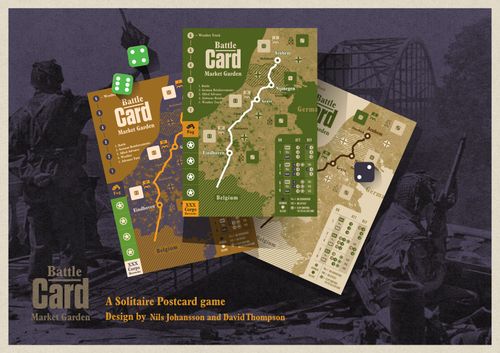
Battle Card: Market Garden
Battle Card: Market Garden Rulebook
Table of Contents
Table of Contents
Components
Besides the map and the rules, the game needs 14 six-sided dice (d6):
- 3d6 for US units
- 4d6 for German forces
- 1d6 for the 30th Corps
- 1d6 as a control marker
- 1d6 as the turn die
- 1d6 for rolling
Game Setup
The map shows 4 cities: Eindhoven, Grave, Nijmegen, Arnhem.
Each position holds:
- an Allied unit
- a German unit
- a control marker
- a city location mark
Steps:
- Place one die as a control marker next to each city with the value "1" up (German control).
- Place unit dice on the map in the corresponding places: in green - Allied forces, in brown - German forces, with their starting values.
- Place a die on the map in the area of Belgium to mark the starting position of the 30th Corps (any value).
- Place a die with the value "1" on the "FOG" sector.
Airborne Landing
Roll a die for each Allied unit to determine its starting strength modifier.
- 1, 2: -2 strength
- 3, 4: -1 strength
- 5, 6: no change
Turn the dice to the corresponding values.
Turn
1. Combat
Choose whether to defend or attack in each city with the Allied unit. Compare strengths. The side with the higher value has the advantage in combat. Roll 1d6 and consult the combat results table. The value of a German unit cannot be less than 1. If an Allied unit's strength falls below 1, remove it from the map. If the Allies take control of a location, set the control die to 6.
2. German Reinforcement
Starting with the topmost city on the map, increase by 1 the strength value on the German unit die. If the value of the German unit exceeds that of the Allied unit, set the control die to "1" to indicate German control. Increase the value of the unit in the city of Nijmegen only if Arnhem is controlled.
3. Allied Movement
You may move either the 30th Corps or any Allied unit to an adjacent location.
- The 30th Corps may move only to a location that is under Allied control. As soon as the 30th Corps moves into a location, remove the German unit in that location from the game.
- An Allied unit may move only if it is in the same location as the 30th Corps. If one unit moves into a location containing another unit, their strengths are combined on one die and the other die is removed from the game.
4. Airborne Landing
Roll 1d6 and compare the result with the turn number. If the result is less than or equal to the number of turns completed, increase the value of the first airborne army by 1 and move its die to the Clear box. Once the strength of the first airborne army has been increased, you must skip this step in the remaining turns.
5. Next Turn
Increase the value of the turn die by 1.
End of the Game
You win if the 30th Corps reaches Arnhem. You lose if all Allied forces leave the game or if you complete 6 turns.
Combat Results Tables (printed on the map)
Legend: green = Allies, brown = Germany. A star symbol = set Allied control (6). NE = no change. Row labels: All = Allied unit has the higher value; Ger = German unit has the higher value; No = equal values. (These row meanings are inferred from the legend "No = equal value" and the table's layout; the Russian text does not spell out "All" and "Ger".) The columns are the d6 roll.
Attack
| Row | Roll 1 | Roll 2, 3, 4 | Roll 5, 6 |
|---|---|---|---|
| All | Allies -1 | Allies -1 and set Allied control; Germany -1 | Set Allied control; Germany -1 |
| Ger | Allies -3 | Allies -2; Germany -1 | Allies -1 and set Allied control |
| No | Allies -2 | Allies -1; Germany -1 | Allies -1 and set Allied control; Germany -1 |
Defense
| Row | Roll 1 | Roll 2, 3, 4 | Roll 5, 6 |
|---|---|---|---|
| All | Allies -1; Germany -1 | NE | NE |
| Ger | Allies -2 | Allies -1 | NE |
| No | Allies -1 | Allies -1; Germany -1 | NE |
Map Notes
The map shows, from top to bottom: the Clear and Fog boxes; Arnhem, Nijmegen, Grave and Eindhoven along the road from Belgium; each city has an Allied unit space, a German unit space and a control space; the 30th Corps starts in Belgium.