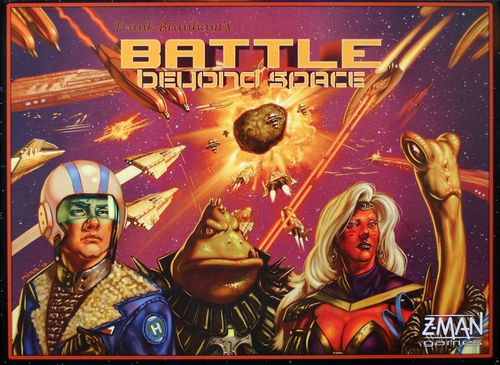
Battle Beyond Space
Battle Beyond Space Rulebook
Table of Contents
Table of Contents
Object
Be the player with the most points from blowing up other ships after 10 turns of play. Destroyed enemy fighters are worth one point. Destroyed enemy capital ships are worth 4 points.
The ships themselves are very simple. Fragile fighters shoot straight forward 5 hexes, and take only one hit to kill. Capital ships fire at anything within two hexes around them, and require two hits to destroy.
Components
- 36 movement cards (9 for each player)
- 12 special power cards (3 for each player)
- 54 fighters (3 squadrons of 6 ships each per player)
- 8 capital ships (2 per player)
- 13 asteroids
- 6 grey sensor probes
- 1 game board
- assorted markers (cotton balls or red cubes are used for damage. Blue cubes are used to mark ships affected by that race's special power)
Setup
Fold out the 3 or 4 player board, place the asteroids on the green marked starting spaces.
Place the 6 grey sensor probes on the 6 spaces surrounding the central asteroid.
Each player takes his set of 9 movement cards and shuffles them to form a deck. The player also takes the same color ships and capital ships. Each player receives ONE of the special power cards corresponding to his color at random. He looks at the card.
Each player takes the top card from his movement deck and looks at it. (This will let you know what your first move will be as you set up.)
Players now place their ships in the start zones on the board.
When placing ships, all fighters of a squadron must be in a connected group. Capital ships must be placed so that they occupy two hexes. No two ships may share a hex. All fighters must also face a specific hexside.
Randomly choose a starting player to begin.
The Über Rules
When reading these rules remember these guidelines:
- Only one ship may occupy a hex at the end of its move.
- Ships may fly THROUGH any obstacle.
- Ships may NOT fire through any obstacle.
A Turn
A turn consists of the following steps, in this order:
- Reveal movement card.
- Move one squadron of fighters.
- The moved squadron of fighters shoots.
- Turn the moving squadron of fighters.
- Move ONE capital ship.
- The moved capital ship shoots.
- Take a new card.
Fighter Movement
Choose one of your 3 squadrons. All fighters in the chosen squadron move ahead EXACTLY the number of spaces shown on the top part of the card. No turning is allowed until after the squadron shoots.
Fighters move THROUGH any obstacle--asteroids, friendly or enemy ships. If a moving fighter ends up in a space with any obstacle, see the section below on collisions.
Firing
All of the fighters that just moved shoot straight ahead of their facing with a range of 5 hexes. Unlike movement, firing does NOT pass through any obstacle. Fighters will not fire at their own ships. Enemy fighters are collected as kills to keep track of victory points. Enemy capital ships take 2 hits to destroy. If one point of damage is done to a capital ship, mark it with a damage marker.
If multiple enemy fighters are within range of the shot of a single ship, only the FIRST ship is blown up. Similarly, if a friendly ship is between a firing ship and an enemy target in range, the shot is not fired.
Example: The squadron fires at range 5. Fighter A kills its target fighter. Fighter B's shot is blocked by an asteroid. Fighter C gets one hit on the enemy capital ship; it does not also hit the fighter even though it is in range. Fighter D is blocked by Fighter C and shoots nothing.
Turning
After firing, the moved fighters may be turned. Each fighter may be turned up to the number of hexsides shown as the middle number on the movement card. (The movement cards with a 0 turning factor do not allow you to turn, while a turning factor of 3 would allow you to turn the fighters to face any direction.)
Each fighter may turn in a different direction, so a squadron may break up. All of those fighters still move and fire if activated by a future movement card.
Moving Capital Ships
Capital ships move differently. For each action point shown on the third section of the movement card, one capital ship may move OR turn. Capital ships may also choose to move less than the number of action points shown on the card. Only one of your two capital ships moves.
Capital ships move one hex straight forward. Capital ships may fly through all obstacles, just like fighters. Capital ships may NOT end a move by running into asteroids, friendly ships, or off the board, but they may run into enemy ships.
Capital ships turn by rotating the entire ship 60 degrees from EITHER hex. So you may rotate the ship about the back hex, swinging the front of the ship to a new hex, or you can rotate the ship about the front hex, swinging the backside around.
Firing from Capital Ships
Capital ships may fire at any ONE target within two hexes of EITHER of the capital ship's hexes. A capital ship may not fire through any obstacle. The target does NOT have to be two hexes in a straight line from the capital ship.
Only the capital ship chosen for movement may fire.
Example: The capital ship at A gets to move 4 spaces this turn. It moves ahead one space into hex B, then swings its nose into hex C. Its last two moves move it forward into hex D, moving through the asteroid at C. It then fires and destroys enemy fighter E. It may not shoot the fighter at F because its shot is blocked by the second enemy fighter.
Collisions
The following tables describe what happens when moving objects encounter each other at the END of a move.
Moving Fighter encounters
| Encounter | Result |
|---|---|
| Enemy Fighter | Both ships are killed and collected as casualties. |
| Friendly Fighter | ONE of the colliding fighters is killed. Acting player chooses and removes the piece from the game. |
| Asteroid | Moving fighter is killed. Remove it from the game. |
| Friendly Capital Ship | Moving fighter is killed, remove it from the game. The capital ship is undamaged. |
| Enemy Capital Ship | Moving fighter is killed. Capital ship suffers one point of damage. (If already damaged, it is taken as a kill.) |
| Sensor Probe | Collected by the moving fighter. No damage is suffered. |
| Off the Board | Fighter is lost. Remove it from the game. |
Moving Capital Ship encounters
| Encounter | Result |
|---|---|
| Enemy Fighter | Fighter destroyed, capital ship takes one point of damage. |
| Friendly Fighter | Friendly fighter is destroyed. Capital ship takes no damage. |
| Sensor Probe | Sensor probe is collected. Capital ship takes no damage. |
| Asteroid | Not permitted |
| Enemy Capital Ship | Not permitted |
| Off the Board | Not permitted |
| Friendly Capital Ship | Not permitted |
Note: There is no way to commit suicide with a capital ship. The experienced commanders will just not do that sort of thing.
Sensor Probes
The 6 sensor probes in the center of the board are worth 1 victory point each. These are collected whenever a player ends a movement on top of a probe. The ship which collects the probe does not receive any damage.
The original sensor probe starting spaces are also worth victory points at the end of the game: 2 points per hex you occupy with a ship.
Game End
The game ends when all players have played all of their movement cards. Most victory points wins.
| Item | Points |
|---|---|
| Killed enemy Fighter | 1 Point |
| Killed enemy Capital Ship | 1 Point (the rules' introduction states 4 points) |
| Sensor Probe | 1 Point |
| Sensor Probe Starting Space occupied at the end of the game | 2 Points per hex occupied |
Special Powers
Each player receives ONE special power card at random. This card does not take effect until revealed. Some of the powers apply for the entire game (like a power that increases all capital ship movement by one). The player keeps even these secret as long as he desires, but once activated, the power must stay in effect.
If a special power destroys an enemy ship, that ship is collected as a kill.
Blue
Blue special powers are all related to their fighters. These are probably a very Buck Rogers sort of Earth race.
- Choose one fighter. That ship may turn DURING movement. It may even break up its turning during movement. The ship may also change facing as much as it wishes with each move. The ship then fires normally after moving and turning.
- Your fighter squadrons have a firing range of 10 hexes. You may also shoot through asteroids. This power may actually be a little weak.
- Once per game, one of your fighters can self destruct. All ships within 2 hexes of the ship take one point of damage. A capital ship takes two points if both of its hexes are within range.
Yellow
This alien specializes in propulsion systems. It has really odd powers of movement and positioning.
- Move one asteroid per turn one hex, as long as it is within 3 hexes of one of your capital ships. You collect ships destroyed in this manner. (If the asteroid hits an undamaged capital ship, the ship is damaged, and the asteroid destroyed.) This is a very odd power. Sometimes it is remarkably powerful in the right hands. Sometimes it is very hard to use.
- Each ship in the fighter squadron you are moving may move double the number of spaces. Ships moving double may not shoot this turn. You may move some or all of the ships double moves.
- Once per game, one of your squadrons may teleport instead of its normal move. The squadron moves up to 6 spaces in any direction, ignoring the ships' facing. All ships in the squadron must move the same direction and distance. The squadron teleports instead of its normal move, then fires and may then turn as usual. The teleport does not have to be in a straight line. The teleporting squadron does not get to turn while moving. It is like the entire group simply pops to another spot in the same formation.
Red
Red has powerful capital ships.
- All of your capital ship movement rates are increased by two.
- Both of your capital ships have fighter lasers as well as turrets, allowing you to fire straight ahead 9 hexes like a fighter. The special shot takes the place of the normal 2 hex turret shot. This looks a bit weak at first, but with the increased carrier movement is really good at taking down other capital ships.
- Once per game, a capital ship may fire the mega-weapon. The mega-weapon causes one point of damage to every hex in a path area 3 hexes wide, and 3 hexes long straight in front of the ship. This is in place of the ship's usual attack. This massive beam does pass through obstacles. The entire 3x3 area is devastated, including asteroids.
Green
Really alien aliens with freaky weird powers.
- One of your capital ships has defense shielding and cannot be shot. The capital ship can even run over asteroids and fighters (but not capital ships). The shielding must be activated when the ship is first shot, and lasts 3 turns. Use blue markers on the card to indicate the length of time for the power. Remove one marker at the end of each of the owning player's turns. The ability to ram enemy fighters COULD be too powerful, but it has not yet been totally devastating in play.
- Once per game, at the end of a turn, you may resurrect any ships that were lost from one fighter squadron. The ships are placed back in your starting area. Opponents get no points from the resurrected ships.
- Draw two extra cards. You choose your card each turn from a hand of 3 cards. You may still play each card only once; your hand will be smaller on the last two turns of the game.