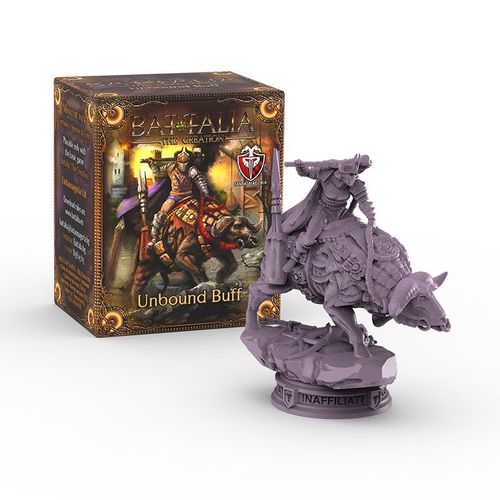
BATTALIA NCBC: Unbound Buff
BATTALIA NCBC: Unbound Buff Rulebook
Table of Contents
Table of Contents
The Unbound Buff Enters the Game
The Unbound Buff enters the game at the end of the first week. After a full rotation of the Oracle, when the vanes with the tool symbol match again, the game is briefly interrupted (before first player's turn). At this moment all players secretly choose cards with battle strength higher than zero from their hand to bet (any number of cards is allowed). When all players have chosen cards they reveal them simultaneously.
The player "sacrificing" the highest total strength to defend himself earns the right to pick the location of Buff's entrance. If there is a tie, the player with the most victory points wins this privilege. If there is still a tie, one of the tied players is chosen at random.
The winner of the bet chooses one of the corner starting cities and places Buff's figure on it. The Unbound Buff master card is placed next to the game board and above it the players put a universal level 6 token. This token represents the horde's strength in battle at the beginning. During the whole second week of the game its strength is 6.
After the Unbound Buff has entered the game board, all cards used for betting are discarded and everybody fills their hand to 6 cards.
Example: After the last day of the first week in a three player game, the players should bet for the privilege to choose the entrance point of the Unbound Buff. The green player wins the bet and now he must choose between the three starting cities (A, B and C). He hopes that Buff may cause some trouble to the currently leading player, so he decides to place the figure on the red player's starting city (B).
(The original sheet marks this moment on a week-cycle diagram labelled "last day of a week" and "first day of a week".)
Movement
After the Unbound Buff is positioned, the game proceeds its normal way with the following changes:
- At the end of his turn, each player has the right to move Buff's figure. To do so the player rolls a die and may move the figure according to the result of the die. The player does not need to spend all the movement points given by the roll. For example if a player rolls 3, he can move Buff one, two or three squares away or he may decide not to move it at all.
- The Unbound Buff moves only on depicted roads like all other heroes. During a single turn Buff's figure may not step twice on the same square while moving. It means also that it may not step again on the square where it started its movement or turn back. If the figure reaches a dead end then its movement ends, and any unspent movement points are lost.
- When the Unbound Buff enters a square containing a hero figure, its movement ends immediately and the hero is automatically considered under attack. This also includes the following case: when entering the game Buff's figure is positioned directly on a starting city with a hero on it. The horde attacks only heroes, no cities (too dangerous)!
At this point the hero owner has three options:
I. To bribe Buff with provisions by playing 3 supply cards. In this case no battle occurs and both figures are left on the same space. Buff and the horde promise not to bother this player's heroes for one week. From now on, if Buff meets again the heroes of that player on the board during the next 7 days, no automatic battle occurs between them, but the heroes are still able to hire Buff (see next option). Heroes are also not allowed to attack Buff on purpose during this week (since this would be against their bargain). To mark 7 days the player places his time marker next to the outer vane of the Oracle, which is illuminated by the ray at the moment. After one full rotation the time marker is removed and those heroes are vulnerable to mercenaries' attacks again.
II. To hire Buff for one week by playing 4 supply cards. The player hires just the leader without his horde (in this game the horde is considered a group of abstract units represented by the token placed on Buff's special card). The player takes the Unbound Buff master card in front of him to remind that he is the figure's owner now and returns the level 6 token back in the box. Buff may be hired only for one week. To mark 7 days the player places his time marker next to the outer vane of the Oracle, which is illuminated by the ray at the moment. After one full rotation the time marker is removed and the Unbound Buff is considered free of duty again. His former master returns Buff's card next to the game board, placing a new universal token for the horde's strength. Buff's figure is left on the same space of the game board and from now on all players continue to move it again.
III. To fight Buff. In this case, being the defender, the player needs to form a battle line with cards which strength is at least equal to the strength of the horde. If the player successfully repelled the horde, the Unbound Buff's figure is removed from the game board till the beginning of the next week. If the player loses the battle his hero is disbanded according to the combat rules.
Additional Rules
- If the horde enters a square containing the figures of several heroes, the player who is responsible for Buff's current movement decides which one of them to attack. Always only one hero should be considered under Buff's attack.
- If a hero enters the square containing the Unbound Buff, the hero is considered under attack. Important: in this case the Unbound Buff is also considered the attacker, since it is expected that he is the more aggressive side.
- If at the end of any week the Unbound Buff is not present on the game board, the figure reenters the game. Every time Buff raids the land again, the players should bet for the privilege to choose the location of his entrance - it's always a starting city.
Owning the Unbound Buff
When a player hires the Unbound Buff he effectively receives a third hero figure for one week. That player may move Buff, attack enemy heroes and cities, or attack the ruins as if it is one of his regular heroes. If other players decide to attack the Unbound figure, its owner is supposed to defend it.
There are two main differences between the mercenary Buff and the regular heroes of a player:
-
No native terrain. The Unbound Buff doesn't have a native terrain, so the player always needs to pay the cost for its movement, even in the advanced game. This should not be confused with the terrain bonus during battle, as it is rewarded to the player, not to the hero himself (meaning the player always receives the bonus while conducting a battle on native terrain, even with Buff leading).
Example: The Islander player is the current owner of Buff in advanced game mode. He wants to move the figure from his 4th level city (A) to the 1st level city of the Emberian player. He must play a horse card or three supply cards to reach his opponent's city, although there is a lake square on the figure's route.
-
No standard moral bonus, but an Unbound bonus. The Unbound Buff doesn't receive the standard moral bonus during combat, because he doesn't belong to any standard faction. The moral bonus has a slightly different interpretation here and the mercenary receives other advantage instead. The Unbound Buff gets +1 strength in combat for every Unbound unit card in the battle line he leads - a very useful bonus under circumstances.
Example: The Islander player attacks the level 3 city of the Emberian player with the Unbound Buff. The total strength of the attack is 13: basically 10 for the units' strength; +2 bonus for the two Unbound cards; +1 bonus for the terrain. The Islander has a Cloudborn card in his battle line, but this plays no role in the current situation. Even if all cards in his battle line were Islanders (besides the universal mercenaries), the total strength of the attack wouldn't change with +1 as the Unbound Buff doesn't receive a moral bonus for this. All that counts is the number of the Unbound mercenaries under his command in the line.
If the player loses a battle in which the Unbound Buff participates, Buff's figure is removed from the game board. He will reenter the game later at the end of the week according to the description above.
The Horde's Strength
At the beginning of the 2nd week, when the Unbound Buff enters the game for the first time, the horde's strength is 6. This value is not constant for the whole game. Every week the horde becomes stronger. During the third week of the game the horde's strength is changed to 8, since the mercenaries get new recruits:
- If no player holds the Unbound Buff figure at the beginning of the new week (e.g. 3rd week), the players remove the level 6 token from Buff's special card and replace it with the level 8 token.
- If a player has hired Buff during the previous 2nd week, then when the figure is released from duty, the special card receives a level 8 token for the horde's strength.
Every week the horde's strength becomes 2 points stronger. During the 4th week of the game the horde's strength is 10, during the 5th it will be 12, and so on. It is a good practice to stack the corresponding even universal tokens on a pile, sorted by strength with the level 6 token on the top. Then when a new token should be placed on Buff's card, just take the topmost of the pile, without the need to track which is the current week. In the very rare case when the game is longer than 6 weeks, remember that 16 is on the back side of the level 14 universal token, and 20 is on the back of the 18 level token.