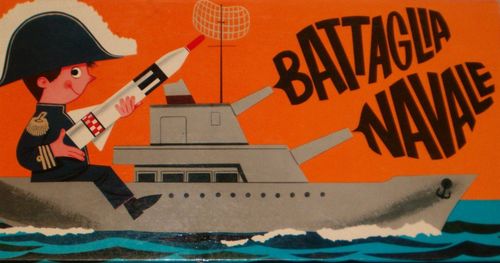
Battaglia Navale
Battaglia Navale Rulebook
Table of Contents
Table of Contents
Preliminaries
Before starting the game, the players detach the counters from their card sheet and lay the sea chart, which represents the sea, open on the table. This chart has one of its short sides marked with the word "NORD" and is divided into 24 large squares arranged in six rows of four squares each. With respect to the North side of the chart, each square therefore has its own North side (upper), its own South side (lower), its own East side (right) and its own West side (left). Each square is in turn divided into 10 cells. (Printed as "10"; the sheet's errata corrects this to 16 cells, see the note at the end of the rulebook.) The two opposing players sit facing each other at the two short sides of the chart. They then carry out the following operations:
- they place face down (that is, with the 4 numbers visible in the numbered spaces inside each naval base) the 4 square counters for building the Polaris missile;
- they place the counter representing the coastal battery inside their respective naval base, on any cell of their choice that is adjacent to the white lines, or to the promontory, or to the platform for building the Polaris missile;
- they set aside, off the chart and within reach of both players, the face-down deck of cards and the two Polaris tokens;
- they draw the position of the islands: to do this they draw two cards at random from the face-down deck; the number printed on the lower part of each card indicates the square where each islet is to be placed.
To identify that square, count row by row, from left to right, the squares, starting from the first at the top left of the North side of the chart, stopping at the one corresponding to the number on the card. Each island is placed straddling the South (lower) side of the drawn square. If, however, no number appears on one or both of the cards drawn, one or both of the islets are not placed, and the game is played with the sea partially or totally clear.
(Attention: once the islands have been placed, the numbers printed on the cards are considered void, having no other function for the whole duration of the game.)
Finally, each player, having chosen the colour of their naval team (white or grey), detaches the ships from their plastic stand:
- each player places their fleet (composed of one Battleship, one Aircraft Carrier with three planes, one Cruiser, one Destroyer and one Atomic Submarine) inside their own naval base, which consists of the two large squares side by side on the right of the short side of the chart that is on their side, using all the available sea space at their discretion;
- each player places in front of them, beside the chart, the square markers representing their own naval units, as well as the markers for the three planes, which they will use when they bring the Aircraft Carrier into operation. The markers, in two sets (one white and one grey), are 16, divided into groups representing the naval units as follows: 5 markers for the Battleship (C), 4 for the Cruiser (I), 3 for the Destroyer (Ct) and 4 for the Aircraft Carrier (P).
Positioning the ships
Naval units, both when they are placed in the two large squares of one's own base and after every move during the game, must lie within the sides of the square they occupy (never straddling a side), occupying exactly, in a vertical or horizontal direction (never diagonal), the following number of cells: Battleship and Aircraft Carrier 4 cells, Cruiser and Destroyer 3 cells, Polaris Submarine 2 cells.
Once the fleets have been placed in their respective naval bases, the game begins and it is decided by lot who makes the first move.
Start of the game
The player's first move may be, at their choice, only one of the following:
- turn over one of the 4 Polaris missile counters, thus starting the construction of the first missile (see the rule further on);
- bring out of its base one or more units, according to the rules described below;
- launch into the air one, two or all three of the Aircraft Carrier's planes, according to the specific rules given in the chapter "The Aircraft Carrier and the bombing planes".
Movement and fire of the ships
Each naval unit may be moved, at each move, by one or two large squares (the latter on one and the same line), and may fire. Movement and fire, however, take place only in one of the four directions: North, South, East or West (that is, forward, backward, to the right or to the left), the diagonal direction being therefore excluded.
The movement and firing possibilities of each unit are summarised in the following table:
| Unit | Maximum movement | Fire: maximum range | Cards to draw |
|---|---|---|---|
| Battleship | 2 squares | 2 squares | 2 |
| Cruiser | 2 squares | 1 square | 1 |
| Destroyer | 2 squares | 1 square | 1 |
| Aircraft Carrier | 2 squares | anti-aircraft fire only (see the instructions) | 2 (only for anti-aircraft fire) |
| Planes | 3 squares | the square on which they are sitting | One for each plane that is in action |
| Polaris Submarine | 2 squares | 4 squares | None. The special token is played instead |
In each move, only the units contained in one square may be moved. If there is only one ship in a square and the player, on their turn, moves that one, they may not move any other until the next move. If instead there are several ships in a square, the player, on their turn and with a single move, may move them all together, either in a single direction, or each in a different direction. Naturally, after each move, each ship must take up, in the arrival square, a vertical or horizontal position in accordance with the rules set out in the chapter "Positioning the ships".
Obstacles to navigation
A ship may not proceed in a given direction when it meets an island or one of the two promontories drawn on the chart.
A ship may not stop in a square that is already occupied by even a single enemy unit.
A ship may, however, pass freely across the white lines that delimit the naval bases, since these are understood as the passage existing at one end of the white lines themselves (the piers). Squares occupied by one or more enemy units may likewise be passed through (for example, a ship intending to make a two-square move may reach the second square even if the first is occupied by enemy ships).
Carrying out and checking the ships' fire
The ships' fire is carried out by means of the deck of 20 cards supplied with the game, which is to be shuffled thoroughly beforehand.
A ship's fire may be carried out either immediately after moving one or more ships, or immediately before moving them. In other words, the player, on their turn, may, at their choice, either move first and then fire, or fire first and then move. It is understood that the player may also either only move or only fire. Likewise, after firing, the player may move a ship that has not fired, or, after moving, may fire even with a ship that has remained stationary.
Fire may be carried out, from time to time, by one ship or by several ships at the same time, but always and only at one and the same target. This target is always a square that contains enemy elements (ships, coastal battery, Polaris missile counters), provided that the square is within firing range. A target is within firing range when it can be reached according to the firing range of each ship, as given in the table in the preceding chapter "Movement and fire of the ships".
It should be remembered that the Aircraft Carrier carries out only anti-aircraft fire (see, in this regard, the specific chapter further on).
Let us now see how the firing is physically carried out. First of all, before carrying out the fire, the player must indicate the square at which they wish to fire and which of their own units take part in the fire. Then they draw from the top of the face-down deck as many cards as the fire of their engaged units requires, as already indicated in the table in the chapter "Movement and fire of the ships". Thus, for example, if the Battleship and the Destroyer take part in the fire, the player draws 3 cards (2 for the Battleship and one for the Destroyer).
Having turned the cards face up, one checks where the shots fired have fallen. For this purpose the red marks printed on the cards are used. The check is made one card at a time, placing this card on the chart, next to the square that was hit and with the word "NORD" turned towards the North side of the chart. Since each card reproduces, smaller but exactly, the layout of the cells contained in each square, it follows that each red mark on the card represents a shot that has fallen in the corresponding cell of the square that was the target. If a cell that has been hit is occupied by a ship, that ship receives the hit.
For each hit that has struck home, the owner of the hit ship must hand over to the opponent one of the counters of that unit. For example, if the Cruiser has received two hits (it does not matter whether both are in the same point), the player who owns that unit must hand over to the opponent two counters marked with the letter "I".
When the coastal battery is hit, its counter is handed over to the opposing player.
When all the counters of a unit have been handed over to the opponent, the unit is considered sunk and is removed from the game.
Obviously, the card "Colpi inesplosi" (Unexploded shells) has no effect.
Once the check of the fire has been carried out, the cards used are returned to the bottom of the face-down deck, so that this, in practice, never runs out.
Important rule for fire: a square may not be bombarded by enemy units that have, between themselves and the target, an island or a promontory. This means that ships have the possibility of defending themselves against enemy fire by "hiding" behind the aforesaid natural obstacles.
Fire of the coastal battery
The coastal and anti-aircraft battery, which is naturally fixed, fires up to the distance of one square (see the table). It may fire either against surface ships or against planes. In addition, in both cases, it may fire against enemy ships or planes that are in its own square.
The Aircraft Carrier and the bombing planes
The Aircraft Carrier is the mobile base of the three bombing planes. To get these into the air, the player, on their turn, announces that they are carrying out an air raid and, starting from the square where the AIRCRAFT CARRIER is, moves the plane or planes, moving them up to 3 squares per move, as the table cited many times says. They may, of course, fly over any obstacle, such as islands and promontories.
The player may launch, in a single move, one only, or two, or all three planes. However, when planes take off in 2 or 3, they must then always fly together, following the same route.
A move made with planes excludes any other simultaneous move by the player; that is, whoever moves the planes may not, in the same move, move any other unit nor fire with these.
Once the planes reach the square to be bombed, they are placed on free cells (that is, cells not occupied by enemy units) inside the square. If there are no free cells in that square, the bombing cannot be carried out. As soon as the planes are placed, the player bombs at once, drawing (see the table) as many cards as there are planes taking part in the action, and checks the points where the bombs fall using the same system used for ships. Then the opponent must hand over the counters corresponding to any units that have been hit. Naturally, if a cell in which a plane is located is hit, the shot is considered to have fallen into the water.
Now it is the opponent's turn, who may reply to the air attack with the anti-aircraft batteries of their own ships and with the coastal battery, if this is within firing range. Only the ships and the coastal battery that are in the same square as the attacking planes, and in the adjacent squares (to the right, to the left, above and below), may fire against enemy planes.
For anti-aircraft fire too, the units taking part turn over the same cards indicated in the table; likewise the check of anti-aircraft hits is carried out as for naval fire. Therefore, if a red mark on the card corresponds to a cell occupied by a plane, that plane is shot down and is consequently removed from the game.
Whoever carries out anti-aircraft fire may not, in the same move, carry out any other fire at the same time. When all three planes have been shot down, the Aircraft Carrier may act only with its own anti-aircraft batteries; otherwise it is harmless, and its task is to escape enemy attacks so as not to be sunk.
If the Aircraft Carrier is sunk, all the planes that were not in the air are lost and are therefore handed over to the opponent.
The planes that, at the moment of the sinking of the Aircraft Carrier, were in the air continue their flight and their bombing runs until they are eventually shot down.
The Polaris nuclear missile submarine
The atomic submarine must remain stationary at the base until the player has won the round token "Polaris". To obtain it, the player, on their turn, instead of moving their ships and planes and firing, may turn over one of the four numbered counters of the "Polaris" missile. When they have succeeded in turning all four, the construction of the missile is completed and the player is entitled to take the corresponding round token at once. However, they must also immediately turn the 4 counters face down again, awaiting a possible future construction of another missile.
The opponent may try to delay the construction of the missile by bombarding the space that contains the 4 Polaris counters. Each hit that falls on a cell containing a counter that has already been turned over will force the player to put it back in its original face-down position.
Once the player has come into possession of the Polaris token, from the following move onwards they may send the atomic submarine into action, observing the movement and firing rules set out in the table, and travelling either alone or in formation with other units.
Once it is within firing range of enemy elements (ships, coastal battery or Polaris counters), the submarine (which hits up to 4 squares away in a straight line, not diagonally) launches the missile by indicating the square it intends to hit and placing the Polaris token again near the deck of cards, awaiting the chance to take it back after the construction of another missile.
The fall of a Polaris missile has the following effects:
- all the ships, and possibly the coastal battery, contained in the square hit are totally destroyed with a single blow, and the opponent must remove the ships from the game and hand over the corresponding counters;
- if the shot is aimed at the space for building the enemy's missile, all the counters that may already have been turned over are turned face down again and returned to their original face-down position.
The atomic submarine, on the other hand, is invulnerable. Its missile, naturally, passes over any obstacle formed by islands and promontories.
Before making another launch, the submarine must necessarily return, with regular moves, to the base, where it will wait for another missile to be completed so that it can set out on another destructive mission.
End of the game
The battle at sea is won by the player who first succeeds in destroying the enemy fleet, that is, in capturing all 19 of the opponent's counters (battleship, cruiser, destroyer, aircraft carrier and related planes), with the exception of the atomic submarine, which, as has already been said, is invulnerable.
Printed errata (on the sheet): the errata line reads "Prima facciata riga 6ª leggasi 16 (e non 10) caselle", that is, on the first side, line 6, read "16" (not "10") cells. The Preliminaries paragraph above is transcribed as printed, with "10 cells"; this printed correction, which concerns the number of cells per square, is recorded here and has not been merged into the text.