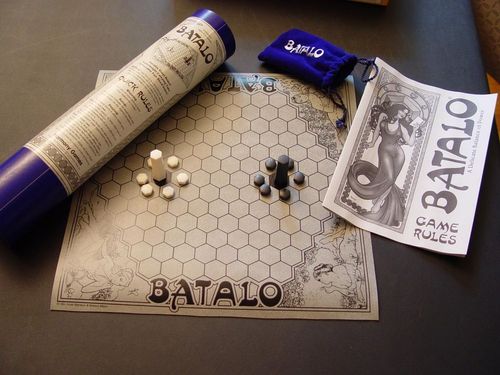
Batalo
Batalo Rulebook
Table of Contents
Table of Contents
Components
- 1 Gameboard
- 7 black pieces (1 column and 6 stones)
- 7 white pieces (1 column and 6 stones)
- 1 drawstring bag for the pieces
- 1 Batalo Charts master sheet
- 1 Batalo Mailers master sheet
Setup
Choose a set of pieces, then place your column on the base nearest you, and your stones on the six spaces surrounding that base (fig. 1).
Fig. 1: Starting positions for pieces.
Object of the Game
To win a game of Batalo you must get one of your pieces onto your opponent's base.
Turns
You must move one of your pieces to a new position each turn. White should move first.
Stone Rules
-
Sliding or Hopping (fig. 2)
- You can slide one of your stones one space in any direction; or you can hop it over one of your other stones or over your column.
- Your hops must be in a straight line.
- You can't hop over more than one of your pieces in a hop.
- You can't hop over your opponent's pieces.
- You can't slide and hop in the same move.
Fig. 2: Sliding or hopping your stone.
-
Continuous Hopping (fig. 3)
- On your turn you can keep hopping your stone over your other stones as long as each hop begins where the previous one ended.
- You can't hop over the same piece twice in a turn, or return your piece to its starting point.
Fig. 3: Continuous hopping.
-
Hopping Your Base
- You can hop your stones over your base, as if it was one of your stones.
- Your stones are not allowed on your base.
-
No Capturing
- Your stones can't capture your opponent's pieces.
Column Rules
-
Sliding or Hopping (fig. 4)
- You can move your column any of the ways you move your stones: sliding it one space, hopping it over your stones, continuous hopping, and hopping it over your base.
- The hopping restrictions for stones also apply to your column.
Fig. 4: Sliding or hopping your column.
-
Continuous Sliding (fig. 5)
- You can slide your column in a straight line until it is blocked by another piece, either one of yours or one of your opponent's.
-
Occupying Your Base
- Only your column can occupy your base. (Unless your opponent gets to it first!)
- You can slide your column through your base.
Fig. 5: Continuous sliding.
-
Capturing Pieces (fig. 6)
- Only your column can capture one of your opponent's pieces (column or stone). It does this by landing on the piece at the end of whatever move it makes.
-
Protecting Your Column and Base
- Your column can't be captured when it's on your base. This position also protects your base from your opponent.
Stone Strategies
Winning a game of Batalo requires a careful balance of attack and defense. As you move your pieces toward your opponent's base, you must still protect your own base. Your pieces must work together to have enough strength and speed to overcome your opponent's team.
Your stones have more power as a group than alone. Working together, they can move farther, block more effectively, and can even pin your opponent's column to its base. Your main stone strategies are:
-
Attacking Your Opponent's Base (fig. 7)
- With the protection of your column, you can move a stone (a) right up to the edge of your opponent's base.
- You can move a stone (b) nearly as close, even without protection, as long as it remains out of reach of your opponent's column.
- You win the game when you get a stone onto your opponent's base.
Fig. 7: Attacking opponent's base.
-
Creating Bridges for Hopping (fig. 8)
- By creating a bridge of stones for continuous hopping you can quickly move your rear stones ahead to join your forward stones.
- Your column can hop along such a bridge to attack your opponent's pieces or base, or to protect one of your stones (a) in a hard to reach spot. Sometimes you can even capture your opponent's column with an unnoticed bridge.
Fig. 8: A bridge for hopping.
-
Blocking Your Opponent's Pieces (fig. 9)
- You can use one of your stones (a) to block the advance of one of your opponent's stones; and if your stone is protected by your column, it can even block your opponent's column.
- Two of your stones in a direct line (b and c) can be used as a buffer to delay your opponent's column when it's attacking your base.
Fig. 9: Blocking opponent's pieces.
-
Sacrificing Your Stones (fig. 10)
Column Strategies
Your column is your most powerful piece. It's the only piece you have that can capture your opponent's pieces or protect your own pieces or your base. Your main column strategies are:
-
Attacking Your Opponent's Base (fig. 11)
- By attacking your opponent's base or the stones protecting it, you can put your opponent on the defensive while moving your stones forward. This is also a good defensive move.
- You win the game when you get your column onto your opponent's base.
Fig. 11: Attacking opponent's base.
-
Capturing Your Opponent's Stones (fig. 12)
- To most effectively capture one of your opponent's stones, attack two stones when only one of them can be protected by your opponent's column. Or attack a stone and your opponent's base when only one can be protected.
Fig. 12: Capturing opponent's stones.
-
Protecting Your Stones and Base (fig. 13)
- Your column can best protect one of your stones (a) by being able to capture your opponent's column in return.
- The next best way to protect one of your stones (b) is to threaten an important stone or the base of your opponent.
- Your column can protect your own base by occupying it (since it can't be captured there) or by protecting the stones you have around it.
Fig. 13: Protecting your stones and base.
Winning Moves
To get one of your pieces onto your opponent's base, you need to prevent your opponent's column from occupying it. The three ways you can do this are:
-
Capturing the Column (fig. 14)
- Using a stone as bait, lure your opponent's column onto a space where you can capture it. Your opponent's base will then be unprotected against your column.
- (This may be hard to pull off with an experienced opponent.)
Fig. 14: Capturing opponent's column.
-
Outmaneuvering the Column (fig. 15)
- With threats or lures, maneuver your opponent's column onto a space where it can't reach its base before one of your pieces does. You may need to attack your opponent's base with your column, since your stones can be blocked by your opponent's stones.
Fig. 15: Outmaneuvering opponent's column.
-
Pinning the Column (fig. 16)
- Pin your opponent's column to its base by threatening that base with two of your pieces (usually a stone (a) and your column). Your opponent's column won't be able to capture one of your pieces without being captured itself or without leaving its base open to your other piece.
- When you pin your opponent's column with two stones (a and b), your column is free to capture your opponent's remaining stones. (Stones can be trapped in the board's corners.) Your opponent's column will then have to move off its base, allowing one of your pieces in.
Fig. 16: Pinning opponent's column.
Winning the Game
To win, you must move one of your pieces onto your opponent's base. If you are able to do this on your next move without being stopped, your opponent may choose to concede the game to you.
You can also win by capturing all of your opponent's pieces. This is only necessary when you must capture your opponent's column to protect your own base from attack and no other pieces are left.
If you and your opponent have both permanently pinned each other's columns to their own bases, the game is a draw.
Etiquette and Conventions
- When you threaten your opponent's column or base with capture, you should warn your opponent by saying "averto" (see below). You don't have to warn your opponent when they move their column into danger (though it's courteous to point out an obvious oversight).
- Once you release your piece, you should not take back the move.
- When a set of moves and countermoves results in the moved pieces returning to their previous position, the attacking player (if this can be determined) should make a different move.
- If you are playing a beginning player, handicapping yourself a few pieces may make the learning process more enjoyable for them.
- When the outcome of a game is obvious to both players, you don't need to play the game to its conclusion.
Glossary
- batalo (bah-TAH-lo) n. a battle, fight, engagement, combat, struggle. [Esperanto]
- averto (ah-VAIR-toe) n. warning, caution. [Esperanto] Use this term to warn your opponent that you will capture their column or base on your next move.
Playing by Phone, Computer or Mail
To play Batalo over the phone or by computer modem, use the enclosed Batalo Phone Chart and simply name the starting space and the ending space of the piece being moved. For example: "I'm moving my stone from space IR to space HS," or more simply "IR to HS." You can place markers or the game pieces on the chart to keep track of positions. You may want to use photocopies of the enclosed Batalo Records Chart to record your moves (fig. 17) in case the pieces get bumped or you need to put them away.
Use the enclosed Batalo Records Chart master sheet to record the moves made during a game of Batalo. On photocopies of the chart, either record a key move for backtracking and replaying the game from that point, or record all the moves from a game played by mail or over the phone (fig. 17).
- To record your games, mark on each diagram the positions of all the pieces after both players have moved. Symbols for the pieces are: W = white column, o = white stone, B = black column, o = black stone.
- Use the space under each diagram to record which turn it represents. When replaying games from an earlier turn, just start an alternate series of numbers by adding a letter (12a, 13a, etc.).
- The chart also has spaces to record the game number, date, white player, black player, and winner.
Fig. 17: Recording moves for a turn.
You may find it more economical or convenient to use postcards when playing Batalo by mail. Make double-sided photocopies of the enclosed Batalo Mailers master sheet on card stock and cut the copies into four postcards. They are designed for four simultaneous games. Number each game and indicate which turn you are on and what color has moved. Use the symbols from above (fig. 17) to fill in each diagram.