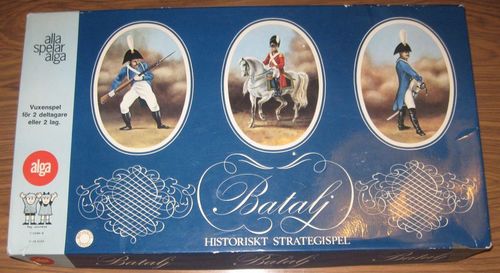
Batalj
Batalj Rulebook
Table of Contents
Table of Contents
Contents
The game contains:
- 1 game board with 64 squares
- 48 game pieces (24 blue, 24 green), made after old battle paintings
- 48 piece stands
Each side has the following figures, which rank among themselves as listed:
| Figure | Count | Value (points) |
|---|---|---|
| General | 1 | 8 |
| Colonel (Överste) | 1 | 7 |
| Major | 2 | 6 |
| Captain | 3 | 5 |
| Lieutenant | 3 | 4 |
| Corporal | 4 | 3 |
| Soldier | 5 | 2 |
| Spy | 1 | 1 |
| Cannon | 4 | 0 |
Preparations
Carefully tear out the cardboard figures, which serve as the game pieces, and insert each one into its stand.
Place the pieces on the three rows of squares nearest each player, on the side of the board where the silhouette of the city is illustrated.
Pieces are placed with the picture side facing their owner, so that each player can see only his or her own pieces. Otherwise the pieces may be arranged in any rank order the player wishes.
The Pieces' Different Values
All pieces except the cannons are ranked 1 to 8. A piece with a higher number beats a piece with a lower number. For example, a Major beats a Captain, Lieutenant, Corporal, Soldier and Spy, but is beaten by the General and the Colonel.
The Spy is the one numbered piece that beats the General, but when the Spy attacks it is beaten by every piece, all the way down to the Soldier.
The Cannons are immovable and remain on the same square for the whole game, unless they are disabled. Only the Corporal can disable a Cannon. All other pieces are beaten by a Cannon, and this includes the General.
The printed rank chart shows the order General, Colonel, Major, Captain, Lieutenant, Corporal, Soldier, Spy, with a separate Cannon, and arrows indicating which piece beats which.
Movement of the Pieces
All pieces except the immovable Cannons may move at most one square per turn, either straight forward, straight backward or sideways. Pieces therefore may not move diagonally or jump over other pieces.
Course of Play
Once the pieces have been placed in the way each player considers most advantageous, the players agree who will begin.
The first player moves one of his pieces one square into the area between the two groups of pieces (the armies). Then it is the second player's turn to move one of his pieces one square, and so on. The players alternate, moving one piece one square at a time.
When a player moves a piece to a square directly in front of one of the opponent's pieces, he goes on the attack and says "Attack!" The attacked player must then state the value of his attacked piece, and the attacker then states the value of his own piece. The weaker piece loses and is removed from the board according to the ranking above. If both fighting pieces have the same value, both fall and both are removed from the board.
A good tip is to sacrifice pieces with low numbers in order to find out how the opponent has grouped his forces. Then keep track of where the opponent's various pieces stand, so that you can later attack them with a piece of higher value.
Who Wins?
When one player has beaten all of the opponent's pieces, or has boxed them in so that they can no longer move, that player has won.
Sometimes both players have one or more pieces left, but these cannot beat each other. The game is then stopped, and both players add up the points of their remaining pieces. Cannons count as zero. The player with the highest total wins.