Baseball Card GM
Baseball Card GM Rulebook
Table of Contents
Table of Contents
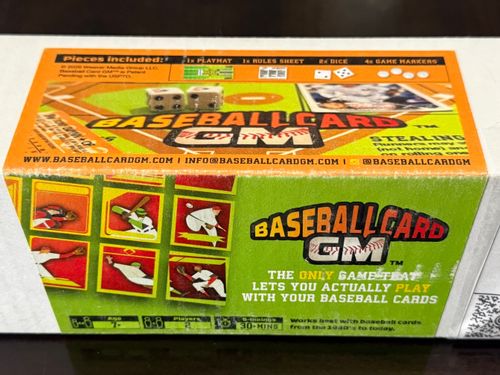
Components
- 1x playmat
- 1x Rules Sheet
- 2x dice
- 4x game markers
Draft Your Team
Draft your team from your own collection of baseball cards. The game works best with baseball cards from the 1980's to today (i.e. most likely to have all the stats needed for the game).
For batters, the cards will need single season stats for eight categories: Homeruns (HR), Triples (3B), Doubles (2B), Batting Average (AVG), Hits (H), Walks (BB), Runs Batted In (RBI), and Stolen Bases (SB).
For Pitchers, the cards will need single season stats for four categories: Wins (W), Saves (SV), Earned Run Average (ERA), and Innings Pitched (IP).
Line-up: You need all position players covered (a catcher, first baseman, second baseman, shortstop, third baseman, three outfielders) by a card with that position listed, however your DH can be any position player if need be.
Pitcher: You need a pitcher at all times, placed in the "Pitcher" box.
Bench: You will want to have a "Bench" of a few back-up players as well, ideally with a mix of righty and lefty batters who excel at that one stat you may need in a pinch (read on for why).
Bullpen: You will need several pitchers for the "Bullpen" to ensure you have enough to cover the entire game and potentially even some extra innings (read on for why). You likely will want a blend of righty and lefty throwers depending on your opponent's lineup.
Draft Notes
Possible ways to draft your team:
- Build your ultimate dream team from your own cards:
- Any cards in your collection
- Cards from a specific year/set
- Cards from the same team
- Use a common pool of cards with your opponent and draft from them:
- Alternate picks
- Assign point values to cards and stay within a point limit
- "Crack Pack" where you buy new packs and play with whatever you get.
Possible ways to build your roster:
While you can carry as many or few bench/bullpen players as you want, for playing out a series of games we recommend a 26-man roster:
- 9 player line-up (8 fielding positions plus a DH)
- 7 bench players (1 catcher, 3-4 infielders, 2-3 outfielders)
- 10 pitchers (4-5 starters, 5-6 relievers)
Use the Stats
The chance that a batter will get a single, double, triple, homerun, walk, strikeout, ground-out (G/O), fly-out (F/O) or pop-out (P/O) are all based on a combination of a single year of their major league stats on the back of their card and the outcome of rolling two dice and looking at the chart on the playmat.
For Beginners and Standard Play
Declare which year's stats you will use for each batter and pitcher before their first at-bat or batter faced. When you roll, the dice combination will be in one of the seven batting stats categories that are on your card (HR, 3B, 2B, AVG, BB, H, and RBI), and there will be two options on the playmat: below a certain number or at-or-above that number. Your batter gets whichever outcome that meets their stats from their chosen stat year.
Example: if you roll a 1 & 6, you would go to the doubles (2B) in the chosen stat year of your card and if that number is greater than or equal to 40 your batter gets a double; if they have below 40 doubles they get a single.
For Advanced Players (Optional)
The quality of the opposing pitcher also changes those cut-offs on the board based on their stats. When certain pitchers (as noted in the "Pitcher Stat Year" section) meet a threshold of ERA, Saves, or Wins, they will increase the cut-offs on the outcomes of the batter's roll. That increase varies if the match-up between hitter-pitcher is Lefty v Lefty (LvL), Righty v Righty (RvR), Lefty v Righty (LvR), or Righty v Lefty (RvL).
Example: when facing a quality right-handed pitcher, a left-side hitter would now need 43+ doubles to hit a double on 1 & 6 while a right-side hitter would now need 46+ doubles to meet the 1 & 6 roll for a double.
Stats Notes
Possible ways to use the stats:
- Use any year's major league stats on the card
- Use the most recent year's major league stats on the card
If you choose to use a card that does not have all the stats necessary (ex SB and/or BB may not be on all cards), you should come to agreement with your opponent before that game how you want to handle that.
When building your team, you will want to pick players that maximize certain stats in the "Batter Stat Year" section and build your line-up accordingly. For instance, hitters with under 40 doubles have 1-of-21 dice combos to hit a double (by rolling a 1 & 5) but players with 40+ doubles have 2-of-21 dice combos to hit a double (by rolling a 1 & 5 or a 1 & 6). Especially look out for the players who exceed the top stat cut-offs even when facing the quality pitchers - they are guaranteed the most success.
Play a Real Game
All the normal baseball rules apply - run through your line-up in order, alternating between Visitors and Home teams, placing cards in the three bases (1st, 2nd, and 3rd) as they move around the bases.
Track outs, runs, and the top-bottom of the nine inning game with the markers placed in the appropriate square. Should the score run over 10 or go more than 10 innings, start back again at 1 as 11 etc.
What happens in special circumstances with runners already on base for a hit, ground-out (G/O), fly-out (F/O) or pop-out (P/O) are described on the playmat in the "Ground-Outs, Pop-Outs & Fly-Outs" section.
[Missing from this file] The "Ground-Outs, Pop-Outs & Fly-Outs" section is printed on the playmat, not on the rules sheet. Its content is not transcribed here.
Standard baseball rules apply for substituting batters, pitchers, or base runners. Pinch runners need not be the same position as the replaced player, but ultimately all substitutions must be of the same position listed on their card.
You may also steal bases with a baserunner, the success of which is based on the roll of one dice, rules on the playmat, and the Stolen Base (SB) totals in the declared player year stats. Declare and make the steal roll before the batter roll, and you are limited to one steal per batter (meaning no double steals and you must wait until another batter to steal another base).
[Missing from this file] The stolen-base outcome table for the one-die steal roll is on the playmat, not on the rules sheet. Its values are not transcribed here.
Finally, be mindful of your pitchers as they may only pitch as many innings as their Innings Pitched (IP) on their declared year stats - see the section of the playmat for "Pitchers" that has those cut-offs. No pitcher can go all nine innings so make sure to have enough relievers who can cover the entire game (plus extra innings).
[Missing from this file] The "Pitchers" innings cut-offs are printed on the playmat, not on the rules sheet. Their values are not transcribed here.
[Missing from this file] The dice-outcome charts for batting (the two-dice chart with its "below / at-or-above" cut-off numbers for each stat category) are printed on the playmat, not on the rules sheet. They are not transcribed here.
Play Notes
Make sure to use the same year's stats for each batter and pitcher throughout the game.
Also remember to share with your opponent if your batter and/or pitcher is a lefty or righty as that may impact certain outcomes. You can choose which side your switch hitters use based on the pitcher they are facing.
If challenged on a player's stats, the opponent must hand over the card for inspection and confirmation.
To remind yourself who made the last out of your previous inning, we recommend just flipping that card over.
You may also choose to use more recent MLB rules at your discretion (ex pitchers facing a minimum of three batters, or a ghost runner starting on 2nd Base in extra innings).