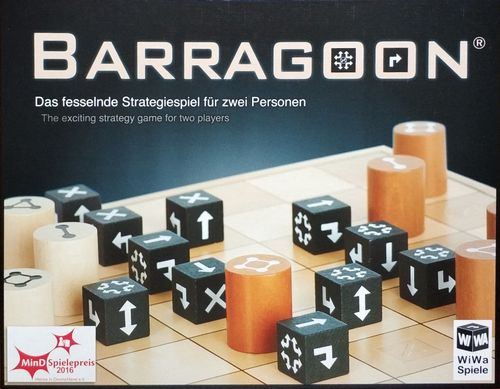
Barragoon
Barragoon Rulebook
Table of Contents
Table of Contents
Components
- 1 set of instructions
- 1 board
- 32 black Barragoon pieces
- 7 white tiles
- 7 brown tiles
1. Preparations for Play
The players draw lots to decide who is to play with which colour.
The 14 tiles and the first 8 Barragoon pieces are arranged on the board in their starting positions (closed variant). The remaining 24 Barragoon pieces are placed next to the board. They are added as the game progresses.
2. Play
Both players use their tactical skills to move their tiles (see 4.1 Moving a Tile) and arrange the Barragoon pieces (see 3. The Barragoon Piece) to enable them to capture all their opponent's tiles or to impede their opponent's progress.
A player has lost when he no longer has any tiles that he can move.
The player with the white tiles begins and moves one of his white tiles. Players take turns to move.
3. The Barragoon Piece
The Barragoon piece is the central element of the game. It blocks or frees the tiles to be moved in specific directions, depending on the direction indicated by the uppermost symbol.
Note: If the uppermost symbol on a Barragoon piece frees up movement in a particular direction, this means that all other directions are blocked.
3.1 Barragoon Symbols
- No Entry — The Barragoon piece cannot be crossed by any tile.
- One Way — The Barragoon piece can only be crossed by any of the tiles in the one direction indicated by the arrow.
- Two Ways — The Barragoon piece can only be crossed by any of the tiles in either of the directions indicated by the arrow.
- Right Turn — The Barragoon piece can only be crossed by any of the tiles with a right turn in the one direction indicated by the arrow.
- Left Turn — The Barragoon piece can only be crossed by any of the tiles with a left turn in the one direction indicated by the arrow.
- All Turns — The Barragoon piece can be crossed by any tile from any direction, but only in the eight arrow directions indicated (in other words always with a turn and never straight through).
In principle, a Barragoon piece with any symbol uppermost can be captured by all tiles. There is one exception! If the All Turns symbol is uppermost, the Barragoon piece cannot be captured by the 2-space tiles.
3.2 Placing a Barragoon
If a captured Barragoon piece (see 4.5 Capturing a Barragoon) is returned to a new position on the board, or if new Barragoon pieces are added when a tile is captured (see 4.4 Capturing a Tile), then proceed as follows:
a) The Barragoon is placed so that the chosen symbol faces upwards. b) The uppermost symbol (if direction-dependent) is turned to the chosen direction (see 3.1 Barragoon Symbols). c) Once the player lets go of the Barragoon, he can no longer change its position or direction.
The Barragoon piece should be kept in your hand until you place it back on the board, otherwise it is easy to forget to use it!
If the next tile is moved before the Barragoon has been placed, this move must be immediately halted or reversed. Otherwise the player will be deemed to have forgotten to place the Barragoon and the piece remains out of play.
4. The Tiles
There are three different kinds of tile in each colour:
- The 2-space tile. As the value indicates, this can move 2 or, alternatively, just 1 square (short move).
- The 3-space tile. As the value indicates, this can move 3 or, alternatively, just 2 squares (short move).
- The 4-space tile. As the value indicates, this can move 4 or, alternatively, just 3 squares (short move).
4.1 Moving a Tile
- A tile moves from its starting square to its target square. The target square counts as part of the move, however the starting square does not.
- A tile may be moved in any direction horizontally or vertically. It may not be moved diagonally.
- A tile may only change direction by an angle of 90 degrees once during a move. You are not permitted to turn more than once or to change direction by 180°!
- A Barragoon piece can be crossed during a move if the direction indicated by the uppermost symbol permits (see 3.1 Barragoon Symbols). The square occupied by the Barragoon is counted when crossed.
- If the Barragoon piece forces the user to turn, this change of direction counts as part of the move. In other words it is not possible to turn again before or after this Barragoon piece as part of the move.
- You cannot jump over your own tiles or those of your opponent.
- You cannot capture your own tiles using one of your own tiles.
4.2 Short Move
The 2-space tile moves 1 square. The 3-space tile moves 2 squares. The 4-space tile moves 3 squares.
Note: A tile can only move in a short move, but cannot capture another piece.
A tile can only move to an unoccupied square in a short move. The square cannot be occupied by a tile, whether your own or an opponent's, or by a Barragoon piece.
4.3 Full Move
The 2-space tile moves 2 squares. The 3-space tile moves 3 squares. The 4-space tile moves 4 squares.
A tile can move and capture other pieces in a full move. It can:
a) move to an unoccupied square. The square is not occupied by a tile, whether your own or an opponent's, or by a Barragoon piece. b) move to a square occupied by an opponent's tile. The opponent's tile is thus captured (see 4.4 Capturing a Tile). c) move to a square occupied by a Barragoon piece. The Barragoon is thus captured (see 4.5 Capturing a Barragoon). Exception: The 2-space tiles cannot move to a square occupied by a Barragoon piece with an All Turns symbol uppermost. In other words you cannot capture it!
4.4 Capturing a Tile
If a tile lands on a square occupied by an opponent's tile during a full move, it captures this tile.
If Player A (e.g. white) captures a tile belonging to Player B (e.g. brown), then the relevant tile belonging to Player B is removed from the board. Player A then picks up two of the Barragoon pieces next to the board and gives one of them to Player B.
Both players keep their Barragoon pieces in their hands (to ensure they don't forget to place the Barragoon piece). Now Player B first places his Barragoon piece on his chosen square on the board (see 3.2 Placing a Barragoon). Player A now also places his Barragoon piece on his chosen empty square on the board, also proceeding according to 3.2 Placing a Barragoon.
It is then the other player's turn.
4.5 Capturing a Barragoon
If a tile lands on a square occupied by a Barragoon piece during a full move, it captures this piece.
Note: The 2-space tiles cannot capture a Barragoon piece with the All Turns symbol uppermost!
The captured Barragoon piece is then immediately placed by the same player on another empty square on the board (see 3.2 Placing a Barragoon).
It is then the other player's turn.
4.6 If You Touch It, You Move It
Once you have touched one of your own tiles you must move it, provided that at least one possible square is available. Once the player has let go of a tile on its square, he can no longer move it.
Once a Barragoon piece or an opponent's tile has been touched it must be captured, provided this is possible with the player's own tile that was first touched. If the opponent's tile or the Barragoon is touched first, it must be captured provided this is possible using any one of the player's own tiles.
5. Examples
The rulebook illustrates the following cases with diagrams:
- A full move with a 4-space tile.
- A short move with a 3-space tile.
- Capturing a piece with a 3-space tile.
- Capturing a piece with a 2-space tile.
- Two changes of direction are not allowed!
- A piece cannot be captured in a short move!
- The Barragoon piece with the All Turns symbol uppermost cannot be captured by 2-space tiles.
6. End of the Game
The game is over when the player whose turn it is no longer has any tiles left or his remaining tiles cannot be moved.
Special cases:
a) If all the tiles belonging to both players have been captured or are unable to move, the player whose turn it is loses because he is unable to make a move. b) If the tiles of the two players can still move but are unable to capture a Barragoon piece or an opponent's tile in the course of the continued game, the game ends in a draw. c) If the players repeat the same pattern of moves three times, then the player whose turn it is, having completed his turn, can offer a draw. If the offer of a draw is declined, the players must choose a different sequence of moves at the earliest opportunity. Thus, as a rule, the player who declined the draw must perform the first different move. That is, unless no other move is available. If both players are unable to deviate from the repetitive sequence of moves, the game ends in a draw.
Optional Express Rule: Reducing Game Duration in 2 Stages
Stage 1: The player whose turn it is has lost the game if, before making his move, he only has one single playing piece left with which he can move. Stage 1 is indicated by a barragoon placed directly alongside the board.
Stage 2: The player whose turn it is has lost the game if, before making his move, he only has two playing pieces left with which he can move. Stage 2 is indicated by two barragoon placed directly alongside the board.
The express rule can also be applied to balance out differences in playing abilities. The weaker player plays the usual way while the stronger player plays according to the rules for stage 1 or 2 above. Alternatively, the weaker player can play the stage 1 rule while the stronger player plays at stage 2.
The special cases a), b) and c) apply accordingly.
7. Variations
As well as the normal, closed set-up, there is also the so-called open variation. In this case the Barragoon pieces are placed in their starting positions with the All Turns symbol uppermost.