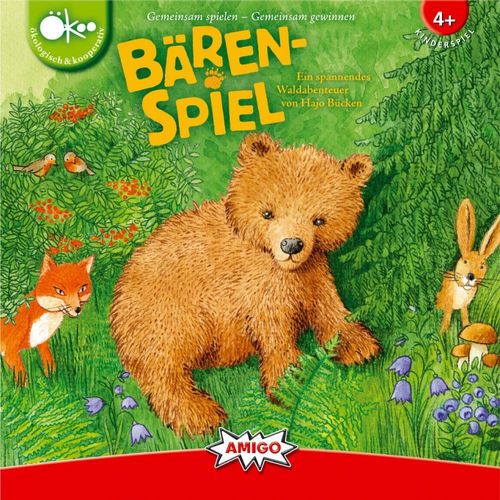
Bärenspiel
Bärenspiel Rulebook
Table of Contents
Table of Contents
Components
- 82 game cards:
- 32 Forest Animal cards
- 32 Path cards
- 16 Obstacle cards
- 2 Little Bear cards (one has a light back and is only used for the twin variant)
- 3 dice
Setup
Return the Little Bear card with the light back to the box. It is only needed for the twin variant (see "Two Variants").
Divide the remaining 81 cards into two piles by back colour, light backs and dark backs. Shuffle each pile separately.
Lay the 25 cards with the dark back facing up in a square of 5 rows with 5 cards each. Then lay the remaining 56 cards with the light back facing up around the square, so that you get a large forest of 9 rows with 9 cards each.
Setup illustration caption: "The big forest of 81 cards."
The Three Dice
The youngest player begins and receives the three dice. Play then continues clockwise.
Turn Sequence
On your turn, roll all three dice.
- For each rolled bear, you may turn over one card.
- For each rolled bear paw, this die may be rolled again.
- For a rolled tree, neither a card may be turned over nor this die rolled again.
Special rule for two players: Even with a bear paw, a card may be turned over.
Important: If you happen to be unable to turn over any card for a whole round in a row (you only rolled trees), then once around the table you may take a turn of "turning over a card" without rolling.
You may help each other decide which cards could be turned over. However, the final decision always lies with the player whose turn it is.
Turning Over Cards
When you turn over a card, a path, a forest animal or an obstacle may appear, or of course the little bear. You may turn over any card on the edge of the forest, or a card that is adjacent to an already revealed path.
Paths
Whoever turns over a path card may immediately turn over one more card adjacent to that path, and so on, until an animal or an obstacle is turned over. Then the player's turn ends, unless they rolled another bear, in which case their turn continues.
Example illustration: "Christian has turned over a path. He may turn over another card." / "Another path! He may turn over one more card." / "A forest animal appears! His turn is over."
Obstacles
When an obstacle is turned over, the path is interrupted and the player's turn ends, unless they rolled another bear, in which case their turn continues.
To get past an obstacle: for a rolled bear, instead of turning over a new card, you may take an already revealed path card from the edge of the forest and place it on the obstacle card. The bear search then continues immediately from this path card, and one more adjacent card is turned over.
Example illustration: "After Uwe has turned over an obstacle, his turn is over." / "Bernd does not turn over a new card for his rolled bear. Instead he takes a path card and places it on the obstacle. Afterwards he may turn over one more card adjacent to this path."
Forest Animals
When a forest animal is turned over, the path ends. The animal must not be disturbed, so the path must be led around the animal. The player's turn is over, unless they rolled another bear, in which case their turn continues.
Example illustration: "Bernd has turned over an animal. His turn is over." / "The next player could lead the path around the animal."
If you cannot continue a path through the forest, you may open a new path from the edge of the forest. It can also help to lead several paths from the edge into the forest from the start.
End of Game
Once the little bear has been found, you can celebrate this bear-strong joint achievement! Now you must escort the bear safely out of the forest. You do this by bringing him out of the forest with four throws along a revealed path. Agree whether one player rolls four times, or several players each roll once.
After each throw, count as follows:
- The bear counts four path cards.
- The bear paw counts two path cards.
- The tree counts one path card.
After each throw, move the Little Bear card the corresponding distance from where it was found toward the edge of the forest. If you manage to move the little bear off the last card of the path in this way, you have all won together!
If the little bear is still standing on a path card after the fourth throw, you have unfortunately had bad luck. Better luck next time!
Example illustration: "Uwe has found the little bear. He rolls a bear paw and moves the bear 2 path cards." / "Bernd rolls a tree and moves the bear 1 path card further." / "Christian rolls a bear (4 path cards) and can bring the little bear out of the forest for everyone after 3 throws. A 4th throw is no longer needed."
In very rare cases, the animals in the forest may want to keep the little bear with them. If they surround him so that you cannot find him, the animals have won!
Two Variants
The Memo Game
A memory game is hidden in the Bärenspiel. Two matching obstacle cards, two matching animal cards, and the two bear cards each form a pair. The path cards do not take part.
Lay out the 50 cards in no particular order, face down on the table. In turn, each player turns over two cards. Whoever finds a pair may take both cards and turn over two more cards. You remain on your turn until you turn over two cards that do not match. Then the next player takes their turn.
Of course, you may also help each other here.
The Twin Game
Here two little bears have got lost in the forest: the bear twins. They, too, want to get back to their parents as quickly as possible. Take both Little Bear cards into the game and remove any one other card.
Setup and turn sequence remain the same. Once you have found both bears, you may roll five times to escort the twins out of the forest. If a bear is revealed at the edge of the forest, it still needs one more step to leave the forest.