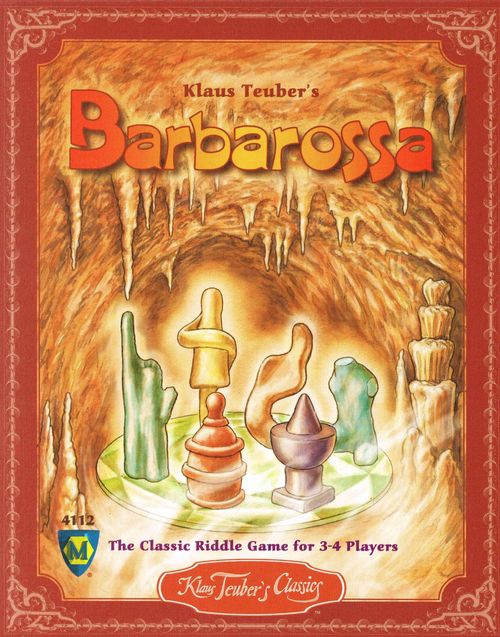
Barbarossa
Barbarossa Rulebook
Table of Contents
Table of Contents
Game Material
- 1 rule booklet with supplement sheet
- 1 game board
- 4 sets of playing pieces (in 4 colours), per set: 1 playing figure (magician), 1 round movement stone (magic hat), 1 square counting stone (elfstone)
- 1 die
- 1 pad of paper
- 1 riddle disc (jewel tile)
- 6 event tiles
- 4 sticks of modelling clay in 4 colours
- 13 spears (arrows)
- 12 curse tiles (curse tokens)
Before the first game: carefully press the cards and tiles out of the two boards.
Game Preparation
Each player chooses a colour and receives in that colour: 1 playing figure, 1 movement stone, 1 counting stone, and 1 stick of modelling clay.
Place the riddle disc in the middle of the table. Lay the event tiles along the edges of the riddle disc in the order 1-6.
Each player places their playing figure on the event tile with the question mark.
Lay out the game board next to the riddle disc with the event tiles. The game board shows a movement track with a start space and a finish space, as well as a jewel counting track.
- Each player places their round movement stone on the start space of the movement track.
- The counting stones go on the space "12" of the jewel counting track.
- Each player receives 3 curse tiles.
- The die, the spears and the pad of paper are placed ready.
Game Overview
The old Emperor Barbarossa is bored in his cave. He invites you to a riddle duel. You and your fellow players use modelling clay to depict things of everyday life as riddles. Each player tries to be the first to solve the riddles of the other players. Whoever shapes their riddles so that they are neither too hard nor too easy, and who solves the riddles of their fellow players first or second, may advance on the movement track. Whoever reaches the finish space first wins the game.
Choosing the Riddle Terms
Each player chooses terms from the riddle list on the supplement sheet that they would like to depict with their modelling clay as riddles.
- With 3 players, each player chooses 3 terms.
- With 4 players, each player chooses 2 terms.
Of course, each player may also think up their own terms. In doing so, however, the following points should be observed:
- No abstract terms such as "honour" or "courage" may be chosen.
- The chosen term should be found in the dictionary.
Each player notes their terms on a slip of paper (keep this absolutely secret), folds the slip and pushes it under the game board. The slip is intended to prevent a player from unfairly changing the solution of one of their riddles during the game. At the end of the game, each player may look at the slips of their fellow players.
Shaping the Riddles
Each player now models their 2 or 3 riddles. The important thing is that the object or living creature that is depicted with the modelling clay is not recognised straight away. Therefore only the approximate shape of an object or living creature should be depicted.
On the other hand, the shape of the riddle should also not deviate too much from its original, because that makes the riddle too hard. On the front of the supplement sheet you will find examples of riddles that are shaped too simply or too hard.
The finished riddles are placed on the riddle disc. The game can begin!
The Course of Play
The player who was first to shape their riddles and place them on the riddle disc begins.
Whoever is on turn rolls the die and moves their playing figure clockwise as many event tiles onward as they have rolled pips. The further actions depend on which event tile the player has landed on with their figure.
Instead of rolling the die, a player may also spend jewels in order to reach one quite specific event tile as their target space. The player announces how many of their jewels they want to use up and moves their playing figure onward by that many spaces. Then they move their counting stone back on the jewel track by the number of jewels used up.
Once the player has carried out the action of the event tile, the next player clockwise is on turn.
(Note from the English edition: a player may never spend more jewels than they have, and a player who has no jewels must roll the die to move.)
The Events
Dragon
If the player lands with their figure on a dragon space, all the other players move their movement stone 1 space forward on the movement track in the direction of the finish.
Jewel
If the player lands with their figure on a jewel space, they receive a jewel, which they mark with their counting stone on the jewel track. If a player already owns 13 jewels, they receive no further one.
Letter Dwarf
Whoever lands on this space may ask a fellow player for any letter of one of their riddles. The questioner points at the riddle concerned and then asks the shaper of the riddle for, for example, the first letter or the third or the last.
The shaper of the riddle writes the requested letter secretly on a slip of paper and hands it folded to the questioner.
Question-Mark Space
If a player lands with their figure on the question-mark space, they receive the opportunity to ask questions about riddles and to solve a riddle. Two phases are available to them for this: the question phase and, following it, the solution phase.
A — Question Phase
The player points at a riddle and asks a general question about it. It may be asked, for example: "Is it a living creature?" — "Is it edible?" — "Is it bigger than me?" — "Did it already exist 1000 years ago?" — "Is it a tool?" It may not be asked concretely for the solution of the riddle, as for example: "Is that a hedgehog?"
The player does not have to limit their questions to one riddle; they may ask questions about different riddles one after another (as long as they receive no "no" as an answer, see below).
The questioned shaper of the riddle must answer aloud and truthfully — namely with one of these 4 permitted statements:
"YES" "POSSIBLY" "NOT CLEARLY ANSWERABLE" "NO"
A player's question phase ends as soon as one of their questions is answered with a "no". The solution phase follows.
B — Solution Phase
The player has two possibilities:
- They may, as in the question phase, ask general questions about riddles and — as long as they receive no "no" as an answer — may at any time try to solve a riddle.
- The player immediately tries to solve one of the riddles.
In any case, either a solution attempt or a "no" ends the player's solution phase and with it also their turn.
Solving a Riddle
If a player is in their solution phase and is of the opinion that they know the solution of a riddle, they write the solution word secretly on a slip of paper, fold it and hand it to the shaper of the riddle. The riddle shaper tells all players whether the solution is right or wrong.
If the solution is wrong, nothing further happens. The player's turn is ended.
If the solution is right, the riddle solver sticks a spear into the riddle concerned. No riddle can be solved more than twice, so each riddle can receive a maximum of only 2 spears.
A correct solution has consequences both for the riddle solver and for the riddle shaper.
The riddle solver
The riddle solver moves their movement stone 5 or 3 spaces forward in the direction of the finish:
- by 5 spaces if they solved a riddle as the first player (the riddle received a spear for the first time).
- by 3 spaces if they solved a riddle as the second player (the riddle received a spear for the second time).
The riddle shaper
The riddle shaper may either move forward with their movement stone in the direction of the finish, or they must move backwards with their movement stone. What is decisive for whether it goes forwards or backwards for them is the total number of all spears that are now stuck in all the riddles:
| Spears in all riddles | Movement stone moves |
|---|---|
| 1 or 2 spears | 2 spaces back |
| 3 spears | 1 space back |
| 4 spears | no effect |
| 5 or 6 spears | 1 space forward |
| 7 or 8 spears | 2 spaces forward |
| 9 spears | 1 space forward |
| 10 spears | no effect |
| 11 spears | 1 space back |
| 12 or 13 spears | 2 spaces back |
Even when a player has solved a riddle, their turn is thereby ended.
(Note: you may never solve — or guess at — your own riddles.)
Special Action: Playing Curse Tiles
Each player owns 3 curse tiles. Whoever wants to play a curse tile calls out "Curse!" and thereby interrupts the game. They may do this at any point of the game, only not during the solution phase of a fellow player.
Whoever has pronounced a curse hands in a curse tile. Then the player may either:
- demand a letter, as described under the event "Letter Dwarf",
- or they may try to solve a riddle.
Afterwards the game is continued at the interrupted place.
Should several players curse at the same time, the die is rolled. Whoever rolls the highest number of pips may use their curse first. The others decide afterwards whether they want to use their curse or take it back.
(The English edition adds: used curse tiles are put in the middle of the board, and once five curse tiles have been used, each player may — once per game — take three curse tiles back if they have run out of curse tiles. This means each player can use six curse tiles over the course of the game.)
The End of the Game
The game ends either:
- as soon as a player reaches the finish space of the movement track with their movement stone, and thereby wins the game, or
- after all 13 spears have been stuck into riddles. In this case the player whose movement stone stands furthest forward has won.
(Optional, but recommended in the English edition: when the game ends on the 13th spear, all players score points for each of their riddles that does not have two spears in it — minus 5 points for each riddle with no spear in it, and minus 2 points for each riddle with one spear in it.)
At the end of the game the slips of paper under the game board are revealed. If any player has given a false letter or a wrong answer, don't play with them again.
Two More Tips
1. Store the modelling clay in the zip bags
The modelling clay enclosed with this game is a high-quality, non-greasy modelling compound from the Weible company. It does not dry out. Nevertheless we recommend that you close the modelling clay after each game in the four zip bags enclosed with this game. Should you need new modelling clay, you can order it from the Catan shop: www.catanshop.de.
2. Info notes
For the writing down of letters and riddle solutions, each player takes as many slips of paper as they have fellow players, folds each slip once into a note and writes the name of a fellow player on the front of each note. The information can now be written in the folded area and handed to the fellow player concerned to look at.
Riddle Examples
When you depict an animal or an object as a riddle, you should model only the rough outlines of the object. You should not depict telltale details. But you should also not distort the outlines of the riddle object so strongly that there are no more clues at all that lead to the solution.
A bird (blue clay):
- Too easy! The only question is whether the solution of the riddle is "stork" or "flamingo". (A bird modelled with a distinct beak, head, neck and several legs.)
- Exactly right! A sleeping flamingo on one leg. (A rounded body on a single thin leg.)
- Too hard! There are no clues at all that could lead to the solution of the riddle. (A featureless blob.)
An ant (red clay):
- Too easy! Ant, wasp, or bee? Whoever learns the first letter of the riddle also knows the solution. (A body with all the legs modelled.)
- Exactly right! The segments of an insect body are enough as a clue. The telltale legs were left off.
- Too hard! Here one thinks rather of a bone. Every clue to the solution "ant" is missing.
The Eiffel Tower (green clay):
- Too easy! Who does not know the famous landmark of Paris? (The tower with its lattice arch modelled in.)
- Exactly right! Whoever has a little imagination will soon question the shaper of the riddle in the direction of "Eiffel Tower". (The tower's silhouette only — a tapering shaft on splayed feet.)
- Too hard! Here too every clue is missing. (A plain tapering spike.)
List of Terms for Shaping Riddles
The supplement sheet's riddle list is printed in German. The terms are given below in the original German with an English gloss, in the order printed on the sheet.
Airbag (airbag), Altar (altar), Ameise (ant), Ameisenbär (anteater), Augenbraue (eyebrow), Bauchnabel (navel), Biberschwanz (beaver tail), Boxer (boxer), Cannelloni (cannelloni), Dusche (shower), Feuerwehrauto (fire engine), Fingernagel (fingernail), Flaschenöffner (bottle opener), Fledermaus (bat), Fluss (river), Fondue (fondue), Fühler (antenna/feeler), Gangway (gangway), Geldbörse (purse), Geysir (geyser), Glatze (bald head), Handstaubsauger (hand vacuum cleaner), Handtuchhalter (towel rail), Heizkörper (radiator), Holzbein (wooden leg), Hydrant (hydrant), Ingwer (ginger), Jojo (yo-yo), Kaffeemaschine (coffee machine), Kochmütze (chef's hat), Kolosseum (Colosseum), Lampion (paper lantern), Lunge (lung), Misthaufen (dung heap), Panzer (tank), Pappnase (cardboard nose), Petticoat (petticoat), Pfau (peacock), Pferdeschwanz (ponytail), Pinocchio (Pinocchio), Pusteblume (dandelion clock), Rammbock (battering ram), Rüssel (trunk/snout), Sattel (saddle), Sattelschlepper (articulated lorry), Schaukel (swing), Scheinwerfer (headlight/spotlight), Schneidezahn (incisor), Schornstein (chimney), Schuhspanner (shoe tree), Silo (silo), Socken (socks), Solarium (solarium), Sonnenuhr (sundial), Steißbein (tailbone), Taschentuch (handkerchief), Tentakel (tentacle), Uhrzeiger (clock hand), Wasserfall (waterfall), Wassermühle (water mill), Weiche (railway points), Wespentaille (wasp waist), Windel (nappy), Zigarettenstummel (cigarette butt), Zuckerstreuer (sugar shaker), Zyklop (cyclops).
Abrissbirne (wrecking ball), Apfel (apple), Beichtstuhl (confessional), Bismarckhering (pickled herring), Bizeps (biceps), Blaulicht (blue emergency light), Chamäleon (chameleon), Chor (choir), Delta (delta), Drehorgel (barrel organ), Dreispitz (tricorne hat), Druse (geode), Düne (dune), Eiffelturm (Eiffel Tower), Fenchel (fennel), Flamingo (flamingo), Föhn (hairdryer), Freiheitsstatue (Statue of Liberty), Gartenzwerg (garden gnome), Gebetsmühle (prayer wheel), Hagebutte (rose hip), Huf (hoof), Imker (beekeeper), Joch (yoke), Kapitell (capital of a column), Kastagnetten (castanets), Keimling (seedling), Klingel (doorbell), Klappbett (folding bed), Knallfrosch (firecracker), Kobra (cobra), Kopfstütze (headrest), Korona (corona), Kotflügel (mudguard), Kreml (Kremlin), Litfasssäule (advertising column), Mähne (mane), Manschettenknopf (cufflink), Maulwurf (mole), Monokel (monocle), Narrenkappe (jester's cap), Obelix (Obelix), Observatorium (observatory), Popcorn (popcorn), Pumpenschwengel (pump handle), Rapunzel (Rapunzel), Schaum (foam), Scheitel (hair parting), Schlagzeug (drum kit), Schlangengrube (snake pit), Schuhlöffel (shoehorn), Schwimmflügel (armband float), Seegurke (sea cucumber), Sextant (sextant), Sonnentau (sundew), Spareribs (spare ribs), Steckenpferd (hobby horse), Stöckelabsatz (stiletto heel), Taufbecken (baptismal font), Teebeutel (tea bag), Termitenhügel (termite mound), Tiara (tiara), Torso (torso), Tortellini (tortellini), Tretmühle (treadmill), Türangel (door hinge), Ufo (UFO), Wadenwickel (calf compress), Walnuss (walnut), Wasserpfeife (hookah), Windhose (whirlwind), Zugbrücke (drawbridge), Zypresse (cypress), Schädel (skull).
Bagger (excavator), Hai (shark), Sarg (coffin), Wippe (seesaw), Garnele (prawn), Bett (bed), Keule (club/leg of meat), Darm (intestine), Kissen (cushion), Kuh (cow), Paprika (pepper), Schinken (ham), Geier (vulture), Schulter (shoulder), Stempel (stamp), Schwein (pig), Kreisel (spinning top), Unterhose (underpants), Strauch (shrub), Fliege (fly), Löwe (lion), Lutscher (lollipop), Stachel (spine/sting), Frosch (frog), Schaf (sheep), Palast (palace), Balkon (balcony), Bauch (belly), Gockelhahn (rooster), Urne (urn), Waage (scales), Ohr (ear), Besen (broom), Ente (duck), Daumen (thumb), Küken (chick), Wal (whale), Knie (knee), Geige (violin), Boje (buoy), Schuppe (scale), Verband (bandage), Rübe (turnip), Mund (mouth), Hobel (plane), Burg (castle), Muskel (muscle), Kran (crane), Reiter (rider).
Eichhörnchen (squirrel), Radieschen (radish), Leuchtturm (lighthouse), Galeere (galley), Batterie (battery), Ventilator (fan), Kartoffel (potato), Kaulquappe (tadpole), Revolver (revolver), Perücke (wig), Waschmaschine (washing machine), Lippe (lip), Kotelett (cutlet), Giraffe (giraffe), Krokodil (crocodile), Ofen (oven), Harpune (harpoon), Schnabel (beak), Roboter (robot), Locke (curl), Koralle (coral), Scheune (barn), Pokal (trophy cup), Dreirad (tricycle), Raupe (caterpillar), Beule (bump), Ferse (heel), Wiege (cradle), Mieder (bodice), Aufzug (lift), Theke (counter), Orgel (organ), Hüfte (hip), Wurzel (root), Sänfte (sedan chair), Kamel (camel), Ampel (traffic light), Zwiebel (onion), Kastanie (chestnut), Amboss (anvil), Maske (mask), Brief (letter).
Stiefel (boot), Mönch (monk), Pinguin (penguin), Krabbe (crab), Spinnrad (spinning wheel), Krippe (crib/manger), Qualle (jellyfish), Kanu (canoe), Kehle (throat), Finger (finger), Knoblauch (garlic), Schnecke (snail), Hecht (pike), Schwan (swan), Zopf (plait), Nest (nest), Brosche (brooch), Kaktus (cactus), Matratze (mattress), Warze (wart), Lampe (lamp), Kanone (cannon), Kapelle (chapel), Kinn (chin), Gebiss (denture), Spargel (asparagus), Niere (kidney), Schwanz (tail), Pflug (plough), Geweih (antlers), Aal (eel), Käfig (cage), Bart (beard), Rakete (rocket), Delphin (dolphin), Narbe (scar), Arm (arm), Tanne (fir tree), Ziegel (brick/tile), Stoßzahn (tusk), Kaugummi (chewing gum), Iglu (igloo), Zehe (toe).
Gehirn (brain), Kurbel (crank), Pfeife (pipe), Schwamm (sponge), Mühle (mill), Saurier (dinosaur), Bumerang (boomerang), Anker (anchor), Backe (cheek), Fuß (foot), Mikroskop (microscope), Markise (awning), Orden (medal), Dübel (wall plug), Pizza (pizza), Schnuller (dummy/pacifier), Turban (turban), Xylophon (xylophone), Rutschbahn (slide), Steigbügel (stirrup), Spritze (syringe), Scherbe (shard), Strauß (ostrich), Blumenstrauß (bouquet), Salat (lettuce), Ranzen (satchel), Krokus (crocus), Pickel (pimple/pickaxe), Pflaster (sticking plaster), Luftpumpe (air pump), Bullauge (porthole), Fernglas (binoculars), Auspuff (exhaust pipe), Ananas (pineapple), Quaste (tassel), Toaster (toaster), Handy (mobile phone), Tretroller (kick scooter), Lockenwickler (hair curler), Wunde (wound), Zunge (tongue), Parkuhr (parking meter), Triebwerk (jet engine), Düsenjäger (jet fighter), Schlauchboot (inflatable boat), Nerzstola (mink stole), Schneeschuhe (snowshoes), Außenbordmotor (outboard motor), Teppichklopfer (carpet beater), Blumenkohl (cauliflower), Tanksäule (petrol pump).