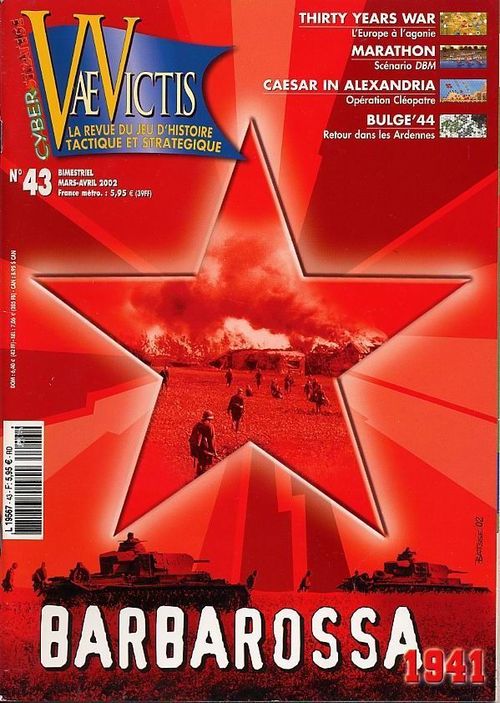
Barbarossa 1941
Barbarossa 1941 Rulebook
Table of Contents
Table of Contents
- 1 - The Counters
- 2 - Sequence of Play
- 3 - Stacking
- 4 – Zone of Control (ZOC)
- 5 - The Movement
- 6 - Combat Phase
- 6.1 - Retreat and Advance after Combat
- 7 - Overrun
- 8 - Supply
- 9 - Reinforcements and Replacements
- 10 - Rail
- 11 - Aviation
- 12 - Special Rules
- 13 - Victory
- 14 - Scenarios
- 15 - Deployment History
- 16 - Abbreviations
- 17 - Operation Typhoon 1941
1 - The Counters
Combat units have the following characteristics:
- Combat potential: used to calculate the balance of power during combat.
- Movement potential: the number of movement points or MPs the unit can spend during its movement phase. Motorized units can also move again during the phase of exploiting half of this potential. Their MP is of a particular color.
- Quality: it is the evaluation of the value of the unit; this value serves as a modifier to the combat die.
- Loss steps (pas de pertes): this is the number of losses the unit can take; is used for combat and for stacking.
Description and Example of Tokens
[The source shows a labelled token diagram here: front and back of a combat unit (NATO code, combat potential, movement potential, black background for a motorized unit, quality, white band "door of one step, or other status"), a colour code for Soviet and German units (Front Nord, Front Centre, Front Sud, Armée de Réserve, Groupe d'Armée Nord, Groupe d'Armée Centre, Groupe d'Armée Sud, Unités en Roumanie, Unités en Finlande, Armée de l'Air, and similar), and examples of units of the different nationalities present (Italy, Finland, Romania, Hungary). The diagram is an image and is not transcribed.]
2 - Sequence of Play
2.1 - Axis Operations Phase
- Isolation Phase (from turn 2).
- Air corps rebasing (from turn 2).
- Replacements and reinforcements (from turn 2).
- Movement by rail (from turn 2).
- Fort construction (from turn 4).
- Movement.
- Combat.
- Exploitation of motorized units.
- Moving "rail markers".
2.2 - Soviet Operations Phase
- Isolation Phase (from turn 2).
- Replacements and reinforcements.
- Placement of partisans.
- Movement by rail.
- Fort construction (from turn 2).
- Movement.
- Combat.
- Exploitation of motorized units.
2.3 - Victory Phase
3 - Stacking
It is allowed to stack in each hex a maximum of 6 points, corresponding to the unit loss steps.
4 – Zone of Control (ZOC)
Any unit or stack representing at least 2 levels (stacking points) has a ZOC. A ZOC is represented by the 6 hexes adjacent to the hex where the unit is located in the direction of the hexes where the units present could access by spending their entire MP.
Note: This means for example that a motorized unit does not exert ZOC towards a marsh hex in mud weather because its reduced MP prohibits it from entering it.
Opposing ZOCs exert each other mutually.
An enemy ZOC is canceled by the presence of a friendly unit for supply, rail movement and retreat after combat. However, the presence of a friendly unit does not cancel the obligation to stop in a hex in an enemy ZOC during normal movement or exploitation.
ZOCs do not extend into a major city hex, nor across estuaries, lakes, and straits while they are impassable.
Note: A unit can therefore always retreat into a Major City if it fights in an adjacent hex.
5 - The Movement
5.1 - Movement Phase
It concerns all units, which move on the grid of hexagons by spending the number of movement points indicated by the terrain table (TEC).
Cavalry units move by expending non-motorized movement points and mobile groups motorized points.
A unit must stop its movement as soon as it enters an enemy ZOC.
A unit must always spend 1 additional MP to leave an enemy ZOC.
A unit can only pass directly from an enemy ZOC to another if it is faster than the enemy units projecting these ZOCs. If not, it must first enter a free hex.
A unit can always move at least 1 hex per phase within the limits of the rules mentioned above.
5.2 - Exploitation Phase
In clear weather, motorized units in supply may move half their movement allowance (rounded up for fractions) during the exploitation phase. In freezing weather, the exploitation movement is fixed at 2 MP for all motorized vehicles, whatever their initial MP.
5.3 - Reaction Movement
For each friendly hex attacked during the enemy combat phase, a unit may attempt a reaction movement at the moment of combat.
This unit must:
- be motorized or cavalry;
- be within a maximum of 2 hexes of the combat (in an adjacent hex in mud or very cold weather);
- and not be itself attacked;
- if the unit is Soviet, it must not itself be in an enemy ZOC.
She makes a reaction test by rolling a D6. If the D6 is less than or equal to the quality of the unit, the test is successful and the movement can take place. The unit thus activated can move half its MP in any direction, cannot perform an overrun and must not violate the stacking limit. The reaction movement costs no MP.
Note: The interest of the reaction movement is either to reinforce a defender thanks to a nearby motorized support, or to open up an axis of retreat for him in case he is surrounded by enemy ZOCs.
5.4 - Strategic Movement
Any unit that does not enter an enemy ZOC receives 1 additional MP to spend during its movement phase (not in the exploitation phase).
Terrain Effects Chart (TEC)
| Terrain | MP Non Motorized / Motorized | Combat Defense Ratio |
|---|---|---|
| River | +1 if ZOC | Units across river only: AF / 2 |
| Rough | 1 | Motorized: Ratio - 1 |
| Forest | 1 / 2 | Ratio - 1 |
| Swamp | 2 | Motorized: CF / 2, Ratio - 1 |
| Mountain | 2 / 3 | Motorized: CF / 2, Ratio - 1 |
| City | Ratio - 1 | |
| Major City | Motorized: CF / 2, Ratio - 1; All: A1 | |
| Fortification | 1d6 - 1 |
6 - Combat Phase
Phasing units are never forced to attack. When several enemy units are in the ZOC of an attacker, it is also not mandatory to attack them all. Combat resolution follows the following routine:
- Choice of combat options: The players announce before the combat is resolved the options they choose, in this order.
- Air and/or naval support: attacker then defender.
- Artillery support: defender then attacker.
- Airborne support: attacker only.
- Zhukov option: Soviet only.
- Helping hand: (for the attacker) last.
- Possible reaction movement: of a mobile unit of the defender (possibly reinforcing the defender or covering a retreat path by occupying a hex in an enemy ZOC).
- Determination of the amplitude of the attack: depending on the number of steps on the more numerous side (attacker or defender), the attacker rolls one or two dice. 1 to 6 steps: one die, 7 steps and more: two dice.
- Indication of the "assault leader" unit: for each side starting with the attacker. This unit will take the first loss step and will be used to calculate the quality bonus. When a motorized unit participates in an attack, it must become an assault leader.
- The differential of the qualities of the two lead units gives a positive or negative modifier to the ratio of forces (a shift varying between - 4 and + 4 columns on the combat table).
- Determination of the ratio of forces: depending on combat value and terrain. Fractions are rounded in favor of the defender.
- Application of results: The numbers obtained are the number of step losses for each side. The defender's second loss step can be transformed into 1 hex of retreat. The attacker applies his results first. He cannot retreat and must suffer all results in no losses.
Exceptions:
- Soviet units do not retreat on turn 1 and must suffer all combat results as losses.
- Static units (garrisons and militias) cannot retreat and must take steps.
Combat Results Table (CRT)
| Die | 1:3 | 1:2 | 1:1 | 3:2 | 2:1 | 3:1 | 4:1 | 5:1 | 6:1 | 7:1 |
|---|---|---|---|---|---|---|---|---|---|---|
| 1 | A2 | A2 | A1 | A1 | A1 | A1D1 | A1D1 | A1D1 | A1D1 | A1D2 |
| 2 | A2 | A1 | A1 | A1D1 | A1D1 | A1D1 | A1D1 | A1D1 | A1D2 |
6.1 - Retreat and Advance after Combat
A retreating stack of units must do so in the direction of a supply source. If it retreats into an uncancelled enemy ZOC, the stack loses an additional loss step. Retreat through enemy units is prohibited.
If no retreat is possible, the stack remains in place and takes the indicated losses. Victorious attackers may advance into the defender's hex within the limits of stacking and regardless of any opposing ZOCs.
7 - Overrun
Any stack of motorized units in supply that does not begin its move in an opposing ZOC may make a crushing attack during its move.
This attack is possible during the movement phase and the exploitation phase but not during the reaction phase.
Units must expend the defender's terrain MP plus 1 MP and resolve the attack as normal.
A successful helping hand allows an overrun across a river (12.6).
7.1 - Prohibited Areas
Overruns are not allowed in the following terrain hexes: major city, swamp, arctic, or across rivers.
7.2 - Limit
No naval or artillery support is possible but air support is allowed.
At the end, the units of the attacking stack can enter the attacked hex if it is free and continue to move if they still have MPs, possibly spending +1 MP to leave this enemy ZOC.
8 - Supply
It is judged during the isolation verification phase.
Units, to be in supply, must trace a supply line of a length less than or equal to their actual MP (i.e. possibly modified by the weather) to a source of supply or a railway line connected to a source.
The cost of land depends on whether the unit is motorized or not; the unit hex is not counted but the arrival hex is. Enemy ZOCs block the supply line unless a friendly unit is present.
Any unit unable to trace such a line is out of supply and receives an "Isolated" marker.
8.1 - Penalties
No exploitation movement for motorized units.
During combat: penalty of -2 to the D6 when the isolated unit takes part in an attack. Bonus of +1 to D6 (for the attacker) when the isolated unit is defending.
During the isolation phase, the state of out-of-supply units is examined. If they are able to trace a supply line, the marker is removed. Failing this, the marker remains in place and 1 step loss is eliminated for each stack.
8.2 - Supply Sources
For the Axis: the following major cities: Königsberg, Warsaw, Helsinki and Bucharest and the rail hexes exiting from the western edge of the map. Helsinki may supply non-Finnish units only if Königsberg, Riga and Talinn are Axis controlled.
For the USSR: any major city connected by rail to the eastern edge of the map. Isolated Russian major cities (ie all majors in the USSR except Lvov and Riga) act as a limited supply source for 4 Soviet steps.
Permanent forts (Sevastopol) are always in supply.
Ports: For the side with naval superiority, any port whose land communications are cut off may act as a limited supply source for 2 steps. To have naval superiority, you must control 2 out of 3 ports in the Black Sea and 3 out of 5 in the Baltic.
9 - Reinforcements and Replacements
9.1 - Reinforcements
They are deployed according to their turn of arrival at the rate of one unit per major city in their country of origin (Germany Warsaw or Königsberg, Romania Bucharest, Italy hex 0131, Hungary hex 0124, Finland Helsinki) and according to the indications provided by the scenario. If the arrival hex is controlled by the adversary, the unit arriving in reinforcement must arrive in the nearest friendly city. These units play normally during their operations phase.
9.2 - Replacements
Each side receives replacements on its turn. Any unit in supply that has suffered losses may receive 1 replacement step per turn if it is on or adjacent to a friendly railroad hex and, for German units, within 20 railroad hexes of the border (this count can be affected by the placement of followers). The unit receiving the replacement step may be in an enemy ZOC.
9.21 - Base: The number of replacement steps available in the base each turn corresponds to 1/4 of the losses suffered for German infantry and German motorized vehicles and to 1/5 for Soviet infantry.
The Finns and Romanians each have 1 infantry replacement point for the entire campaign.
9.22 - Complement: The Soviet receives 1 to 3 infantry replacement steps per turn starting on turn 2.
- Turns 2 to 5: 2 infantry steps per turn if at least 3 non-isolated major cities, otherwise 1 step.
- Turns 6 to 12: 3 infantry steps per turn if at least 3 non-isolated major cities, otherwise 2 or 1 step.
He additionally receives 1 motorized replacement step per turn starting on turn 3 depending on the control of Leningrad and Kharkov.
- Turns 3 to 5: 1 motorized step per turn if 2 cities are controlled.
- Turns 6 to 7: 1 motorized step per turn if 1 controlled city.
- Turns 8+: 1 motorized step per turn.
The German also has 5 infantry replacement steps (≤ 2 per turn) and 3 motorized steps (1 per turn) for the entire campaign.
Finland: 1 infantry step for the entire campaign available from turn 3.
Romania: 1 infantry step for the entire campaign available from turn 3.
Italy, Slovakia and Hungary: no replacements.
Loss marker: During each combat, the loss marker is advanced one space per step destroyed, except if, during its destruction, the unit carries an isolated marker or if it is surrounded by non-cancelled enemy ZOCs.
During each side's replacement phase, 1 replacement step is made available for every 4 (German) or 5 (USSR) steps eliminated (1/4, 1/5: 9.21).
The following units are not counted in the casualty tally: cavalry, militia, airborne, forts.
Example: the marker for Soviet infantry replacements is on space 7 (corresponding to 7 steps eliminated so far). The Soviet player receives 1 replacement step and the marker is placed on space 2 (corresponding to 7-5).
Replacements are used to create new combined units, replenish weakened units or replenish destroyed units.
A reconstituted unit has only one step loss.
Only Soviet 4-2-3 / 2-2-3 armies can be brought back into play after being eliminated. The Soviet may place it in any city he controls.
The German places it as a reinforcement.
A weakened unit is replenished on the spot.
A German corps (infantry, security and panzer) does not come back into play when its last step is destroyed. In its place an "ersatz" 3-3-3 corps can be brought into play by expending a replacement step as a reconstituted unit.
Soviet mechanized corps (Mec/Cav) cannot be replenished when depleted, nor replenished when destroyed.
10 - Rail
During his rail movement phase, each player can move his units by spending the rail points available each turn (2 for the Axis, 4 for the Soviets).
10.1 - Limit
The cost is 1 rail point per unit step moved. This movement may have a maximum length of 20 hexes entirely on connected railroad hexes belonging to the friendly network. The convoyed unit must be in supply and not be in an enemy ZOC at any time during the movement (unless there is a friendly unit present). The movement uses all of its MP.
10.2 – Friendly Rail
The friendly rail is initially the one included in the borders of his country. All connected rail hexes between a rail marker and an Axis supply source belong to the Axis rail. All connected rail hexes between a marker and a Soviet supply source belong to the Soviet rail.
10.3 - Rail Markers
To determine the part of the Soviet railway network that it controls, the Axis has "rail markers". At the end of its operations phase, each marker may advance 3 hexes of connected rail provided they are not in an opposing ZOC. Rail segments not exceeding 3 hexes between two forks are considered Axis-controlled as long as each end receives a "rail marker". Freed markers (when 2 rail sections join) are immediately reusable on other railroad segments.
11 - Aviation
Each camp has an air corps. The first number of the token represents the bonus of combat columns given by the unit and the second its radius of action expressed in hexes. The number of air corps available is 4 for the Axis and 2 for the Soviet. Soviet air corps arrive as reinforcements during the game on any major city controlled by the player.
11.1 - Air Bases
Cities serve as airbases. Each minor city can host 1 air corps, and each major city 2. During the common phase of each turn, both players can rebase all their air corps. The new air base must be a city located within the range of the air corps, ie 6 hexes for the German and 5 for the Soviet. If an enemy unit enters an air base, the air corps present are eliminated and come back into play two days later as reinforcements.
11.2 - Air Support
The attacker decides first whether to assign air support on each attack. The number of air corps that can take part in a combat is limited to 1 per side. Each air corps can intervene once per turn, in attack or in defense.
12 - Special Rules
12.1 - Naval Movement
Each side may move a unit worth up to 2 step losses per turn between controlled ports in the same sea (Baltic or Black Sea). Only the side that controls a majority of ports in the sea in question has the right to make this move. The unit must start the movement phase in the port of embarkation. Naval movement consumes all its MP.
12.2 - Axis Countries
Romanians: Romanian units may neither be stacked on nor attack with Hungarian units. The 3rd and 4th armies have 3 step losses: 4-3-3 / 2-3-3 / 1-3-3.
Finns: Finnish units South or East of their 1940 border may move normally but may not enter an enemy ZOC (a Finnish corps may very well capture Leningrad if the Soviet does not leave a garrison there). They can attack across this border but not beyond.
Hungarians: The entry into the war of the 2 Hungarian units is conditioned by some initial successes in Operation Barbarossa (See paragraph 13-Victory).
Italians: Italian units may not enter a hex adjacent to the Black Sea or Sea of Azov.
Garrison: Axis units can garrison objective cities.
12.3 - Weather
Weather Zones: The map includes two weather zones, North and South which have varying conditions as shown on the game calendar. The first variable is the North weather zone and the second is the South zone.
Clear weather: No particular effect.
Mud: All units have 2 MP except cavalry which has 3 MP. No motorized operating movement. No reaction movement. No air support possible.
Freeze: All infantry units have 2 MP, all motorized and cavalry 3 MP. Possible exploitation movement of all motorized units on a uniform value of 2 MP. German air support is halved (+1 and not +2).
Extreme cold: All infantry units have 2 MP, all motorized vehicles and cavalry 3 MP. Motorized exploitation movements are not permitted. Combat suffers a -1 penalty to D6 in attack. Except for combats in which the "attack leader" unit is a mountain unit, a Finnish unit, a Guard corps or a shock army. No reaction movement. German air support is halved (+1 and not +2).
12.4 - Fortifications
There are two types of fortifications. On the one hand the permanent fortifications (Sevastopol). On the other hand the fortifications built during the campaign.
Permanent fortification of Sevastopol: its combat value is indicated on the name counter. During a defensive combat, this value is added to that of the Soviet units present in the hex. The player can also use his quality of 3. This fort is worth 2 step losses.
Field fortifications: they give a defensive bonus limited to -1 to the attacker's D6. The field fortification is automatically destroyed when an enemy ground unit enters its hex.
Construction: The Soviet player may fortify 2 hexes per turn starting on turn 2 and 3 at the time of the turn the Axis controls 8 VP (Total Mobilization event) for a maximum of 12 intact forts on the map. A fort can be destroyed for free per turn to be placed elsewhere.
The German player may fortify 1 hex per turn starting on turn 4 for a maximum of 3 intact forts on the map.
A fort can be built on any hex adjacent to a city (minor or major) or on the city itself, provided the hex is in supply and out of an enemy ZOC. However, the presence of a friendly unit cancels the enemy ZOC. The counter is placed on the hex at the start of the player's Operations Phase and immediately becomes active.
12.5 - Airborne Units
Initial airborne corps: At the start of the game, the Soviet player has 5 airborne corps (located in Minsk, Kharkov, Dvinsk, Kiev and Odessa) but does not have the means to make drops. Each Airborne Corps is an infantry unit worth 0 steps and can move 3 MPs. When participating in a stacked combat with at least one other Soviet unit, the airborne corps gives a bonus of +1 in attack and -1 in defense. He is eliminated regardless of the outcome of the fight. An airborne corps that is not stacked with another Soviet unit is immediately destroyed when an Axis unit of quality 3 or better enters its hex. At the end of turn 5 the initial Airborne Corps remaining in play are eliminated.
Reconstituted Guards Airborne Corps: On turn 7, the Soviet player receives a reconstituted Airborne Corps and then a second on turn 8. A Guards Airborne Corps can enter the game in two ways:
- The Soviet player immediately stacks it on top of a non-isolated Soviet unit and uses it as one of the initial Corps.
- He keeps it off-map until the movement phase of the turn in which he decides to drop it.
One Guards Airborne Corps per turn can be dropped at a distance of 6 hexes during a Soviet movement phase from a supplied Soviet city and not in an enemy ZOC. If the drop hex does not contain an enemy unit, the airborne corps is eliminated on a D6 of 5 or 6. If the hex is occupied by an enemy unit the airborne corps is eliminated on a D6 of 3, 4, 5 or 6.
In the combat phase following its release, it supports a single friendly attack on its hex or on an adjacent hex by giving it its combat bonus (+1) and prohibiting any retreat as well as any adverse reaction movement on its drop hex. The Corps is then eliminated regardless of the outcome of the combat.
The 7.Fallschirmjäger unit: From turn 3, the German receives the 7FjD. He can use it in two ways:
- Or it can be dropped 7 hexes from an Axis controlled city. It survives the drop on a die of 1 to 5 (1 to 4 if it is dropped on a hex containing an enemy unit). It supports any friendly attack targeting its drop hex or an adjacent hex - giving it its combat bonus (+1) and prohibiting any retreat and any enemy reaction movement on its drop hex. It is then eliminated regardless of the outcome of the fight.
- Or it adds 1 infantry replacement point to the German total available for the entire campaign.
Restriction: Regardless of the side, an airborne unit can never be dropped on a major city.
12.6 – Helping Hand ("Coup de main")
Procedure: When a German unit wishes to attack across a river, it can attempt a "Coup de main" to avoid the combat penalties linked to this river. The "Coup de main" is successful on a D6 of 4 to 6.
Limit: 2 hands are allowed in turn 1 and 1 in turn 2. They are forbidden afterwards.
A helping hand can also be attempted to authorize a crush across a river. If the helping hand succeeds, the overrun takes place, but the combat penalty linked to the river (attacker divided by 2) is maintained.
12.7 - Partisans
Starting with the turn where the Axis controls 18 VP, the Soviet player receives 2 Partisans.
Placement: Partisans are placed at the start of the Soviet Operations Phase in any hex at least 5 hexes inside the western border of the USSR, one unit per hex. One of the units must be placed north of the Bobruisk row of hexes.
Apart from this constraint, the Soviet player places his partisans in each turn as he wishes. Non-eliminated partisans remain on the map turn after turn. They do not move during a game turn or from one turn to another.
Note: Counters represent areas of activity and not constituted units.
Effect: A railroad hex with partisans costs 4 points (of the 20 allowed) instead of 1 for railroad movement and for the transfer of replacements. Partisans have no other effect.
Withdrawal: When at any time during the turn a partisan is in the ZOC of an Axis unit (in the same hex for combat units not exercising ZOC), he is removed from the game until at the end of the turn. Eliminated partisans become available again in the next turn.
Major Cities: If a Russian major city (i.e. any Soviet major city except Riga and Lvov) is ungarrisoned at any point in the game (i.e. even before normal partisans), a partisan can be placed there at the choice of the Soviet player. It takes effect immediately. The VPs of a major city liberated by partisans are deducted from Axis VPs, even if it is subsequently reoccupied.
12.8 - Turn 1
The following rules only apply during the first turn of play.
In combat, the Soviet player must take all hits as losses. No retreats are allowed. No Soviet naval support is allowed.
Soviet ZOCs do not operate beyond the USSR state border.
Note: Various rules simulate the surprise effect of the German attack as well as Russian unpreparedness and unsuitable instructions from the first weeks of the war.
German motorized units ignore the effect of Soviet ZOCs for movement during the Movement Phase and the Exploitation Phase.
All German attacks benefit from a +1 modifier to the D6.
The only possible Soviet replacements are base replacements (1/5 infantry losses for a maximum of 2 steps) and not complement replacements (related to controlling major cities) available later.
12.9 - Baltic Fleet
The Soviet player has a VMF unit (Voenno Morskoi Flot, Navy) with 2 loss steps representing the support of the Baltic fleet.
This counter provides a bonus of +1 in attack and -1 in defense to a combat per turn taking place in a coastal hex up to 3 hexes from a Soviet naval base. The initial bases are Leningrad, Talinn and Riga. From the turn where the Axis controls Königsberg, Talinn, Riga and Helsinki, the Gulf of Bothnia is considered mined and the VMF can only support combat on Leningrad and the two adjacent coastal hexes (hexes 1204 and 1305).
To eliminate the VMF, the Axis player must assign one and only one air fleet to this mission (clear and freezing weather only) to the exclusion of any other combat mission. The VMF is reduced by 1 step on a D6 from 1 to 3. After having lost its 2 loss steps, it is definitively eliminated.
12.10 - Specific Grounds
Rivers: If a unit does not enter an opposing ZOC, crossing a river does not cost it additional MP. Same thing when the weather is freezing or very cold.
Lakes and Straits: Hexes and hexsides marked as lakes or straits are normally impassable. A unit does not exercise ZOC through it, nor can it initiate combat. In Extreme Cold weather, these hexsides are ignored. Hexes full of lakes (Ladoga, Onega, Peipous) can be crossed (by respecting the rules relating to the effect of enemy ZOCs on movement, cf 5). However, a unit cannot end its movement there. Sea of Azov hexes may not be crossed in Extreme Cold weather.
Exception: Kerch Strait (hex 1930-2031) can be crossed by units of the side with naval superiority in the Black Sea for 1 additional MP.
Note: This obliges the Axis to take Sevastopol if it wants to approach the Caucasus by this way.
Arctic terrain: 2 MP to enter, no motorized overrun, defensive bonus of -1 column.
12.11 - Soviet Special Units
Operational Groups Luga and Neva: These units appear on turns 2 and 3 near Leningrad. These units cannot return to play once destroyed.
Militias: As soon as the Axis controls 5 Victory Points, the Soviet player has 2 Opolchenie (Militia) units. They may be placed one per Soviet-controlled major city only if an Axis unit is adjacent to it for the first time.
Note: Placement may therefore occur during the Axis Movement or Exploitation Phase. It represents a particular effort of the local authorities in the rapid organization of the defenses of a city.
These units are static, do not move or retreat. They can be voluntarily destroyed by the Soviet. When a Militia is destroyed, it becomes available again for free on the following turn, and can enter the game under the same conditions, but not in the same city (each city can only generate one Militia unit).
Mobile groups: To create a mobile group from a Cavalry Corps, the Soviet player must spend 1 motorized replacement point during the replacement phase. The cavalry corps is then flipped to its mobile group side. It then moves like a motorized unit. The 3 groups Kachalov, Ermakov and Khostenko enter the game directly on their mobile group side and can be reconstituted in the same way. These units cannot return to play once destroyed.
Shock armies: The Soviet player has 4 shock armies (value 6-3-3/4-3-3) available from turn 7. One shock army can be created per turn.
To create a shock army worth 3 steps of losses, it is necessary to spend during the replacement phase 1 infantry replacement point. The shock army then takes the place of a normal army with 2 steps of losses.
Guards Cavalry Corps: The Soviet player has 3 Guards Cavalry Corps (Belov, Dovator and Kriouchenkine). On their turn of arrival, they enter on their Cavalry side (reduced side) into any controlled Soviet city. To create a mobile group from a Guards Cavalry Corps, the Soviet player must spend 1 motorized replacement point during his replacement phase. The Guards Cavalry Corps is then flipped to its mobile group side. It then moves like a motorized unit. These units cannot return to play once destroyed.
12.12 - Artillery Support
Both players have artillery support points: 6 points for the German for the entire campaign (with a maximum expenditure of 3 points per turn). 3 points for the Soviet, available from turn 7 (with a maximum expenditure of 1 point per turn).
In any combat (other than an overrun), each side may allocate 1 artillery support, starting with the defender. He adjusts the "Artillery" marker to the appropriate track. Each artillery support adds 1 automatic loss to the opponent's losses. Artillery support is only available for combat if one of the friendly units participating in the combat is on or adjacent to a controlled railroad.
12.13 – Zhukov (Joukov)
For one attack or one defense per turn starting from the turn where the Axis controls 10 VP, the Soviet player has the possibility of using the Zhukov option. In attack, Zhukov has the following effect: 1 automatic loss for the Soviet and a bonus of +1 to the D6. In defense, the bonus is as follows: 1 automatic loss for each side.
Note: In attack, as in defense, the Zhukov option can be used in conjunction with other modifiers.
Example: Zhukov attack + artillery + airborne: 1 automatic loss for the German, 1 loss for the Soviet and + 2 on the die.
13 - Victory
Victory is judged on the control of geographical objectives at the end of the game. Major cities conquered by the Axis but ungarrisoned do not count towards the total. A minor city is Axis controlled if an Axis unit was the last to occupy it.
The level of victory is to be followed with the ad hoc marker on the victory point track. As the Axis gain control of their objectives, the following events occur and take effect immediately.
- 3 VP: Better late than never: The following Hungarian units enter play as reinforcements on hex 0124: Gyorhadtest 2-3-4 (next turn) and 8th Security Corps 1-2-3 (in two turns).
- 5 VP: The Fatherland in Danger: The two Opolchenie (Soviet Militias) enter the game.
- 8 VP: Resource Mobilization: The Soviet can build three forts per turn instead of two.
- 10 VP: Reorganization of the Stavka: Zhukov option available.
- 15 PV: Planes for Africa: The OKH prematurely considers the campaign won and transfers its planes. Remove 1 German Air Corps.
- 18 VP: The two Soviet Partisans enter the game.
On the other hand, if the Axis reaches 20 VP before the end of turn 6, it wins an immediate victory and wins by sudden death. The game ends.
Note: This represents, for example, a fall of Moscow and other key cities before the onset of winter, and before the Red Army and war production had time to reorganize.
Turn 10 Victory Determination
- Major Soviet Victory: Axis controls 14 points or less.
- Soviet Minor Victory: Axis controls between 15 and 19 points. (Historical situation: 19 points)
- Undecided situation: Axis controls 20 to 25 points.
- Minor Axis victory: Axis controls between 26 and 30 points.
- Total Axis Victory: Axis controls 31 points or more.
Points Awarded for Controlling Objectives
- Moscow: 6 VP
- Leningrad: 4 VP
- Rostov, Kharkov, Sevastopol: 3 VP
- Kyiv, Odessa, Dnepropetrovsk, Voronezh: 2 VP
- Lvov, Minsk, Riga, Volkhov, Rjev, Kalinaine, Vyazma, Kaluga, Tula, Kursk, Smoyensk, Velikye-Luki, Bryansk, Stalino, Orel: 1 VP.
- Finnish occupation zone: 1 VP. To validate this victory point, no Soviet unit must be present in Finland or in the Finnish border zone (hexs 1203, 1204, 1302, 1303, 1402, 1501, 1601, 1602, 1603, 1604, 1701, 1702, 1703, 1803).
14 - Scenarios
14.1 - Historical Scenario
Units are deployed according to their historical position.
14.2 - Hypothetical Scenario
The deployment of units is free, within the following constraints.
Soviet Player: All hexes adjacent to the border must be occupied by a combat unit or in a ZOC. All minor cities four hexes deep inside Soviet territory and all major cities eight hexes deep must be occupied by at least two stacking points.
German Player: Axis minor country units may only deploy in their own country. German combat units deployed in Romania: 6 steps maximum, in Finland: 2 steps maximum. All other German units must be placed in Poland.
14.3 - Optional Rules
14.3.1 - Mandatory Soviet attacks (favours Axis, historical). On turns 1, 2 and 3, the Soviet player rolls 1D6. He halves the result of the die, rounding down to the nearest whole number. The number is the number of hexes he must attack during his turn. If it does not make that number of attacks, the Axis receives +1 Victory Point for that turn. Simulates Stalin's stubbornness in ordering sterile counter-attacks, a mania that he will temporarily abandon in the fall, when the situation is desperate.
14.3.2 - No Fallschirmjäger (favors Soviet, historical). Delete the German reinforcement 7FjD. After the costly victory in Crete, the paratroopers will return to the Eastern front on foot, and will fight in Army Group North.
14.3.3 - Capture of Murmansk (favours the Axis, hypothetical). On turn 5, the Axis player rolls 1D6. On a roll of 6, Murmansk fell under the attacks of General Dietl. The mountain corps Dielt immediately appeared as German reinforcements in Helsinki. An unlikely eventuality, given Dietl's lack of means to achieve his objective and your good defense of Murmansk.
14.3.4 - Early Siberian reinforcements (favors the Soviet, hypothetical). The following Soviet formations arrive earlier than indicated on the calendar: 58th Army (turn 6), 59th Army (turn 7), 60th Army (turn 8). Instead of waiting for winter, the Kremlin quickly decides that there is no Japanese danger in Siberia.
14.3.5 - Masters of the Blitzkrieg (favours Axis). The following rule applies during the Soviet isolation check phase, in clear and freezing weather. Any newly isolated Soviet unit adjacent to a Panzer Corps that does not itself carry an isolated marker receives an isolated marker, and immediately loses one step loss without waiting for the next turn. Recently isolated Soviet formations tended to disintegrate more quickly when pressed by German motorized units.
15 - Deployment History
15.1 - Axis Forces
Finland:
- In Karelia (1301 or 1401): 6th and 7th Corps 2-4-3.
- Adjacent to Vyborg (1102 or 1103): 2nd and 4th Corps 2-4-3.
- Helsinki (0804): Reserve Corps 2-3-3.
- Free placement: Oinonen Group (Mnt) 2-4-3.
Army Group North:
- Konigsberg (0112): Bef 101 1-2-3, 1 Luftwaffe, 23.AK 3-4-3.
- 18.Armee (0312 and adjacent): 1.AK 4-4-3, 26.AK 3-4-3, 38.AK 3-4-3.
- 16.Amee (0314 and adj): 2.AK 4-4-3, 10.AK 3-4-3, 28.AK 3-4-3.
- Panzergruppe 4 Hoepner (0313 and adj): 41.PzK 4-5-5, 56.PzK 3-5-5.
Army Group Center:
- Warsaw (0117): Bef 102 1-2-3, 2 Luftwaffe, 53.AK 3-4-3.
- 9.Army (0216 and adj): 8.AK 3-4-3, 20.AK 3-4-3, 42.AK 3-3-3.
- 4.Armee (0317 and adj): 7.AK 4-4-3, 9.AK 4-4-3, 13.AK 3-3-3, 43.AK 3-4-3.
- Panzergruppe 2 Hoth (0315 and adj): 24.PzK 4-5-5, 46.PzK 3-5-5, 47.PzK 4-5-5, 12.AK 4-4-3.
- Panzergruppe 3 Guderian (0318 and adj): 39.PzK 4-5-5, 57.PzK 4-5-5, 5.AK 3-4-3, 6.AK 3-4-3.
Army Group South:
- Lublin (0219): Bef 103 1-2-3, 1 Lufwaffe, Jager K Mt 3-4-3.
- 6th Army (0319 and adj): 17.AK 3-4-3, 29.AK 3-4-3, 44.AK 4-4-3, 55.AK 3-3-3.
- Panzergruppe 1 Kleist (0220 and adj): 3.PzK 4-5-5, 14.PzK 4-5-5, 48.PzK 3-5-5.
- 17th Army (0120 and adj): 4.AK 4-4-3, 49.Geb K Mnt 3-4-3, 52.AK 3-3-3, Corps Slovak 1-2-3 (0121).
Romania:
- 11th German Army (0727 and adj): 11.AK 3-4-3, 30.AK 3-4-3, 54.AK 3-3-3.
- 3rd Romanian Army (0625 and adj): 4-3-3, Rum Kav 1-3-4, Rum Geb Mnt 2-4-3.
- Bucharest (0531): Rum Sich 1-2-3.
15.2 - Soviet Forces
The cavalry corps (+ Reinforcements and Guards) come into play on their reduced side. Only the 3 mobile groups named after their commander come into play on their reinforced side.
TVD Leningrad:
- 7th Army 4-2-3 + 1 fort: 1402 or 1302.
- 23rd Army 5-2-3 + 1 fort Vyborg: 1204.
- 1-10th Mecha 3-2-4 Leningrad: 1304.
Baltic TVD:
- 8th Army 4-2-3: 0411 or 0310.
- 11th Army Kovno 5-2-3: 0512 or 0412 or 0413.
- 3-12th Mecha 3-2-4: 0511 or 0613.
- 5th Para Dvinsk: 0911.
TVD West:
- 3rd Army Grodno 5-2-3: 0615 or 0514.
- 4th Army Brest 4-2-3: 0418 or 0417.
- 1 Fort Brest: 0418.
- 10th Army Bialystok 4-2-3: 0416 or 0415 or 0316.
- 13th Army Minsk 4-2-3: 0915 or adj.
- 6-11e Mecha 3-2-4: 0515 or 0516.
- 13-14th Mecha 2-2-4: 0416 or 0517.
- 17-20e Mecha 2-2-4: 0716 or 0816.
- 6th Cav 1-2-4: 0618 or adj.
- 4th Para Minsk: 0915 or adj.
TVD South West:
- 5th Army 5-2-3: 0420 or 0419.
- 6th Army 4-2-3: 0321 or 0221 or 0320.
- 5th Cav Lvov 1-2-4: 0321 or adj.
- 12th Army Chernovtsy 5-2-3: 0424 or 0425.
- 26th Army 4-2-3: 0322.
- 4-8th Mecha 3-2-4: 0420 or 421.
- 9-15e Mecha 3-2-4: 0719 or 0520.
- 16-19e Mecha 2-2-4: 0522 or adj.
- 22-24e Mecha 3-2-4: 0621 or adj.
- 1st Para Kyiv: 1121.
TVD South:
- 9th Army 5-2-3: 0829 or 0830.
- 18th Army 4-2-3: 0827 or 0828 or 0927.
- 2nd Cav 1-2-4: 0825 or adj.
- 2-18th Mecha 2-2-4: 1025 or 1027.
- 3rd Para Odessa: 1128.
Reserve:
- 16th Army Kyiv 5-2-3: 1121.
- 19th Army Moscow 4-2-3: 2012.
- 20th Army Smolensk 4-2-3: 1414.
- 21st Army Gomel 4-2-3: 1318.
- 22nd Army Velikye-Luki 4-2-3: 1311.
- 24th Army Rjev 4-2-3: 1711.
- 27th Army Pskov 4-2-3: 1108.
- 28th Army Yaroslavl 4-2-3: 2209.
- 5-26th Mecha Rostov 3-2-4: 2427.
- 7-21st Meca Moscow 3-2-4: 2012.
- 23-25th Mecha Bryansk 2-2-4: 1716.
- 2nd Para Kharkov: 1922.
- 4th Cav Rostov 1-2-4: 2427.
- Permanent Fort Sevastopol: 1532.
15.3 - Reinforcements
Turn 2 (Jul 16 - Aug 5)
- Axis: 50 AK 3-4-3 (0112 Königsberg), 35 AK 3-4-3, 40 PzK 4-5-5 (0117 Warschau), 34 AK 3-4-3 (0121), CSIR ITA 3-3-3 (0131 Craiova), 4th Romanian Army 4-3-3 (0729 Galati).
- USSR: Armies 29th 4-2-3 (Velikye-Louki), 30th 4-2-3 (Rjev), 31st 4-2-3 (Moskva), 32nd 4-2-3 (Vyazma), 43rd 4-2-3 (Tula), 44th 4-2-3 (Rostov), 45th 4-2-3 (Krasnodar), 48th 4-2-3 (Novgorod). 11th Cavalry Corps 1-2-4 (Moskva). Mobile group Kachalov 3-3-4 (Bryansk), Luga group 3-2-3 (Novgorod). Two fortified hexes per turn.
Turn 3 (August 6 - August 26)
- Axis: 62 AK 3-3-3 (0117 Warschau), 51 AK 3-4-3 (0121), 1 Sec Roum 1-2-3, 1 Cav Roum 1-3-4 (0531 Bucuresti), 7FjD schirmjäger available.
- USSR: Armies 33rd 4-2-3 (Kaluga), 34th 4-2-3 (Kalinine), 37th 4-2-3 (Kiev), 40th 4-2-3 (Kursk), 46th 4-2-3 (Novorossiisk), 47th 4-2-3 (Krasnodar), 49th 4-2-3 (Moskva), 51st 4-2-3 (Sevastopol), 52nd 4-2-3 (Volkhov), 53rd 4-2-3 (2618 or 2625). Group Neva 3-2-3 (Leningrad). 13th Cavalry Corps 1-2-4 (Rostov).
Turn 4 (27 Aug - 16 Sep)
- USSR: Armies 4th 4-2-3 (Volkhov), 6th 4-2-3 (Kharkov), 11th 5-2-3 (Moskva), 12th 5-2-3 (Zaporoje), 38th 4-2-3 (Poltava), 42nd 4-2-3 (Leningrad), 50th 4-2-3 (Orel).
Turn 5 (17 Sep - 7 Oct)
- USSR: Armies 5th 5-2-3 (Moskva), 54th 4-2-3 (Petrozavodsk), 55th 4-2-3 (Vologda), 56th 4-2-3 (Rostov), 57th 4-2-3 (2618 or 2625). Mobile Group Emakov 3-3-4 (Kaluga).
Turn 6 (Oct 8 - Oct 28)
- USSR: 26th 4-2-3 (Vladimir), 39th Army 4-2-3 (Moskva). 15th Cavalry Corps 1-2-4 (Moskva). Remove the surviving initial Airborne Corps.
Turn 7 (Oct 29 - Nov 18)
- USSR: Armies 24th 4-2-3 (Moskva), 10th 4-2-3 (Ryazan), 1 Air Corps, 1st Guards Airborne Corps available, 1st shock army 6-3-3 available to replace an army.
Turn 8 (19 Nov - 9 Dec)
- USSR: Armies 58th 4-2-3 (2618 or 2625), 59th 4-2-3 (Vologda). Mobile Khostenko 3-3-4 group (Ryazan). 2nd Guards Airborne Corps available. 1st and 2nd Guards Cavalry Corps 1-3-4 (Belov and Dovator): any Soviet cities. 2nd Shock Army 6-3-3 available to replace an army.
Turn 9 (Dec 10 - Dec 30)
- USSR: Armies 60th 4-2-3 (Vladimir), 61st 4-2-3 (Tambov). 3rd Shock Army 6-3-3 available to replace an army. 3rd Guards Cavalry Corps 1-3-4 (Kriouchenkin): any Soviet city.
Turn 10 (Dec 31 - Jan 21)
- USSR: 1 Air Corps. 4th Shock Army 6-3-3 available to replace an army.
16 - Abbreviations
- CA: Corps of Year
- AK: Army Corps
- PzK: Panzer Corps
- Cavalry: Cavalry
- Geb (Gebirgsjäger): Alpine hunters
- Jäg: Hunters
- Munt (Vanatore de Muntane): Romanian Mountain Corps
- Gyor (Gyorhadtest): Hungarian Rapid Corps
- Opol (Narodnoie Opolchenie): Soviet militias
17 - Operation Typhoon 1941
This scenario takes the operations when the encirclement of Kyiv has just taken place, a few days before the order is given to resume the attack on Moscow. Supplies, especially in the south, are stretched to the limit.
- Start: Turn 5 (September 17)
- End: Turn 10 (January 21)
- Weather: Mud in the North and Clear in the South
17.1 – Axis Placement
Karelia:
- 1602 6th and 7th (reduced) 1-4-3 Finnish Corps
- 1204 2nd and 4th (reduced) 1-4-3 Finnish Corps
- 1302 Finnish Reserve Corps 2-3-3
North:
- 1108 (Pskov) Bef 101 1-2-3
- 1206 1.AK 2-4-3 (reduced), 26.AK 3-4-3
- 1207 28.AK 2-4-3 (reduced), 50.AK 3-4-3
- 1306 41.Pz 4-5-5
- 1307 10.AK 2-4-3 (reduced), 38.AK 3-4-3
- 1407 56.Pz 2-5-5 (reduced)
- 1308 2.AK 2-4-3 (reduced)
- 1309 23.AK 3-4-3
Center:
- 1213 (Vitebsk) 42.AK 2-3-3 (reduced)
- 1310 39.Pz 4-5-5
- 1311 5.AK 3-4-3
- 0915 (Minsk) Bef 102 1-2-3
- 1412 6.AK 2-4-3 (reduced)
- 1413 8.AK 3-4-3, 46.Pz 2-5-5 (reduced)
- 1414 (Smolensk) 9.AK 4-4-3
- 1514 7.AK 2-4-3 (reduced), 20.AK 3-4-3
- 1515 40.Pz 4-5-5
- 1516 53.AK 3-4-3
- 1517 43.AK 3-3-3
- 1418 35.AK 3-4-3
- 1318 (Gomel) 13.AK 3-3-3
- 1218 12.AK 4-4-3
- 1216 (Mogilev) 62.AK 3-3-3
- 1518 47.Pz 4-5-5
- 1519 57.Pz 2-5-5 (reduced)
- 1521 24.Pz 4-5-5
South:
- 1121 (Kyiv) Bef 103 1-2-3
- 1220 17.AK 2-4-3 (reduced)
- 1221 51.AK 3-4-3
- 1122 Gyor Hungary 2-3-4
- 1222 29.AK 3-4-3
- 1223 44.AK 2-4-3 (reduced)
- 1320 17.AK 2-4-3 (reduced)
- 1323 4.AK 2-4-3 (reduced), 34.AK 3-4-3
- 1423 48.Pz 3-5-5
- 1522 14.Pz 2-5-5 (reduced)
- 1424 52.AK 3-3-3
- 1523 55.AK 3-3-3
- 1524 CSIR ITA 3-3-3
- 0920 (Korosten) Slov Sich 1-2-3
- 0522 (Ternopol) 8th Hun Sich 1-2-3
- 0923 (Vinnitsa) Rum Sich 1-2-3
- 0927 (Kishinev) Rum Sich 1-2-3
- 1725 3.Pz 2-5-5 (reduced)
- 1526 Romanian 3rd Army (reduced 2-3-3), 49.GebK Mnt 3-4-3
- 1428 (Nikolayev) 11.AK 3-4-3
- 1427 30.AK 3-4-3
- 1127 Romanian 4th Army (reduced to 2-3-3)
- 1228 Roum Cav 1-3-4, 54.AK 2-3-3 (reduced)
Aviation: An air corps in Pskov (1108), Korosten (0920), Vitebsk (1213) and Mogilev (1216).
Railways: an Axis rail marker in Pskov (1108), in 1110, in Smolensk (1414), in Gomel (1318), in Kiev (1121), in 1323 and in 1028.
Artillery Support: 3
Infantry Replacements: 2
Motorized replacements: 0
Axis Replacements: 0
Victory Points: 9
17.2 - Soviet Placement
- 1702 7th Army 4-2-3
- 1205 Baltic Fleet
- 1304 23rd Army 3-2-3 (reduced) + Fort
- 1405 8th Army 2-2-3 (reduced) + Fort
- 1305 42nd Army 2-2-3 (reduced) + Luga Group 3-2-3
- 1406 Neva Group 3-2-3
- 1506 54th Army 4-2-3
- 1505 (Volkhov) 55th Army 4-2-3
- 1507 52nd Army 4-2-3
- 1408 11th Army 3-2-3 (reduced)
- 1409 34th Army 4-2-3
- 1410 27th Army 2-2-3 (reduced)
- 1510 22nd Army 4-2-3
- 1511 29th Army 2-2-3 (reduced)
- 1512 30th Army 4-2-3
- 1711 (Rjev) 31st Army 2-2-3 (reduced)
- 1513 19th 2-2-3 and 16th 3-2-3 Armies (reduced)
- 1614 20th Army 4-2-3
- 1713 (Vyazma) 49th Army 4-2-3 + Fort
- 1914 (Kaluga) Strong
- 1910 (Kalinin) Strong
- 1615 24th Army 4-2-3
- 1616 43rd Army 4-2-3
- 1617 50th Army 4-2-3
- 1619 3rd Army 3-2-3 (reduced)
- 1620 Mobile Group Emakov Cav 1-3-4 (reduced)
- 1919 (Orel) 15th Corps Cav 1-2-4
Artillery support: 3 available from turn 7.
Reinforcements (USSR only):
- Turn 6: 39th Army 4-2-3 (Moskva). Withdraw the 3rd Airborne Corps.
- Turn 7: 1st Air Corps (any controlled city), 1st Guards Airborne Corps. 1st Shock Army 6-3-3 (to replace an army).
- Turn 8: 58th Army 4-2-3 (2625 or 2618), 59th Army 4-2-3 (Vologda). 2nd Guards Airborne Corps. 2nd Shock Army 6-3-3 (to replace an army). Khostenko 3-3-4 Mobile Group (2314 Ryazan). 1st and 2nd Gds Cav Corps 1-3-4 (any city controlled).
- Turn 9: 60th Army 4-2-3 (2311 Vladimir), 61st Army 4-2-3 (2517 Tambov). 3rd Shock Army 6-3-3 (to replace an army). 3rd Guards Cav Corps 1-3-4 (any controlled city).
- Turn 10: 2nd Air Corps (any city controlled). 4th Shock Army 6-3-3 (to replace an army).