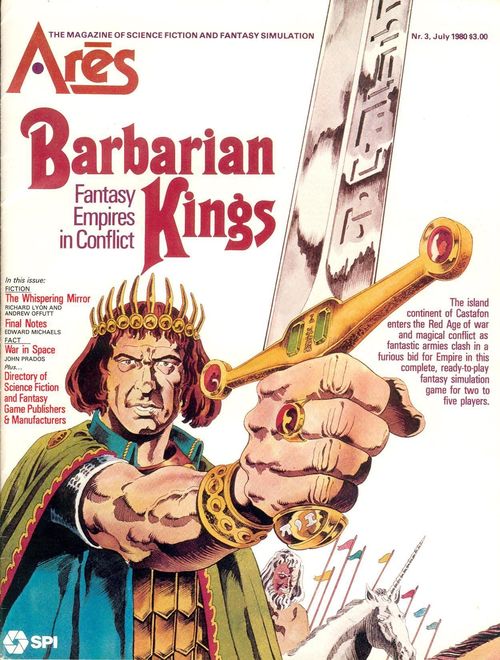
Barbarian Kings
Barbarian Kings Rulebook
Table of Contents
Table of Contents
- Read This First
- Inventory of Game Parts
- [1.0] Basic Description
- [2.0] Equipment
- [3.0] Definition of Terms
- [4.0] Setting up the Game and the Starting Sequence
- [5.0] Sequence of Play
- [6.0] Alliances (When Three or More Players Are in the Game)
- [7.0] Finance: Taxation, Maintenance and Purchase
- [7.1] A Player controls a province only if at least one of his units occupies it or was the last to occupy it, or if he controlled it since the start of the game and never lost control.
- [7.2] Units are purchased and maintained for the costs shown on their faces.
- [7.3] Wizards and Heroes are each assigned one ability when purchased.
- [8.0] Movement Plot, Execution and Block
- [8.1] When travelling without units, Leaders and Wizards may enter any type of province at a cost of 1 Movement Point per province.
- [8.2] Should a Wizard or Leader enter or remain in a province without Friendly military units, and that province is occupied by Enemy military units, a King is captured and a Wizard or Hero is eliminated automatically.
- [8.3] A Leader with March Ability has an increased Movement Allowance of "5."
- [8.4] No unit, Leader, or Wizard may move directly from an Enemy occupied province to another Enemy occupied province nor to an Enemy controlled province.
- [8.5] Each province is characterized, for movement, by the basic kind of terrain it contains.
- [8.6] Some units have special movement abilities and restrictions.
- [8.7] If Players wish to avoid plotting moves, they may experiment with the following procedure:
- [9.0] Combat
- [9.1] No force can participate in combat with the same Enemy force more than once in the same Combat Phase.
- [9.2] Each force in a Province is considered an integral value and must be used in total in any combat.
- [9.3] If any Leader of a force has Tactical Ability, the column on the Combat Result Table is shifted one column in his favor.
- [9.4] Combat may take place in Sea Provinces exactly as in Land Provinces.
- [9.5] When all Player-initiated combat in a Province is finished, a neutral unit in that Province then has combat with any forces, starting with the high-roller that did not already have combat with it.
- [9.6] When called upon to retreat by the Combat Results Table, a force must conduct the retreat under the same strictures as a move.
- [9.7] Leaders with net Retreat Abilities greater than one never have to retreat their own force (they ignore "r" results).
- [10.0] Magic
- [10.1] Some spells have a cost in sequins which must be paid only if the spell succeeds.
- [10.2] Each spell has a specific time during the Game-Turn when it may be cast as explained in the Sequence of Play.
- [10.3] A Spellcaster may attempt to cast only one spell per Game-Turn from each branch of magic with which he is familiar.
- [10.4] Mind Magic
- [10.5] Elemental Magic
- [10.6] Illusory Magic
- [10.7] Necromancy
- [10.8] Spell Summary
- [11.0] Victory Conditions
- [9.6] Combat Results Table
- [8.7] Terrain Effects Chart
- Leader and Wizard Summary
- Province Listings
Read This First
The rules to Barbarian Kings are organized by major topics arranged in the order in which they occur in the play of the game. Each such major topic is given a number and a name below which is given (usually) a General Rule or Description which summarizes the rules in that section. This is usually followed by numbered paragraphs called Cases, which give the specifics of the rules. Note that the numbering of the Cases is a decimal form of the Major Section number. Players should examine the map and counters and then quickly read the rules (without trying to memorize them). Then the game should be set up to play and a "trial run" made.
- Basic Description
- Equipment
- Definition of Terms
- Setting Up the Game and the Starting Sequence
- Sequence of Play
- Alliances
- Finance
- Movement Plot, Execution and Block
- Combat
- Magic
- Victory Conditions
Inventory of Game Parts
Each game of Barbarian Kings should contain the following parts:
- One 11" x 16" mapsheet
- One sheet of die-cut counters (100 pieces)
- One rules folder (bound into Ares version)
- One die (not in Ares version)
- One game box (not in Ares version)
[1.0] Basic Description
The Players (from two to five) assume the roles of provincial kings, bent on conquest and consolidation. By force and deceit, maneuver, and manipulation, each has the goal of bringing under his control sufficient numbers of provinces to win the game (in other words achieving the game equivalent of the Peace of King Coth, which marked the end of the Red Age in 87,805 HE).
Each Player begins the game with one or more provinces under his control and is given a limited amount of money with which to raise an army (represented by the various die-cut cardboard pieces). Each turn in the game, Players write movement orders for their leaders and armies, make alliances, and have battle. In all these activities, the influence of magic is felt through the casting of spells by the various kings and wizards.
[2.0] Equipment
Examine all equipment and read up through Section 5.0 before punching out any playing pieces.
[2.1] Game-Map
The game is played upon an 11" x 16" map divided into land and sea provinces. Each province contains the province's name, a unique province code to identify it in written orders, and a taxation value. Each land province and one of the sea provinces also contains the name of the indigenous population, indicating the type of people native to the province and the kind of units which can be built there.
[2.2] Playing Pieces
One-hundred die-cut cardboard playing pieces (or "counters") are provided with the game; they represent the various military units, Heroes, Wizards, and Kings used in the game. Each military unit has a unit symbol, Purchase Cost, Maintenance Cost, Combat Strength, Movement Allowance, and ID number printed on its face. A counter's color indicates its race/national grouping (this same information can be derived from a unit's ID number).
Sample combat unit (Civilized Legion Infantry, ID 223): the upper left number is the Purchase Cost (7), the upper right number is the Maintenance Cost (3), the lower left number is the Combat Strength (3), the lower right number is the Movement Allowance (2), and the three-digit number between them is the ID Number.
Summary of Units (Purchase Cost / Maintenance Cost / Combat Strength / Movement Allowance):
| Unit | ID numbers | Purchase | Maintenance | Combat | Movement |
|---|---|---|---|---|---|
| King | 010, 020, 030, 040, 050 | - | - | - | - |
| Hero | 011, 012, 021, 022, 031, 032, 041, 042, 051, 052 | 10 | 4 | - | - |
| Wizard | 013, 014, 023, 024, 033, 034, 043, 044, 053, 054 | 10 | 4 | - | - |
| Barbarian Fleet | 111-115 | 2 | 1 | 1 | 2 |
- King (Nr. 010): King Coth, House of Evrin. Nr. 020: King Aradren II, House of Nol; Nr. 030: King Fina, House of Meimil; Nr. 040: King Wil, House of LiMoren; Nr. 050: King Baxx, House of Greensword.
- Heroes and Wizards: numbers and colors indicate historical allegiance; in game, any Player may hire any Hero or Wizard.
- Phase Marker: used on Phase Record Track if Players need a reminder of the current Phase.
IMPORTANT NOTE: Units are grouped by origin, not by allegiance to Players. It is perfectly possible for opposing Players to have units of identical types in their armies. Even the Heroes and Wizards of a given house may be bought by different Players (although it is good game practice to do this only when there is no other choice). Because of this, Players should keep very careful records of who belongs to whom at what point in the game.
[2.3] Charts and Tables
The charts and tables necessary to play the game are organized on page 8 in the rules. Charts include the Terrain Effects Chart (8.7) and the Combat Results Table (9.8).
[2.4] Game Scale
One centimeter on the game-map equals 150 Imperial zots; each Game-Turn represents one complete revolution of the planet Hypastia around its sun (i.e., one Hypastian year).
[2.5] The Die
Players will need a single die from a set of 6-sided dice. This is not supplied with the Ares version of the game. This die is used in conjunction with the Combat Results Table, in Spellcasting, and to decide which Player is to go first in a given activity within the Sequence of Play.
[3.0] Definition of Terms
Combat Strength: A unit's relative fighting ability.
Movement Allowance: The relative speed with which a unit can move from province to province. Basically it costs a unit one Movement Point from its Movement Allowance to enter a province.
Taxation Value: The number of sequins (units of money) a province produces in tax revenues for its owner each Game-Turn. The Taxation Value is the large bold number printed within the province on the game-map.
Origin: The racial and/or ethnic grouping of a unit, signified by the color and the first digit of the military unit's ID number. Units may only be built in provinces to which their type is indigenous. The color of units does not indicate which Player owns them. See ID number.
Purchase Cost: The number of sequins required to build the unit.
Maintenance Cost: The per-Game-Turn cost (in sequins) to keep a unit in play.
ID Number: A unique three digit number that identifies each unit and unit type. Note that in the case of military units the first digit (the leftmost) indicates the origin of the unit (all units in the 200 series are civilized, for example) and the middle digit indicates what type of unit it is (for example, all 220's are legion infantry units).
Magic Value: A variable number associated with a specific Spellcaster's specific branch of magic. When casting a spell, a die-roll compared to the number determines success or failure.
[4.0] Setting up the Game and the Starting Sequence
GENERAL RULE:
Each Player should be provided with a notepad, a pen, and a pencil. The playing pieces should be carefully punched out and sorted according to type, placing them in piles at the head of the map. Players then use the Starting Sequence to determine how many units, provinces, and which Leaders they start with. It is recommended that all record-keeping be in pencil, except where noted otherwise.
The Starting Sequence
A. Choosing Provinces
- The Player to choose first is determined by rolling the die; high roller wins (if two players tie for highest, those two re-roll).
- First Player chooses one province.
- Second Player (clockwise from first) chooses one province. If only two Players are in game, repeat steps 2 and 3 until each Player has chosen three provinces.
- Third Player chooses one province.
- Fourth Player chooses one province. In games with only three or four Players repeat steps 2, 3, 4, and 5 until each Player has chosen two provinces.
- Fifth Player chooses one province. In games with five Players, each chooses only one province.
B. Choosing Kings
- In the same order as provinces were chosen, each Player takes a King counter and places it in one of his provinces. Each Player records his King's position.
- Each Player assigns as many as three of the following military and magical abilities to his King (this should be done secretly, in ink).
- a. Tactical Skill
- b. March Ability
- c. Retreat Ability
- d. Mind Magic
- e. Elemental Magic
- f. Illusory Magic
- g. Necromancy
Abilities may be assigned in duplicate or triplicate (i.e., the same King may have a double March Ability, for example).
C. Endow Treasury
Each Player starts the game with a Treasury of 50 sequins. Throughout the game all expenditures and additions should be strictly accounted for in itemized fashion suitable for audit by other Players at the end of the game. Standardized bookkeeping practices are recommended.
D. Place Neutral Units
In every unchosen province having a Taxation Value of 6 or more, place one infantry unit of the proper origin for that province.
E. Start Game
Go to the Sequence of Play (5.0).
[5.0] Sequence of Play
GENERAL RULE:
Play proceeds according to a strict sequence (detailed in the body of this Section of the rules). No action may be taken out of order. Any rule which can be logically derived from this sequence is to be considered as if explicitly given in the rules. For example, because C2, Maintenance, occurs before C4, Purchase, units need not be maintained on the Game-Turn in which they are purchased. Each run-through of the Sequence of Play is termed a Game-Turn. Play proceeds for an indefinite number of Game-Turns, until one Player satisfies the Victory Conditions (11.0) or until the Players unanimously agree to terminate play.
PROCEDURE:
The Sequence of Play of a Game-Turn
A. Alliance Phase
- Plot Bickering: Players with capable Spellcasters secretly record their intention to cast these spells and at whom.
- Sign Alliances: Allying Players exchange slips of paper bearing their signatures (one set of slips can be used throughout the game by writing the Game-Turn number by the name whenever the slip is used). These alliances are irrevocable for the entire Game-Turn, except as affected by magic.
- Execute Bickering and Harmony Spells: Spells plotted in Step 1 are announced and resolved. If an alliance is made or broken by magic, signatures are exchanged or returned immediately.
B. Tornado Phase
Players with capable Spellcasters may cause magical tornados to appear in specified provinces, preventing the collection of taxes from it for this Game-Turn.
C. Finance Phase
- Tax Collection: Each Player receives a number of sequins equal to the total Taxation Value of all the provinces he controls. This sum is recorded in the ledger of the Player's Treasury.
- Unit Maintenance: Each Player must spend the number of sequins equal to the total maintenance cost of each of his current units he wishes to remain in play.
- Disbanding: Any unit for which the maintenance cost was not spent is considered immediately disbanded (removed from play and returned to the units available for purchase).
- Unit Purchase: Roll for precedence; high roller builds all the units he wishes to first; this privilege moves clockwise around table until each Player has had a chance to purchase new units. Units may only be placed in a province to which they are native and which the purchasing Player controls. Players with capable Spellcasters may purchase Illusory units.
D. First Magic Phase
- Kill Wizards and Heroes: Players with capable Spellcasters plot the death of Wizards or Heroes, resolving all such spells simultaneously and immediately.
- Kill Units: Surviving capable Spellcasters may plot and resolve the destruction of Enemy units. Results are applied immediately.
- Allegiance: Capable Spellcasters may attempt to take permanent control of neutral units.
E. Movement Plot Phase
- Clairvoyance: Capable Spellcasters may plot to examine one other Player's Movement Plot before plotting that of the Spellcaster Player.
- Plot Leader, Unit, and Wizard Movement: Using the ID numbers of the pieces and Provinces, each Player secretly records his intended movements, Movement Point-by-Movement Point.
F. Second Magic Phase
Players with capable Spellcasters may cast any or all of these spells: Mind Control, Stormy Seas, Storms in Mountains, Freeze Sea, Flood, Invisibility.
G. Movement Execution Phase
- First Movement Point Expenditure: All units and Leaders of all Players entering any Province by the expenditure of a single Movement Point do so. When all such units have moved, Players may announce their intention to block the further movement of any Enemy units now in the same province as they are. The presence of a neutral unit automatically blocks the movement of Players' units out of the province.
- Second Movement Point Expenditure: All units expending two Movement Points to enter a province and all units spending a second Point to enter a second province (this Game-Turn) now do so. Players announce their intention to block further movement.
- Third Movement Point Expenditure: All units expending two Movement Points to enter their second province or one Movement Point to enter their third now do so.
- Subsequent Movement Point Expenditures: Use the same techniques to make any remaining moves.
- Detect Illusions: Spellcasters capable of doing so may attempt to detect illusory units and invisible units.
H. Combat
- Precedence of Resolution: Each Player rolls the die and the high roller resolves all his combat situations first in the province of his choice. In clockwise order other Players resolve their combats in the same province. Re-start entire procedure for each province in which combat can occur.
- Announcement of Intentions: The high roller announces his intention to attack Enemy units in a given province (or his intention to ignore their presence). Other Players announce clockwise from the high roller as each gets his opportunity to attack in that province.
- Result Application: Combat results are applied immediately as they occur, before any further combat takes place.
I. Third Magic Phase
Players with capable Spellcasters occupying provinces in which units were destroyed in this Game-Turn's Combat Phase, may attempt to raise those units from the dead. If more than one such Spellcaster occupies a province, the die is rolled for precedence.
J. Game-Turn
Restart the Sequence of Play and record the passage of one Game-Turn on each Player's plot pad.
[6.0] Alliances (When Three or More Players Are in the Game)
GENERAL RULE:
An Alliance is a contracted activity lasting only for the Game-Turn in which it is agreed to in writing. Allies may neither block each other's movement nor engage each other in combat.
PROCEDURE:
Before exchanging signature slips, Players may openly discuss their intention to ally with one another. They are, however, bound only by exchanging signature slips (in other words they may double cross each other).
CASES:
[6.1]
If two or more Players exchange signature slips, then they are allied for that Game-Turn.
[6.2]
A Player may be a member of only one alliance per Game-Turn. This alliance may consist of as few as two and as many as five Players. Alliances require no expenditures but may be the result of bribes. If Players wish to allow Allied Kings and Heroes to lead their units, they must mutually plot which units will be led by which allied leader. If the Plots don't agree, the temporary control is not exercised. If, through magic or mistake, a Player becomes a member of more than one alliance, then all those alliances are voided for all members.
[6.3]
When combat occurs in a province, the forces of allies are always considered as one Player.
The Players must agree (and write it into their Movement Plot) which of their Leaders present in the province will lead any fight (and consequently which Player has the final say as to whether or not an attack is made). If no commander is named, the allies in that province may not attack (but of course still defend as one force).
[7.0] Finance: Taxation, Maintenance and Purchase
GENERAL RULE:
At the beginning of the Finance Phase, each Player collects from each province he controls, a number of sequins equal to the taxation value of those provinces. These sequins are used to maintain and purchase units and to bribe other Players.
CASES:
[7.1] A Player controls a province only if at least one of his units occupies it or was the last to occupy it, or if he controlled it since the start of the game and never lost control.
Note that other Players' units that are allies do not upset or contest the controlled condition of a province. Indigenous neutral units do prevent any Player from controlling any provinces they presently occupy. The presence of a Leader or Wizard does not constitute control.
[7.2] Units are purchased and maintained for the costs shown on their faces.
Note that the limit of the countermix is a design limit (Players are discouraged from introducing more counters into the game). Except for Kings, Players may purchase units of any type of any house regardless of the types and house they control.
[7.3] Wizards and Heroes are each assigned one ability when purchased.
The Player should note which magical ability he wishes a purchased Wizard to have and which non-magical ability a purchased Hero to have.
- Magical Abilities: Mind Magic, Elemental Magic, Necromancy, Illusory Magic
- Heroic Abilities: March Ability, Retreat Ability, Tactical Ability
[8.0] Movement Plot, Execution and Block
GENERAL RULE:
Units and their Leaders must have their movement plotted for them each Game-Turn. This requires Players to specify from where, through where, and to where units are moving and by whom they are being led.
All units require Leaders (Kings or Heroes) to accompany them throughout their actual movement (whether or not the Leader starts with them or remains with them). Wizards may move independent of Leaders.
The Movement Allowance of a unit indicates, basically, how many provinces a Player can move that unit.
How to Plot:
On the plot sheet, write the ID number and Type of Leader unit (King or Hero) making the move and which combat units are going with him. The move is plotted using either the names or ID numbers of all the provinces moved from, through, and into. Movement of Wizards may be plotted separately so as not to confuse them with Leaders.
How to Execute the Plot:
Follow the procedure detailed in the Sequence of Play, and perform it within the restrictions of the Movement Rules.
CASES:
[8.1] When travelling without units, Leaders and Wizards may enter any type of province at a cost of 1 Movement Point per province.
If, however, Leaders are travelling with units, they must expend as many Movement Points as their units. Leaders may move any number of units. Since Wizards never lead units, they are not subject to this limit. Wizards and Leaders may not end their movement at sea unless they are with a Fleet. There is no limit to the number of Kings, Leaders, and Wizards that may be in a province.
[8.2] Should a Wizard or Leader enter or remain in a province without Friendly military units, and that province is occupied by Enemy military units, a King is captured and a Wizard or Hero is eliminated automatically.
A captured King may not be actually used by the captor, but he may be ransomed, sold, or traded to another captor or held indefinitely. He must be in the custody of a military unit (and may not be killed). If the King is restored to his original Player, he once again functions normally.
[8.3] A Leader with March Ability has an increased Movement Allowance of "5."
If a King has a duplicate or triplicate March Ability, his Movement Allowance is raised to "6" or "7." Units travelling with such a King (start to finish) have their Movement Allowance increased by one, two, or three Movement Points for that move.
[8.4] No unit, Leader, or Wizard may move directly from an Enemy occupied province to another Enemy occupied province nor to an Enemy controlled province.
Units may move from a vacant Enemy controlled province to an Enemy occupied or controlled province. Note also that units cannot be blocked by neutral units or Enemy units from leaving the province in which they began the Game-Turn if the province they move to is not Enemy occupied.
[8.5] Each province is characterized, for movement, by the basic kind of terrain it contains.
See the Terrain Effects Chart. Note that any number of units may enter a province, provided they meet the restrictions of 8.6.
[8.6] Some units have special movement abilities and restrictions.
Fleet units may only enter Sea provinces and Coastal provinces.
Note that three Coastal provinces have two separated coasts. The Player must note which side of the province the Fleet entered by (and it must leave the same way).
Fleet units may each transport one military unit and any number of Leaders and Wizards, if they begin their movement in the same province as the units to be transported. Land units may not move by land in the same Game-Turn as transported over sea. There is no cost to the Fleet unit to embark or disembark a land unit.
Airships may enter any province at a cost of one Movement Point per province. They may not end their movement in either a Sea or Mountain province (if plotted or forced to do so, they are eliminated instead). Airships may transport land units in the same manner as Fleets.
WarFrog units may move through one Sea province per Movement Phase. They may not remain at sea, and are eliminated if forced to do so. When coming ashore (entering a Coastal province from the sea) WarFrogs pay only 1 Movement Point regardless of the actual cost to enter the province. WarFrogs always pay only 1 Movement Point to enter a Swamp province.
Whale units may never enter coastal provinces - only Sea provinces.
Dwarven units pay only one Movement Point to enter Mountain provinces.
Elven units pay only one Movement Point to enter Forest provinces.
[8.7] If Players wish to avoid plotting moves, they may experiment with the following procedure:
Roll for precedence; the first Player makes those moves constituting the expenditure of the first Movement Point for his Leaders, Wizards, and units. Then the second Player makes his first Movement Point moves and so on until each Player has moved all the units and Leaders for their first Movement Point. Roll for precedence again and make the second Movement Point move (and any two Point moves). The Movement Phase proceeds on the basis of rolling for precedence before the expenditure of each Movement Point. All other rules apply.
The drawback to this system is that some of the surprise and mystery will be eliminated from the game in order to avoid the tedium of plotting.
[9.0] Combat
GENERAL RULE:
During the Combat Phase, a Player may exercise his option to have combat with Enemy units which are in the same province as the Player's. See the Sequence of Play for determining who shall conduct combat first.
PROCEDURE:
Combat is not plotted. Rather the Player announces his desire to have combat and it automatically ensues. Regardless of who initiated combat, the simplified ratio is stated from the point of view of the Player with the larger force. For example, a Player with a force of three Combat Strength Points elects to have combat with a Player with eight Combat Strength Points. The ratio is rounded off in favor of the smaller force (always) and stated as 2-to-1. The die is rolled and the result found by cross-indexing the die number with the ratio column.
CASES:
[9.1] No force can participate in combat with the same Enemy force more than once in the same Combat Phase.
A force may have combat with each Enemy force in the province, one at a time, if the Player so wishes. The restriction against having combat with the same force more than once per Game-Turn applies regardless of who initiated the first combat.
[9.2] Each force in a Province is considered an integral value and must be used in total in any combat.
Note that allied forces in the same Province are considered to be one force (and the Players should have plotted beforehand which Player controls those units for combat purposes).
[9.3] If any Leader of a force has Tactical Ability, the column on the Combat Result Table is shifted one column in his favor.
If the Leader has duplicate or triplicate Tactical Ability, the column is shifted twice or thrice (within the limits of the table). Net out the shift if both opposing Leaders have Tactical Ability.
[9.4] Combat may take place in Sea Provinces exactly as in Land Provinces.
Land units and Fleets in Sea provinces add their Combat Strengths into one integral value (see 9.2) just as Fleets in Coastal provinces must add their strength to land combat. When losing units at sea, first lose a land unit, then a Fleet, then a land unit, and so on until the loss called for is satisfied. The same basic rule applies to airships.
[9.5] When all Player-initiated combat in a Province is finished, a neutral unit in that Province then has combat with any forces, starting with the high-roller that did not already have combat with it.
[9.6] When called upon to retreat by the Combat Results Table, a force must conduct the retreat under the same strictures as a move.
If the force (or parts of it) cannot legally retreat into the available provinces then it (or the parts of it) is eliminated instead. The owning Player decides which province or provinces his losing units retreat to unless the opposing Leader has Retreat Abilities greater than that of the loser, in which case the victor decides. Forces may never retreat into Enemy occupied provinces. Land forces may embark onto ships in order to retreat.
[9.7] Leaders with net Retreat Abilities greater than one never have to retreat their own force (they ignore "r" results).
If opposing Leaders net out against each other, it is as if they had no Retreat Ability at all. A superiority of one Retreat Ability allows that Leader to retreat the loser. A superiority of two or more allows a King to ignore retreat results.
[10.0] Magic
GENERAL RULE:
Only Wizards and Kings who have taken magical powers (collectively called "Spellcasters") may cast spells. Each Wizard has knowledge of one of the four branches of magic, assigned when he is first hired; a King may have knowledge of up to three branches of magic. Each Spellcaster is assigned a Magic Value of 2 with each of the branches of magic he knows. Kings may take the same branch of magic twice or three times, in which case they have two or three separate Magic Values for the same branch.
PROCEDURE:
A Spellcaster may only cast spells from his branch(es) of magic. Each time a Spellcaster attempts to cast a spell, roll a die; if the roll is equal to or less than his Magic Value, the spell succeeds. If the roll is 1, his Magic Value increases by one; if 6, his Magic Value decreases by one. Magic Values may never increase above 5 nor drop below 1. Players should keep accurate records of changing Magic Values.
CASES:
[10.1] Some spells have a cost in sequins which must be paid only if the spell succeeds.
[10.2] Each spell has a specific time during the Game-Turn when it may be cast as explained in the Sequence of Play.
A Phase Record Track, used primarily to keep track of when various spells may be cast, is printed on the game-map. The Phase Record marker is placed on this Track, and moved along it as each Game-Turn progresses to indicate the precise actions which each Player should be taking at any given time. These times are also listed on the Spell Summary (10.8).
[10.3] A Spellcaster may attempt to cast only one spell per Game-Turn from each branch of magic with which he is familiar.
A King with a double or triple Magical Ability - i.e., who took a single branch of magic two or three times - may cast spells from that branch two or three times, using a different Magic Value each time (see General Rule).
[10.4] Mind Magic
[10.41] Clairvoyance [Time of Casting: Movement Plot Phase. Cost: None.] Allows the caster to see the plotted moves of one other Player before he plots his own movement. Works only for the current plot phase. If two Players cast this spell on each other, neither may see the other's plot.
[10.42] Mind Control [Time of Casting: 2nd Magic Phase. Cost: None.] Allows the caster to take control of one Hero owned by an Enemy Player. During the Movement Plot Phase, the casting Player must plot movement for the Hero. After the Plot Phase, he determines whether the spell succeeds. If so, the casting Player's plot is executed during the following Movement Phase. The Hero reverts to the control of his owning Player at the end of the Movement Phase, and may not turn units over to the controlling Player's Leaders, nor may he attack units belonging to his owning Player.
[10.43] Cause Bickering [Time of Casting: Alliance Phase (must be plotted in diplomatic orders). Cost: None.] Spell prevents any one specified Enemy Player from allying with one other specified Enemy Player. Affects only the current Phase.
[10.44] Harmony [Time of Casting: Alliance Phase (must be plotted). Cost: None.] The spell forces one specified Player to ally with another specified (possibly the Spellcaster's) Player. Cancels out bickering. Affects only the current Phase.
[10.45] Allegiance [Time of Casting: 1st Magic Phase. Cost: 5 Sequins/unit.] Allows the caster to take control of any number of neutral units, permanently. In case of conflict, roll for precedence.
[10.5] Elemental Magic
[10.51] Stormy Seas [Time of Casting: 2nd Magic Phase. Cost: None.] The caster specifies two contiguous sea provinces. All naval units in the provinces are immobilized (i.e., may not move during the subsequent Movement Phase); no Fleets, WarFrog, Whale, or Airship units may move to the provinces (plotted movement is aborted). Units controlled by the casting and allied Players are not affected. Lasts for one Movement Phase only. Leaders and Wizards are not affected.
[10.52] Storms in Mountains [Time of Casting: 2nd Magic Phase. Cost: None.] As above, but applying to Mountain provinces and land and air units. Dwarven units are not affected.
[10.53] Flood [Time of Casting: 2nd Magic Phase. Cost: None.] Immobilizes all land units (except Warfrogs), Leaders, and Wizards in a single province for one Movement Phase. Any force moving into the province is also immobilized; no combat may take place in the province. Units controlled by the casting and allied players, as well as Leaders and Wizards, are not affected.
[10.54] Freeze Sea [Time of Casting: 2nd Magic Phase. Cost: None.] Makes a single Sea province impassable to all naval units (and Whales) - any such units in the province are immobilized, and any movement into the province is aborted. The province becomes passable to land units. Effects end after the Movement Phase; any land units in the province at that time are eliminated. Swamp provinces may also be frozen without affecting any units therein. A frozen province is the equivalent of a plains province for one Movement Phase.
[10.55] Tornados [Time of Casting: Tornado Phase. Cost: None.] Prevents collection of taxes from one (specified) province for the current Finance Phase.
[10.6] Illusory Magic
[10.61] Illusory Units [Time of Casting: Finance Phase. Cost: 1 sequin/unit.] The Player must announce that he is casting the spell, but not which of the units he purchases are illusory. He may create any number of illusory units at a cost of 1 sequin per unit. The ID numbers of all illusory units must be noted on scrap paper for later verification. The illusory units remain on the game-map, but if forced to engage in combat they are removed before combat is resolved. Illusory units do not prevent an Enemy Player from building units because of countermix limitations; if a Player wishes to build a unit and none are available but illusory units of that type are on the game-map, he may require the owning Player of an illusory unit to remove it from the game-map so he may construct it. An illusory unit behaves as a regular unit until removed from play.
[10.62] Invisibility [Time of Casting: 2nd Magic Phase. Cost: None.] The spell is cast on one Friendly Leader; the Leader and any units, Wizards, and other Leaders he moves with are removed from the game-map. They are now considered invisible, and the casting Player must keep track of their position on a piece of scrap paper. If the Leader drops off any units, they become visible and are placed on the game-map; if he picks up any units, they become invisible and are removed. The invisible force may not be blocked by an Enemy force - but they may block Enemy movement. The invisible force may not be attacked. If the invisible force blocks Enemy movement or attacks an Enemy force, it loses its invisibility and is returned to the game-map. Otherwise, invisibility is permanent. Units hired in a province containing an invisible force may be added to that force without first being put on the game-map.
[10.63] Detect Illusion [Time of Casting: Movement Execution Phase. Cost: None.] The spell is cast at any province; if there are any illusory or invisible units in the province, the owner of those units must tell the caster of their presence, type, and number.
[10.7] Necromancy
[10.71] Kill Wizard or Hero [Time of Casting: 1st Magic Phase. Cost: 8 sequins.] Causes one specified Enemy Wizard or Hero to be eliminated.
[10.72] Kill Units [Time of Casting: Magic Phase. Cost: 5 sequins per unit.] Immediately eliminates Enemy unit.
[10.73] Raise Units [Time of Casting: 3rd Magic Phase. Cost: None.] If the Spellcaster is in a province where combat took place in the preceding Combat Phase and in which units were eliminated and the Spellcaster's force did not retreat, all eliminated units (of all sides) may be raised. These are now zombie units, and controlled by the caster. They must be maintained at normal costs. Special Rule: If a 6 is rolled, not only does the spell fail and the Spellcaster's Magic Value decrease, but he loses as many units of his non-zombie force as he tried to raise. (If he attempted to raise more zombie units than are present in his original force, he loses all units).
[10.8] Spell Summary
Phase Record and Spell Summary (printed on the map; M = Mind Magic, E = Elemental Magic, I = Illusory Magic, N = Necromancy):
- Alliance Phase: Plot Harmony (M) and Bickering (M); Signatures; Reveal Harmony (M) and Bickering (M)
- Tornado Phase: (E)
- Finance Phase: Collect Tax; Maintain or Disband; Purchase units; Illusory units: $1 (I)
- 1st Magic Phase: Kill Wizard or Hero: $8 per person (N); Kill unit: $5 per unit (N); Allegiance (M)
- Movement Plot: Plot Movement; Clairvoyance (M)
- 2nd Magic Phase: Mind Control (M); Stormy Sea or Mountain; Freeze Sea or Flood (E); Invisibility (I)
- Movement Execution: 1st, 2nd, 3rd, etc.; Detect Illusion (I)
- Combat Phase: Announce Combat
- 3rd Magic Phase: Raise the Dead (N)
[11.0] Victory Conditions
GENERAL RULE:
In two-player games, a Player must control Provinces with a total taxation value of 420 or more at the beginning of a Game-Turn to win. In three-player games, a Player must control a total taxation value of 100; in games with more players, of 90.
A game may be ended before one Player fulfills the victory conditions with the mutual agreement of all Players. In this case, the Players may unanimously concede the game to one Player or group of Players.
[9.6] Combat Results Table
Combat Ratio (columns), cross-indexed with the die roll:
| Die | 1-1 | 2-1 | 3-1 | 4-1 | 5-1 | 6-1 |
|---|---|---|---|---|---|---|
| 1 | Le | Lr | Lr | Sr | Sr | S1/2e |
| 2 | L1/2e | Lr | Sr | Sr | S1/2e | S1/2e |
| 3 | Lr | Sr | Sr | S1/2e | S1/2e | Se |
| 4 | Sr | Sr | S1/2e |
Explanation of Results:
- e: Force is eliminated.
- 1/2e: Units with Combat Strengths equal to or greater than half of the force's total Combat Strength are eliminated from the force; owning Player chooses which are eliminated.
- r: Force must retreat (but see Retreat Ability, 9.7).
- L: Result applies to larger force.
- S: Result applies to smaller force.
Note: If the two forces are of equal size, arbitrarily assign one to be the "larger" and the other the "smaller." If two forces are of equal size, that of the higher-rolling player is deemed to be the "larger" and the other the "smaller". A leader's Tactics Ability can cause a numerically inferior force to be treated as the larger force. Example: A King with a triple Tactics Ability leads a force on the smaller side of a 2-1 ratio. The ratio is first shifted one to the left (to 1-1) and then "bounced" two to the right (to 3-1) for a total of three column shifts.
[8.7] Terrain Effects Chart
| Terrain Type (and Map Reference Sample) | Military Unit Movement Point Cost to Enter | Combat Effects |
|---|---|---|
| Plains Province (nr. 30, Shevane) | 1 MP | Normal |
| Mountain Province (nr. 32, Grandarite) | 2 MP; Dwarven: 1 MP | Double Dwarven and halve Cavalry Strength |
| Forest Province (nr. 28, Yaro) | 2 MP; Elven: 1 MP | Double Elven and halve non-Elven, Cavalry and Legion |
| Swamp Province (nr. 38, Drormt) | 2 MP; WarFrog: 1 MP | Double WarFrog; halve all others |
| Sea Province (nr. 06, Thorian Abyss) | 1 MP* | Normal |
*Unembarked Land units are prohibited.
When halving Strengths, total first, then halve rounding down. When doubling or halving, count the effective final Strength as the size of the force.
Leader and Wizard Summary
- A King is a Leader who may be a Spellcaster (choice of 3 Branches and/or Abilities).
- A Hero is a Leader who may not be a Spellcaster (choice of 1 Ability).
- A Wizard is a Spellcaster who is not a leader (choice of 1 Branch).
- Abilities are: March (8.3), Retreat (9.7), Tactics (9.3).
- Branches of Magic are: Elemental Magic (10.5), Illusory Magic (10.6), Mind Magic (10.4), Necromancy (10.7).
- A King may duplicate (or triplicate) any Ability or Branch of Magic, and has a separate Magic Value for each time he takes a Branch of Magic.
Province Listings
| Nr. | Name | Tax | Natives |
|---|---|---|---|
| 01 | Sea of Whales | 1 | Whales |
| 02 | Sea of Ice | 0 | none |
| 03 | Northern Arm | 2 | none |
| 04 | Dragon's Claw | 1 | none |
| 05 | Sea of Winds | 1 | none |
| 06 | Thorian Abyss | 1 | none |
| 07 | Sta Fira Ocean |