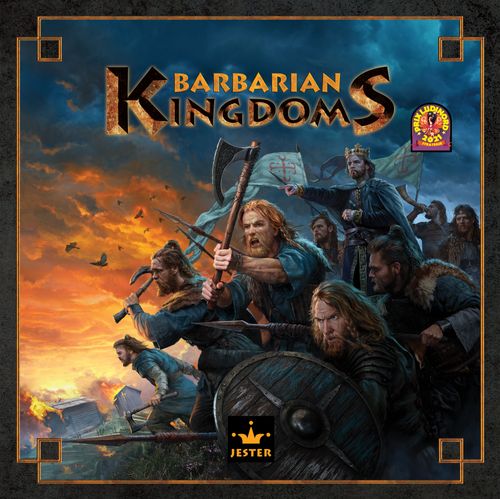
Barbarian Kingdoms
Barbarian Kingdoms Rulebook
Table of Contents
Table of Contents
History
In the 5th century AD the Huns swept into Europe from the East, forcing the various Germanic tribes ever westwards. Hundreds of thousands of Germanic warriors crossed the frozen Rhine, bypassing the fortified defenses of the Roman Empire.
The Roman imperial army, undermined by unprecedented internal crises, failed to repel the incursions - these "Great Invasions" would lead to years of looting, displacement, and war.
In an attempt to end this tumult, Rome ceded territories to barbarian warlords who founded their own kingdoms. The loss of resources, combined with the growing autonomy of the "Barbarian Kingdoms", sounded the death knell for the Western Roman Empire.
After a thousand years of Roman supremacy, a new era of instability and opportunity began in Europe: the Middle Ages.
Note: The rules described in the following pages are intended for competitive play with 3-6 players. If you are playing the 2-player variant or the Team variant, please refer to the adaptations described under Optional Rules & Variants.
Object of the Game
The object of the game is to be the first player to achieve one of the following two victory conditions:
- Territorial victory: Control a total of 7 Provinces.
Note: Your three starting provinces, including your Capital Province, contribute to the total of seven provinces you need for a Territorial victory. To claim this victory, none of your starting provinces can be controlled or occupied by opposing Kingdom(s).
- Military victory: Eliminate 2 opposing Kings by defeating them in battle.
Note: A player who has lost their King is not eliminated from the game. It is still possible to win the game without your King.
The game ends as soon as any player meets one of the victory conditions; that player wins the game.
Kingdom Score
After the winner has been decided, the other players may determine their placement by calculating their Kingdom Scores (see the Kingdom Score section below).
Course of the Game
Turn Order
The first player is the person seated closest (in clockwise order) to the star symbol near the red "Huns" emblem on the edge of the game board.
Play will proceed in clockwise order, with players taking their turns one at a time. This order will continue until the end of the game.
Player's Turn
On your turn, announce and resolve one Action from the list below:
- Recruit: Deploy a Warrior
- Maneuver: Reposition your Units
- Invade: Assault a Province
- Claim: Attempt to annex a Province
- Tax: Collect taxes
A Battle will be triggered and immediately resolved when:
- The active player Invades an enemy-occupied Province, OR
- An opponent Challenges the active player's Invasion or Claim.
Set Up
Game Components
- 1 Score pad
- 1 Game board
- 1 Game Setups card
- 2 Purses
- 6 Domination tiles
- 72 Treasure tokens
- 30x bronze (value: 1 Tremis)
- 24x silver (value: 2 Tremis)
- 17x gold (value: 3 Tremis)
- 1x diamond (value: 5 Tremis, not represented)
- 6 Kingdom sets consisting of:
- 1 King standee
- 1 Power card
- 4 Warrior standees
- 4 Control tokens
- 1 Player board
- 1 Player screen
Choose a setup. For your first games, we suggest the beginner-friendly ones. Here is an example for a 4 player game.
Reading the Game Setups: On the "Game Setups card", each row represents a different possible game setup. The first column lists the number of players, while the icon to the left of the first row indicates setups that are beginner-friendly. The kingdom icons in each row represent the kingdoms that are part of the game setup, and the small squares serve as a reminder to place the "Domination tiles" for the kingdoms that are not in play.
Assign players' Kingdoms randomly or by mutual agreement. For a random setup place one control token from each Kingdom into a purse, from which each player will draw their Kingdom.
Once Kingdoms have been assigned, we recommend that players seat themselves near their respective Kingdoms' emblems (as printed on the game board).
Setup Steps
-
Place each non-player Kingdom's Domination tile on its matching Province (indicated on the tile). These Provinces are considered to be impassable (as are the non-player Kingdom's Starting Provinces).
-
Place the purses next to the game board.
-
Give each player 1 bronze (value 1), 1 silver (value 2), and 1 gold (value 3) Treasure token. Place one of these tokens randomly on each of your 3 Starting Provinces (including your Capital Province), face-up (so their values are visible).
-
Give each player 10 Tremis (3 bronze, 2 silver, 1 gold) as their starting Treasury, along with their matching player screen (used to conceal Treasure tokens during the game), their matching player board (which should be visible to other players) and their matching power card.
-
Place your 4 Control tokens and 4 Warriors on your player board, and your King in your Capital Province.
-
Randomly place one Treasure token (chest side up) on each neutral Province. Note that Treasure tokens are not placed on non-player Kingdoms' 3 Starting Provinces, or in any Province in which a Domination tile has been placed. Return all remaining Treasure tokens to the game box, face-down.
-
Finally, each player must read aloud the special powers associated with their King and their Kingdom as listed on their player board. This step is crucial to ensure that all players are fully aware of and understand the unique abilities in play.
Game Concepts
Game Map
The Map is divided into 36 Provinces and 1 Sea, and is marked with 3 passable Straits.
- Neutral Provinces: Provinces that no Kingdom controls at the start of the game.
- Starting Provinces: Provinces controlled by any given Kingdom at the start of the game.
- Capital Provinces: Provinces where Kings are placed during setup. Other Kingdoms may Invade these Provinces (to occupy them), but they may never Claim (take control of) them.
- Port Provinces: Provinces where is it possible to move into or out of the Sea.
- Sea: This is a single area, adjacent to all port provinces. Note that there are no naval battles in this game.
- Straits: Connectors between two Provinces separated by the Sea. Straits do not divide the Sea into separate areas.
Economy
Tremis: The game's currency, represented by Treasure tokens. When these tokens are face-down, their values are hidden.
Player and Province Treasuries: Each player has their own Treasury, which is used to pay for Recruits, Claims, and Bribes. You should keep your Treasury behind your player screen, to keep your wealth (or lack thereof) secret from other players.
Each Province on the board may also have its own Province Treasury, represented by one or more Treasure tokens. These may be gained in full by Pillaging, or in part through Taxation.
Pillaging: Pillaging is the act of taking all Treasure tokens from a Province and adding them to your Treasury (behind your player screen). Provinces may only be Pillaged after a successful Challenge or Invade action, and only if the Province is not under their control. The values of face-down tokens should not be revealed to other players.
Paid Actions: There is no common Treasury; when you perform a paid action (Recruit or Claim), place the paid Tremis face-up in the same Province where your action took place. Other actions (Maneuver, Invade, Tax) are free.
Loans and Change: Players may not lend or give Tremis to each other. If you do not have the exact amount of Tremis needed to perform a paid action, you may make change between your Treasury and that of one of the Provinces under your control. If you cannot make change you must either pay more money (if payment is required), or receive less (if gaining Tremis).
Control
Control markers: Printed Emblems and/or Control tokens indicate which Kingdom controls a Province.
Taking control: To take control of a Province, you must first occupy it with one of your Units (via an Invade action or a Challenge), and then successfully complete a Claim action. Place one of your Control tokens on that Province to indicate your ownership of that area.
Note: You may never take control of an opposing Kingdom's Capital Province. Non-player Kingdoms' Starting Provinces or any Province with a Domination tile are impassable and therefore may not be controlled by players.
Losing control: A Kingdom will lose control of a Province if it is successfully Invaded by an opposing Kingdom.
Note: If a Starting Province is Invaded, control is suspended and it does not belong to any player while an opposing Unit remains there or until the Province is successfully Claimed. The opposing Unit, placed over the Province's printed Emblem, obscures it and indicates uncontrolled status. Occupied Starting Provinces don't count for Taxation or Territorial Victory, and Warriors cannot be Recruited there. Control is automatically regained if the occupying Unit leaves or is eliminated, unless the Province has been Claimed.
Diplomacy: Players may collaborate and strategize with each other at any time.
Special Powers
Each Kingdom and King has a unique power, as indicated on their player boards and power cards. In case of contradiction, powers take precedence over the standard rules.
A Kingdom's power is active throughout the game, while a King's power is lost if that King is eliminated.
Moving
During Battle, and as part of Invade and Maneuver actions, Units may be moved from one area on the map (Province or Sea) to an adjacent one.
Adjacency: The following areas are considered adjacent:
- Provinces sharing a common border
- Provinces separated by a passable strait
- Port Provinces and the Sea
Impassable provinces: You may not move Units into non-player Kingdoms' Starting Provinces, or into any Province with a Domination tile.
Occupancy limit: Except for Battles, each land Province may only be occupied by one Unit; on the other hand, the Sea may contain any number of Units, from any number of Kingdoms.
Component Limits: Components are limited to the items that come with the game. You may only perform an action if you meet the required conditions and resources (controlled Provinces, Tremis, Control tokens, Units, etc.).
Player's Actions
On your turn, you may choose one of these 5 different actions: Recruit, Maneuver, Invade, Claim, and Tax.
Recruit
The Recruit action allows you to deploy one Warrior from your player board to any Province you control, for the cost shown on your player board below the Warrior you are recruiting; this cost increases as you move Warriors from your player board onto the game board.
To perform the Recruit action, place the least-expensive Warrior available on your player board into an eligible province (one that is already under your control and not already occupied by any Unit). All Tremis paid to recruit a Warrior must be placed in that Warrior's Province.
Maneuver
The Maneuver action allows you to move any or all of your Units (King and/or Warriors) on the game board to adjacent Provinces or the Sea, but each Unit can only be moved once during this action; this action may not be used to invade a Province (for that, you must use the Invade action).
You may only move a Unit to an adjacent, unoccupied Province already under your control. Your Unit(s) present in Port Provinces may instead move into the Sea.
Castling: This special movement may be performed during a Maneuver action. To Castle, simply switch the location of your King with that of one of your Warriors in an adjacent area. This action counts as a movement action for both your King and your Warrior. It is possible to Castle when the King and/or Warrior occupy neutral Province(s) or Sea.
Invade
The Invade action allows you to assault a Province that you do not control (one that is neutral or controlled by an opponent) with one of your Units. If successful, you will occupy the invaded Province, Pillage it and remove an opponent's control over it. Opposing Kingdoms may Challenge the Invasion.
To perform an Invade action:
-
Move one of your Units to an adjacent eligible Province (one controlled by another Kingdom, or a neutral one not already occupied by one of your Units). You may target an opposing Capital Province. The chosen Province may not be impassable (a Starting Province of a non-player Kingdom, or one with a Domination tile).
Note: The Invade action is irrevocable. Once you have moved your Unit, you may not change your mind or take it back. Eligible players must be given the opportunity to Challenge your action, so consider your options carefully!
Hasty Pillage: Important! If you pillage a face-down Treasure token before giving opponents the chance to Challenge, you must replace that Treasure token with a total value of 3 Tremis (from your Treasury). By mutual agreement, you may choose to exempt new players from this penalty.
An eligible Province must meet the following criteria: it must be occupied by one of your Units, it must not contain one of your Control markers, and it must not be an opposing Capital Province.
-
If there is an enemy Unit in the Invaded province, a Battle immediately takes place (see Battles below for details). If there is no enemy Unit present, you must ask your opponents with Units present in adjacent areas if they would like to Challenge your action (see Challenges below for details).
-
If your Invade action is successful, Pillage all Treasure tokens from the Province (add them to your Treasury). If that Province was previously claimed by an opposing Kingdom, remove that Kingdom's Control token from the Province and return it to most-expensive free space of the corresponding Player board. If you take an opposing Kingdom's Starting Province, place your Unit over the emblem printed on that Province.
Claim
Through the Claim action, you may attempt to take control of a Province occupied by one of your Units (Warrior or King). As with the Invade action, success is not automatic - opposing Kingdoms may Challenge your Claim.
The cost to Claim a Province is indicated on your player board, below the Control token you will remove if your Claim is successful. This cost increases as you move Control tokens from your player board onto the game board.
An eligible Province must meet the following criteria: it must be occupied by one of your Units, it must not contain one of your Control markers, and it must not be an opposing Capital Province.
To perform a Claim action:
-
Move the required amount of Tremis from your Treasury to the eligible Province you wish to Claim. It is important to note that the claim's cost must be paid in full, regardless of whether the Claim is successful or not.
Note: The Claim action is irrevocable. Once you have paid its cost, you may not change your mind or take it back. Eligible players must be given the opportunity to Challenge your action, so consider your options carefully!
-
Any opponent(s) with a Unit in an adjacent area (Province or Sea) may choose to Challenge your Claim (see Challenges below for details).
-
If your Claim is successful, place the least-expensive Control token from your player board onto the Claimed Province. You may not pillage that Province.
Tax
The Tax action allows you to collect an amount of Tremis up to the number of Provinces that you control. Thus, controlling 4 Provinces allows you to collect up to 4 Tremis in taxes.
These Tremis are collected in any of your Provinces on the game board; move all collected taxes behind your player screen.
Note: In the event that you cannot collect the full amount of your taxes, collect as much as you can and forego the rest. You may collect Tremis from a Province you control, even if you do not have a Unit there.
Challenges
When you perform an Invade or Claim action, opposing players with Units in an area adjacent to that Province must be given the opportunity to Challenge your action. Recruit, Maneuver and Tax actions may not be Challenged.
Opponents must be given this opportunity in turn order (following the active player). A player may choose to Challenge or pass. If a player passes, the next player in turn order may make their choice. Only one player may Challenge; no others may join the subsequent Battle. Note that you may challenge an Invasion or Claim in a Province controlled by another player.
A player that chooses to Challenge must move at least 1 of their adjacent Units (King or Warrior) to the relevant Province.
Battle immediately follows a Challenged action (see Battles below for details). If there is no Challenge, or if a Battle resulting from a Challenge is won by the active player, the action is deemed to be successful. For more details, refer to the "Invade" and "Claim" sections of these rules.
Strategic advice: Positioning yourself strategically will allow you to challenge opponents and prevent players from winning the game prematurely; you should also pay attention to situations where conceding a battle will help you win the war.
Battles
A Battle will occur under 3 circumstances:
- A player Invades a Province occupied by an enemy Unit
- A player is Challenged after Invading an unoccupied Province
- A player is Challenged after Claiming a Province
Triumphing in Battle
A Battle's victor is the player with the most total Battle Points (BP), as calculated below. Resolve ties in favor of the active player.
- +2 BP if the Province contains your Control marker
- +6 BP if the Province contains your King
- +3 BP for each of your Warriors in the Province
- +1 BP for each Tremis you pay as a bribe
Note: Treasure tokens in the Province do not earn any Battle Points.
Battle Resolution
1. Assign Reinforcements
Starting with the active player, both players involved in the Battle may move Units from adjacent areas (Sea or Province) into the Battle area. A player that does not move at least 1 Unit definitively passes; continue until both players have passed. Once engaged in the Battle, a unit cannot be retreated, and must remain in the Battle area until the conflict is resolved.
2. Pay Bribes
Following the assignment of reinforcements, first count your Battle Points (BP), then decide how many Tremis to spend in an attempt to bribe opposing Units. Secretly place your chosen amount of Tremis into a purse, which you must then exchange with your opponent. Then, both players reveal the amount of Tremis in the purse they received.
3. Count Battle Points
Each Tremis assigned as a bribe counts as 1 BP, and is added to your BP total. The Tremis you pay in bribes counts towards your BP, NOT the Tremis you receive from your opponent.
The victor is the player with the greatest total amount of BP (remember that the active player wins ties).
4. Collect Bribes
Each player in the Battle receives the Tremis that their opponent assigned as bribes and adds them to their Treasury.
5. Eliminate Units
All the battling Units of the defeated player are removed from the game board. Return all defeated Warriors to their corresponding player board, on the most expensive free space(s). If a King is defeated, it is permanently removed from the game; the victor receives their opponent's King standee as an indicator of a potential Military victory.
6. Move Out
After the battle, exactly one of the victor's Units must remain in the Province where the Battle took place. Thus, all of the victor's other Units must be moved to unoccupied adjacent Provinces they control (only 1 Unit may move to each eligible Province). Any Warrior(s) that cannot be placed must be returned to the most-expensive free space(s) on the player board.
Note: Units may not be moved to the Sea and the King may not be sacrificed during this stage.
7. Action Resolution
If the active player is the victor, the original action is deemed to be successful. Refer to the relevant sections under the "Invade" and "Claim" headings.
It goes without saying that if the active player was defeated, their action was unsuccessful and will not be resolved.
8. Pillage
Finally, as long as the Province in which the Battle took place is not controlled by the victor (i.e. does not contain the victor's Control marker), that player collects all Treasure tokens in the Province and adds them to their Treasury.
End of the Game
The game ends as soon as any player meets one of the victory conditions (Territorial victory or Military victory); that player wins the game. The other players may determine their placement by calculating their Kingdom Scores.
Kingdom Score
At the end of the game you may wish to calculate your Kingdom score based on the following factors:
- +2 points for each opponent's King you defeated during the game.
- +2 points if your King is alive at the end of the game.
- +1 point for each of your Warriors on the game board.
- +1 point for each of your Control tokens on the game board.
- +1 point for every 5 Tremis in your Treasury.
Ties are won by those who played later in the turn order.
Optional Rules & Variants
Advanced Rules
After you have played a few times and become familiar with the rules, you may wish to try the following optional rules:
- Privilege: The player who won the most recent game may pick the setup for a new game.
- Legacy: Then each player chooses their Kingdom, going in descending order of Kingdom scores in the most recent game.
- Mercy: Finally, the person who lost the most recent game is first player.
Expert Rules
Once you have a solid grasp of the rules and gameplay, you may wish to experiment with setups beyond those provided on the Game Setups card. This process involves a semi-collaborative effort and can be broken down into two successive steps: selecting the Kingdoms and assigning them to the players.
Kingdom Selection: You may decide together which Kingdoms to include in your game, or you may allow each player in descending order of Kingdom score from the most recent game to choose one Kingdom to include. During this phase, discussion between players is recommended.
Kingdom Assignment: Once all participating Kingdoms have been selected, they can be assigned to players either randomly or based on previous Kingdom scores. If assigned based on scores, players choose a kingdom in turn starting from the player with the highest score from the most recent game.
2-Player Variant
In this variant each player controls two Kingdoms, each of which must have the same letter in the chosen game setup. Each player starts with a single Treasury of 10 Tremis, which is shared by the two Kingdoms they control.
The game has two victory conditions:
- Territorial Victory: One of the two Kingdoms you control must control a total of 7 Provinces.
- Military Victory: Eliminate both opposing kings.
When it is your turn to play, take a turn for each of your two Kingdoms, one after the other (and always in the same order) before passing the turn to your opponent.
While both of your Kingdoms share a single Treasury, they are otherwise independent. They cannot support each other in battle, in the same way that two Kingdoms cannot support each other in the main game mode.
Team Variant
This variant is for 4 players (2v2) or 6 players (3v3 or 2v2v2). The players who control Kingdoms that share the same letter in the chosen game setup belong to the same team, and they win or lose together.
The game has two Victory Conditions:
- Territorial Victory: Control at least 7 Provinces with one of the team's Kingdoms.
- Military Victory: Eliminate all kings belonging to an opposing team, with any of the team's Kingdoms.
A single team's Kingdoms may never Invade or Claim each other's Provinces, and they may never Battle each other. These Kingdoms may not support each other in battle or lend money to each other.
Historical Notes
The Huns were a nomadic people who originated from the region of modern-day Mongolia. Led by the infamous Attila, the Huns swept across Europe in the 5th century, conquering many territories along the way. Attila, known for his ruthless military tactics, has also been referred to as "the Scourge of God".
The Ostrogoths were an East Germanic people who played a major role in the fall of the Western Roman Empire. Led by Theodoric the Great, the Ostrogoths established a powerful kingdom in Italy in the 5th and 6th centuries; Theodoric is known for his military prowess and his efforts to restore order and stability in Italy.
The Vandals were a Germanic people who established a powerful kingdom in North Africa in the 5th century. Their leader, Geiseric, is known for his cunning and military skill. Under his leadership, the Vandals conducted devastating raids on Rome and other cities in the Mediterranean.
The Visigoths were a West Germanic people who played a major role in the fall of the Western Roman Empire. Led by Alaric I, the Visigoths sacked Rome in 410 AD, marking a turning point in the history of the Roman Empire. Alaric's fame comes from his military prowess and his role in the downfall of Rome.
The Saxons were a Germanic people who played a major role in the Anglo-Saxon settlement of England. Led by Ælle of Sussex, who is known for his role in the early history of the Anglo-Saxon kingdoms, the Saxons established a number of kingdoms in southern England during the 5th and 6th centuries.
The Franks were a Germanic people who in the 5th and 6th centuries established a powerful kingdom in what is now France. Led by Clovis, the Franks played a major role in the development of the medieval European state system. Clovis is known for his military victories and his conversion to Christianity.
Glossary
Active Player: The player currently taking their turn.
Adjacent Areas: Provinces sharing a land border; Provinces on either side of a passable strait; the Sea and a Port Province.
Area: Province or Sea.
Bribes: The amount of Tremis a player has assigned to a Battle. This simulates their efforts in convincing enemy warriors to defect to their side, and thus counts toward their Battle Point total.
Coastal provinces: Provinces sharing a common border with the Sea (regardless of whether they have a Port icon or not).
Control marker: Either a printed Emblem or a Kingdom's Control token.
Controlled Province: A Province that contains a Control marker.
Neutral Province: A Province that is not controlled by any player.
Occupied Province: A Province where any Unit is present.
Pillage: Retrieve all Treasure tokens from a given Province.
Player's Treasury: A player's collection of Tremis, always placed behind their player screen.
Port Province: A province distinguished by the presence of a Port icon; from it, units can move into or out of the Sea.
Province Treasury: All Tremis present in a single Province, in the form of Treasure tokens.
Tremis: Historical Roman currency, and the monetary unit used in the game. It was used in practice by many of the historical barbarian kingdoms represented in this game.
Unit: Warrior or King.
Iconography
- Treasure token
- Tremis
- Paid action
- Domination tile
- Neutral province
- Port province
- Challenge
- Warrior
- King
- Defeated King
- Battle Points
- Kingdom Score
Summary
Actions
- Recruit: Pay the appropriate action cost and place a Warrior in one of your unoccupied Provinces.
- Maneuver: Move any or all of your Units once each. They may move to adjacent areas only.
- Invade: Move a Unit to a Province you do not control or occupy. This may be challenged. If successful, pillage all Treasure tokens from that Province and remove the opponent's Control token.
- Claim: Pay the appropriate action cost in a Province you occupy but do not control. This may be challenged. If successful, place one of your Control tokens in that Province.
- Tax: Collect an amount of Tremis from your Provinces, up to the number of Provinces you control.
Challenge
A Challenge may be triggered by a Claim, or by the Invasion of an unoccupied Province. Going clockwise in turn order from the active player, each opposing player must choose whether to Challenge or pass. If a player chooses to Challenge, a Battle immediately takes place. No more than one Challenge may happen on any turn.
Battle Phases
Battle can be triggered by a Challenge, or by the Invasion of an occupied Province. Below, the phases of Battle resolution:
- Assign Reinforcements
- Pay Bribes
- Count Battle Points
- Collect Bribes
- Eliminate Units
- Move Out
- Action Resolution
- Pillage
Victory Conditions
- Territorial victory: Control a total of 7 Provinces
- Military victory: Eliminate 2 opposing Kings
Kingdom Score
- Opponent king defeated: 2 points per King
- Surviving King: 2 points
- Warriors deployed: 1 point per Warrior
- Control tokens placed: 1 point per Control token
- Player's Treasury: 1 point per 5 Tremis
Kingdom's Performance
| Points | Reign |
|---|---|
| 0 - 2 points | Atrocious reign |
| 3 - 5 points | Humiliating reign |
| 6 - 8 points | Adequate reign |
| 9 - 11 points | Brilliant reign |
| 12 + points | Legendary reign |