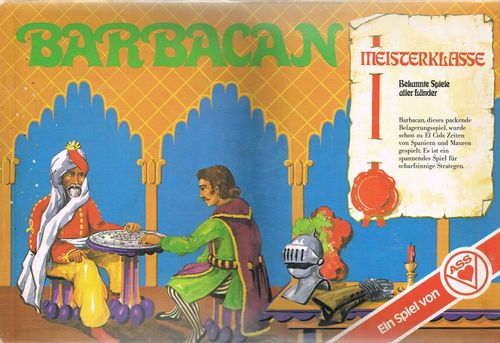
Barbacan
Barbacan Rulebook
Table of Contents
Table of Contents
Components
The game includes 47 game pieces ("Spielsteine") in 6 different colours and 1 blue spare piece, 1 game board, and 2 to 6 players.
Setup
The game board itself represents a fortress with several defensive rings. If you look at the plan closely, you will see that the point markings run in four circles arranged around the centre point. Between the second and third circle a thick line is drawn, which represents the outer boundary of the fortress. On the outermost circle line, 25 starting points are marked.
Each player places their fighting stones ("Kampfsteine") on these starting points, always alternating, and on a point of their own choice. When occupying the starting points, no particular order needs to be observed.
The number of fighting stones depends on the number of players:
- Two players: one player receives twelve green and the other twelve red fighting stones.
- Three players: the first player receives eight red, the second eight green, and the third eight blue.
- Four players: each player takes six, namely the red, green, blue and yellow fighting stones.
- Five players: each player plays with five red, green, blue, yellow and orange stones.
- Six players: each player takes four fighting stones of all six colours.
Then it is decided by lot who places the first stone.
Movement
Movement is along the marked lines of the game board, and always only from point to point. There is compulsion to move. Striking or jumping over opposing fighting stones is not permitted.
One does not fight the other players; one only tries to be inside the fortress before them. Since the second ring in front of the fortress rampart has only thirteen points (as opposed to the outer 25), a row of fighting stones must soon wait in line. However, this waiting time passes very quickly when the first stones penetrate over the rampart into the interior of the fortress, because here the real contest begins.
All lines of the second ring lead without exception to the squares ("Vierecke"), so that a stone occupying such a square simultaneously blocks another stone. Thus the situation could arise where one player occupies the majority of the squares and excludes the other players. This is prevented by an important rule:
When a fighting stone leaves a square, it may not, for the rest of the game, move onto any square point.
End of the Game
The player who first has all of their fighting stones in the fortress is the winner. If the majority of the other players wish, the second or third winner can also be determined.