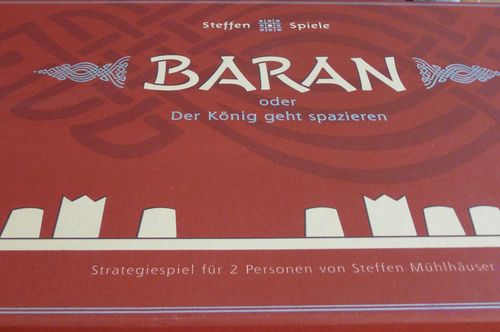
Baran
Baran Rulebook
Table of Contents
Table of Contents
Components
- 14 red warriors
- 1 red king
- 14 black warriors
- 1 black king
- 1 game board
Goal of the Game
The goal is to be the first player to occupy the opposing throne (the point of the board opposite your own) with your own king.
Setup
- Place the board between the two players so that each player sits in front of one point of the board.
- The players choose their colours. Each player receives 10 warriors, 4 fast warriors (recognisable by the circle marking) and one king.
- The two kings are placed on the marked throne spaces. Each player's warriors occupy the four rows that follow on their side of the board. The three middle rows are empty at the start of the game.
- The starting player is determined by lot.
[diagram: starting position]
Playing the Game
On their turn, a player moves either one of their warriors or their king.
Moving the Warriors
Warriors can move forward, sideways and backward. There are two kinds of movement:
- Move: The warrior can move to any free adjacent space.
- Jump: The warrior can jump in a straight line over an adjacent piece onto the free space directly behind it. Both your own pieces and enemy pieces can be jumped over.
Chain Jumps
Chain jumps are allowed but are not compulsory. A chain jump is a jump over several pieces in a single move. It is possible whenever there is an unoccupied space between the pieces being jumped over.
Within a chain jump, a warrior may change direction by bending at an obtuse angle (see [diagram]). Bending at an acute angle is not allowed (see [diagram]).
[diagram: chain jump that is not allowed]
Fast Warriors
Fast warriors are marked with a circle.
- Move: A fast warrior can move in a straight line over any number of free spaces.
- Jump: A fast warrior can jump, just like an ordinary warrior, only over a piece standing directly next to it onto the free space behind it. Chain jumps are also allowed for fast warriors.
All of the following rules apply to both warriors and fast warriors.
Restrictions
- Warriors cannot jump over the kings.
- Warriors may not enter the two marked throne spaces.
[diagram]
Capturing Enemy Warriors
- Enemy warriors that are jumped over in a forward movement are captured and removed from the board.
- A chain jump can capture several enemy warriors in a single move.
- Jumps backward or sideways have no capturing effect (see [diagram]).
- Mixed-colour chain jumps (a single move that jumps over both your own and enemy warriors) are allowed, but have no capturing effect (see [diagram]).
Forced Capture
If, at the start of their turn, a player has the opportunity to capture an enemy piece, that player is in forced capture. The player must capture the enemy piece with a warrior.
If a player overlooks the capture opportunity, or deliberately leaves a warrior in forced capture and makes a different move instead, the opponent may afterwards remove the warrior that was in forced capture from the board. Removing the enemy piece does not count as a turn.
If two of a player's warriors are in forced capture at the same time, the player may choose freely which one to capture with.
[diagram]
Moving the King
The king can move in any direction to an adjacent free space, or jump in a straight line over an adjacent piece (its own or an enemy's) onto the free space directly behind it.
- The king cannot jump over the enemy king.
- Chain jumps are not allowed for the king.
Special Rules for the King
- Because the king may not be jumped over, it cannot be captured.
- When a king jumps over an enemy warrior, this has no capturing effect. The king cannot be captured, the king does not capture, the king goes for a stroll.
- The king may not reach the opposing throne space by a jump; it must enter it by a move. This means the king must first reach one of the two second-to-last spaces in the opposing point of the board, and step onto the throne from there.
End of the Game
The game ends as soon as one of the kings enters the opposing throne space.
If a king has not yet left its own throne space when the other king arrives, the winner of the game gently nudges it off the throne.
[diagram: correct move and jump that is not allowed]
Afterword
The source heading for this section is garbled ("NachBEmErKuNG Fendlikeit"). It is read here as "Nachbemerkung" (afterword) with "Fairness" as the topic, since the text is about the fairness of forced capture.
It is always annoying to lose warriors because you overlooked that they were in forced capture. Checking at the start of each turn whether any of your pieces has a capture opportunity sounds like a simple exercise in attention. Even concentrated players sometimes overlook such a situation anyway.
Losing a piece through your own inattention is part of the game and is always a good lesson. Players who would rather avoid such frustrating experiences can agree at the start of the game to play "open", that is, to remind each other of forced capture.
Open play is also recommended between players of unequal strength.
Have fun with Baran!