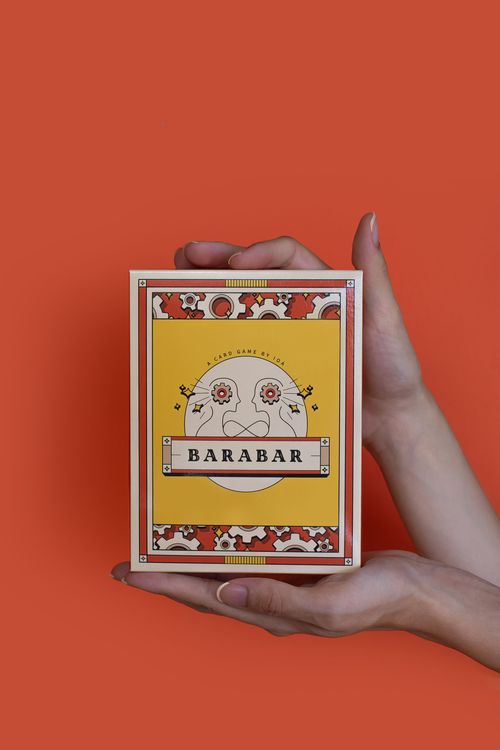
BARABAR
BARABAR Rulebook
Table of Contents
Table of Contents
Game Information
Barabar is played by 2 to 6 players, in 30 to 90 minutes.
Goal of the Game
Barabar is a card game in which players solve a series of challenges to save our endangered world. At their disposal they have the powers and resources of the five clans, as well as their own creativity and storytelling skill to change the world!
Here you will find instructions on how to play Barabar, but remember that the most important thing is to spend pleasant time with family and/or friends while playing! Learning about the activists and causes in Barabar will last if learning is accompanied by fun and play, so we would like to encourage adapting the game to your own temperament and style. You are free to choose how to start the game: with the youngest player, going clockwise, or with the first person who feels like telling a funny story about saving the world with their deck of cards.
Stages of the Game
First Stage: Get to Know the Clans
The game begins by showing 8 randomly chosen cards from the deck. One of the players must read aloud from the instruction booklet the short biographies of the heroes on those cards. All players aim to remember their names and their stories.
In the second stage of the game (see Second Stage: Working Together), if a player draws one of the initial 8 cards and manages to tell the hero's biography while playing the card on their turn, the value of all resources the card has is doubled.
Second Stage: Working Together
Components and Terminology
Types of cards:
-
Challenge card. Every game starts with such a card. The goal of the players is to find a solution to the problem written on it. Each Challenge card contains an event happening in 2037 that the participants must overcome through the strengths and knowledge of each clan. Barabar contains 15 different Challenge cards, which can range from severe drought to a zombie apocalypse. Discover and overcome each one!
-
Hero card. At the start of each game the participants receive 5 Hero cards. Each one depicts a representative of one of the five clans: a historical or contemporary figure who has contributed to a better future for the Earth. The cards are marked with different colours and have a specific main power depending on the clan the person belongs to.
| Clan | Colour | Resource |
|---|---|---|
| Activists | Red | Fire |
| Ecologists | Green | Nature |
| Entrepreneurs | Gold | Money |
| Scientists | Blue | Technology |
| Artists | Purple | Culture |
The choice of heroes in the five clans stems from the desire of the team of the association "Opportunities Without Borders" (Възможности без граници) to present and promote significant personalities and achievements in the field of protecting human rights and social causes, which make the world a better place to live. The team has focused on a variety of vulnerable communities and underrepresented groups, without claiming to be exhaustive on the subject. The goal is to provoke curiosity and encourage people to follow the good example of creating change in their surroundings. The educational aspect of Barabar rests on the principle of so-called "food for thought": learning or reflection on a topic, person or cause from the game, which has an effect, has the potential to have an effect, or has already contributed to improving the situation or the acceptance of a given marginalised group, happens at different moments for different people. It is also important to emphasise that none of the heroes has a direct connection to the game, including, but not limited to, sponsoring, advertising, giving approval to, recommending or being associated with Barabar.
-
"X Factor" card. X Factor cards contain secret missions or tasks that must be carried out personally by the player who drew one of them. These cards are mixed in among all the other Hero cards. If a player draws an X Factor card, they must play according to the condition written on it. If someone draws a second X Factor card, they return the first one they drew to the deck. They must then adapt their game to what is written on the new X Factor card. The old card is shown to the other players before being returned to the deck.
-
Freedom card. If a player draws a Freedom card, they may discard the X Factor card they hold. If they currently have no X Factor card, the Freedom card may be kept and used when needed later. Once used, however, it must be returned to the deck.
If you are playing Barabar for the first time, it may be better to set aside the X Factor cards, at least at the beginning, since their task is to complicate the game further. Focus on telling amazing stories with our heroes and leave the competitive part for a later moment.
Examples (from the booklet):
- X Factor card: "You may only use a card with a hero who has the Fire resource."
- Freedom card: "You may discard one X Factor card."
Other elements:
-
Resources. Resources are marked with a numeric value on each card. They are divided into 5 groups (fire, nature, money, technology and culture) according to the powers of the different clans. Each card has no more than 3 resources. Each time a player uses a Hero card, its powers contribute to overcoming the challenge in one of the campaigns.
-
Closing a resource. A resource is closed when the players together collect the total sum needed to overcome the Challenge card. The player who places the last card and reaches the required number receives the points. (See Third Stage: Save the World, Scoring System and End of Game.)
-
Campaigns (parallel storylines for overcoming the chosen challenge). In one game there can be up to three parallel campaigns, which try to overcome the same challenge at the same time. Each player is free to decide whether to cooperate in an existing campaign or to start a new one, within the three allowed campaigns.
Setup and Start of the Game
Please shuffle all cards, including the X Factor cards, before starting the game. All players must agree on the first challenge to be overcome. One Challenge card is placed in the middle of the table and shown to all players. Each player draws 5 cards from the main deck. If you draw an X Factor card, separate it from the Hero cards in your hand, but do not show its contents to the other players (this is your secret mission). Each player must have 5 Hero cards (plus an X Factor card, if they drew one) at the start of the game.
When a challenge is over (but not the game), all players must return their cards to the main deck and then take a new set of cards.
If you want to see how to set up the game or watch a video explaining the rules, scan the QR code, which will take you directly to the Barabar website.
What Happens on Each Turn
When it is Player 1's turn, they must play a Hero card into any of the three possible campaigns (if there are 3 current campaigns, and their secret mission does not contradict this). After playing their hero, the player must draw a new card from the deck so that they have 5 Hero cards at the end of their turn. The resources of the Hero card they used will help to overcome the challenge.
- If the player draws a Hero card: the turn passes to the next player.
- If the player draws an X Factor card:
- a. If the player did not have any X Factor card before, they keep it and separate it from the Hero cards in their hand, so that the others can see that they have an X Factor card but not what is written on it. The player then draws one more card, so that they have 5 Hero cards to play with on their next turn. If they draw another X Factor card, they repeat the process.
- b. If the player already has an X Factor card, they show everyone the contents of their original X Factor card and return it to the deck, shuffling the deck. They keep the new X Factor card, without showing its contents to the other players. The player then draws another card until they have 5 Hero cards in hand. If they draw an X Factor card again, they repeat the process.
Storytelling
One of the most important components of Barabar is storytelling. Each time a player uses a Hero card, they must explain or invent a story about how the character would contribute to overcoming the challenge.
Example. The challenge is "The End of Oil."
- Player 1: "I will play Elon Musk, and he will help solve the challenge by investing in a new modern renewable energy source."
- Player 2: "I will play Greta Thunberg, since she will raise awareness of alternative energy sources and will negotiate at the UN."
As part of a collective campaign, the heroes can also cooperate with each other:
- Player 3: "I will play Nikola Tesla, who will use his knowledge of electricity in cooperation with Elon Musk to find this new energy source."
Heroes can cooperate to solve the problem in many ways, so be creative!
Third Stage: Save the World
Scoring System
Each challenge has 3 resources to "close", and each of them has a numerical value. The player who contributes the last point toward closing each resource scores points: 1 point for the resource with the lowest value, 2 points for closing the resource with the second-highest value, and 3 points for closing the resource with the highest value. In addition, the player who closes the last resource (and with it the whole campaign) scores 1 extra point.
The maximum a single player can score in one game with a challenge that has three resources of different numerical values (if the player manages to close all the resources alone) is 7: 1 + 2 + 3 for the resources, plus 1 extra point for "closing" the campaign.
The booklet shows a scoring sheet, with the challenge number, columns for Campaign 1, Campaign 2 and Campaign 3, rows for the resources and a total row. The diagram is not reproduced here.
What happens if a challenge has two resources with the same value?
- If two resources have the same value, lower than that of the third resource, both are worth 2 points when closed, and the third, most valuable resource is worth 3 points. (2 pts, 2 pts, 3 pts)
- If two resources have the same value and are more valuable than the third resource, both are worth 3 points, and the third, lowest resource is worth 2 points. (2 pts, 3 pts, 3 pts)
End of the Game
The game ends when one of the players reaches 10 points (short version), or when a total of 5 challenges have been defeated (long version).
Variant: Barabar in Pairs
Barabar in pairs is a variant in which the players are divided into pairs and cooperate to solve the challenges. The mechanics are the same as in the individual game, with the only difference that the players are placed in pairs. The pairs and their positions at the table are assigned at random before the start of the game, into Team A, Team B and Team C (for 6 players).
Players may not tell their partner what cards they have. Decisions in the game are made by intuition, and the goal is to solve the challenge together and earn points for your team.
Frequently Asked Questions
I have two X Factor cards in my hand before the game starts.
Another player chooses one of them at random and returns it to the deck. You keep the other one and choose Hero cards until you have 5 Hero cards and an X Factor card.
I cannot play a card that supports the campaign.
If you cannot play a Hero card that would continue the current campaign, or start a new one with a required resource, you cannot play any cards. You must discard one of your Hero cards, return it to the deck at random, and then draw a new one from the deck.
I drew an X Factor card and now I have two.
Show everyone the contents of your previous X Factor card, place it in the deck and shuffle. Keep your new X Factor card separate from your Hero cards, without showing its contents. Then draw another card until you have 5 Hero cards. If you draw an X Factor card again, repeat the process.
I have a Freedom card and I drew a new X Factor card.
You can use your Freedom card to discard the X Factor card. You must then also discard the Freedom card and draw a Hero card from the deck.
I drew a Freedom card while I already had an X Factor card.
You can use your Freedom card to discard the X Factor card. You also discard the Freedom card and draw a new Hero card from the deck.
My X Factor card does not allow me to play any of my heroes.
If you cannot play any of your cards because of your X Factor card, you must discard one of your Hero cards of your choice and draw a card from the deck. Your turn is then over.
The resource is closed in one campaign, but I have just closed it in another campaign. Do I still receive points?
If a resource (for example Nature) is closed in one campaign, and a player closes the same resource (Nature) in another campaign, that player receives points for closing a resource, even though it was already closed elsewhere.
Hero Descriptions
The booklet gives a short biography for each hero card, grouped by clan. The biographies are flavour text about real people and are not transcribed here; the hero names are listed by clan.
Scientists: Hedy Lamarr (1914–2000); Alan Turing (1912–1954); Yuval Noah Harari (1976–); Nikola Tesla (1856–1943); Charles Darwin (1809–1882); Albert Einstein (1879–1955); Wilbur (1867–1912) and Orville (1871–1948) Wright; Stephen Hawking (1942–2018); Louis Pasteur (1822–1895); Florence Nightingale (1820–1910); Ada Lovelace (1815–1852); Rita Levi-Montalcini (1909–2012); Barbara McClintock (1902–1992); Rosalind Franklin (1920–1958); Maria Mayer (1906–1972).
Ecologists: Amariyana "Mari" Copeny (2007–); Greta Thunberg (2003–); Dr Jane Goodall (1934–); Leonardo DiCaprio (1974–); Rachel Carson (1907–1964); Julia Hill "the Butterfly" (1974–); Theodore Roosevelt (1858–1919); Wangari Maathai (1940–2011); Gaylord Nelson (1916–2005); Lily Platt (2008–); John Paul Jose (1997–); Israa Hirsi (2003–); Al Gore (1948–); Jamie Margolin (2001–); Jerome Foster II (2002–).
Artists: Judy Chicago (1939–); Frida Kahlo (1907–1954); Valya Balkanska (1942–); Sofia Taykon (1926–2017); Paula Modersohn-Becker (1876–1907); Esma Redzepova (1943–2016); Joaquín Cortés (1969–); Charlie Chaplin (1889–1977); Tsea Stoyka (1933–2013); Christo (1935–2020); Pablo Picasso (1881–1973); Tom Hanks (1956–); Friedrich Nietzsche (1844–1900); Tracey Emin (1963–); Banksy (1973–).
Activists: Nadia Murad (1993–); Emma Watson (1990–); Guerrilla Girls (1985–); Todora Bakardzhieva (1850–1934); Bill Gates (1955–) and Melinda Gates (1964–); Malala Yousafzai (1997–); Mari Asad (1922–2018); Rosa Parks (1913–2005); Martin Luther King Jr. (1929–1968); Muhammad Ali (1942–2016); Simone de Beauvoir (1908–1986); Sophie Scholl (1921–1943); Jane Elliott (1933–); Nkosi Johnson (1989–2001); Sadhguru (1957–).
Entrepreneurs: Ezequiel Vedana da Rosa; Vibin Joseph (1985–); Bonnie Chiu (1998–); Enas Abu-Hamed; Kevin Smiley; Malika Dutt (1962–); Clara Brown (1800–1889); Brit Gilmour (1989–); Tom Hunter (1961–); Andrew Carnegie (1835–1919); Pierre Omidyar (1967–); Steve Case (1958–); Elon Musk (1971–); Boyan Slat (1994–); Zhang Yin (1957–).