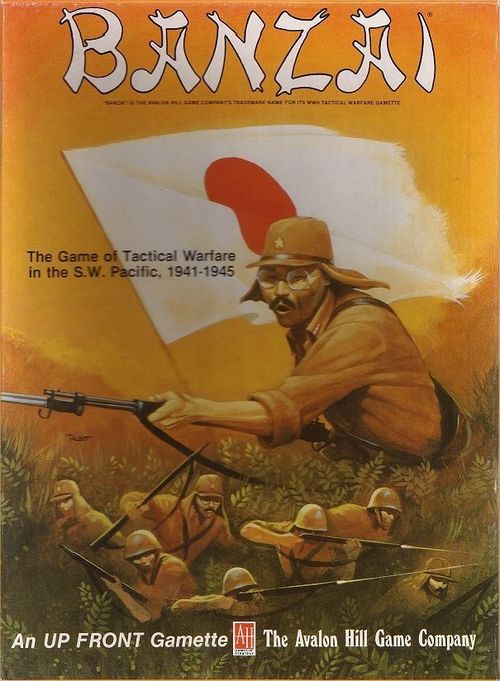
Banzai
Banzai Rulebook
Table of Contents
Table of Contents
44. British
44.1 HAND SIZE: British Line Troops have a hand size of five cards with a maximum discard capacity of two cards per turn, but discards are permitted only in those player turns in which the British take no actions.
44.2 SPLIT-ACTION CARDS: The British player may use any Split-Action card that either the Americans or the Germans may use. There is one exception: the British player may use a Radio card only if it can be used by both the Americans and the Germans.
44.3 FIREPOWER BONUS: The British were known for their coolness under fire and also had an advantage in marksmanship thanks to a greater emphasis on live-fire practice in training. Accordingly, the British player may reduce the Fire Power factors required for any attack (infantry only) by one per attack (to a minimum of one).
44.4 TROOP TYPES: Paratroopers are British Elite troops. Paratroopers may take one action and still discard one card, or take no action and still discard two cards. Militia are British Second Line troops. Militia have a maximum discard capacity of one card per turn, and only in those turns in which they take no action.
44.5 PIAT: The PIAT is a LATW (30) and is governed by the rules for the Bazooka, except that it is not a crew-served weapon (hence the absence of To Hit frequency numbers in square brackets).
44.6 HEAVY WEAPONS: At the start of the Second World War, British heavy weapons suffered from being unable to fire both armour-piercing and high-explosive rounds. Anti-tank guns and tanks were regarded exclusively as a means of countering enemy armour and consequently were of no use when it came to hitting infantry. To fight infantry, one had to use special "CS" (Close Support) versions of each tank type, which could fire only high-explosive rounds, which in turn were inferior to enemy armour. To reflect this in game terms, all British heavy weapons incapable of firing high-explosive rounds received a red Fire Power 0 not in a box. Such weapons may not add the Random Number To Hit from the RNC just drawn to determine the hit to the Fire Power 0 of the heavy weapon card (25.4). The maximum Fire Strength of a hit by any British heavy weapon with a red Fire Power 0 not in a box is always 0 (excluding any positive target modifiers for wire or movement).
44.7 BREN CARRIER: The British have AFV cards that can be destroyed by Panic under Fire. The "Wasp" and "Bren Carrier" cards follow the usual rules for open-topped AFVs, but can also be destroyed by Panic in the same way as an infantryman, because they were vehicles that never gave full protection against small-arms fire. A "Bren Carrier" (or any AFV) cannot be captured or used by other personnel; it is removed from the game after it routs.
44.8 DYO: The cost of acquiring British radio in a DYO scenario is identical to German radio of the same strength (43.7).
44.9 LMG: The Bren machine gun is not counted as a crew-served weapon; hence the absence of Fire Power values and breakdown numbers in square brackets. A Hero card may be used to double the non-bracketed Fire Power values (10.45) of this weapon only if that Hero card is also a black RNC. This rule may not be used for other nationalities (EXC: Japanese).
45. Japanese
45.1 HAND SIZE: Japanese Line Troops have a hand size of four cards with a maximum discard capacity of two cards per turn, but discards are possible only in those turns in which no actions were taken (EXC: 45.11 and .12).
45.11 FREE MOVEMENT: The Japanese may play Movement cards in any capacity without affecting their discard capacity for that turn. In other words, a Movement card played by the Japanese counts as an action for the group on which it is played, but does not count as an action that prevents the Japanese from discarding in that turn.
45.12 DISCARD OF COWER CARDS: Regardless of the number of actions taken or cards discarded in a turn, the Japanese player may always discard Cower cards printed as such, or designated as such by the scenario, in excess of his normal discard capacity for that turn, by showing those Cower cards to his opponent before discarding them. Remember that cards to be removed from the deck after their initial discard or use as RNC/RPC are considered "scenario-defined Cower cards", as are Sniper cards for a player who does not have Sniper ability.
45.13 INFILTRATION: To reflect the preference the Japanese gave to infiltration tactics, any Japanese infiltration attempt is favoured by an additional one-column shift to the left. This shift is cumulative with the jungle terrain shift and other similar shifts.
45.2 SPLIT-ACTION CARDS: On any Split-Action card, the Japanese player uses the side designated for the Russians.
45.3 BUSHIDO: The Japanese code of honour of the "Samurai", or warrior, imbued fighters with an incredible fighting spirit that far surpassed the will to resist of combatants of other nationalities. This willingness to die for the Emperor is reflected in their higher relative morale state, and in the following special rules.
45.31 BROKEN SQUAD: Unlike other nationalities, the Japanese do not automatically lose when they lose more than half of their Personality cards to KIA and/or Rout (16.5). A Japanese squad is not Broken until it has lost at least 75% of its Personality cards (i.e., 10 of 13 cards in the average scenario).
45.32 ROUT: Although the Japanese are given the lowest Panic values in the game, this does not reflect a high probability that they will run away. On the contrary, these low Panic values reflect a greater likelihood that a Japanese soldier under fire will ignore suppressive fire and continue to pursue the enemy, and consequently be killed. Accordingly, the Rout Number printed on the back of each Personality card is always two higher than that man's Panic value. Therefore most Japanese under fire who are removed as a result of subsequent fire attacks (6.531) will not rout, but will be counted as KIA and will yield more Victory Points to the opponent.
45.33 Any Japanese CC attack against an AFV receives a "heroic" modifier of +1 in CC (28.81). This modification is in addition to the effects of any Hero card(s) played at the same time.
45.4 BANZAI: Any Japanese group containing an SL or ASL may declare a Banzai attack as its sole action for that player turn, by playing a Movement card sideways (regardless of whether it has pinned men) and declaring the enemy group it attacks. The Movement card may not serve any other purpose (such as Sideways Transfer, Wading, Wire Removal or Flanking Fire, etc.); its only effect may be to declare the Banzai attack. A Banzai attack may be declared only against an adjacent or directly opposite group, regardless of the distance to it. Place a Banzai marker bearing the ID of the declared target group on the Banzai group, to mark the attacking group and the group that is the target.
45.41 EFFECT ON RALLY: Declaring a Banzai attack automatically rallies all pinned men in the group at the time of the declaration (including the leader who declared the Banzai attack).
45.42 EFFECT ON MOVEMENT: Once a Banzai attack has been declared, the Japanese may take no action with that group other than Close Combat or playing Movement cards forward or sideways, for as long as the Banzai attack lasts. In addition, the Japanese player may not play a Movement card on any other group if he has not yet played a Movement card on the Banzai group during this turn, or if the Banzai group is not currently engaged in Close Combat.
45.421 The Japanese player may not place terrain on a Banzai group, but his opponent may still discard terrain on the Banzai group to slow it down or to change the TEM of subsequent attacks against the Banzai group or the CCV of its members (45.423). Placing such terrain does not cancel the Banzai attack, i.e., there is no need to show a Movement card in order to count as being in the course of a Banzai. The Japanese player retains the right to reject terrain in the normal manner.
45.422 In the Japanese player turn following the one in which the Banzai group reached Relative Range 5 to its target, all members of this group conduct Close Combat in that player turn as the group's sole action for that player turn (provided the target group is still at Relative Range 5), and in all subsequent player turns until no enemy men remain in the target group at Relative Range 5. Infiltration, Morale checks and/or playing additional Movement cards are not required; Close Combat occurs automatically. Even after a Banzai attack has resulted in Close Combat, the Banzai group remains subject to fire attacks from the target group and/or other enemy groups.
45.423 A Banzai group may conduct Close Combat even while on a Stream, Marsh or Wire card, provided it is at Relative Range 5 to its target. However, Banzai attackers from such terrain suffer an Attack Strength modifier of -1 to the CCV of these men. If the Banzai group is not at Relative Range 5 to its target, it must play Movement cards as normal to overcome these obstacles in order to be able to reduce the distance. A group may not declare a Banzai against a group in a Pillbox (23.5). A Banzai group (or berserker man; ignore 24.7) may conduct Close Combat even while on a Minefield, provided it is at Relative Range to its target. However, each such man must draw a black RNC before entering Close Combat for the first time; if he draws a red RNC he is destroyed. A man who survives one such RNC draw need not draw again for the same minefield.
45.43 DURATION: Once declared, a Banzai attack continues until all attacking or defending cards in the respective groups have been destroyed, or the game ends because one side has lost by sufficient losses, causing a Broken Squad (16.5). The Japanese player may cancel a Banzai attack only if the target group retreats or makes a sideways move, leaving the range (i.e., the target group is no longer directly opposite or adjacent), or if another enemy group moves in such a way as to block the Banzai group's access to the declared target. Cancelling a Banzai attack requires no action, but it must be declared during the Japanese player's turn.
45.44 CONCEALMENT: The Japanese player may not use Concealment cards to help a Banzai group, whether in defence or in Close Combat.
45.45 EFFECT ON FIRE: A group that has declared a Banzai is no longer subject to the "Pinned" results (6.52). The "Pinned" result instead counts as KIA, unless the man was wounded. A "Wounded" result may occur whenever the final attack strength is ≥ the target's Morale value and < 9. The RNC that produced that final attack strength is then checked on column 7W to determine whether it equals the target's Morale value and therefore causes a wound. A wounded man continues the Banzai attack as normal, although he takes part in Close Combat with his CCV under fire (33.5).
45.46 AGAINST ARMOUR: Banzai attackers need not infiltrate in order to attack AFVs, but their Close Combat attack (28.81) is modified by a -3 modifier for a berserker attacker.
45.47 COUNTERATTACK: Once a Banzai attack has resulted in Close Combat, any heavy weapons in the defending group may not attack the Banzai group while they remain at Relative Range 5 (20.54). However, all unpinned men in the defending group attacked by the Banzai group may conduct CC (even if on a Stream, Marsh or Wire card according to 45.243 [as printed; probably meaning 45.423]) against the remaining Banzai attackers without infiltrating, provided the Banzai group has not been subjected to Fire Attack from any source during that player turn.
45.48 VICTORY CONDITIONS: A Banzai group may not be used to satisfy any Victory Conditions relating to reaching a specified range marker or Relative Range. The group must leave the Banzai state before it can satisfy these Victory Conditions.
45.5 SPECIAL WEAPONS: All Japanese paratroopers and Sergeants are armed with pistols, which may be used as a weapon with 1 FP at Relative Range 5 if they are otherwise unarmed (19.4), provided that it is used in combination with a Fire card with a black RNC. A pistol is not sufficient armament to cancel the Morale/Panic penalties of 19.4.
45.51 In addition, Japanese LMGs and submachine guns were fitted with bayonets. Therefore the Japanese LMG has a weapon CCV of 2 instead of 1 (20.6), and the Japanese submachine gun has a CCV of 4 instead of 3.
45.52 The Japanese LMG breaks on a red RNC 5 or red 6, and will break automatically on a red RNC 5 without a check of which weapon in the group broke (unless the group also contains a FT [flamethrower], captured weapon or another LMG). Note that the Japanese LMG is not considered a crew-served weapon, and therefore has no Fire Power values or breakdown numbers in square brackets. A Hero card may be used to double the non-bracketed Fire Power values (10.45) of this weapon only if that Hero card is also a black RNC.
45.6 HEAVY WEAPONS: The Japanese ATR and Medium Machine Gun were so heavy that they could not be moved by a single man. Any group with these weapons must contain at least two unwounded men as the crew of these weapons in order to play a Movement card with any target, unless they drop their weapons. Dropping weapons requires no action. Men who are the crew of these weapons may not also be armed with other weapons that require crew for effective use.
45.7 DYO: The cost of acquiring Japanese radio is identical to Russian radio of the same type (43.7), and the cost of acquiring a Japanese AT Mine equals that of an ATMM.
45.8 TROOP TYPES: SNLF are Japanese second-line troops. Special Naval Landing Force units may not play Movement cards without counting them as an action. Samurai are Japanese elite troops. Samurai may take one action and still discard up to two cards (plus the free discard function of any Cower card).
45.9 TROOP TYPE TABLE:
| Year | 1945 | 1944b | 1944a | 1943b | 1943a | 1942b | 1942a | 1941b |
|---|---|---|---|---|---|---|---|---|
| British S | - | 1 | 1 | 1 | 1 | 1 | 1-2 | 1-2 |
| British L | 1-7 | 2-7 | 2-7 | 2-7 | 2-8 | 2-8 | 3-8 | 3-9 |
| British E | 8-0 | 8-0 | 8-0 | 8-0 |
(Row labels S, L and E are as printed in the table; the table is reproduced as printed.)
46. Marines
46.1 FEATURE: In the UP FRONT and BANZAI scenarios included in the respective games, all American forces opposing the Japanese are considered Marines, unless the Scenario Special Rule (hereafter SSR) states otherwise. In scenarios against the Germans, regular US Army troops are considered to be used.
46.2 MORALE LEVEL: Marines are considered half-elite troops in that they must start each scenario with a minimum Morale value of 2. If a scenario with Marines lists a man with Morale value 1, a "Morale 2" marker and a "Panic 3" marker should be placed next to that man's card to reflect his higher morale state.
46.3 HAND SIZE: Marines have the same hand size, discard capability and all other characteristics as American Line troops. Marines are represented by the same American Personality cards and weapon markers used in UP FRONT, plus two additional leader cards found in BANZAI.
46.4 SUPPORT FIRE GROUPS: In any scenario featuring a 1944–45 Marine squad (with three BARs), no BAR man may be placed in one group with another BAR man. Also, a BAR man may not make an Individual Transfer into another group containing a BAR man while his own group has another man not under fire who can make the transfer instead of him. This rule also applies to any nationality and scenario with two or more LMGs on one side, since such a concentration would not have been realistic.
46.5 The "#(Weapon)" entry in an American order of battle (OB) for a scenario refers to one of the spare unnumbered Personality cards in UP FRONT; the type to be used is indicated by the weapon in brackets. If Morale/Panic values are not given for such a card, it is always assumed that Morale is 2 and Panic is 3. In all scenarios with Marines before 1943, the Marines are assumed to be armed with bolt-action rifles instead of semi-automatic rifles. The only difference in game terms is that their Fire Power will be halved for fire on the move (12.11), and their acquisition cost in DYO scenarios will be one less. It is assumed that any scenario in which the Marine leaders #42 and #43, armed with Springfield rifles, are used takes place before 1943; those scenarios that do not include these leaders are assumed to take place in 1943 or later.
47. Jungle Terrain
47.1 Because of the nature of the war in the Pacific, most of the fighting there took place in jungle terrain, where line of sight and long-range fire were extremely limited. To model this type of combat at ultra-short distances using the UP FRONT game system would not be very interesting in game terms, since almost all long- and medium-range fire would have to be abandoned. Accordingly, our depiction of jungle terrain is abstracted, for playability, only to those engagements that took place on the edge of jungle terrain, where in fact most of the fighting did take place.
47.2 Jungle terrain is in effect only if introduced through an SSR, and only in scenarios in which the Japanese fight the British or Americans. In jungle scenarios, all Buildings cards are treated as equal to Woods cards in every respect, except that Buildings cards with TEM -3 also have TEM -3 as a Woods card (representing exceptionally dense jungle). A Buildings card retains none of its other characteristics in a Jungle scenario.
47.3 All Fire attacks (including heavy weapons and Demolition Charges, but excluding Flamethrowers and CC) that occur in a scenario using jungle rules must reduce their Fire Strength by one, regardless of the terrain cards in play.
47.4 Marsh cards may not be rejected in a Jungle scenario, and for this reason they may not be placed on a group with an AFV or an Infantry Gun.
47.5 All infiltration attempts during a Jungle scenario apply one additional column shift to the left on the infiltration check (in addition to the usual one-column shift to the left for Woods terrain).
47.6 An AFV must check for Bog each time it plays a Movement card, and may not enter, or attack by Overrun, Buildings with TEM -3 (Woods) in a Jungle scenario.
48. Random Reinforcements
48.1 Random Reinforcements are used in conjunction with the Reinforcements rules (35), and may be used only if introduced through an SSR or at a cost of 50 points per deck in a DYO scenario (43). Note that a player may acquire the ability to receive Random Reinforcements only for a separate segment (deck) of the scenario's length, but in that case he may attempt to obtain a Random Reinforcement only during the deck for which he paid. Reinforcements need not arrive during the deck for which they were paid.
48.2 A player may attempt to obtain a Random Reinforcement immediately only during his own next player turn, following his opponent's drawing of a black RNC 6 (the card must be used by him as an RNC, not as an RPC, action or discard). If the player decides to attempt to obtain reinforcements, he may do so by drawing an RNC as his sole action for that player turn. If he draws a red RNC, he does not obtain reinforcements; but if he draws a black RNC, he has successfully obtained reinforcements and immediately checks the Random Reinforcements Table (48.3) to determine the value of his reinforcements according to the RNC drawn. Reinforcements obtained do not appear on the table immediately, but must enter according to 35.3–.4 in the subsequent turn. A player may also attempt to obtain a Random Reinforcement in his first turn following the shuffling of a deck in which he could obtain one. However, in both cases, if the player does not attempt to obtain a Random Reinforcement in his next player turn, he loses this ability until the next opportunity presents itself (the opponent's drawing of a black RNC 6, or the end of the corresponding deck).
48.21 Russian Entrenchment attempts and Japanese Movement, although they do not count as an action for discard purposes, are not permitted during the player turn in which this player attempts to obtain a Random Reinforcement. The Hero card is the only card that may be played during the player turn in which an attempt to obtain a Random Reinforcement is made.
48.22 No discard is permitted during the player turn in which an attempt to obtain a Random Reinforcement is made, except for the free discard capability of Cower cards by the Japanese.
48.3 RANDOM REINFORCEMENTS TABLE
| RNC | British | German | Japanese | Russian | American |
|---|---|---|---|---|---|
| 0 | Sniper | Sniper | Sniper | Sniper | Sniper |
| 1 | 8, 9 | 8, 9 | 11, 12 | 24, 25 | 11, 12 |
| 2 | 10, 22, 24 | 9, 10, 24 | 4, 13, 25 | 21-23 | 17, 20, 21 |
| 3 | 8, 22, 25, * | 10, 19, 24, * | 15, 18, 25, * | 20-22, * | 20, 25, 26, * |
48.31 SELECTION: An entry of reinforcement listed only as "*" gives the recipient a choice of any one Personality card available to him, except MMG, AT Gun or AFV. If he selects a man armed with a rifle or MP, he may equip that man with a secondary weapon such as a DC, PF or ATMM. If he selects an unfilled Personality card, he must use Morale/Panic markers to reflect a Morale/Panic rating of 3/4 respectively, regardless of nationality. Whatever his choice, the player must make it at once; he may not wait until he actually enters the reinforcements into play.
48.32 REPLACEMENTS: If the specified reinforcement Personality card is not available, because it is already in play, or because the weapon was not available during the year in which the scenario is played, a replacement is made according to the following order of priority:
A. A Personality card with the same weapon and Morale/Panic values (use unfilled or other Personality cards with the same weapon and the corresponding Morale/Panic value markers).
B. A Personality card with a different weapon that costs the same or fewer points than the unavailable reinforcement.
48.33 ENTRY: A Random Reinforcement may enter at Group E or Z. Reinforcements that enter with a Movement card that is a red RNC must enter as Group Z. Reinforcements that enter with a Movement card that is a black RNC must enter as Group E. If Group E or Z is already present, thereby blocking reinforcement entry along that edge, reinforcements may not enter along that edge until the blocking group has been moved or destroyed. Reinforcements may not use Individual Transfer to enter the game.
48.4 SNIPER: A Sniper reinforcement may be used to restore a lost Sniper ability, or to give a Sniper ability to a player who did not begin the scenario with this ability. If a player still has Sniper ability when he receives a Sniper reinforcement, he may attack twice for each Sniper card he plays (or three times if he receives a Sniper reinforcement twice, etc.). Multiple Sniper attacks using the same Sniper card must each draw a separate RPC to determine the target of that attack (unless only one card is in the single group attacked). This dual Sniper attack ability may also be used in DYO scenarios where additional snipers are purchased.
48.41 A player with a Sniper has the option of dividing his multiple Sniper attacks between different groups, or directing all shots at one group; but he must declare the group(s) to be attacked in advance, before the result of the first attack is determined.
48.42 A successful Sniper Check (14.4) destroys only one Sniper, not the player's entire multiple Sniper ability. For each group attacked by a Sniper, the attacked group is still permitted to make only one Sniper Check, as its sole action for that turn, regardless of how many times it was attacked by one or more Sniper cards during that turn.
48.43 Sniper reinforcements are not required to enter the game by means of a Movement card (35.3), as other reinforcements are. They automatically appear as available in the player's next turn.
49. Solo Play
49.1 Although UP FRONT is designed as a competitive game for two players or teams, it can be modified to allow an engaging solitaire game with only a few minor changes to the existing game rules.
49.11 All actions in a player turn must be declared in advance, before the result of any of them is determined. A player is not allowed to see the result of one action before declaring the others he will take during that player turn.
49.12 Cards in hand are laid face up on the table. However, all cards taken in place of cards played are laid face down, and are not revealed until that side's turn, or until the opposing side attacks or discards a terrain card on one of the moving groups (whichever comes first). Usually this means that each side has a number of unknown cards in hand that may be played at the last minute to weaken an attack or to influence the decision to accept or reject a terrain card.
49.13 Don't cheat! Play both sides to the best of your ability, taking into account the resources of that nationality, its situation on the board and the Victory Conditions. By playing the cards in hand in the best interests of a side, you will get a working solitaire system, but only if you do not favour one side or the other.
Designer's Notes
The designer's notes below are reproduced from the BANZAI designer's notes section (pp. 87–88 of the translated file).
Again Bringing Up the Rear
The UP FRONT designer's notes cover the rationale of the game system well, so I refer players to that material for most explanations. My comments here are limited to issues unique to the BANZAI game expansion.
Depicting the Japanese soldier within the UP FRONT game system presented us with an interesting challenge. Although the standard Japanese rifle was a smaller-calibre weapon with a slower bullet, this fact had little consequence for our rating of the Japanese rifle. The Japanese soldier simply suffered from an appallingly low standard of individual marksmanship, and, as in the Russian army, they were taught to close with the enemy as quickly as possible. In addition, they preferred to fire aimed shots from a crouching position, which they had not been taught, but which simply arose naturally from Japanese culture; the Japanese often talk while squatting. While the Japanese shot from a crouching position much better than their Allied opponents, it was still an awkward firing position compared with the prone position preferred by Western soldiers. Furthermore, the rifle sling was not used to steady the weapon during firing, as was common in Western armies. Also, rapid fire, as practised by the British with their Enfield rifles, was virtually impossible for the Japanese soldier, who was too short to bring the rifle to his shoulder and work the bolt without the support of a sling stabilising the weapon. This low accuracy was also attributed to the rural, machinery-unfamiliar background of most soldiers. Complex long-range weapons would simply have been wasted in their hands.
During training the Japanese soldier underwent intensive instruction, and the typical soldier could be relied upon to carry out his assigned task for as long as he was physically able. Their specialisation in infiltration and high morale are represented in the game by their ability to play Movement cards without affecting the choice of Discard. Their morale, already the highest in the game, in fact represents the knowledgeable application of soldierly skill to a greater degree than a desire not to bow to bullets.
The Japanese never lacked courage, but their sense of honour and duty often led them easily to their deaths, as represented by their high Rout values. Although the Japanese had 50mm smoke grenades, which could be thrown by hand or fired from their grenade launchers, they were rarely used. The widely advertised Banzai attack better matched the Japanese belief that cold steel and courage can overcome firepower. While such rushes worked well against poorly armed Chinese, this tactic bordered on criminal stupidity against an enemy with automatic weapons. Players should accordingly exercise caution in considering this option, although in a suitable situation (desperation) a Banzai attack may bring victory, at least in a scenario. The Japanese emphasis on spirit and motivation is modelled in the game by increasing the percentage of losses a squad may sustain before becoming "broken", and by allowing free discard of Cower cards. A hand size of four cards and a maximum discard of two cards reflects the Japanese reluctance to take initiative and react quickly to unexpected situations.
Contrary to popular belief, SNLF troops were not better than, or even equal to, ordinary troops. On the contrary, they demonstrated a surprising lack of ability in infantry combat when facing determined resistance. In game terms I therefore used them to represent, for convenience, practically any "second line" troops. Also note that the Japanese have no real elite troops, because there essentially were none. Although there were units that performed unusually well in combat, this was as much a consequence of circumstances or leadership as of their organisation. The term "Samurai", which we use to classify elite units, is simply a conventional term; no specially formed units of this kind existed.
Before leaving the Japanese, we should note that Japanese armour rarely appeared even outside the jungle, although it was used to a considerable extent against the Russians on the plains of Manchuria. Even rarer was the half-track, which they produced in very limited numbers and which, for the sake of game interest, we represented with a field-mounted machine gun as its armament.
The average British infantryman was a well-motivated, professional soldier, fully devoted to his unit. On the battlefield the ordinary soldier considered himself practically invulnerable, which in many respects contributed to his effectiveness. For officers, however, this resulted in excessive self-confidence, which high command was in no hurry to dispel. Within the game's parameters I tried to show these characteristics with a German hand size of five cards, but with the restricted discard capacity of the Americans. More than any other army of the time, the British placed emphasis on the marksmanship of the individual soldier. Their unique training in rapid fire is reflected in their ability to reduce the required Fire Power factor of each attack by one. Indeed, they came close to achieving the same rate of fire as the American semi-automatic rifle. The name "Militia" for British second-line troops is again a conventional designation in the absence of a better term. In reality, they can be used to represent any lower-quality British Commonwealth troops.
Finally we have reached the American Marine Corps. Contrary to popular belief, Marines were not the hardened, professional soldiers that the cinema depicts, especially early in the war. During the battle for Guadalcanal, the average age of a Marine was 19. What experience can any soldier have at 19? Marines also had to develop jungle fighting techniques, as did everyone else. Army regiments arriving in the Pacific learned from the Marines' experience and in general fought no worse than they did. Therefore, in game terms they were given "half-elite" status, in that they have a minimum morale level of 2, because they did not seek first of all to avoid losses. Although Marines were often armed with various types of weapons (for example, the Johnson machine gun), the difference in game terms was not considered sufficient to print additional Personality cards.