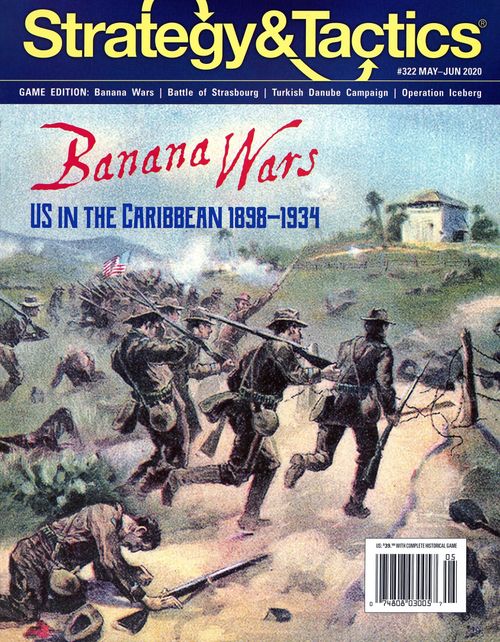
Banana Wars: US Intervention in the Caribbean 1897-1933
Banana Wars: US Intervention in the Caribbean 1897-1933 Rulebook
Table of Contents
Table of Contents
Victory Conditions
If the US player is required to spend an AP on a crisis and no APs remain on the US Action and Military Resource Tracks, the game ends and the Activista player wins a sudden death victory.
Otherwise, victory is determined when the "Good Neighbor Policy" card is played. Count the number of crises remaining in the game. Crisis markers on the map count as one crisis regardless of level. Each US Market (Bananas, Sugar, Tobacco, or Other) in the red zone counts as one crisis. The U.S wins if there are zero or one crises remaining. The Activista player wins if there are two or more crises remaining.
Set-Up
- Place one Agitator in Haiti.
- Place one Rebel in Nicaragua.
- Place one Agitator in Honduras.
- Place two USA units (2 side up), a level 2 crisis and one Rebel in Cuba.
- Place a green marker on the #0 box of the US Action Track.
- Place a green marker on the #10 box on the US Military Resource Track.
- Place a green marker on each Market Stability Track #5 Box.
- Place one USN and three USMC units in the US Deployment Box (2 side up).
- Place all remaining US units in the US Training Box.
- Place a yellow marker on the #0 box of the Activista Action Track.
- Place a yellow marker on each country's #1 box.
- Place all remaining Jefe, Rebel, Agitator and Crisis units under the Activista Action Track (lower left of the map).
- Place the Administration marker to the right of the picture of President McKinley (Administration 1) on the west (left) side of the map.
Card set-up:
- Separate the deck into eight separate Administration Decks (by number in upper right corner of cards) and one Recurring Deck (the ones with stars in the middle). Shuffle the Recurring Deck.
- Shuffle together the six administration 1 cards and the top six cards from the Recurring Deck. This becomes the Administration 1 Deck. Deal three cards to each player. The rest of the Recurring cards will be used during Administration Change.
- Deal three cards from the newly shuffled Administration 1 Deck face-up to the east (right) of the map. These will be referred to as the display cards.
- Add the Administration Change card to the remaining three cards of the Administration 1 Deck and shuffle the cards.
Components
A complete game of Banana Wars includes a 22×17-inch game map, rule set. and a sheet of 80 counters. Players must provide one six-sided die to resolve probabilistic game events.
Note: All counters provided are a limit. No additional units or marker types may be created if all of that type are in play.
Cards
The deck contains 55 cards consisting of eight administration sets with colored borders for easy sorting (44 cards), one recurring set (10), and one Administration Change card.
Note: As cards are played, Administration cards will be discarded permanently. Recurring cards will be set aside and be shuffled into the next Administration Deck.
A player begins with three cards but there is no limit to the number of cards players may hold in their hands.
Card Anatomy
Administration cards carry a US side and an Activista side. Each side shows:
- Available number of Action Points (the left number of the pair, such as 3/0, 3/1 or 0/2 on the card): the left number is the AP value (in the upper left corner of the card) added to that side's Action Track when the card is played.
- # of cards to be drawn (the right number of the pair): the number of cards the player draws after playing the card (for example, 0/2 is 0 APs and 2 card draws).
- Administration Deck Number (the number printed beside that label on the card).
- Special Instructions: a red text instruction the player must complete if possible.
- Historical Note (no in-game effect).
- Card Number (no in-game effect).
- Current US President (no in-game effect).
- Commodity that can be affected: a symbol showing Tobacco, Bananas, Sugar or Other.
- Crisis #: an increase in Crisis Level if already present, or a new marker of that value placed in the indicated location at no AP cost or required AP expenditure. See Sections 4 and 9 for additional details.
Recurring cards show a star in the middle and carry over into the following administration. Administration Change and Good Neighbor Policy cards must be played if they are in a player's hand.
Sets
Each administration is a set of cards, identified by the President, party and years in office:
- Warren McKinley: R, 1897-1901 (6 cards)
- Theodore Roosevelt: R, 1901-1909 (8 cards)
- William Howard Taft: R, 1909-1913 (6 cards)
- Woodrow Wilson: D, 1913-1921 (8 cards)
- Warren Gamaliel Harding: R, 1921-1923 (2 cards)
- Calvin Coolidge: R, 1923-1929 (8 cards)
- Herbert Clark Hoover: R, 1929-1933 (4 cards)
- Franklin Delano Roosevelt: D, 1933-1945 (2 cards*)
*Includes the Good Neighbor Policy game ending card.
Recurring Cards: 10 cards. Administration Change Card: 1 card.
Sequence of Play
Activista Player
- Free Activista Action Point?
- Activista Plays Card
- Activista Records Action Points
- Activista Takes Actions
- Activista Draws Card(s)
US Player
- Free US Action Point?
- US Plays Card
- US Records Action Points
- US Takes Actions
- US Draws Card(s)
Housekeeping
- Administration Change?
- Next Turn
Activista Player Sequence
-
Free Activista Action Point? The Activista adds one free point to the Activista Action Track if the US Military Resources Track is four or less (in the red).
-
Activista Plays Card The Activista player chooses one card from his hand or from the face up cards, displaying the card for both players to see. If a card is chosen from the displayed cards, the card must be replaced face-up with one from the Activista player's hand reducing the player's hand and his available choices. The card chosen to replace the chosen display card may be a current Administration card or a Recurring card but may not be a past Administration card. If a player has only past Administration cards, he must play one of those cards.
Should a player have no cards in his hand, he must draw and play the top card from the Administration Deck.
- If the card he draws and plays indicates one or more cards to be drawn, he draws them from the Administration Deck. If the Administration Deck runs out during a draw, the player is out of luck and loses the rest of his card draws.
- If the card he drew and played was the Administration Change card, he will draw one card from the new Administration Deck per the administration change rule. If there are no more cards in the Administration Deck, the player picks and plays one of the display cards; no exchange required in this exception.
Any red "action text" on the card (e.g. Crisis 3 would mean place a Crisis 3 marker in the identified country) is executed at this time, at no action point cost to the player.
-
Activista Records Action Points (APs) The value (left hand number in the upper left corner of the card) of the Activista player's side of the card is added to the Activista Actions Track. Action points may be earned from each played card. Points are recorded on the Activista Action Track.
-
Activista Actions Each action costs one action point (1 AP). The Activista player may make a number of actions up to the number of the Activista Actions Track, plus he may spend AP from his Country Tracks. Actions may be taken in one or more countries, but each type of action may only be taken once per country per turn and only one Degrade Market Stability action may be made per turn (see Degrade Market Stability).
Should a card mention a country in red, at least one of the card's APs must be spent in the country indicated (no required AP expenditure if no red country text). If two countries are mentioned in red, the player may choose between them. If a card lists a CRISIS level in red, a Crisis marker indicating that level is placed in the country indicated whether there is a Rebel presence or not. At times a CRISIS may even be placed due to US card text.
The Activista player may always examine the composition of US forces in a country before taking his actions. The Activista player need not announce all his actions at once. He need only announce his next action after completing his previous action.
Which actions and how many are spent in a country is up to the Activista player. Action points may be spent in any of the ten countries listed. Points assigned to a Country Track must be spent in that country. Once spent, points are removed from the track from which they were drawn. If any APs remain on the Actions Track at the end of the player turn, they are lost (Country Tracks are unaffected).
Available Activista Actions (each type limited to once per country per turn)
- 0 AP: Record and Save 1 AP
- 1 AP: Create Agitators
- 1 AP: Create a Rebel
- 1 AP: Create or Move a Jefe
- 1 AP: Create or Increase a Crisis
- 1 AP: Degrade Market Stability (limit once per turn)
Record and Save 1 AP (0 AP): Record and save one action point on a Country Track. The Activista player transfers one AP from his Action Track to the country of his choice. This may be done for multiple countries but only 1 AP per country per turn.
Note: This does not cost an action point.
Raise Agitators (1 AP): Choose a country. Pay 1 AP. Place one Agitator unit if no crisis is present. If a crisis is present, place a number of Agitator units equal to the crisis level in that country.
EXAMPLE: One AP is spent and one Agitator is raised in Costa Rica. Only one can be raised there since a crisis in Costa Rica does not exist. A level 3 crisis does exist in Guatemala so as one of his actions the Activista player may create three Agitators in Guatemala for one AP.
Create a Rebel (1 AP): Choose a country. Pay 1 AP. If no crisis exists there flip one Agitator to its Rebel side. If a crisis does exist in the country, a number of Agitator units in that country equal to the current crisis level in that country may be flipped to their Rebel side.
Note: No more than four Rebels may occupy any one country.
EXAMPLE: Costa Rica still has no crisis but one Activist unit may be converted to a Rebel unit for one AP. Guatemala still has a level 3 crisis. As one of his actions the Activista player may convert the three Agitators there to three Rebels for one AP.
Raise a Jefe (1 AP): Choose a country containing a crisis. Pay 1 AP. Place one Jefe in the country. The Jefe increases the probability of raising the crisis level (See Create or Increase a Crisis).
Jefe is an abstract Latin American Leader, a Presidente perhaps, a Generalissimo, a Rebel leader or even a popular Bandito. Such people rose and fell in popularity spurring rebellion and war, often feeding on peasant unrest over US policies.
Move a Jefe (1 AP): Choose a Jefe to move to another country containing a Crisis marker. Only two Jefes are provided. Having both on the map does not mean that one cannot be raised in another country, but two Jefes may not occupy the same country. If both Jefes have already been raised, pay 1 AP to move one Jefe to the desired country containing a crisis. This does not mean the Jefe carries his brand of revolution to a neighboring region. It instead represents the fall of one Jefe and the rise of another.
Create or Increase a Crisis (1 AP): Pay 1 AP. Roll a number of dice equal to the number of Rebels in any country. Create or increase the crisis level once on each roll of 5-6. The presence of a Jefe increases the range of a successful roll to 3-6. No crisis may exceed level 4. If any US forces are present in the country, the US player may ask for the reroll of one successful die roll.
EXAMPLE: Three Rebels exist in Guatemala where there is no crisis. The Activista player rolls three dice resulting in a 2, 5, and 6. The two successful rolls create a level 2 crisis. The US player has an USA unit in Guatemala so he asks that the Activista player reroll one of his successes. He does and fails the second roll, which still calls for the placement of a Level 1 Crisis marker in Guatemala.
Degrade Market Stability (1 AP, limit once per turn): The Activista player may attempt one US market reduction roll, if a total of 3 or more Crisis steps (not markers) exist on the entire map. Instead of using an AP from the Actions Track, an AP banked in a particular country may be spent to affect the US market but only if there happens to be a crisis in the country from which the AP is removed.
Note: Each degraded market (in the red) is considered a crisis for victory purposes (however they do not count towards qualifying for the degrade market stability action).
- Identify the market symbol on the card just played.
- Spend one action point (AP) to roll one die against that market.
The number rolled is the value that market is decreased.
EXAMPLE: The Activista player plays a 0/2 card (0 APs / 2 card draws) that carries the banana market symbol. He has a total of 4 crisis steps on the map: a Crisis 2 in Cuba, a Crisis 1 in Nicaragua and another Crisis 1 in Columbia. He announces he is spending an AP to degrade the Banana Market. If he had any APs on the Activista Action Track he could spend one or more of these to affect the market but since his card indicates 0 APs he turns to his Country Tracks. He has one AP banked in Cuba (a country in crisis) and commits this AP to a market die roll against bananas (the symbol on the card). His result is a 4, He decreases the US Banana Market value four points from 5 to 1.
General Example #1: The Activista player notes the US Military Resources Track is at 8 and thus not in the red. So he adds no bonus AP to Activista Actions Track. Then, he reveals a 2 AP card and records 2 action points on his Action Track. The card, "Cuban Uprising," carries the red text indicating that he is allowed to place, for free, a Level 2 CRISIS in Cuba (since this card is directed, there does not need to be a Rebel in the country to do so). It also carries red CUBA text. This means that at least one if not both of his APs must be spent in Cuba this turn. He chooses not to transfer any points to a country on his Country Tracks. Instead he chooses to spend both APs in Cuba. He spends one to change an Agitator to a Rebel and spends the remaining AP in an attempt to increase the CRISIS level in Cuba. His roll results in a 5 so he replaces the CRISIS 2 level with a CRISIS 3 level marker, moves the marker on his Actions Track to 0 and ends his turn.
General Example #2: The Activista player notes that the US Military Resources Track marker is at 3 (in the red). This allows him to add one AP to the Actions Track. He then reveals a 2 AP card and places his Action marker on his Actions Track's 3 box. He spends 1AP to increase the Nicaragua Track to 2. Then he spends 1 AP to change an Agitator to a Rebel in Cuba and another in an attempt to increase the current crisis level in that country. His crisis roll results in a 2 so he fails in the attempt. Having spent all his APs he moves the marker on his Actions Track to 0 but is not quite finished. He looks over his various Country Tracks and decides to spend one of two points in Haiti to add a Jefe to that country. He subtracts 1 AP from the Haitian Track and ends his turn.
Activista Draws Card(s)
- Activista Draws Card(s) Once the Activista player is finished, the card he has just played is removed permanently from the game UNLESS it is one of the Recurring cards in which case it is placed in the discard pile. He cannot play another card this turn.
The Activista player must draw a number of cards from the Administration Deck equal to the second number in the upper left-hand corner of the card played. A "0" means he will draw no cards at the end of that card play. If the Administration Deck is depleted, the remaining card draws are forfeited.
Note: This is different when the Administration Change card has been played; see 11. Administration Change.
US Player Sequence
-
Free US Action Point The US player adds one free action point to his Actions Track if there are no Crisis markers currently on the map and all four markets are stable (not in red).
-
US Plays Card The US player chooses one card from his hand or from the face up cards, displaying the card for both players to see. If a card is chosen from the displayed cards, the card must be replaced face-up with one from the US player's hand reducing the player's hand and his available choices. The card chosen to replace the chosen display card may be a current Administration card or a Recurring card but may not be a past Administration card. If a player has only past Administration cards, he must play one of those cards.
Should a player have no cards in his hand he must draw and play the top card from the Administration Deck. If the card he draws and plays indicates one or more cards to be drawn, he draws them from the Administration Deck. If the Administration Deck runs out during a draw, the player is out of luck and loses the rest of his card draws. If the card he drew and played was the Administration Change card, he will draw one card from the new Administration Deck per the administration change rule. If there are no more cards in the Administration Deck, the player picks and plays one of the display cards; no exchange required in this exception.
Any red "action text" on the card (e.g. Crisis 3 would mean place a Crisis 3 marker in the identified country) is executed at this time, at no action point cost to the player.
- US Records Action Points (APs) The value (left hand number in the upper left corner of the card) of the US player's side of the card is added to the US Actions Track. Action points may be earned from each played card. Points are recorded on the US Action Track.
The US Action Process
- US Actions Each action costs one action point (1 AP) except creating units (costs are 1 to 3 AP). The US player may make as many actions as he has available on his Actions Track plus his Military Resources Track. The US player should be careful not to let the Military Resources Track fall into the red segment of his Military Resource Track as the Activista player is rewarded with 1 free AP at the beginning of the Activista turn that the US Military Resources Track is in the red segment. The US player may take as many actions as he sees fit with a limit of one military operation action per country per turn. He must first spend at least 1 AP on at least one of the countries with a Crisis marker (if any) and, second, spend at least 1 AP on improve market stability if any markets are in crisis (those in the red, if any) before taking any other actions. These two mandatory actions may be taken in any order (e.g. a US improve market stability action could be conducted first, followed by addressing a country with a crisis marker) before any other actions.
For the crisis response action, the US player must either conduct a move action to move one or more units to a country with a Crisis marker or may conduct an attempt to end crisis action (see below) or play a card that has red text action that reduces a crisis. For the market crisis response, he must conduct a US improve market stability action. After these two potential mandatory actions, the US player is free to conduct any actions in any order (within the military operation limit and total AP available).
Should a card mention a country in red, at least one of the card's APs must be spent in the country indicated. If two countries are mentioned in red, the player may choose between them. If a card lists a CRISIS level in red, a Crisis marker indicating that level is placed in the country indicated whether there is a Rebel presence or not. At times a CRISIS may even be placed due to US card text.
The US player may always examine the composition of Activista forces in a country before taking his actions. The US player need not announce all his actions at once. He need only announce his next action after completing his previous action.
Which actions and how many of each is up to the US player. If a crisis exists and if the US player does not have AP on his Actions Track (from the card play) he must spend AP from his Military Resources Track to address one or both types of crises. If no APs remain on both tracks, the game ends and the Activista player is declared the winner. If any APs remain on the Actions Track at the end of the player turn, they are lost. (Military Resource Track unaffected).
Available US Actions
- 0 AP: Record and Save
- 1 AP: Improve Market Stability
- 1 AP: Create One USA Unit
- 2 AP: Create a USN Unit
- 3 AP: Create a USMC Unit
- 1 AP: Move Units
Military Operations (1 per country per turn)
- 1 AP: Attempt to End Crisis
- 1 AP: Attempt to Eliminate Rebels
- 1 AP: Attempt to Eliminate a Jefe
- 1 AP: Attempt to Eliminate Agitators
US Actions: The player need not spend any of his action points (except for required crises). Record and save all or part of the points on the US Action Track to his Military Resource Track (up to 10 point limit).
Note: This does not cost an action point.
Improve Market Stability: The US player may spend an AP to attempt to improve any US market in crisis (red).
- Identify the box value of the US Military Resources Track.
- Roll dice equal to the box strength on the US Military Resources Track.
- Every roll of 4-6 increases the value of the targeted market by one space.
Note: The market icon symbol on cards only applies to Rebel attempts to degrade market stability.
EXAMPLE: The US player plays a 1/1 Action card. During his turn the US player faces a crisis in three countries: a Crisis 2 in Cuba, a Crisis 1 in Nicaragua and another Crisis 1 in Columbia, as well as banana market problems currently a value of 1 (this is in the red), and tobacco - value 3 (also in the red). He spends his card's 1 AP to have his marines attempt to end the crisis in Cuba and he successfully removes the two crisis levels there. Removal of all crisis steps in a country allows him to improve any market of his choice by 1. He increases the tobacco market, moving its value from a 3 to a 4 (out of the red and into the green). He then spends one of his 8 APs from his Military Resources Track in an attempt to improve stability of his banana market. He rolls 7 dice (the current value of his Military Resources Track after spending 1AP for improve market stability). His result is 3,6,2,5,4,2,1, or 3 die rolls of 4-6. This means that he can improve the banana market by 3 points, bringing it up from a red 1 to a stable 4.
Create Units
- Create One USA unit (1 AP): move a USA (Army) unit from the Training to the Deployment Box. Units moving from the Training to the Deployment Box are always full strength.
- Create a USN unit (2 AP): move a USN (Navy) unit from the Training to the Deployment Box, full strength.
- Create a USMC unit (3 AP): move a USMC (Marine) unit from the Training to the Deployment Box, full strength.
Important: Throughout the rules & cards, the term "unit" means a single counter, so a 2-strength point counter is one unit, not two. When the "2" side is up, the unit is able to roll twice during Military Operations. When the "1" side is up, the unit is able to roll once during Military Operations.
Move Units (1 AP): The US player may repeat this action multiple times (even moving different units to the same country) as long as no unit is moved more than once. He has three movement possibilities. For 1 AP he may:
- Move one unit between countries.
- Move one unit from his Deployment Box to a targeted country.
- Move any number of damaged units from the map to the Deployment Box and flip them to full strength.
EXAMPLE 1: The US player has three APs to spend. He has two USMC units and a USN unit in his Deployment Box. He spends an action point to move one USMC unit to Cuba and another AP to send the USN unit from his Deployment Box to the Dominican Republic. He spends his third AP to send a damaged USA unit from Mexico and a damaged USMC unit from Costa Rica back to the Deployment Box where he flips both back to full strength. He also spends one AP from his Military Resource Track to move a USMC unit in Nicaragua to Cuba.
Military Operations
Military Operations: Any time the US rolls against Crises, Jefes, Rebels, or Agitators, it is considered a military operation. Only one military operation can be conducted in a country per turn. These actions must be taken in the following priority:
Military Operation Priority
- Reducing the Crisis level to 1/removing a Crisis 1 marker.
- Removing a Jefe.
- Reducing Rebels to Agitators.
- Removing Agitators.
EXAMPLE: This means a Jefe may not be removed until all crisis levels have been reduced/removed. No Agitators could be removed until all Crisis, Jefes, and Rebels were reduced/removed.
EXAMPLE: Nicaragua displays a CRISIS 2 backed by a Jefe, one Rebel and two Agitators. The US player has only one USMC unit present in Nicaragua and, recognizing that the presence of an influential Jefe could make matters worse, he spends two AP to attempt to bring the country back under control. One point moves a USMC unit from Mexico to Nicaragua. A second AP is spent in an attempt to end the Crisis. The US player rolls 4 dice, one for each US force point present. His 4 USMC strength points hit on a 3-6. His first three rolls are 2, 3, and 3 - two successful rolls. These first two hits must be applied to the crisis; since it is a level 2 Crisis it is removed (do not forget to increase one market by one point for removing all crisis levels in one country!). The final die roll of 1 misses the Jefe (see next section and Military Operations).
Attempt to End Crisis: The US player ends a crisis by reducing the crisis level to 0. Spend 1 AP to roll dice equal to the strength of all US units present in the country. A USA unit reduces a crisis level by 1 on a roll of 5-6. A USN unit removes a crisis level on a roll of 4-6. A USMC unit removes a crisis level on a 3-6. This is representative not only of military operations but of stabilizing political unrest, restoring law and order, and improving a country's infrastructure.
Important: Each time he ends a crisis in a country, the US player may increase the value of a market commodity of his choice by one space.
Note: If there were excess "hits" and all crisis levels have been removed, the additional "hits" are applied to remove a Jefe, then reduce any Rebels to Agitators, then remove Agitators (in that order).
Attempt to Eliminate Jefes and Rebels: Spend 1 AP to roll dice equal to the number of US strength points present where the action is to be performed. Each hit against a Rebel unit flips it to its Agitator side. A USA unit hits on a roll of 5-6, A USN unit hits on a roll of 4-6. A USMC unit hits on a 3-6. (See Military Operations for priority objectives). If a Jefe is present, the first hit removes the Jefe.
Note: If a Jefe and any Rebels have been eliminated or reduced to Agitators, the remaining die rolls can be applied against the Agitators in this operation.
EXAMPLE (continuing from previous): No current crisis exists on the map. The crisis in Nicaragua has just been quelled but Activista forces there are still strong with a Jefe, two Rebels and two Agitators so the US player knows a new crisis is brewing. He has only one USMC unit in Nicaragua but two more USMC units in his Deployment Box. He spends 2 actions to move the USMC units from his Deployment Box to Nicaragua and spends another action point from his Military Resource Track in an attempt to crush the Rebels. His three USMC units (6 force points), hitting on a 3-6, roll 1,1,1,2, 4, and 5 - two hits. The Jefe must be the first target and is removed. The second hit reduces a Rebel. There are still a Rebel and three Agitators present.
Attempt to Eliminate Agitators: If no Rebels are present, spend 1 AP to roll dice equal to the number of US strength points present in a country. A USA unit will remove an Agitator counter on a roll of 6. A USN unit hits on a roll of 5-6. A USMC unit hits on a 4-6. (See Military Operations for priority objectives) The attempt to silence Agitators was not always a combat mission but often engaged the military in winning the hearts and minds of the people through good will, internal improvements and occasionally through coercion. Players may question the role of the US Navy here, yet at times just the presence of US warships offshore ended agitation. If a Jefe is present, the first hit removes the Jefe.
EXAMPLE #1: No country is currently in crisis, but the US player spies a gathering of three Agitators in Honduras where he has only one USA unit. The Activista is trying to be cagey by building non-threatening forces in an attempt to gradually turn them all into Rebels. Things are heating up elsewhere so the US player does not want to waste an AP to ship in additional troops. The number of Activista units bothers him but he is unsure whether or not to spend one of his valuable action points when he may well fail in the attempt. Because it is an Army unit, which succeeds against Agitators only on a roll of 6 (one-sixth of the time), he grits his teeth, spends the AP and makes the attempt but rolls a 3 and a 5 - both failures.
EXAMPLE #2 (continuing from previous): There are still a Rebel and three Agitators present on the following US turn. The US player moves one USMC unit to another crisis location but still has two USMC units with four strength to attempt to eradicate the Activista forces. The four USMC points are rolled one at a time because of the different die roll ranges for hits - the first roll is a 4 reducing the Rebel unit to an Agitator. The remaining three dice are rolled together (needing a die roll of 5 or 6 to remove Agitators instead of 4-6 to reduce Rebels) - the die rolls are 2, 5, 6 and two Agitators are removed.
Housekeeping
- US Draws Card(s) Once the US player is finished, the card he has just played is removed permanently from the game UNLESS it is one of the Recurring cards in which case it is placed in the discard pile. He cannot play another card this turn.
The US must draw a number of cards from the Administration Deck equal to the second number in the upper left-hand corner of the card played. A "0" means he will draw no cards at the end of that card play. If the Administration Deck is depleted, the remaining card draws are forfeited.
Note: This is different when the Administration Change card has been played; see 11. Administration Change.
- Administration Change During phases #2 and #7, the Administration Change card must be the card played if held in one's hand. In the case of the US player, skip immediately to phase #11 Administration Change, whereas the Activista player is able to play the card's Rebel action point (but no other AP) before the administration change.
Making the Next Administration Deck
- From the display cards, discard all of the Administration cards (Administration cards remaining in a player's hand as well as those remaining in the Administration Deck remain in play - consider these to be policies that carry over to the following administration).
- Pick up any face-up Recurring cards, add the discarded Recurring cards, and add the Recurring cards that were not added to the last Administration Deck (created during set-up or the last administration change - this means all Recurring cards not in players' hands or the Administration Deck). Shuffle and deal the first four Recurring cards face-down and set them aside for the next administration change. If there are less than four cards, all are set aside.
- Hold the Administration Change card out for now.
- Take the remaining 0-6 Recurring cards and the remaining cards in the current Administration Deck (if any) and add the next Administration cards. Shuffle these cards to form the new Administration Deck.
- Deal three cards from the new Administration Deck face-up to the east (right) side of the map (display cards).
- The player who played the Administration Change card draws one card from the new Administration Deck.
- Split the Administration Deck cards evenly into a "top" and a "bottom" group; if there are an odd number of cards, the top group gets the extra card. Add the Administration Change card to the bottom group.
Note: If this is the final FDR administration substitute the Good Neighbor Policy card.
- Shuffle the bottom group, then shuffle the top group and place it on top of the bottom group to form the new Administration Deck.
- The US player then rolls one die for each US unit on the map. On a die roll of six, the unit is flipped to the one-strength point side. If the unit is a one strength-point unit, he moves it from the map to his Training Box where it is flipped back to full strength. This represents combat & fever casualties.
- The Administration marker is moved down to the next president.
- The player who did not play the administration change now takes his next turn.
-
Final Administration Sequence Continue to repeat the phase sequence until Franklin Roosevelt's Administration (the 8th and final administration). Do not shuffle the Administration Change card into the final Administration Deck. Instead, the game ending "GOOD NEIGHBOR POLICY" card is shuffled in as in 11 above. This card is treated like the Administration Change card in that it has priority for play. When it is played, the game ends immediately.
-
Victory Determination If the US player is required to spend AP on a crisis and no APs remain on the US Action and Military Resource Tracks, the game ends and the Activista player wins a sudden death victory.
Otherwise, victory is determined when the Good Neighbor Policy card is played. Count the number of crises remaining in the game. Crisis markers on the map count as one crisis regardless of level. Each US market (bananas, sugar, tobacco, or other) in the red zone counts as one crisis. The US wins if there are zero or one crises remaining. The Activista player wins if there are two or more crises remaining.
Sources
Books
- Empire's Workshop, Greg Grandin, 2006, Henry Holt & Company
- Banana, Dan Koeppel, 2008, Hudson Street Press
- Bananas, Peter Chapman, 2007, Canongate Books
- Banana Wars, Steve Striffler and Mark Moberg, 2003, Duke University Press
- Savage Wars of Peace, Max Boot, 2002, Perseus Books Group
- War is a Racket, General Smedley D. Butler, 1935/2014, Aristeus Books
Websites
- www.unitedfruit.org/chron.htm
- www.ushistory.org/us/44e.asp
- www.au.af.mil/au/awc/awcgate/usmc/ford.pdf
- www.history.navy.mil/library/online/haiti_list_exp.htm
- www.smplanet.com/teaching/imperialism/#intervention
- www.yachana.org/teaching//resources/interventions.html
- militaryhistory.about.com/od/1900s/p/Banana-Wars-Major-General-Smedley-Butler.htm
- www.mcu.usmc.mil/historydivision/Pages/Publications/The_Banana_Wars_1899_1934.aspx
- www.boundless.com/u-s-history/textbooks/boundless-u-s-history-textbook/race-empire-and-culture-in-the-gilded-age-1870-1900-21/war-empire-and-an-emerging-american-world-power-164/the-banana-wars-905-8104/
How to Define Our Historical Role
It can be argued that The United States and its commercial interests provided jobs and internal improvements to Latin American countries during this period and that it reduced bloodshed by stabilizing Latin American governments through its intervention and sometimes through lengthy occupation, maintained peace while reducing European interference in the Americas. Alternatively, the case can be made that the US pursued imperialistic policies at the expense of its Latin American neighbors. Marine General and decorated War hero, Smedley D. Butler, who actively participated in many of our Latin-American adventures, summarized his own intervention on foreign shores in this quote drawn from a 1935 issue of the socialist magazine Common Sense:
"I spent 33 years and four months in active military service and during that period I spent most of my time as a high class muscle man for Big Business, for Wall Street and the bankers. In short, I was a racketeer, a gangster for capitalism. I helped make Mexico and especially Tampico safe for American oil interests in 1914. I helped make Haiti and Cuba a decent place for the National City Bank boys to collect revenues in. I helped in the raping of half a dozen Central American republics for the benefit of Wall Street. I helped purify Nicaragua for the International Banking House of Brown Brothers in 1902-1912. I brought light to the Dominican Republic for the American sugar interests in 1916. I helped make Honduras right for the American fruit companies in 1903. In China in 1927 I helped see to it that Standard Oil went on its way unmolested. Looking back on it, I might have given Al Capone a few hints. The best he could do was to operate his racket in three districts. I operated on three continents."
History is written by the winners. The United States is by no stretch of the imagination a loser. And yet our Revolutionary War, our Civil War, one might argue that every conflict in which the US has ever been involved has had distinct opposing points of view. Our histories exude patriotic fervor. However, in recent years the trend has been to reinterpret past chronicles, often negatively. My hope in this design as in all my designs is not to debunk the reputation of our country but to help players understand the reasoning on both sides of conflict and take the time to consider all points of view. It is my firm belief that the more we understand how people approach conflicts, the easier it will be to resolve them. Thank you for taking an interest in this often-overlooked segment of our US heritage.
Reference Chart
Activista Actions (each type limited to once per country per turn)
- 0 AP: Record and Save 1 AP
- 1 AP: Create an Agitator
- 1 AP: Create a Rebel
- 1 AP: Create or Move a Jefe
- 1 AP: Create or Increase a Crisis
- 1 AP: Degrade Market Stability (only once per turn)
US Actions
- 0 AP: Record and Save
- 1 AP: Improve Market Stability
- 1 AP: Create a USA Unit
- 2 AP: Create a USN Unit
- 3 AP: Create a USMC Unit
- 1 AP: Move Units
Military Operations (only 1 per country per turn)
- 1 AP: Attempt to End Crisis
- 1 AP: Attempt to Eliminate Rebels
- 1 AP: Attempt to Eliminate a Jefe
- 1 AP: Attempt to Eliminate Agitators
US Military Operation Priority
- Reducing the Crisis level to 1/removing a Crisis 1 marker.
- Removing a Jefe.
- Reducing Rebels to Agitators.
- Removing Agitators.
Degrade Market Stability: Requires 3 or more total Crisis steps on map. Roll one die. Decrease the market value by the number rolled.
Improve Market Stability: Roll dice equal to the strength on the US Military Resources Track. 1-3: No Effect. 4-6: Increases the market value by 1. (Printed as "increaes" in the source.)
Create/Increase a Crisis: Roll dice equal to the number of Rebels in the country.
- 1-2: No Effect
- 3-4: Increase if a Jefe is Present
- 5-6: Increase
No crisis may exceed level 4. If US forces are in the country, the US player may ask for one reroll.
Attempt to End Crisis: Roll dice equal to the strength of all US units present in the country. End a crisis by reducing the Crisis Level to 0.
- USA units: 1-4: No Effect; 5-6: Reduce
- USN units: 1-3: No Effect; 4-6: Reduce
- USMC units: 1-2: No Effect; 3-6: Reduce
Attempt to Eliminate Rebels: Roll dice equal to the number of US strength points present. Each hit against a Rebel unit flips it to its Agitator side. First hit removes a Jefe, if present.
- USA units: 1-4: No Effect; 5-6: Hit
- USN units: 1-3: No Effect; 4-6: Hit
- USMC units: 1-2: No Effect; 3-6: Hit
Attempt to Eliminate Agitators: Roll dice equal to the number of US strength points present. Each hit removes an Agitator. First hit removes a Jefe, if present.
- USA units: 1-5: No Effect; 6: Hit
- USN units: 1-4: No Effect; 5-6: Hit
- USMC units: 1-3: No Effect; 4-6: Hit