Bambam Booboo
Bambam Booboo Rulebook
Table of Contents
Table of Contents
Game Rules
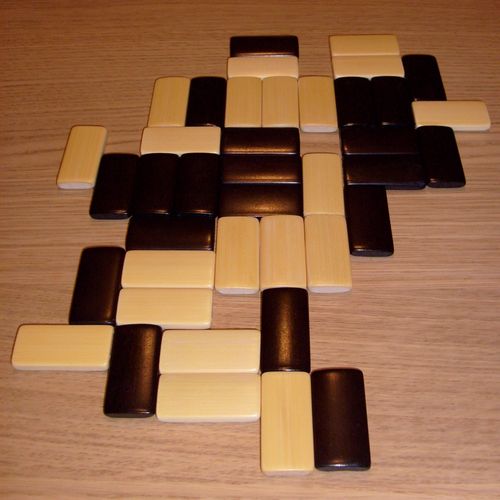
Bambam Booboo is a game for 2 players. Each player has 20 identical stones, made of bamboo, in their own colour. The game has no board, and it can be played on any flat surface.
The winner is the first player to make one of the combinations of 4 stones shown below, in their own colour. The game is then immediately over. Of course, a new game can be started.
The winning combinations, shown in each colour, are:
- Four stones standing side by side in a row.
- An upright stone at each end, with two horizontal stones stacked between them (one above the other), forming a closed box of 4 by 2 places.
- Two upright stones side by side at one end, with two horizontal stones stacked on top of each other at the other end.
(Page 1 of the rulebook shows these three combinations as diagrams in both colours.)
Course of Play
Players take turns. In the first move one of the players slides a stone forward. After that, a move consists of sliding a stone into place, where the stone at its end position has at least one contact with at least one other stone.
Valid contacts ("Geldige contacten") are shown in the rulebook as four examples:
- Two stones lying flush side by side.
- Two stones side by side, one shifted along the other.
- Two stones end to end, one directly above the other.
- One stone's end touching the side of another stone, forming an L-shape.
Corner-to-corner contacts ("hoek-hoek contacten") are not valid; the rulebook shows two examples of this, crossed out. A stone must be slid in a horizontal or a vertical direction. When sliding, other stones must not be moved.
Stones keep being slid until one of the players has made a winning combination or all stones have been slid.
Moving Stones
If no winning combination has been made and all stones have been slid, the players simply keep taking turns. A move then no longer consists of sliding a stone from hand, but of moving a stone already on the table.
A stone is moved horizontally or vertically. As with sliding, the stone must have a valid contact at its end position, and other stones must not be moved.
If a stone comes loose from the other stones while it is being moved, it may be slid again at any arbitrary place, horizontally or vertically. If a stone only has corner-to-corner contacts with the other stones, this also counts as coming loose. Between sliding it loose and sliding it back into place, the stone may be turned through a quarter turn.
If a loose stone is on the outside, it must also be slid back in on the outside. The stone may not be lifted and placed somewhere inside. Conversely, the same applies: if a loose stone is enclosed by other stones, it must be slid back in within the enclosed area. The stone may not be lifted and moved to the outside.
Within a single move, a stone may come loose and be slid back into place only once.
Loose Stones
After a move, one or more groups of stones may be lying loose. Corner-to-corner contacts also count as loose groups of stones.
If there are loose (groups of) stones, only the stones of the largest group remain on the table. All other stones go back to their players. If groups are equally large, the last player chooses which group remains on the table.
Stones returned to a player must be slid into play before that player may move stones on the table again. Moving stones on the table is therefore only allowed with an empty hand.
Next Round
The winning player places the first stone in the next round.