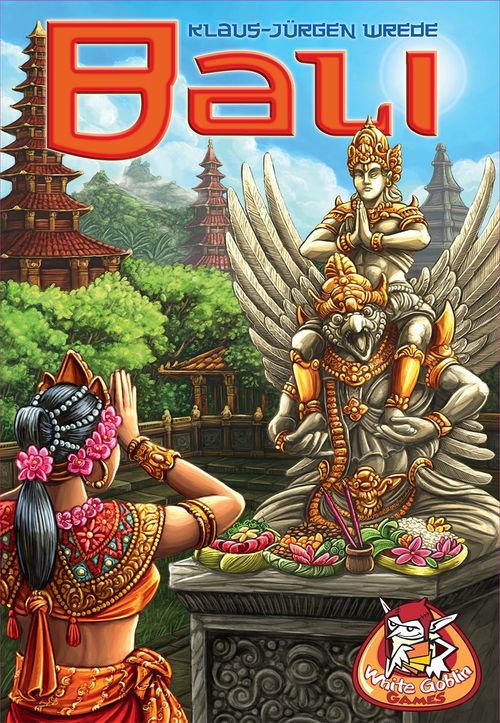
Bali
Bali Rulebook
Table of Contents
Table of Contents
Components
- 58 playing cards
- 9 x priest
- 9 x shrine
- 12 x stonemason
- 8 x oracle (for the oracle variant)
- 20 farmers, in 4 types (5 cards each type): rice farmer, peanut farmer, banana farmer, pepper farmer
- 100 sacrifice cards, in 4 types (25 cards each type): rice, peanut, banana, pepper
- 16 starting cards: 4 sets in player colours (red, blue, yellow and green)
- 30 victory point tokens
- 46 stone tokens
- 1 altar
- 1 demon figure (for the demon variant)
Setup
- Place the altar in the center of the table.
- Each player receives a set of starting cards (consisting of 1 stonemason and 3 farmers). Place the stonemason open in front of you. Take the 3 farmers on hand and keep them secret from the other players. If less than 4 players participate, the remaining starting cards are returned to the game box. These cards are not used in the game.
- Sort the sacrifice cards by type (rice, peanuts, bananas and peppers) and place these cards in 4 separate piles next to the altar. Each player takes 1 sacrifice card per type and places these face down in front of them. At any time during the game, players may look at the sacrifice cards in front of them.
- Shuffle the remaining playing cards (farmers, stonemasons, shrines and priests) and put these in a face down pile next to the altar. Then draw 16 cards from the pile and put them into 4 rows of 4 cards. This is the offer. Note: Put the oracle cards back in the game box. These are only used when playing with the oracle variant.
- Put the victory point tokens and stone tokens in the general supply.
- Choose a starting player. This player receives 2 stone. Every other player in playing order receives 1 stone more than the player in front of him. So player 2 receives 3 stone, player 3 receives 4 stone and player 4 receives 5 stone.
Setup example
The pile of playing cards, the offer, and the general supply sit near the altar, with 4 piles of sacrifice cards next to it.
Gameplay
The game is played in turns. Play progresses in clockwise order. Each turn consists of 4 phases:
- Take a sacrifice card (optional)
- a. Play card(s) b. Sacrifice phase (only when a "shrine" is played)
- Take card(s)
- Scoring
1. Take a sacrifice card (optional)
You can take 1 sacrifice card from a pile of your choice from the supply. Put the card face down with the other sacrifice cards you own. The cost of a card is 5 stone minus the number of farmers of that type you have in front of you. If you have 5 or more farmers of a type in front of you when you take a card of that type, you pay 0 stone.
Example: Kenny has 4 banana farmers in front of him. He takes a banana card from the supply and pays 1 stone for it.
If a type of sacrifice card is no longer available then you cannot choose that type.
2a. Play cards
You must play 1 (or more) card(s) from your hand and put it on the table in front of you. You must choose one of the following options:
- 1 stonemason (cost: none)
- 1 priest (cost: none)
- 1 shrine (cost: 7 stone, followed immediately by a sacrifice phase)
- 1/2/3 farmers of the same type (cost: 0/1/2 stone)
Put the cards you have played sorted in rows in front of you. This way it is clear to everyone how many cards of each type you have.
Example: Robert plays 2 rice farmers from his hand and puts these in front of him, for which he pays 1 stone. He puts these cards in the row of rice farmers which he has played in earlier rounds.
Important: Basically, you only play 1 card during your turn, unless you choose to play farmers, in which case you may play up to 3 cards of the same type of farmer.
Note: If a player has 3 shrine cards on hand and does not have the 7 stone to play such a card, then he has to return a card from his hand to the game box instead of placing a card in front of him.
2b. Sacrifice phase
If a player has played a shrine, the game is briefly interrupted for a sacrifice phase. In any other case the game continues with phase 3: Take card(s).
Starting with the player to the left of the player whose turn it is and then in clockwise order each player must choose 1 sacrifice card in front of them and place it open on top of the altar.
The player whose turn it is places their own card face down on the altar. Then the player whose turn it is chooses 1 sacrifice card from the supply and place it open on top of the altar. Always put the cards on top of each other so that only the top card on the altar is visible.
Example: It is Kenny's turn and he plays a shrine. Now a sacrifice phase follows. Robert chooses to sacrifice one of his peanut cards and places this card open on top of the altar. After that Jessica must sacrifice a card. She also chooses to sacrifice one of her peanut cards and places it open on top of the altar. Then Kenny chooses one of his rice cards and puts it face down on top of the altar. Finally he takes a pepper card from the supply and places it open on top of the pile of cards on the altar.
Note: If a player doesn't have any sacrifice cards (remaining) in front of them then no replacement card will be taken from the supply. Thus, 1 card less will be placed on the altar. Then the game continues with phase 3: Take card(s).
At the end of the game the cards on the altar will determine the value of the sacrifice cards in front of the players. During the game it is not allowed to look through the cards on the altar.
3. Take card(s)
You must take cards from the offer until you have 3 cards in hand. You must always take the bottom card of a row. If you need to take multiple cards you can take cards from the same row or from different rows, as long as you take the bottom card of a row.
After the last card of a row has been taken, four cards will immediately be drawn from the pile to create a new row. You may, if you still need to take cards, also take a card from that row.
Example: Robert has 1 card left in hand, so he has to take 2 cards from the offer. He chooses to take the shrine and then to take the banana farmer. He takes both cards on hand.
4. Scoring
At the end of a turn a scoring follows. The last card revealed when taking cards is scored. If when taking the last card a new row is created then the bottom card of that row is scored.
Example: The last card Robert took was in the third row. The bottom card in that row now determines which cards are scored. In this case the stonemasons are scored.
Stonemason: Each player receives 1 stone for each stonemason in front of them. If a player alone has the majority of stonemasons in front of them (and they have at least 2!), they will receive 1 extra stone.
Example: Robert has 2 stonemasons. He receives 2 stone from the supply. Kenny has 1 stonemason and Jessica none. So Kenny receives 1 stone and Jessica receives nothing. Because Robert alone has the majority of stonemasons (and at least 2) he will receive 1 extra stone. Robert: 2+1, Kenny: 1.
Priest: Each player receives 1 victory point for each priest in front of them. If a player alone has the majority of priests in front of them (and they have at least 2!), they will receive 1 extra victory point.
Example: Jessica and Kenny both have 2 priests. Robert has 1 priest. Jessica and Kenny receive 2 victory points each and Robert receives 1 victory point. Because none of the players has a majority of priests, nobody gets the extra victory point. Jessica: 2, Kenny: 2, Robert: 1.
Shrine: Each player receives 1 victory point or 1 stone for each shrine they have in front of them. If a player alone has the majority of shrines in front of them (and they have at least 2!), they will receive 1 extra victory point or stone.
Important! You must choose the same reward (including the additional reward) for all your shrines. It is not possible to choose a combination of victory points or stone if you have multiple shrines.
Example: Kenny has 3 shrines in front of him. He must choose either 3 victory points OR 3 stone. He cannot choose a combination of stone and victory points. Because Kenny alone has the majority of shrines (and at least 2) he will receive an additional stone or victory point. Kenny: 3+1 (victory points) / 3+1 (stone), Jessica: 1/1, Robert: 2/2.
Farmer: Each player receives exactly 1 sacrifice card of this type, provided they have at least 1 farmer of that type in front of them. If a player alone has the majority of farmers of that type (and they have at least 2!), they will receive 1 extra sacrifice card of that type.
Important! Unlike the other card types you do not receive a reward per card. The number of cards you have of a certain type of farmer does not matter, you will only receive 1 card. However more farmer cards of the same type do provide a discount in phase 1: Take a sacrifice card.
Note: The player whose turn it is will take a sacrifice card first, then the player to the left, etc. If there is no sacrifice card of that type left in the supply you may take a sacrifice card of your choice. If a player gets an extra card for having the majority, they take it after all player have taken their card.
Example: Jessica has 1 rice farmer. The other players have no rice farmers in front of them. She alone receives 1 rice card. Despite the fact that she has the majority in rice farmers she does not get an additional sacrifice card because she does not have at least 2 rice farmers. Jessica: 1.
Game end and end scoring
The game ends immediately when the pile of playing cards is exhausted. Phase 4: Scoring is skipped.
First, determine the victory points for the sacrifice cards. Take all cards from the altar and sort them by type. The type most sacrificed is worth 3 victory points per card, the second most sacrificed type is worth 2 victory points per card and the type which is next most sacrificed is worth 1 victory point per card. The type least sacrificed is worth 0 victory points per card.
If there is an equal number cards of a type, these yield the same amount of victory points:
- If 2 types are sacrificed equally, 3, 2 or 1 victory points will be assigned.
- If 3 types are sacrificed equally, only 3 and 2 victory points will be assigned.
- If 2x 2 types are sacrificed equally, only 3 and 2 victory points will be assigned.
- If all types are sacrificed equally, then each type is worth 3 victory points.
Note: If there are no cards of a particular type on the altar then that type automatically yields no victory points!
Example: At the end of the game the altar contains 5x peppers, 4x bananas, 4x peanuts, and 3x rice. Peppers are worth 3 points, bananas and peanuts are worth 2 points, and rice is worth 1 point.
Next comes the end scoring. Players receive victory points for their remaining stone and the cards in front of them:
- per shrine: 4 VP
- per 5 stone: 1 VP
- per sacrifice card: 0-3 VP (per the values just determined)
Example: At the end of the game Robert has sacrifice cards, shrines and stones in front of him worth 2x3=6, 3x2=6, 3x1=3, 1x2=2, 1 shrine worth 4, and 1 lot of 5 stone worth 1. He scores a total of 22 victory points.
The player with the most victory points wins the game. In case of a tie, the tied player with the most shrines wins. If the players are still tied, then the tied player with the most stone wins the game. If the players are still tied they share the victory.
Variant 1: The oracle
The oracle lets you look in the future and provides more prosperity. Use the knowledge of the oracle to get more information about what is on the altar and make sure you yourself score more points.
The rules of play remain the same with the following adjustments:
Setup
- Take 4 sacrifice cards (1 per type), shuffle these cards and put them in a face down pile on the altar.
- After placing 16 cards in 4 rows in the offer, shuffle the 8 oracle cards through the pile of remaining playing cards.
Gameplay
If in phase 3: Take Card(s) a row contains 1 or more oracle cards (after a new row is created), these oracle cards are immediately removed from the row and placed back in the game box. No replacements cards are drawn (unless all 4 cards were oracle cards)!
The player whose turn it is may now take and view the top 4 cards of the altar. That player chooses 1 of those cards to add to the other sacrifice cards in front of them. The other cards are put back on top of the altar in the same order.
Note: If there are less than 4 cards on the altar, the player takes all cards on the altar. That player then chooses 1 card to keep. The other cards are put back on top of the altar in the same order.
Variant 2: The demon
The people of Bali believe that demons are evil spirits who visit their home at night. Therefore, they ask priests to chase away these evil spirits.
The rules of play remain the same with the following adjustments:
Setup
Place the demon on the first (leftmost) row of cards in the offer.
Gameplay
- If you play a priest in phase 2 A: Play card(s), move the demon to the next row to the right in the offer. If the demon was on the last row, move him to the first row.
- In phase 3: Take card(s), you may not take cards from the row on which the demon is located.
You can add the variants independently to the game or you can play with both variants simultaneously.