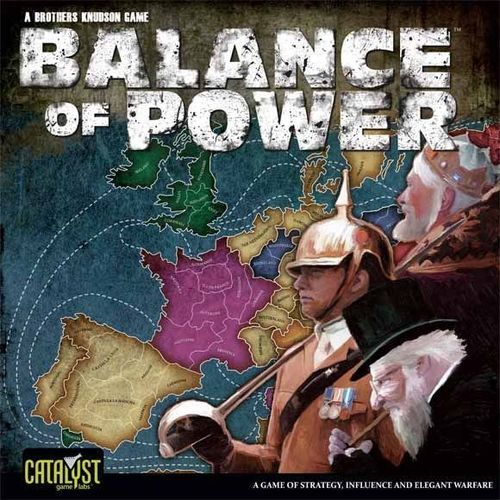
Balance of Power
Balance of Power Rulebook
Table of Contents
Table of Contents
Contents
Balance of Power contains everything you need to conquer all of Europe.
Gameboard
The gameboard represents the countries of Europe circa 1815, which is where the action of Balance of Power takes place. It has been abstracted, as necessary, for game play.
Pawns (Playing Pieces)
There are 6 different colors of playing pieces, with a total of 45 pieces per color, divided into 3 different classes of pawns: 15 Kings, 15 Generals, and 15 Bankers. Players place and move these pieces around the board to win the game. (The game includes 2 extra pieces for every pawn of every color in case any are lost.)
In these rules, the playing pieces (Kings, Generals, and Bankers) are collectively referred to as pawns.
Empire Tokens
Each empire has a single token marked with their flag as displayed on the gameboard. This token is used during the setup of the game and is also a reminder of a player's capital and empire during game play.
The empire tokens are: Kingdom of France, Kingdom of Great Britain, Kingdom of Prussia, Austrian Empire, Russian Empire and Ottoman Empire.
Reference Cards
For ease of use during game play, each player is provided with a reference card that lists what actions a player takes on each turn and which class of pawn eliminates another class.
The printed cards carry a short summary of each nation's turn, bonus, scoring and winning conditions and the elimination chart; that summary repeats the rules in this document and is not reproduced separately.
Scoring Track
The scoring track is used when visibly keeping score (see Expanded Game Play).
Set-Up
First, unfold the map and lay it out on a smooth surface with enough room around the edges for your playing pieces.
Next, select a number of Empire Tokens equal to the number of players. These tokens should all represent adjacent empires. For example, if only three players are playing and England and France were selected, then Russia and Austria should not be selected as they are not adjacent to either empire; Constantinople is considered adjacent to England as Malta is directly connected to Turkey (see bottom of gameboard for the Malta territory). The method for selecting Empire Tokens—and thus choosing which empires will be played in the game—is up to the players to decide (e.g., using a dice roll, pulling tokens blindly out of the box, or any other method). All empires not selected are considered neutral territories, equal to any other neutral territories on the board.
Once the Empire Tokens that will be active in the game have been selected, randomly assign the tokens to each player. Players then choose which color of playing pieces will represent their empire during the game and selects those 45 playing pieces (15 of each pawn type).
Each player places one of each class of pawn—General, King, and Banker—in its capital territory (the location on the gameboard where the empire flag is located).
Finally, players randomly determine who will be the starting player. The starting player places one more of each class of pawn—General, King, and Banker—in any other of its empire's territories except the capital. This can be any combination of territories—for example, three separate territories, or two pawns in one and one pawn in another territory, and so on. Moving clockwise around the table, the rest of the players place three additional pawns in a similar fashion.
You're now ready for the game to begin!
How to Play the Game
During a player's turn, the player has 1 General Action, 1 King Action, and 1 Banker Action. Regardless of the number of pawns a player has on the gameboard he will only ever have 3 Actions, 1 for each class of pawn (see Achieving Empire for the exception). A player need not spend all of his Actions in his turn; he can spend all, some, or none, at his discretion.
Regardless of Actions taken, a territory can never contain more than three pawns, regardless of whether there are pawns from different empires in the same territory.
When taking an Action a player can do one of the following:
- Move Action: Move a pawn into an adjacent territory.
- Attack Action: Attack another pawn in one of your pawn's territories, or move one of your pawns into territories occupied by another pawn and attack it.
- Duplicate Action: Duplicate the pawn in its current territory.
Move Action
A pawn may move into any adjacent territory, provided that territory has 2 or less pawns already in that territory; the 2 or less limit applies whether both pawns in that territory are from the same empire or from different empires. Territories connected with dotted lines on the gameboard through water regions are considered adjacent for movement, regardless of the length of a dotted line. This move can be made regardless of what pawns (the player's own or pawns belonging to another empires) are located in that territory. A pawn can also leave a territory empty through a Move Action.
In a Move Action, if there are enemy pawns in the territory, or even a pawn that can be eliminated by the pawn that has moved into the territory, there is no attack.
Attack Action
A pawn may move into and attack any adjacent territory, provided that territory has 3 or less pawns already in that territory; the 3 or less limit applies whether the pawns in that territory are all from the same empire or from different empires. This does not violate the rule of only three pawns in any territory at one time as the attack automatically eliminates an enemy pawn as the player's pawn moves in.
Pawns attack and eliminate enemy pawns under the following rules:
- A General pawn eliminates a King pawn
- A King pawn eliminates a Banker pawn
- A Banker pawn eliminates a General pawn
Regardless of the type of pawns in a territory, an Attack Action only ever eliminates a single enemy pawn. Once a pawn is eliminated, it returns to the player's pool of pawns for use later in the game.
Note that a pawn need not move out of its territory to eliminate an enemy pawn if an enemy pawn is already located in its territory. However, if a player attacks without moving, the attacking pawn cannot then move into another territory this turn.
Duplicate Action
A pawn can duplicate itself in a territory. The player simply chooses a pawn of the same class he wishes to duplicate and adds it to the territory. Note that this Action cannot result in more than three pawns being placed in any one territory.
Eliminated Pawns
If all pawns of a particular class are eliminated, that pawn can no longer be re-spawned; the player can no longer make use of that class of pawn for the remainder of the game.
Achieving Empire
At the beginning of any turn in which a player has sole control over all the territories of his empire (there are no enemy pawns in any territory in the player's empire), he gains an extra Action. This fourth bonus Action can be any of the three Actions noted above. The fourth bonus Action can be applied to a pawn that has not yet been activated this turn, or it can be applied to a pawn that has already taken an Action.
Players cannot gain a bonus fifth action, even if they fully control another empire.
Example One
The source shows a diagram of the board after setup for this example, followed by a second diagram.
In the example diagram below, the game begins after setup. Brian, playing England, starts the game. He's got a King Action, a Banker Action, and General Action to resolve before his turn is over.
While he could move his General from Cornwall to Normandy (the General in Normandy would have no effect on this move), the Banker in Paris provides a great defense against that action as the French player would likely eliminate the General by an Attack Action with the Banker from Paris to Normandy. As such, Brian decides he needs to grow his forces, so he uses his General Action for a Duplicate Action in Cornwall; next turn he can then either look at Normandy again or take a Move Action to the Midlands; he can only take a Move Action to London if at the start of next turn there are 2 or less pawns in that territory.
From London, Brian can take a Move Action with any of the three pawns to either Cornwall, Midlands, The Netherlands, Hanover, or Denmark. Brian decides he wants to be aggressive and wonders if he should take an Attack Action with his General into the Netherlands to eliminate the German King in that territory. However, as with Paris, the Banker in Westphalia means that during the German Player's turn he could take an Attack Action from The Netherlands and easily eliminate Brian's King. Brian decides to use his King Action for a simple Move Action from London to The Netherlands. Nothing happens this turn as Kings do not eliminate each other. However, the German player could lose Westphalia on Brian's next turn as an Attack Action by the King would eliminate the Banker. To try and forestall this, the German player would need to move the General from Brunswick to either Hanover or Hesse on his turn to help defend against that move. Brian's actions force the German player to react, leaving Brian in control of the situation.
As a final action Brian decides that instead of reinforcing The Netherlands, he'll take the Banker Action as a Move Action to Denmark. This will allow him to take a Duplicate Action next turn and start building up a force that he can try and drive down between Brunswick and Westphalia/Rhineland, making those territories easier to conquer as the German player will find it difficult to get reinforcements to those territories.
Brian has now taken a King Action, Banker Action, and General Action, so his turn is over.
Example Two
The source shows several alternative diagrams for this example, each introduced by "OR".
Let's take the diagram above and say that everything is the same except that England has achieved empire and has a bonus fourth move. This provides a host of additional opportunities, as a player can assign that fourth Action to a pawn that has not yet been activated in a turn, or the player can combine any two types of Actions in a single pawn. The following is a sampling of various Actions that can be accomplished with a fourth bonus Action.
Instead of just taking a Move Action with the Banker to Denmark, Brian could take a Move Action to Denmark and then another Move Action to Mecklenburg to really put pressure on Germany. Or he could opt for his original plan but speed it up by taking a Move Action to Denmark and then taking a Duplicate Action with that pawn to add another Banker in Denmark.
Alternately, in Cornwall, Brian could take a Duplicate Action and then a Move Action, either to Midlands or Normandy, leaving Cornwall protected by a General and Brian able to move a General somewhere else. He could also take a Duplicate Action and then another Duplicate Action, leaving Cornwall with three Generals.
In London, beyond the options above, Brian has numerous actions he could potentially take. He could take an Attack Action with the General to eliminate the King in The Netherlands and then take a Move Action to either Normandy, Rhineland, Westphalia, or Hanover. After the Attack Action to The Netherlands he could also take a Duplicate Action, adding another General to The Netherlands. He could also decide that taking Westphalia from the German player to ensure he doesn't achieve empire is more important, so after a standard Attack Action with his General to eliminate the King in The Netherlands, and another standard Move Action with his King to The Netherlands, Brian could then assign the fourth bonus move to the King, taking an Attack Action into Westphalia to eliminate the Banker in that territory.
This is not a complete list of all the combinations available to the player but it provides a solid sampling of the importance of the bonus fourth move and how it can be used effectively.
Winning the Game
Players win the game by scoring points through gaining territories. The points each player has rises and falls as territories are gained and lost throughout the length of the game, with players calculating their points at any time to see if they've achieved victory. The following describes how points are awarded:
- For each territory a player controls (meaning there are no other pawns but his own in a territory), the player receives 1 point.
- For each capital territory where a player has a King, General, and Banker pawns, the player receives 3 points in addition to the 1 point the player receives for controlling the capital territory. This can be any empire's capital territory, so a player can gain these bonus points multiple times if he controls multiple capital territories. The player must have one of each kind of pawn in a capital territory in order to gain the bonus.
At any time during a player's turn if a player reaches the point value listed in the table below at any point in their turn, the player immediately wins and the game is over.
| Number of Players | Points To Win |
|---|---|
| 2 | 30 |
| 3 | 27 |
| 4 | 24 |
| 5 | 21 |
| 6 | 18 |
If at any time a player wishes to duplicate a class of pawn in his turn, and he cannot perform the Action since all such pawns are already placed on the gameboard, the game immediately ends, with scores determined as described above and the player with the highest total being declared the winner.
Any time there is a tie in points, the player with the most pawns on the gameboard is the winner; if there is also a tie for the number of pawns on the gameboard, the game ends in a draw.
Expanded Game Play
The following rules provide expanded game play options for additional enjoyment of Balance of Power!
Tracking Points
In standard Balance of Power play, each player is left to track points in their head, allowing for a certain "fog of war" feel, where each player may actually forget how close (or far) an opponent is from winning. However, some players may not enjoy this type of play and would prefer that everyone at the table knows exactly where everyone stands in the points.
If players wish to visibly track their points, pull out the Scoring Track board and place it next to the gameboard. Players then use their Empire Tokens to visibly track points throughout the game. At the end of every turn the player finishing his turn counts up his current point total (as described under Winning The Game) and adjusts his Empire Token appropriately.
Selecting Empires
In place of randomly determining empires for use in the game, players can add a level of strategy to the setup by selecting which countries they'll play. Players randomly determine who will select first, after which selection moves clockwise around the gameboard.
While the game is perfectly enjoyable if players are in empires across the board from each other, such a setup will likely increase the length of a game if there are only 2 or 3 players. As such, players are encouraged to select empires that are adjacent to already selected empires.
Ultimately, however, it is completely up to the players to determine how they'll select their empires and which empires to select under this rule.
Tougher Neutral Empires
In standard Balance of Power play, if there are less than 6 players, as soon as a player occupies a neutral empire's capital with one of each class of pawn they gain 3 additional bonus points. If players wish they can make such neutral empires tougher, cutting down on the ease of gaining extra points.
Under this rule a player gains 1 point for occupying the capital territory. However, the player does not gain the 3 additional bonus points—regardless of having the 3 different classes of pawns present—until the player has achieved empire with that neutral empire (see Achieving Empire).
Re-spawn Eliminated Class of Pawn
In standard play, if a pawn of a particular class is eliminated, it cannot be brought back into the game. This rule allows for play that is a little more lenient towards the loss of a class of pawns.
If all pawns of a particular class are eliminated, during a player's next turn he can spend the Action for that class of pawn to place a single pawn of that type in his capital territory. Note that this Action still cannot violate the limit of 3 pawns in any one territory.
If the player no longer has pawns located in his capital, he can spawn in any territory where he has at least one pawn. However he must choose the closest territory to the capital (if two are equally close to the capital, the player chooses where to spawn).
This means that even if an enemy pawn is in the capital, the active player can still spawn if he still has a pawn in the capital. However, he cannot spawn and attack an enemy pawn, which means that there can only be two pawns in the capital (the player's own and one enemy) in this situation.
Note if the player has a fourth bonus move (see Achieving Empire) there's another option available here. The player can spawn in that territory and then assign his fourth action to that pawn to eliminate the enemy pawn (provided it's the correct class of pawn for such an elimination).
Total Domination
In standard play, players try to achieve a specific points limit to win the game (as shown under Winning The Game). In Total Domination, however, achieving victory points is set aside. Instead, to win this game the player must completely eliminate all other pawns from the board.
While a fun and brutal style game, this expanded play option will drastically increase the length of a Balance of Power game.