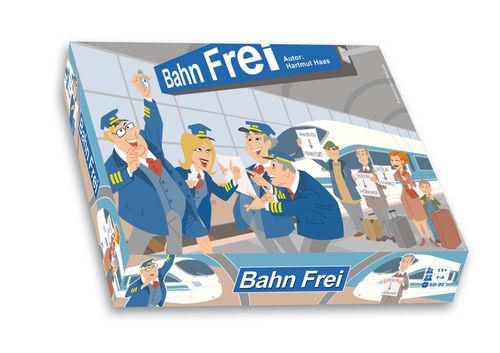
Bahn Frei
Bahn Frei Rulebook
Table of Contents
Table of Contents
Objective and Summary
The aim of your game is to prove yourselves as a team over 15 rounds in the organization of rail operations and master all upcoming challenges. Along the way, you may cause a maximum of 7 passenger complaints. The team is jointly responsible for the satisfaction of the passengers.
In order to be successful, pick up all passengers who appear as quickly as possible at their respective departure stations and transport them punctually to their desired destinations. Each player controls a train that can move up to 8 spaces in each round. He may transport as many passengers as he wants at the same time. Passengers can also change trains if both trains meet in the same station.
The game ends after 15 rounds. If fewer than 8 complaints are received, you win the game. If 8 or more complaints arise by the end of the game, the game is over and you lose the game.
The task may sound simple at first, but you will find out very soon that not only the passengers but also the traffic conditions will challenge you.
You can play the game in several variants. For the first game play, I recommend the beginner variant ("Einsteiger"). Experienced players can read at the end of the instructions how they can enrich their game play with the frequent traveler variants ("Vielfahrer").
Chief of Operations
At the beginning of the game, designate the player with the most recent train ride to be the chief of operations for the first round and give him the signaling disk. The chief of operations is responsible for moderating the round according to the overview on the signaling disk. In case there is no agreement on a procedure among the players, e.g. in the operations briefing (phase 3), the chief of operations has the last word on how passengers are transported in this round. Furthermore, you start the rail operations phase (phase 4) on his signal and he keeps an eye on the hourglass. If necessary, he can also call to order players who are too dominant towards others and threaten to usurp the game. He is free to use the signaling disk at any time.
At the end of each round, the next player in clockwise order becomes the chief of operations for the next round.
Components
You will need the following material for successful rail operations:
- 1 Game Board
- 6 dice
- 4 locomotives
- 1 warning marker
- 4 train plates
- 8 angry passenger chips
- 75 passenger cards
- 1 round marker
- 8 special passenger cards
- 8 cubes (orange)
- 1 cubes (blue)
- 25 event cards
- 1 signaling disk
- 1 hourglass
Setup and Preparation
Lay out the game board on the table and make sure you leave some space all around. Shuffle the passenger cards well and put them in a face-down pile next to the game board. Do the same with the event cards. Place the green wooden cylinder as a round marker on the round space "1".
Now choose 2 of the 6 dice for your game. Which dice you take depends on the number of players:
| Rounds 1-7 | Rounds 8-14 | |
|---|---|---|
| 2 Players | light green | green |
| 3 Players | light blue | blue |
| 4 Players | orange | red |
You only use one of the two dice at a time. In round 8 you swap the die as indicated in the table above. Please also have the hourglass, the angry passengers, the orange voucher cubes and the warning marker ready.
Each player now chooses a wooden locomotive and the train plate of the same color. Please use the beginners' page of the train plate ("Einsteiger"), unless you want to play the frequent traveler variant ("Vielfahrer", for advanced players). Everyone places their train plate on the table in front of them. Each player now places his locomotive on one of the red stations on the map. This is the starting space for the first round.
Game Play for 1 and 2 Players
In the game for 2 players, the passenger cards with the "3-4" symbol are removed at the beginning of the game. Please put these cards back into the box.
You can also play this game as a single player. Choose whether you want to control 2, 3 or 4 trains. The more trains you control, the more difficult the game becomes. Please follow the other rules according to the number of trains (= players) you choose and set yourself a time limit of 1 minute instead of 30 seconds in phase 4.
Game Play
The game is played over 15 rounds. Each round consists of 5 phases:
| Phase | Action |
|---|---|
| 1 | New passengers arrive: Roll die to find out how many |
| 2 | Draw event card (starting in round 3): Draw card, read out loud and follow the instructions |
| 3 | Operations briefing: Coordinate within the group: Who is picking up which passenger? Would it make sense for a passenger to change trains? |
| 4 | Rail operations (30 seconds): Turn hourglass, move trains on the board simultaneously, passengers board, deboard or change trains. Try to win vouchers for the team |
| 5 | Complaint management: Move passengers to the next car; use vouchers; passengers who got moved out of the train from the last car leave the game and add an angry face to the complaint-O-meter; move round marker |
The Phases in Detail
Phase 1: New Passengers Arrive
At the beginning of each round new passengers arrive on the game board. One player rolls the die once to determine the number of new passengers (= cards) that you draw from the pile.
Place the passenger cards face up around the map, as close as possible to their departure stations on the respective cards. Passenger cards may not cover any stations or tracks. New passengers have now entered the game and are waiting to be picked up.
Phase 2: Draw Event Card
One player draws an event card from the pile and reads it out loud. The event card may have positive or negative consequences for your rail operations in this round. All instructions from the card must be followed immediately or during the round. Leave the card face up on the table until the end of the round. You only need to start drawing event cards from round 3.
Phase 3: Operations Briefing
Players can now discuss and plan rail operations for this round: Who is picking up which passengers, who needs to change trains? You should carefully analyze who is closest to a new passenger and his destination. All new passengers have to be picked up in the same round they appear. In case a passenger remains on the board at the end of the round, he will complain unless you have a voucher (see complaint management for details).
Phase 4: Rail Operations
Now you start the rail operations phase when the chief of operations turns the hourglass. Within the next 30 seconds all players conduct their moves simultaneously on the board. This includes the following steps:
Move Train
Every train can move as many spaces as indicated on the train plate. For beginners ("Einsteiger") these are 8 spaces, for frequent travelers ("Vielfahrer") these are 7 or 6 spaces. Black, white and red spaces on the game board are counted equally. You may only move along the lines. To get from Rostock to Berlin, for example, you will need 4 spaces on the direct way. A movement can be paused once or several times per round to conduct other actions (board/alight/change). A train may move forward and backward once or several times per round. If you do not use the maximum of spaces in one round you may not take any leftover moves to the next round.
Passenger Boarding
Once a train reaches a station with a waiting passenger, you may pause the movement to let the passenger board the train. This is done by picking up the passenger card and putting it below the train plate while the locomotive is in the station. The passenger card is placed below the car of the train plate that matches the travel time (number of rounds) indicated on the card.
Example: A passenger with the travel time "3 rounds" will be put below car 3, a passenger with travel time "2 rounds" below car 2.
Passenger Changes Trains
A passenger may change trains when both the current train and the connecting train are in the same station. This means both locomotives need to be on the same space. The transfer is completed when the passenger card has been moved from the train plate of the current train to the connecting train. Please keep in mind to place the card below the car with the same number as in the current train. Only after transfer is completed may both trains continue their movements.
Passenger Alights
In order to successfully take a passenger to his destination the locomotive has to reach the related station space. Now the player may discard the passenger card from his train plate and place it upside down next to himself on the table. The passenger has now reached his destination and has left the game in a satisfied mood.
ATTENTION: All players make their moves simultaneously at the same time. All actions need to be finished before the time is up (30 seconds). Actions that have not been completed expire and may not be finished. Please note that you may only pick up and discard passenger cards if your locomotive is located on the pick-up or destination station. It is not allowed to move along a certain route and only pick up and discard cards later after you have finished all moves.
Vouchers
If a passenger reaches his destination earlier than expected, the player can earn a voucher (orange cube) for the team. A passenger reaches his destination early if the passenger card is located in car 2, 3, 4 or 5 at the moment the locomotive reaches the desired destination. In order to get the voucher, the player needs to take an orange cube and place it in the orange voucher circle ("Gutscheine") on the game board IMMEDIATELY after discarding the passenger card. This action must be completed within the time limit. The voucher circle may only contain as many vouchers as players participate in the game. In case a player wins a voucher and the voucher circle already holds the maximum number of vouchers no further voucher can be added to the circle. Vouchers can be used in phase 5.
Phase 5: Complaint Management
After the rail operations phase the round closes with the complaint management:
Move Passengers Within Train
All passengers on the trains are checking their watches whether they are still on time. They have travelled another round and expect to have come closer to their destinations. However, they want to stay on board only as many rounds as indicated on the bottom of the passenger card. Now please move every passenger card in the direction of the arrows into the next car with a lower number.
Example: The passenger in car 3 will be moved into car 2, the passenger in car 2 into car 1 accordingly. Passengers in car 1 will be moved out of the train and are now late (see next step).
Delays at the Departure Station
Delays at the departure station occur if a passenger card is still lying on the board at the end of the operations phase. These passengers are upset because their trains are late. They leave the game and complain. Place an (additional) angry passenger chip onto the complaint-O-meter, thus increasing the complaints by one.
You can prevent a complaint on the complaint-O-meter by using a voucher. If you have a voucher in the voucher circle, take one and place it on the delayed passenger card in order to keep the passenger in the game and avoid the complaint. If you have multiple vouchers you can use these for several delayed passengers. Please note that if you pick up a delayed passenger in the following round, he will board a car with a lower number than he would without the delay. The number of vouchers on the passenger card are subtracted from the indicated number of rounds ("Fahrzeit") to identify the appropriate car to board.
Example: If the travel time on the passenger card is 3 rounds and there is one voucher on the passenger card, the passenger boards car 2 instead of car 3.
Delays at the Destination Station
Delays at the destination station occur if passengers have been moved from car 1 out of the train after the operations phase. These passengers will not reach their destinations on time and are therefore upset and complain. Take these passenger cards out of the game and place an (additional) angry passenger chip onto the complaint-O-meter for each complaining passenger. If a passenger is moved out of the train due to an event card, place an angry passenger chip onto the complaint-O-meter immediately. This passenger may no longer be transported.
You may use vouchers to eliminate a complaint from the complaint-O-meter or to prevent an additional complaint. In order to do so you need to have as many vouchers in the voucher circle as players participate in the game, i.e. the permitted maximum. Take all vouchers from the circle, put them back into the pile and eliminate the complaint.
As soon as the complaint-O-meter is filled with 8 angry passengers the team has immediately lost the game. This can happen anytime during the game or at the end of round 15.
After phase 5 you have completed the round. Move the round marker forward into the next space and start the new round with phase 1.
Round 15
No new passengers come into play in the last round. You can only transport passengers that are already on the trains and take them to their destinations. You draw an event card and then continue playing with the operations briefing and rail operations phases. As part of the complaint management, the final settlement of the complaints takes place.
For each passenger who is still waiting at his departure station, the value of the complaint-O-meter is increased by one point. For every 2 passengers who remain in the trains at the end of the rail operations in round 15, the value of the complaint-O-meter increases by one point.
If at the end of the round all players manage to finish the game in a red train station, you can remove a remaining passenger card from the board or a train without complaint.
End of Game
The game ends after round 15 has been played. If there are 7 or fewer complaints on the complaint-O-meter you win the game. Are there, on the other hand, now or at an earlier stage, 8 complaints or more, the game is over and you unfortunately lost.
Frequent Traveler Variants
Enrich your game with one or more variants.
Train Characters
Each of the four trains can move up to 8 spaces per round ("Einsteiger"). In the advanced variant for frequent travelers ("Vielfahrer"), a train drives up to 7 spaces per round and has an additional special ability that can be used in the rounds.
Red Train (Express)
The red train travels up to 6 spaces per round, but is able to advance faster on the red express routes. This is done by skipping the white spaces when counting the spaces moved. So, for example, if the express travels the route from Cologne to Frankfurt, this counts as 1 space for him, whereas the other trains require 3 spaces. However, white spaces are counted when entering an express route on a white space.
Example Würzburg – Stuttgart: The Express needs two spaces from Würzburg to Mannheim, just like all other trains.
Green Train (Sinatra)
Good on-board entertainment is important for the well-being – and especially the patience – of the passengers. The green train has special entertainment capabilities, which make the stay particularly pleasant for the passengers. Therefore, at the end of each round, the player may choose to leave one passenger of his choice in the same car instead of pushing him to the next car. In case the player always chooses the same passenger throughout the game, he may potentially stay on the train without complaining until the end of the game.
Yellow Train (Röntgen)
The yellow train has special abilities that are used when new passengers arrive. The yellow train brings along the privilege of an additional passenger selection. For example, if the passenger die shows a 3, the players may now draw 4 new passenger cards instead of the usual 3. They can pick 3 out of the 4 passengers and bring them into the game while the fourth card is put back under the pile. The same procedure applies if 2 new passengers according to the die are to join the game. Here 3 cards can be drawn, 2 of which are chosen, etc. Please note that when using the "Special passengers" variant in combination with this ability, any special passengers may not be sorted out.
Blue Train (St. Martin)
The blue train has the ability to split himself into two parts in rounds 3, 6, 9, 12. At the beginning of these rounds place the blue wooden cube on the same space with the blue locomotive. The player thus has two train parts, each of which has 7 spaces to move in this round. Each part of the train is allowed to travel in a different direction and to have passengers board and alight. If both parts of the train travel the same route, both consume their potential range of spaces. At the end of the round, the blue wooden cube is removed from the game board. All passengers who have been picked up by this part of the train should be brought to their destination by the end of the round. If there is still a passenger in this part of the train at the end of the round, he is eliminated from the game and the complaint value increases by one point.
Example of a train split in Fulda: One part of the train (locomotive) carries a passenger to Hannover and then travels via Bremen towards Düsseldorf. The other part (cube) brings a passenger to Leipzig. Because the blue cube is removed from the board again after the round, he cannot let the passenger in Leipzig board the train.
Special Passengers
As a further variant, the 8 cards with special passengers can be shuffled into the pile of passenger cards. These cards contain passengers with special requirements that are described on the cards. In case a special passenger does not get to his destination on time, this leads to a lot of trouble and 2 points on the complaint-O-meter per special passenger.
Event Cards
The event card sheets are printed with 25 cards in total, without card numbers. They are listed here in sheet order, left to right and top to bottom. Each card's text is transcribed from the designer's English translation of the event cards.
Sheet 1
- The toilets could not be emptied overnight. Now some waste water containers are full by noon and half of the toilets have to be closed. On every train one passenger loses his patience and immediately moves to the next car with a lower number.
- The windshields of your trains are full of mosquitoes and flies, but unfortunately the windshield washer fluid is empty. In this round, all players have to pause briefly in the next train station to take a sip from their glass / bottle before they can continue. If you don't have a drink, you need to drive through a red train station (e.g. Frankfurt, Cologne) to refuel.
- One of your trains is delayed by more than 20 minutes and has to stop more often to let other trains overtake. All passengers on this train lose their patience and move to the next car with a lower number.
- Tickets, please! Turn the hourglass around: If you can show a train ticket or BahnCard (paper or electronic) before the time runs out, you may drive two more spaces in this round.
- A new software enables you to assess the number of passengers more precisely and to create better connections. Everyone can (but does not have to) pass one passenger from his train to the player on his left.
- You have to wait for passengers from delayed trains who want to get connected. Each player draws two more passenger cards from the pile. One of the two must be placed on the game board, the other one goes back under the pile. These additional cards must also be picked up by the players in this round (does not apply in round 15).
- The train drivers' union calls for a warning strike and everyone is annoyed. Either each train drives one space less in this round or in each train one passenger moves to the next car with a lower number.
- Cyclone "Eberhard" brings storm and hurricane gusts all across the country. Train traffic is set back by days. Move the round marker back by one round and continue the game with the operations briefing.
Sheet 2
- Engine damage on one of your trains: Either one player is not moving this round or all of you drive at the cost of one additional point on the complaint-O-meter. (3-4 players only)
- Due to the defusing of an aircraft bomb, Fulda cannot be passed through this round. Those who are already in Fulda are lucky and can just get away. Place a warning marker on Fulda for this round.
- Embankment fire between Cologne and Frankfurt: The fire brigade is on duty and has to close the route for this round. Place a warning marker on the route for this round. Trains that are already en route between Cologne and Frankfurt may slowly continue and their range is reduced by two spaces.
- Children are picking blackberries between Hannover and Kassel. No train movements are possible here this round until the police have secured the route. Place a warning marker on the route. Trains that are already on this route in the direction of Hannover, Kassel, Hamm or Wolfsburg are allowed to continue their journey slowly, but lose 2 spaces of their range.
- A passenger is very sick. A doctor is urgently needed on the train. If someone among you is working in a medical profession (doctor, nurse, etc.), everyone is allowed to continue driving without delay. Otherwise you have to wait for the ambulance service in the train station, the departure is delayed and everyone drives one space less this round.
- Due to a missing part of the train, the remaining cars are completely overcrowded. No passenger wants to get off voluntarily. The onward journey is therefore delayed until the federal police have cleared the car. Everyone drives one space less this round.
- It's snowing ... and it isn't really going to stop this round! All trains progress slowly in this round and move two spaces less.
- It is summer and temperatures of up to 40 degrees are prevailing throughout Germany. The air conditioning systems in the trains fail and the passengers suffer. Either one player with his train stays in the station this round to take care of the passengers or increase the complaint value by one point. (3-4 players only)
Sheet 3
- An employee of the railway control center in Frankfurt fell ill and a replacement could not be found at short notice. Frankfurt can therefore not be driven through in this round. Anyone who is already in Frankfurt is lucky and can just get away. For this round, place a warning marker on Frankfurt.
- Change of shift: Each player passes his train including passengers clockwise to the next player. So from now on each player drives a different train.
- Change of shift: Each player passes his train including passengers clockwise to the next player. So from now on each player drives a different train.
- Before departure, they forgot to load the newspapers for 1st class passengers. The business travelers grumble. Immediately use a voucher to appease them or move one passenger on one train one car back into the car with the next lower number.
- Changed train arrangement: The cars are arranged differently than planned. Since this is not displayed on the platform, chaos arises and the departure is delayed. Immediately use a voucher to keep the passengers happy, or one train travels one space less this round.
- The car display on the train is out of order and the passengers are disoriented. The creative attendant writes the car numbers on currywurst trays, which he attaches to the walls with tape. The passengers are amused and find their seats without any problems. As a reward, you will immediately receive an additional voucher.
- A group of drunk bachelors get on one of your trains in car 3. The passengers are disgusted and immediately flee to the front into car 2.
- The conductor drove too fast and therefore arrived earlier than planned. The passengers can't believe it and spontaneously break out into great cheers after looking at the clock. All trains may move one more space this round.
Sheet 4
- Another passenger jumps on the train at the last second. Draw another passenger from the pile and place it on the game board. This passenger must also be picked up in this round.
Glossary of German Terms
The designer's glossary explains the German terms on the passenger cards, the game board and the train plates.
Passenger Cards
- Fahrzeit 3 Runden – Desired travel time by the passenger is 3 rounds.
Game Board
- Runde – Round
- Beschwerd-O-Meter – Complaint-O-Meter: captures all complaints
- Gutschein – Vouchers: place vouchers you won for the team in this field
Train Plates
- Einsteiger – Beginner side of the plate: use this side for the first game
- Reichweite: 8 Felder – Range of moves per round: max. 8 spaces
- Wagennummer = (Rest-)Fahrzeit – Car number = indicates remaining driving time for passenger
- Rundenende = Karten schieben – End of the round = move passengers into next car with a lower number
- Vielfahrer – Frequent traveler: use this side if you are more advanced
- Name in car window 3 – Name of the train in frequent traveler variant, e.g. Express, Sinatra
- Description in car window 2 – Special ability of the train in frequent traveler variant:
- Express: travels faster on red routes
- Sinatra: keep one passenger in the car at the end of the round
- Röntgen: draw one more passenger card from pile and choose to discard one of your choice
- St. Martin: may play with two train parts in rounds 3, 6, 9, 12