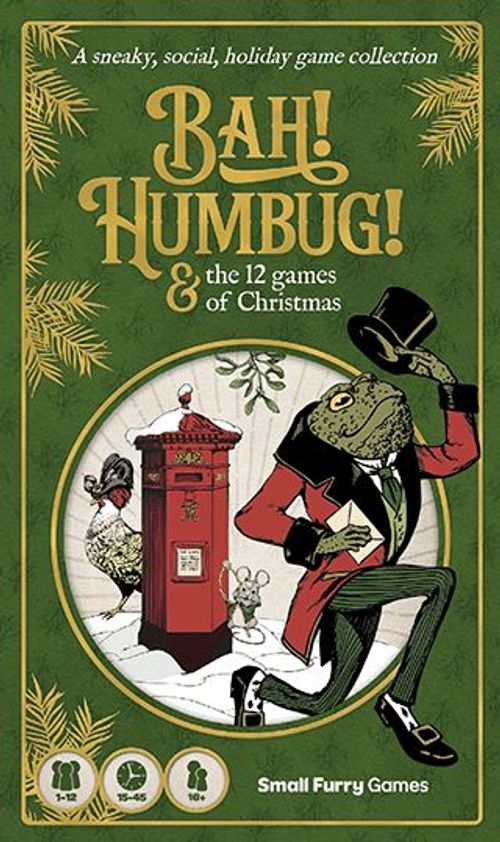
Bah! Humbug! and the 12 Games of Christmas
Bah! Humbug! and the 12 Games of Christmas Rulebook
Table of Contents
Table of Contents
- What's in the Box
- Bah! Humbug!
- Christmas Parade
- Deckbuild the Halls
- Dress the Mantel
- The Duke's Daughters
- The Giving Spirit
- Ladies Dancing
- Menagerie
- O Christmas Tree
- Post the Parcels
- Snapdragon
- Swindling Suitors
- Woodland Winter
- The Merrily on High Street
- One High, 2 Low, 3 of a Kind
- Ribbon, Rabbit, Ribbit
What's in the Box
Playing Cards
80 Mail cards, including:
- 12 x "Drummer Drumming" (12)
- 11 x "Piper Piping" (11)
- 10 x "Lord a-Leaping" (10)
- 9 x "Lady Dancing" (9)
- 8 x "Maid a-Milking" (8)
- 7 x "Swan a-Swimming" (7)
- 6 x "Goose a-Laying" (6)
- 5 x "Golden Ring" (5)
- 4 x "Calling Bird" (4)
- 3 x "French Hen" (3)
- 2 x "Turtle Dove" (2)
- 1 x "Partridge in a Pear Tree" (1)
- 2 x Postman (P) (1 blue coat and 1 red coat)
1 x Bah Humbug / Letterbox card
4 x Brown Box / reminder cards
16 x Evergreen cards, including:
- 12 x Ribbon cards (numbers 1 to 12)
- 3 x Clock cards (numbers 13 to 15)
- 1 x Star card (not numbered)
6 x Calendar / Door cards
13 x game reference cards
Other Pieces
- 1 x wooden pawn
- 12 x red tokens
- 20 x black tokens
- 3 x golden arrows
...and 1 drawstring bag.
Bah! Humbug!
"On the twelfth day of Christmas, my True Love sent to me..."
Mail your True Love one Christmas card each day, and be sure to boast to everyone in town about it. To keep up with other suitors, you might have to bluff about what you've sent. But bluffing is half the fun! Will you win by being the sneakiest liar, or by catching others in their lies?
Players: 2-5 | Difficulty: LIGHT | Play time: 15-20 minutes
You'll Need: all 80 Mail cards (include both Postmen); Bah! Humbug! / Letterbox card; 12 Evergreen cards (1-12); all red tokens (12); all black tokens (20); 1 golden arrow; the wooden pawn; Bah Humbug reference card (blue); Brown Box cards for players to share.
Setup
- Shuffle together the Mail cards (including the Postmen). Deal each player 8 cards, as shown on the setup diagram (A). Put the rest of the cards in a pile nearby to form a draw deck (B).
- Use the Evergreen cards to form a ring in the center of the table, starting with the number 12, then continuing clockwise to 11, 10, 9 ... down to 1. This is called the "wreath." Put the golden arrow on 12 (C).
- Place the double-sided Bah! Humbug! / Letterbox card in the center of the wreath, where all players can reach it. Flip it to the Letterbox side. Scatter the holly berries and coal inside the wreath (D).
- Give the pawn to the player who most recently mailed something. They will be the first player (E).
- Give players reminder cards to share, if they wish (F). You can also use the reference card to help with the rules.
"Bah! Humbug!" is composed of "Bah!" (an expression of contempt, disgust, or bad temper) and "Humbug!" (meaning "balderdash!, nonsense!, rubbish!"). It was coined by Charles Dickens in his 1843 novella, A Christmas Carol, as the catchphrase of Ebenezer Scrooge.
Game Overview
Bah! Humbug! is a bluffing game. Each round, you'll take turns mailing 1 secret Christmas card to your True Love (playing 1 card face-down). As you boast about what you're sending, another player might shout, "Bah! Humbug!" to accuse you of lying. If they catch you in a lie, they'll earn 1 holly berry. But if you were telling the truth, you'll steal 1 holly berry from them. Then all players will earn coal for lies they got away with this round.
GOAL: You can win in either of 2 ways:
- by being the NICEST (the first to collect enough berries), OR
- by being the NAUGHTIEST (the first to collect enough coal).
To win, you need to collect:
- 3 to 5 players: 3 holly berries OR 5 coal.
- 2 players: 3 holly berries OR 7 coal.
How to Play
ROUNDS & TURNS
The game has several rounds, with up to 12 turns each. Each round, players take turns in order until someone shouts "Bah! Humbug!" Then you'll Resolve the Accusation, and Check for Lies. This ends the round. You'll keep playing rounds until one player collects enough tokens to win.
HOW A ROUND WORKS
- To start the first round, the first player says, "On the 12th day of Christmas, I sent my True Love..." Then they must say "12 Drummers Drumming" (or simply, "twelve") and place 1 Mail card, face-down, next to the 12 space on the wreath. Note: After each round, the golden arrow will move and the starting number will change.
- Play continues. The player to the left of the first player says "11 Pipers Piping" (or simply, "eleven") and places 1 Mail card next to the 11. Then the next player says "10 Lords a-Leaping," and so on. Every turn, a player must play exactly 1 Mail card next to the highest-numbered available space on the wreath. The Mail card you play does NOT have to match the wreath. Any player may lie about what they are playing! (E.g., Linda might say "ten" as she plays a 3 card next to 10.)
- Shouting "Bah! Humbug!" Anytime, during anyone's turn, if any player suspects another player is lying about their card, they may shout "Bah! Humbug!" and flip the Letterbox to the "Bah! Humbug!" side to accuse the player of bluffing. (If multiple players shout, the first player to flip the Letterbox is the accuser.) You may ONLY accuse the player who played the most recent card. (E.g., If Irvin says, "Seven Swans a-Swimming" and plays on 7, you may shout, "Bah! Humbug!" at him. But as soon as Conrad plays on 6, you may no longer accuse Irvin. You may only accuse Conrad.)
HINT: As the numbers descend, the cards become more rare. (There are 12 copies of the 12 card, 11 of the 11 card, etc.) The lower the number, the more likely it could be that a player is lying!
RESOLVE A "BAH! HUMBUG!"
If "Bah! Humbug!" is called, the accused player reveals their card. Then 1 player will get a holly berry:
- If the card was a lie (i.e., doesn't match the wreath), the player who caught the liar wins 1 holly berry, which they take from the lying player, or from the center if the lying player has none.
- If the card was the truth (it matches, or it's a Postman), the accused player wins 1 holly berry, which they take from the accuser, or from the center if the accuser has none.
Note: if all the wreath spaces are full and no one has called "Bah! Humbug!", Check for Lies (see below).
EXAMPLE: After Conrad plays a card face-down on 5, Meredith shouts, "Bah! Humbug!" and flips over the Letterbox. Conrad reveals the card. He lied! Because Meredith caught him, Conrad must give Meredith 1 holly berry.
CHECKING FOR LIES & GIVING COAL
If a Postman card was revealed during the "Bah! Humbug!" Accusation, skip to the next page. Otherwise, Check for Lies: Working backwards from the most recently played card, flip each card that was played and Check for a Lie. For any card that doesn't match its space on the wreath, award 1 coal to the player who played that card and got away with the lie. If you encounter a Postman, immediately stop Checking for Lies and skip to the next section.
EXAMPLE: In the third round, you resolved a "Bah! Humbug!" Accusation on 5. Then you Check for Lies: The card on 6 matches, so nothing happens. You reveal a lie (a 2) on 7, so that player takes 1 coal. Spaces 8 and 9 match, so nothing happens. Space 10 is a lie, so that player takes coal. This ends the round.
POSTMAN CARDS
The 2 Postmen (P) are wild cards that always count as a match. In addition, when a Postman is revealed, it prevents any remaining Mail cards from being checked for lies. (The Postman takes away the mail!) If you reveal a Postman:
- ...while Resolving a "Bah! Humbug!" Accusation: Resolve the "Bah! Humbug!" as if you had revealed the truth. (The accused player takes 1 holly berry.) Do NOT Check for Lies. Instead, clear all remaining Mail cards from the wreath without revealing them.
- ...while Checking for Lies: Stop checking cards. Clear all the remaining Mail cards from the wreath, without revealing them.
EXAMPLE: In the fourth round, after resolving a "Bah! Humbug!" on 4, you Check for Lies: The card on 5 is a match, so nothing happens. The card on 6 is a lie. That player takes 1 coal. When you reveal the card on 7, it's a Postman, so you clear away the cards on 8 and 9 without looking at them. This ends the round.
RESETTING FOR A NEW ROUND
At the end of a round, if anyone has collected enough tokens to win, the game ends. (See "Game End," below.) If no one has collected enough tokens, set up for a new round:
- Players keep the cards remaining in their hands.
- Clear all Mail cards still on the wreath. Shuffle them face-down and add them to the bottom of the draw deck.
- All players draw to 8 cards.
- Flip the "Bah! Humbug!" to the Letterbox side.
- Move the golden arrow CLOCKWISE to the next-lowest number on the wreath, or 2 lower, if playing with an even number of players.
- Pass the pawn COUNTER-CLOCKWISE.
Game End
THE GAME ENDS WHEN 1 PLAYER COLLECTS:
- 3 to 5 players: 3 holly berries OR 5 coal.
- 2 players: 3 holly berries OR 7 coal.
If they collect enough berries, they win as the NICEST. If they collect enough coal, they win as the NAUGHTIEST!
TIES: If multiple players claim their winning coal tokens in the same round, the player whose Mail card was revealed first (i.e., is on a lower-numbered wreath space) wins the game.
Christmas Parade
Felix Falk's game: Organize the animals to earn the most applause and create the winning Christmas parade.
Players: 2 | Difficulty: MEDIUM | Play time: 15-20 minutes
You'll Need: 18 specially marked Mail cards (each has an encircled symbol in its top-right corner); 17 black tokens; Christmas Parade reference card (yellow).
Setup
- Place the black tokens within reach.
- Shuffle the 18 specially-marked Mail cards. Return all other cards to the game box.
- Randomly deal 9 cards face-up in a horizontal line in front of each player.
- Choose 1 player to go first.
- Place the reference card nearby for players to share.
CHRISTMAS PARADE: Setup is complete.
Game Overview
GOAL: This is a card-manipulation game. To win, collect the most cards during the "parade," which happens at the very end of the game. To collect cards, you'll have to organize your animals such that they score more "applause" (points) than the animals in your opponent's lineup.
PHASES OF THE GAME: The game has 2 phases:
- ORGANIZING. First, players will alternate turns as they organize their animal lineups. You'll use various actions to move, lock, and swap your cards, organizing them from the "start" of your lineup (the left side) to the "end" (the right side). These actions are explained further under "How to Play."
- THE PARADE (SCORING). As soon as either player's lineup is finished, the official parade (scoring) begins: You'll compare the animals, one by one, in parade order, to see whose animal scores more applause. If your animal scores the most applause, you'll collect both of the cards in that parade position: your opponent's and your own. (In a tie, each player keeps their own card.) Once the parade is over, the player with the most cards wins.
ANIMAL CARDS & SYMBOLS
Card numbers are not used in this game. Instead, each animal has its own identifying symbol in a circle in its top-right corner: Drummer Drumming, Piper Piping, Lord a-Leaping, Lady Dancing, Maid a-Milking.
Most animals also have 1 or more small scoring symbol(s) near the bottom of their cards. These symbols allow the animal to score applause during the parade at the end of the game.
SYMBOL LOCATIONS
Each type of animal shows a special identifying symbol in the top-right corner of its card. Most animals also have 1 or more small scoring symbol(s) near the bottom of their cards. These symbols allow the animal to score applause during the parade at the end of the game.
APPLAUSE EXAMPLE
The Bell symbol identifies the Maid a-Milking.
The Maid a-Milking card will score 1 applause for every Bow (Lady Dancing) marching behind her (to the right of her) in the final parade.
EXAMPLE: If organized like this at the end of the game, the Maid will score 2 applause, because there are 2 bows behind her.
How to Play
TURNS & ROUNDS
Beginning with the first player and alternating back and forth, players will take turns manipulating their lineups. You'll continue playing until 1 player has "locked" all of their cards. Then the parade will begin and players will score points.
ON YOUR TURN, CHOOSE 2 ACTIONS
Take exactly 2 actions, chosen from the following. You may take the same action twice, if you wish. Note: The first player only takes 1 action on their first turn.
- MOVE 1 ANIMAL (1 action). Pick up 1 card in your lineup. Move it to any new location within your lineup, sliding aside other cards to make space for it.
- LOCK 1 ANIMAL (1 action). Place 1 black token onto an animal in your lineup. This "locks" it for the rest of the game. Locked animals may not be Moved or included in a Swap, but you may still slide them to make room for other animals you Move.
- SWAP 1 ANIMAL (2 actions). Remove 1 animal from your lineup. Then choose an animal in your opponent's lineup, and swap your animal for theirs.
NOTE: If you Swap immediately after your opponent Swaps, you may not take the same animal type they took, nor give the same animal type they gave. (E.g., If your opponent Swaps their Piper for your Maid, you may not use your next action to take a Maid or give a Piper.)
Game End & Scoring
As soon as one player's lineup is completely locked (i.e., has a token on every card) the organizing ends, and the parade (scoring) begins:
- Clear all the black tokens from your cards.
- Compare the animal at the start of your parade to the animal at the start of your opponent's to see whose animal scores more applause. (For help, see the "Applause Example.") The player whose animal scores more applause collects both of the cards. (If tied, each player collects their own card.) Place collected cards face-down in a pile near you.
- Continue comparing cards, left to right in parade order.
- Once all cards are collected, whoever has the most cards wins. If tied, the player with the most 12s is the winner.
(An example of game-end scoring follows.)
PLAYING WITH KIDS? For easier scoring, simply count the total applause for each parade. The player with the most applause wins.
EXAMPLE: Martha's parade leader (A) scores 5 applause. Bob's parade leader (B) does, too. It's a tie, so they both collect their cards. Martha's second animal (C) scores 3 applause, and Bob's (D) scores 5. Bob's animal wins, so he collects both of the cards in second position. Players continue comparing each card, from the start of their lineup to the end. Martha ends with 8 cards. Bob ends with 10. Bob wins.
ALTERNATE GAME MODE: Once players have tried the base game, try this strategic twist: When you Swap, steal your opponent's card and place it anywhere in your line. (Don't give them a card in return.) At game end, if 1 player has more cards, they discard from each end (i.e., front card, then back card, then front card...) until the parades are the same length. Score as usual.
Deckbuild the Halls
Duncan Hecht's advanced game: In this more advanced game, compete to collect the best inventory of Christmas decorations, so you can "deck" your hall with the most impressive decor. But avoid collecting birds, they're out of fashion this season.
Players: 2-4 | Difficulty: ADVANCED | Play time: 45 minutes
You'll Need: 78 Mail cards (no Postmen); 5 Evergreen cards (1, 2, 3, 5, 7); the wooden pawn; all 12 red tokens; Deckbuild the Halls reference card (green).
Setup
- CREATE PLAYER DECKS. Give each player this special set of 8 cards ("decorations"):
- 1 x "Drummer Drumming" (12)
- 2 x "Piper Piping" (11)
- 2 x "Lord a-Leaping" (10)
- 2 x "Lady Dancing" (9)
- 1 x "Maid a-Milking" (8)
- Each player combines these cards to form their player deck, shuffles it, and places it face-down nearby. Leave room for a discard pile next to your player deck.
See the setup diagram on the following page.
2. PREPARE THE MARKET.
- In a 2-player game, return all the remaining "Piper Piping" (11) cards to the game box. (For 3- and 4-player games, do not remove any cards.) Shuffle all the remaining Mail cards into a face-down pile. Place it to one side of the play area. This is the "Market deck."
- Place the 1, 2, 3, 5, and 7 Evergreen cards face-up in a line near the Market deck. These represent "booths" in the Market, and the number on each booth represents the cost to buy the card(s) beneath it.
- From the Market deck, deal 1 card face-up into each booth of the Market. These are the "decorations" for sale in each booth.
- While filling the Market, if you draw any cards with the same number, stack them together in the same booth. Then continue drawing from the Market deck and filling the Market until there is at least 1 decoration in each booth.
- Rearrange the decoration(s) within the Market booths, putting the highest-valued card(s) in booth "1," and the lowest-valued card(s) in booth "7." (Note: This is a special step for setup only. You will not rearrange cards when refilling the Market later.)
- Leave room for a discard area to the left of booth "1."
- Place the holly berries in a supply where all players can reach them.
- Place the reference card nearby for players to share.
3. GET READY
- Every player draws 5 cards from the top of their deck. This is their starting hand.
- Randomly choose a player to go first. Give them the wooden pawn.
Game Overview
THIS IS A DECK-BUILDING GAME. In this game, each player has their own "set of decorations" (deck of cards). Everyone starts with an identical deck. But over the course of the game, players will lose some cards, and collect other ones as they play "tricks." Your score at the end of the game will be determined by the collection of decorations you have acquired, i.e., the deck of cards you've "built" over the course of the game.
THIS IS ALSO A TRICK-TAKING GAME. Playing "tricks" is one way to collect new decorations and build your deck. Each round ("trick"), every player will play 1 decoration face-up in front of them. After every player has played 1 decoration, players compare them to see whose is the "rarest" (lowest). The lowest card wins each trick. At the end of each trick, you'll collect a different reward, either decorations or holly berries, based on whether you played the lowest, the highest, or something in between. Tricks continue until the Market deck is empty. Then players play the final trick and determine the winner.
GOAL: To win the game, earn the most points. At the end of the game, you'll earn 1 point for each non-bird decoration you have. (Decorations with birds are worth 0.) You'll also earn 1 point for each set of 3 holly berries you have.
HINT: As you collect decorations, remember the lower the number on the card, the more rare the decoration is, and the more likely it is to outshine your opponents' decorations (win the trick). But also remember, this season birds are out of fashion. Birds can still win tricks, but will not be worth points at the end of the game.
Collecting Cards
There are 2 ways to collect cards, and thus build your deck:
- Winning cards from other players (during tricks).
- Buying cards from the Market (between tricks).
WINNING CARDS IN TRICKS: At the end of each trick, the player who played the "rarest decoration" (the lowest card) will win the trick. The player who played the "most common decoration" (the highest card) will lose the trick. The winning player will collect the losing player's card and add it to their discard pile. Everyone else (except the losing player) will collect their own card back.
BUYING FROM THE MARKET: Players may spend holly berries to buy new decorations from a Market booth:
- Any player may do this before they play a card for the trick.
- The winner of the trick gains a bonus. They may spend that bonus to buy from the Market immediately after that trick.
REFILLING THE MARKET. Whenever a player buys the decoration(s) in a Market booth, immediately refill that booth. To do so, shift the decorations from the other booths to the left to fill the empty booth (leaving an empty space under booth "7"). Then draw 1 new decoration from the Market deck and add it to booth "7."
IMPORTANT: Anytime you draw from the Market deck, if the card matches one already in the Market, add it to that same booth. Then draw again from the Market deck and refill again until there is at least 1 card in each booth.
How to Play
PLAYING A TRICK: The player with the pawn will start the trick. The structure of each trick is as follows:
- Everyone plays 1 card, then discards 1 card (see "Play 1, Discard 1").
- Determine who won and who lost the trick.
- Collect prizes from the trick.
- The winner gains a bonus.
- Everyone refills their hand to 5 cards.
These steps are explained in more detail below.
1. PLAY 1, DISCARD 1
Starting with the player who has the pawn and continuing clockwise, each player takes the following 3 steps, in order:
- BUY DECORATION(S) FROM 1 BOOTH (optional). You may purchase the contents of 1 Market booth:
- Pay holly berries equal to the number of the Market booth. (Return the holly berries to the supply.)
- Place the purchased decoration(s) onto your discard pile.
- Refill the Market.
- PLAY 1 decoration face-up onto the table.
- DISCARD 1 decoration from your hand face-up onto your discard pile.
After every player has taken their turn:
2. DETERMINE WHO WON/LOST
- The player who played the LOWEST card ("the rarest decoration") WINS the trick. If tied, the tied player who played their card first wins the trick.
- The player who played the HIGHEST card ("the most common decoration") LOSES the trick. If tied, the tied player who played their card later loses the trick.
EXAMPLE: The 4 players play these cards, in this order: Nick, Noelle, Ivy, Tim. Though there are two 9s in the trick, Nick played the first one. Nick's card is therefore considered the lowest, so Nick wins the trick. Noelle played the highest card (the 11) so Noelle loses the trick.
3. COLLECT PRIZES
The player who WON the trick collects their card AND the losing card (i.e., the highest and lowest cards from the trick) and places them face-up onto their discard pile. The player who LOST the trick collects 1 holly berry from the supply, and the first-player pawn. (Note: If you run out of holly berries, use the black tokens as substitutes.) Anyone whose card was NOT taken collects their own card and places it face-up on their discard pile.
EXAMPLE: Continuing from the previous example, Nick won, and therefore collects the highest and lowest played cards (the 9 and 11) and discards both of them face-up. Noelle lost, and therefore collects the pawn and 1 holly berry. Ivy collects and discards her own card. Tim does the same.
4. THE WINNER GAINS A BONUS
The winner may use EITHER of 2 things:
- BUY FROM 1 BOOTH. Gain a bonus equal to the difference between your 2 collected decorations. (E.g., In the previous example, Nick's bonus is 11 - 9 = 2.) Spend your bonus, plus any number of holly berries (worth +1 each) to buy the decoration(s) in 1 booth.
- OR, CLEAR 1 BOOTH & TAKE 1 BERRY. Choose 1 Market booth. Clear all its decorations (return them to the game box). Refill the Market. Take 1 holly berry.
EXAMPLE: Continuing from the previous example, with his bonus of 2 (11 minus 9), Nick may: buy the "Swans a-Swimming" (the 7s) from Market booth 2; buy the "Maid a-Milking" (8) from Market booth 1; or clear any Market booth (return its cards to the game box) and refill the Market. But instead, Nick decides to discard 1 holly berry, increasing his spending power to 3, and buy the "French Hen" (3) from booth 3.
Note: If a player does not use their entire bonus, they lose the remainder of the bonus. (I.e., They may not save it for later.) A bonus may not be "split," either (e.g., If a player has a bonus of 5, they may NOT buy Market booth 2 AND booth 3. They must choose only 1 booth).
5. REFILL YOUR HAND TO 5
Each player draws 2 cards from their deck (so that all players are holding 5 cards). If a player is unable to draw a card into their hand because their deck is empty, they shuffle their discard pile to create a new draw deck.
Game End
When the last card is moved from the Market deck into the Market, players finish the current trick, determine the winner, and collect their decorations and bonuses. Then calculate scores.
SCORING
- Gather all the cards from your hand, deck, and discard pile.
- Remove the cards with birds (1, 2, 3, 4, 6, 7, 11). These cards are worth 0 points.
- Score 1 point for each remaining card (5, 8, 9, 10, 12).
- Score 1 point for every set of 3 holly berries you have.
- The player with the most points wins. In the event of a tie, the tied player with the most holly berries wins.
EXAMPLE: At the end of the game, Ivy has these cards: birds = 0; non-birds = 9; berries = 1. Her total score is 9 + 1, or 10.
GAME VARIANT: For a more intense game, play with bird cards worth -1 point each (instead of 0) at the game end.
Dress the Mantel
David Waldman's game: Decorate your fireplace mantel by creating a garland of Christmas decorations, starting at your mantel clock and working outward in both directions. Score points by chaining together similar types of decorations. After all the cards are played, the player with the most points wins.
Players: 2 | Difficulty: LIGHT | Play time: 10 minutes
You'll Need: 12 ribbon-back Evergreen cards (1-12); 2 Clock cards; the wooden pawn; Dress the Mantel reference card (yellow).
PLAY OTHER GAMES AT THE SAME TIME! Because this game uses only the Evergreen cards and the wooden pawn, other players can play additional games while you're playing this one. See Christmas Parade (p. 15), The Giving Spirit (p. 38), or Menagerie (p. 48).
Setup
- Give each player 1 Clock card to place in front of them.
- Shuffle the Evergreen cards. Place them face-down in a draw pile in the center of the table. Note: In this game, the numbers on the Evergreen cards have no significance. Instead, you'll use the decorations surrounding the numbers.
- Decide who will go first. Give them the wooden pawn.
- Place the reference card nearby for players to share.
DRESS THE MANTEL: Setup is complete.
Game Overview
GOAL: This is a card-laying and chaining game. To win, score the most points by collecting and arranging decorations on your "Mantel" (the area to the left and right of your Clock card). In most cases, you'll score by placing similar decorations next to each other.
DECORATIONS: There are 5 decorations: Pine cones, Oranges, Jingle Bells, Poinsettias, and Mistletoe. Each has a special way of scoring at the end of the game. (For details, see the reference card, or "How Each Decoration Scores" below.)
Dressing Your Mantel
EXAMPLE: After selecting a card, you will rotate it as you wish, then slide it under another card already on your Mantel. This creates a "garland" of decorations.
How Each Decoration Scores
- PINE CONES = 1 point each. If you have at least 2 pine cones adjacent, you will score 1 point for each one in a continuous line.
- ORANGES = 1 point each. If you have at least 2 oranges adjacent, you will score 1 point for each one in a continuous line.
- JINGLE BELLS = 4 points. If you have at least 2 pairs adjacent ("Jingle Bells, Jingle Bells"), you will score 4 points. Max. 4 points.
- POINSETTIAS = 5 points. If you have at least 3 poinsettias adjacent, you will score 5 points. Max. 5 points.
- MISTLETOE = 3 points (MOST). If you have MORE mistletoe (anywhere on your Mantel) than your opponent, score 3 points. In a tie, both players score 3 points.
CHOOSE CAREFULLY. Each card has up to 4 decorations on it, but because you must tuck it under another card, you will only be able to score 1-2 decorations per card.
How to Play
If you have the pawn, it's your turn! On your turn:
- DRAW 2 CARDS. Keep them secret.
- OFFER 1, HIDE 1. Offer 1 of your 2 cards as a "gift" to the other player, holding it face-up in your hand. Hold the other close, facing you.
- YOUR OPPONENT CHOOSES. They may accept your gifted card, OR reject it and take the hidden card instead!
- DECORATE. Both players take their card and add it to one side of their Mantel, tucking it beneath another card to continue their garland. Note that:
- Cards may be rotated to use either decorated edge.
- Once a card is placed, it may NOT be rearranged.
- PASS THE PAWN to the other player. Continue taking turns until all cards have been placed onto Mantels. (Each player will end with 1 Clock + 6 cards.)
Game End & Scoring
Count your scores. (Use the reference card, or the chart above.)
Notes about scoring: In general, as long as 2 cards are adjacent, their visible decorations are considered adjacent. (See oranges above.)
EXAMPLE: At the end of the game, David's Mantel (shown on the printed page 33 with icons) scores 9 points. Per decoration: 0 for the decoration with none adjacent; 5 for the decoration with 3 on the left and 2 on the right; 4 for the decoration with 2 pairs adjacent; 0 for a decoration with fewer than 3; and 0 for mistletoe, because his opponent Hillary has 3 and he only has 2.
The player with the highest score wins. If tied, play again!
The Duke's Daughters
Koyomi Kawasumi's game: You, the antique shop owners of the square, have been commissioned by the Duke to send a set of your most delicate antique figurines to each of his 12 daughters. He wants all 12 parcels to be equally extravagant, worth a total of £25 each. Can you work together to manage the incoming and outgoing shipments without breaking too many items?
Players: 1-4 | Difficulty: MEDIUM | Play time: 15-30 minutes
You'll Need: 79 Mail cards (include the blue Postman, but not red); 12 Evergreen cards (1-12); the Letterbox; 3 Calendar cards; 3 Brown Box cards; all 12 red tokens; the wooden pawn; The Duke's Daughters reference card (purple).
Setup
- Place the Letterbox near the top of the play area. This is where you'll collect the deliveries you complete (A).
- Place the Postman card off to the side, and deal 2 cards face-down near it to form "the Postman's Bag" (B).
- Shuffle the other Mail cards into a draw deck. Place it to the right of the Letterbox (C). Leave room for a discard pile (D).
- Place 3 Calendar cards in a column below the Letterbox, and place 1 Brown Box card near each Calendar (E). (These represent "Parcels" of gifts you'll need to assemble and deliver.) Deal 1 Mail card to each parcel. Then use a red token to mark the total value of the gifts in each box.
- Place the 12 Evergreen cards face-up in an ordered stack, with "1" on top. Place it to the side, with the red tokens (F).
- Deal a hand of 3 cards to each player (G).
- Choose the first player. Give them the wooden pawn (H).
- Place the reference card nearby for players to share (I).
Game Overview
GOAL: This is a cooperative game in which all players win or lose together. To win, assemble and deliver 12 different Parcels filled with antiques (cards), with each set worth exactly 25 points. Be careful not to break anything (go over 25 points in any Parcel). If you do, you'll lose 1 red token. If you run out of red tokens before you deliver 12 Parcels, you will lose!
TURNS & ROUNDS: The game has several rounds. Each round, play starts with the first player, then continues clockwise. Every player will take 1 turn. Then players will "Receive Mail" together, and begin a new round. You will continue playing rounds until you win or lose the game.
On Your Turn
Starting with the first player and proceeding clockwise, players take turns. On your turn, do the following, in order:
- Add 1 item (card) to any Parcel, OR take 1 special action.
- Check the Parcels.
1(a) ADD 1 GIFT TO ANY PARCEL
Take 1 card, from your hand OR from the Postman's Bag, and add it to any Parcel (A). Update the Parcel's value (B). Replace the card you just took with one from the draw deck (C). If you do not wish to add a gift to a Parcel, you may take a special action instead.
EXAMPLE: Tyki adds a Ladybird (9) to the Parcel (A), and adjusts the red token to mark the Parcel's new value (B). Then he draws a new card (C).
1(b) TAKE 1 SPECIAL ACTION
Instead of adding 1 card to a Parcel, you may remove 1 red token from the game (return it to the game box) to do one of the following:
- Move 1 card between 2 Parcels.
- Play 2 cards (instead of 1).
- Reveal the Postman's Bag.
- Reveal all player hands face-up.
2 CHECK THE PARCELS
If any Parcel is exactly 25 points, you may "Deliver" it: Discard all the cards from that Parcel. Then take the top Evergreen card and place it next to the Letterbox, to signify how many packages you've delivered so far.
If any Parcel is above 25 points, it "breaks." Discard all cards in the Parcel. Remove its red token from the game. If there is another red token available in the supply, add it to the left of the "1" space for that Parcel. If there are no red tokens left, put the Parcel (the brown card and Calendar card) in the game box. You may not use it anymore.
END YOUR TURN. The player to your left plays next.
After all players have taken a turn, Receive Mail together.
Receive Mail
For each Parcel, draw 1 new card. Add that card to the Parcel. Then update its total value and Check the Parcels to see if any can be delivered, or if they "break." Then pass the pawn clockwise and start a new round.
Game End
ALL PLAYERS WIN IF... you make 12 deliveries. The number of red tokens you have left determines your "Christmas bonus."
ALL PLAYERS LOSE IF... you run out of red tokens before you make all 12 deliveries. The Duke will be very disappointed, but perhaps he'll give you a second chance.
The Giving Spirit
Evan Halbert's game: In this trick-taking game, 'tis better to give than to receive! The highest card will take each trick. But be careful not to take too many, for at the end of each round, penalties will be awarded to the players with the most of each type of card. (That is, unless they got exactly what they wanted...)
Players: 3-6 | Difficulty: MEDIUM | Play time: 15-30 minutes
You'll Need: 79 Mail cards (include the blue Postman, but not red); the Letterbox; 8 Evergreen cards (1-8); 1 Calendar card and 1 red token per player; all the black tokens; 3 golden arrows; The Giving Spirit reference card (blue).
Setup
- Choose 1 player to go first. Give them the Postman card (A).
- Shuffle the other Mail cards. Deal 12 to each player (B). Set aside the rest of the deck (C).
- Give each player a Calendar to use as a scorecard. Place a red token to the left of each "1" space (D).
- Place the Letterbox in the center (E).
- Put the coal and golden arrows nearby (F).
- Place the Evergreen cards (1-8) nearby for players to see (G).
- Place the reference card nearby for players to share (H).
THE GIVING SPIRIT: Setup for a 4-player game (see the printed setup diagram).
Game Overview
GOAL: To win, have the lowest score when the game ends.
TRICKS & ROUNDS: The game has multiple rounds. Each round has 6 "tricks." During each trick, every player will play 1 card and mail 1 card to the Letterbox. Then the player who played the highest-numbered card will take the trick, meaning they will collect ALL the cards that were played, including the Postman, and then deliver the mail from the Letterbox to themselves, or to all the players. You will continue playing tricks until every player runs out of cards. Then the round will end and players will count the cards they collected, receive tokens, and score penalties. Then you'll start a new round. The game will end when any player reaches 25 points.
TOKENS & POINTS
At the end of each round, each player will earn tokens (golden arrows or coal) if they have collected the most of any type of card. (E.g., A player who collected more "Golden Rings" than anyone else will get a golden arrow. Players who collected the most of any other card will get 1 coal each.) Players who tie for the most of a card will get tokens, too. After all tokens are given, those tokens will become penalties, and be scored on players' scorecards. BUT...
If you manage to collect ALL the "Golden Rings" and/or the perfect amount of coal from a round, you won't get those penalties! Instead you will "push" your penalties onto the other players. (See "Scoring" for details.)
How to Play a Round
- DETERMINE THE FIRST PLAYER. Each round, the player with the Postman will go first.
- CHOOSE WISH LISTS. Starting with the player who has the Postman and continuing clockwise, each player takes 1 of the Evergreen cards to represent how many pieces of coal they think they will take this round. This is their "wish list." Hint: For your first round, taking a low- or middle-value card is a good idea.
- PLAY 6 TRICKS (see "Playing Each Trick" below).
- SCORE POINTS (see "Scoring a Round" below).
- RESET FOR THE NEXT ROUND. If anyone has 25+ points, the game ends. If not:
- Return the Evergreen cards to the center.
- The player with the Postman keeps it, and they shuffle the Mail cards and deal 12 to each player.
- Start a new round. (Follow steps 1-4 above.)
Playing Each Trick
To play each trick, do the following:
-
MAIL CARDS. Simultaneously, each player chooses 1 card from their hand and hides it face-down under the Letterbox.
WHAT SHOULD I PUT IN THE LETTERBOX? Generally, your goal is to avoid collecting the most of any card. Since high cards take tricks, you might want to start by "mailing away" a high card.
-
PLAY CARDS. The player with the Postman plays the Postman to the center, along with 1 face-down card. Then, in clockwise order, every other player plays 1 card face-up to the center.
-
DETERMINE WHO TAKES THE TRICK. Flip over the Postman player's played card. Then the player who played the highest card takes the trick.
Note: During a trick, if there is a tie for highest card, the tied player who played their card later takes the trick.
EXAMPLE: Though there are two 12s in the trick, Jodi played later, so her card is considered the highest. She takes the trick.
-
TAKE THE TRICK & DELIVER THE MAIL. The taker of the trick does the following:
- Collect ALL the cards from the trick. Put the Postman nearby. Display the others face-up in front of you, arranged by value, so all players can see your collection.
- Deliver the mail. Take the cards from the Letterbox (without looking at them), and choose to either: (A) add ALL those cards face-up to your own collection, or (B) deliver 1 card randomly to each player (including yourself). Then each player adds that card to their collection.
If players still have cards in their hands, repeat steps 1-4 above until hands are empty. Then move on to scoring.
Scoring a Round
When all players are out of cards and all the mail has been delivered from the Letterbox, the round ends, and it's time to score.
-
FIRST, HAND OUT TOKENS: If any player(s) collected more 5s than anyone else, they take a golden arrow. Then give out coal, in this order:
- If any player(s) collected the most 12s, they take 1 coal.
- If any player(s) collected the most 11s, they take 1 coal.
- If any player(s) collected the most 10s, they take 1 coal.
- Continue giving coal for each number (skipping 5s) until you have given coal to the player with the 1 (if anyone has it).
Note: If there is ever a tie for the most, all tied players get a token.
-
PLAYERS SCORE POINTS FOR TOKENS:
- Golden arrow = 5 POINTS. The player(s) with the golden arrow score(s) 5 points, UNLESS they are the ONLY player with ANY Golden Ring cards. If they are, they are a Miser: they score 0 points for the arrow and all other players score 5 points. Return the arrow to the supply.
- Coal = 1 POINT each. Players with coal score 1 point for each coal they have, UNLESS they got the number of coal equal to their Wish List. If so, they are a Lucky one: they score 0 points for coal and ALL other players score 1 point for each coal that Lucky player collected! Return the coal to the supply.
Players move their red tokens to add the points to their scorecards.
-
SEE IF ANYONE HAS 25+ POINTS. If they do, the game ends. If not, reset for a new round (see step 5 above).
Game End
Once any player reaches 25, all players finish scoring the round. The player with the FEWEST points wins. In a tie, all tied players win.
Ladies Dancing
Emily & Clark Willix's game: The night of the holiday ball has arrived! Every lady in the room is hoping to waltz with her sweetheart, but she'll have to vie for attention among all the other ladies at the dance. If she plays her cards right, perhaps the night will end with a kiss... or even a proposal!
Players: 1-3 | Difficulty: MEDIUM | Play time: 20 minutes
Note: For a solo game, you may ignore instructions marked with a solo symbol.
You'll Need: 78 Mail cards (no Postmen); 9 red tokens; all 20 black tokens; the wooden pawn; Ladies Dancing reference card (pink).
Setup
-
Ready the Ladies. Separate the "Lady Dancing" (9) cards. Distribute them among the players as follows:
- 3 players: 3 Lady cards each
- 2 players: 4 Lady cards each
- 1 player: 5 Lady cards each
Return any extra Lady cards to the game box.
-
Prepare the Ballroom. Shuffle together the remaining Mail cards and "cut" them into 9 roughly equal piles (about 7-8 cards per pile). Arrange them in a circle in the center of the table. This circle is called the "Ballroom," and the top card of each pile represents a "Suitor."
-
Place all the tokens in the Ballroom.
-
Choose the first player. The player to their right takes the wooden pawn and places it next to any Suitor.
-
Place the reference card nearby, for players to share.
-
For a solo game, finish "Solo Game Setup" below.
LADIES DANCING: Setup for a 4-player game (see the printed setup diagram).
Game Overview
This is a rondel, set collection game. Each player is a sponsor for a group of eligible young Ladies (e.g., your "Lady Dancing" cards) attending a ball. Over the course of 6 "dances" (rounds), each Lady will dance with 6 Suitors (collect 6 cards, which you'll place in a column beneath that Lady's card). After 6 dances, the ball will end and Ladies will be eligible to score points.
To win, be the player who earns the most points for their Ladies. (For solo players, see "Solo Game Setup.")
The main way to score points is for a Lady to find her Sweetheart. To do so, she must dance with the same Suitor 3 times during the ball (i.e., collect 3-of-a-kind within her column). If she does, she may be able to score additional bonuses, too. (See "Game End & Scoring.") But she must always follow the rules of social etiquette!
Social Etiquette
As Ladies search for Sweethearts, they must follow these rules:
- A Lady must dance with at least 3 different Suitors during the ball (i.e., have at least 3 differently-numbered cards in her column at the end of the game), AND...
- A Lady must NEVER dance with the same Suitor 3 times in a row, AND...
- A Lady must keep pace with the other Ladies. (E.g., She may not add a second Suitor to her column until every Lady in her group has added her first Suitor.)
LUCKY LADYBIRDS. Some women in the Victorian era believed that if a ladybird landed on them, they would soon receive something new. If it landed on their head, it might mean a new hat. On the hand, it might mean new gloves. Today, some still believe that if a ladybird lands on you, it will bring good luck!
How to Play
Start with the first player. Then take turns clockwise.
ON YOUR TURN...
- Choose a Suitor. Move the wooden pawn clockwise exactly 1 or 2 spaces, to choose which Suitor to dance with.
- Take that Suitor's card and assign it to one of your Ladies. The card must go in the bottom-most position under that Lady's card, and follow all the rules of etiquette.
- End your turn. (Turns continue clockwise.)
ENDING A ROUND: After every Lady at the ball has a Suitor to dance with for this dance, the dance ends. If all Ladies have collected 6 cards, the game ends. If not, play another round.
Game End & Scoring
After 6 rounds, if a Lady did NOT find a Sweetheart, pick up the cards in her column. Stack them face-down. (She was not successful at this ball, but she may write letters to her Suitors.) This is worth 0 points.
If a Lady danced with the same Suitor 3 times and obeyed all rules of etiquette, she found her Sweetheart! Take 1 black token, worth 1 point. Place it on the Lady. She is eligible for bonuses:
- KISS. If her Sweetheart was the final Suitor she danced with, the Lady may accept a "kiss" and place it on that Suitor. This is worth 1 point.
- PROPOSAL. If the Lady has a "Golden Ring" in the same column as a Sweetheart, she may decide to accept a "proposal." Take 2 black tokens, for 2 points, and place them on that "Golden Ring" card.
The player with the most points wins the game. If there is a tie, the victory goes to the player whose Ladies had the most interesting conversations during the ball (the player who collected the most symbols in the top-right corners of Suitor cards). If there is still a tie, the tied players share a victory dance.
EXAMPLE: Gloria's first Lady found a Sweetheart (Piper) for 1 point, and a proposal, worth 2 points. Her second Lady found a Sweetheart (Swan) for 1 point, and danced with the Swan for the last song, receiving a kiss for 1 point. Her third Lady did not find a Sweetheart. But her fourth one did. Gloria's total is 6 points.
Solo Game Setup
In a solo game, the first dance for each lady is mostly automatic:
- Select your first Suitor from anywhere in the Ballroom. Place the wooden pawn near that Suitor. Take that Suitor's card and place it under your first Lady.
- Move the pawn a number of spaces equal to the value of the most recent card you took. (E.g., If you took a "Golden Ring," move the pawn 5 spaces.) Take that Suitor card as your next card and place it under a different Lady.
- Repeat step 2 until each of your Ladies has 1 Suitor.
- Play the rest of the game as normal, starting from "On Your Turn" above.
As a solo player, you will sponsor 5 Ladies at the ball. To win, find a Sweetheart for every Lady (total 5 points). A perfect score is 20 points (a Sweetheart, a kiss, and a proposal for every Lady).
Menagerie
Emily & Clark Willix's game: Which exhibitor will present the best collection of animals? In this game, 2 players compete to collect and display sets of animals in their menageries. The bigger the set, the more points it will score. Watch your opponent carefully to prevent their exhibition from becoming more impressive than yours. At the end of the game, the player with the most complete menagerie (most points) wins.
Players: 2 | Difficulty: MEDIUM | Play time: 20-30 minutes
You'll Need: 79 Mail cards (include the red Postman, remove the blue); 3 red tokens; 3 black tokens; Menagerie reference card (yellow).
Setup
- Choose a large table or surface where you can play.
- Give one player 3 red tokens. Give the other player 3 black tokens (A).
- Shuffle the 79 Mail cards. Deal each player 12 cards (B). (Note: This will be your hand limit for the game.)
- Arrange the remaining cards into a "tree" on the table, alternating each row to be face-up or face-down. Specifically:
- Place 1 card face-down (C).
- Overlapping that card, place 2 cards face-up (D).
- Overlapping the row of 2, place 3 cards face-down (E).
- Continue this pattern, alternating rows of cards face-up and face-down until you run out of cards (F).
- Place the reference card nearby for players to share (G).
MENAGERIE: Setup is complete.
Game Overview
GOAL: This is a drafting and set collection game. To win, earn the most points by the end of the game. You'll earn points by collecting cards, then displaying sets (e.g., 2 of a kind, 3 of a kind, etc.). The larger a set is, the more points it will score. Completed sets (e.g., all 5 of the "Golden Ring" cards) are worth the most.
How to Play
Choose a player to go first. Alternate turns until the game ends.
ON YOUR TURN follow these steps, in order:
-
FIRST, TAKE 2 ACTIONS. You may take the same action twice in the same turn, or take 2 different actions. Note: The first player only takes 1 action on their first turn. The 2 actions are:
- ADOPT 1 ANIMAL. Take 1 card, from the tree, OR your opponent's discard pile.
- RESERVE 1 ANIMAL. Place 1 of your tokens on 1 card on the tree. (It's reserved now.)
(These actions are explained further under "Actions, In Detail" below.)
-
OPTIONALLY, DISPLAY 1 OR MORE SETS. (See "Displaying Sets" below.)
-
DISCARD DOWN TO 12 CARDS. Place discarded cards face-up, one at a time, into your own distinct discard pile, so your opponent can see each one as you discard.
-
END YOUR TURN. Continue taking turns this way until the final animal is adopted from the tree. That triggers the Final Phase. (See "The Final Phase" below.)
Displaying Sets
To display a set, you will take 2 or more animals of the same type from your hand and place them face-up in front of you. This area is called your "Menagerie."
- When you display a complete set, you will add all the animal values together and score that many points. (E.g., A set of all 5 "Golden Rings" (5) is worth 25 points.)
- When you display an incomplete set (2 or more of the same animal, but not a complete set), you will score 1 point per animal. (E.g., 3 "Maids a-Milking" (8) cards is worth 3 points.)
The Postman is a wild card, and will score a number of points equal to the value of any other animal in the same set:
- The Postman can complete a set. (E.g., If you display the Postman with 5 of the six "Goose a-Laying" (6) cards, the Postman completes the set of 6 "Geese a-Laying." Each card in the set, including the Postman, is worth 6 points. The total score for the set is 36.)
- The Postman can expand an incomplete set. (E.g., If displayed with only 2 of the 6 "Goose a-Laying" (6) cards, the Postman is worth 1 point. The total score for the set is 3.)
- A Postman may never expand a set that is already complete. (E.g., It may not be used as a third "Turtle Dove" (2) since there are only 2 "Turtle Dove" cards in the game.)
IMPORTANT: Once a player displays a set of an animal type, that player may not add any more animals (nor the Postman) to that set, nor may they display any other sets of that animal type for the rest of the game. (The set represents an "animal pen" has been built within your Menagerie. It's just the right size for that set of animals, no more will fit!)
HINT: Consider carefully when to play each animal type. If on one turn you display 4 of the "Swans a-Swimming" (7) in your Menagerie, then on a future turn you have 3 more Swans, you may NOT add any of the new Swans to your set of Swans, or start a new Swan set elsewhere in your Menagerie. (Though your opponent may start their own Swan exhibit.)
Actions, In Detail
+ ADOPTING AN ANIMAL
- When adopting an animal from the tree, it must be a card that has no cards covering/overlapping it, AND does not have your opponent's token on it. This is called an "available" animal. Generally, you must work from the bottom row, upward toward the shorter rows. If you take one of your reserved animals (a card with your token on it), discard that token to the game box.
- When adopting an animal from your opponent's discard pile, you may only take the top animal.
- You may not take animals from your own discard pile.
+ RESERVING AN ANIMAL
- You may reserve ANY animal on the tree, as long as it is not already reserved by an opponent's token.
- Reserving an animal prevents your opponent from adopting it for the rest of the game.
- Once you place a token, you may NOT move it to another animal. You may only remove the token once your animal is available, AND it is your turn, AND you use an action to adopt the animal. When you do, return the token to the game box.
The Final Phase
TRIGGERING THE FINAL PHASE: As soon as the last animal is adopted from the tree, immediately:
- Take ALL the animals from both discard piles and return them to the game box.
- The player who adopted the final animal from the tree finishes their turn. If they discard, they discard to a new, common discard area. Then the final phase begins.
PLAYING THE FINAL PHASE: In the final phase, players continue alternating turns as they finish their Menageries for their exhibition (final scoring). On their turn, a player MAY adopt 1 animal from the top of the discard pile if they wish, but every turn, they MUST either display 1 set from their hand, or discard 1 animal. When one player runs out of cards, the other player continues playing until they also run out.
Game End
When both players have displayed all their animals in their Menageries, the game ends and the exhibition (final scoring) begins.
SCORING
- Each complete set = the quantity of animals x their value. (E.g., A set of 11 "Piper Piping" cards scores 11 x 11 = 121 points.)
- Each incomplete set = 1 point per animal. (E.g., A set of 5 "Drummers Drumming" (12) is worth 5 points.)
- A Postman scores the same points as each animal in its set. (E.g., A set of 2 "French Hen" cards + 1 Postman will count as 3 "French Hens," which scores 3 x 3 = 9 points.)
The player with the most points wins.
FINAL SCORING EXAMPLE: For the final exhibition, Clark's Menagerie has 9 sets:
- A: 1 "French Hen" card = 1 pt
- B: The Postman completes a 4 "Calling Birds" set (4 x 4) = 16 pts
- C: 2 "Golden Ring" cards = 2 pts
- D: A complete set of 6 "Goose a-Laying" cards (6 x 6) = 36 pts
- E: 3 "Swan a-Swimming" cards = 3 pts
- F: 1 "Maid a-Milking" card = 1 pt
- G: 2 "Lord a-Leaping" cards = 2 pts
- H: 6 "Piper Piping" cards = 6 pts
- I: 3 "Drummer Drumming" cards = 3 pts
Clark's total score is 1 + 16 + 2 + 36 + 3 + 1 + 2 + 6 + 3 = 70 points.
HINT: To make the math easier, count your complete sets first. Then just count 1 point per card.
O Christmas Tree
Pedro Kerouac & Jan Spodek's game: It's Christmastime again, and as always, neighbors are competing to show off their skills as tree decorators. Whose tree will outshine all the others? Push your luck to get the ideal decorations for your Christmas tree, then race to finish decorating. The player who completes their tree first (or completes the best tree), will win.
Players: 2-4 (double the player count by playing in teams of 2) | Difficulty: MEDIUM | Play time: 30 minutes
You'll Need: 78 Mail cards (no Postmen); 12 Evergreen cards (1-12); all 12 red tokens; 12 black tokens; the wooden pawn; 1 golden arrow; O Christmas Tree reference card (green).
Setup
- Choose a large surface where you can play the game.
- Prepare the Mail deck, based on the number of players:
- 4 players: Use all 78 Mail cards.
- 3 players: Return all the 12 cards to the game box.
- 2 players: Return all the 12 and 11 cards to the game box.
- Deal each player a hand of 2 Mail cards (A). Shuffle together the remaining Mail cards so that about half of them are face-up and half of them are face-down.
- Create the Block of "Shops." Divide the shuffled Mail cards into 12 roughly-equal piles (5 to 6 cards per pile). Arrange these piles to form a square in the center of the table (B). Each pile is a "Shop" and the square of shops is called the "Square."
- Shuffle the 12 Evergreen cards into a face-down stack (C).
- Put the 12 ornaments in the center of the Square (D).
- Choose the first player. Give them the betting tokens and the golden arrow (E).
- Place the Shopper. The player to the right of the first player takes the "Shopper" and places it next to any 1 of the Shops (F).
- Place the reference card nearby for players to share (G).
O CHRISTMAS TREE: Setup for a 2-player game (see the printed setup diagram).
Game Overview
GOAL: This is a betting and set collection game. To win, you must gather enough cards to build your Christmas Tree (an arrangement of 11 cards), AND end with the lowest score.
CHRISTMAS TREES: Your completed Christmas Tree must begin with a "Trunk" (1 card) at the bottom (A), have 3 rows of "Branches" (rows of 4, 3, and 2 of a kind) in the middle (B), and end with a "Star" (1 card) at the top (C). There are special rules about how to build your Christmas Tree. (See "Decorate" below.)
CHRISTMAS TREES, A ROYAL INTRODUCTION. When Queen Victoria's German husband, Prince Albert, brought a Christmas tree to Windsor Castle in the 1840s, he helped to make them as popular in Britain as they were in his native Germany. The carol "O Christmas Tree" is based on a German tune, "O Tannenbaum" ("O fir tree"), written in 1824 to the tune of a traditional German folk song.
How to Play
Play starts with the first player and continues clockwise. The golden arrow helps remind you who went first, because all players will get an equal number of turns in this game. The first player should keep the golden arrow for the whole game.
ON YOUR TURN, complete 3 tasks, in order:
- BET
- DECORATE (optional)
- DISCARD TO 7 CARDS
Each of these 3 tasks is explained below.
1. BET
You must always start your turn by Betting. It can help you collect cards for your Tree. When you Bet, you'll try to guess what cards are going to be drawn from the Evergreen deck. If you're right, you win 1 card (from the Shop where the Shopper is). Then you may stop and keep your winnings, or push your luck and try to win more cards. Here's how to Bet:
-
Shuffle the Evergreen Deck: Flip over the top card and place it face-up next to the stack.
-
Move the Shopper clockwise, to one of the next 3 Shops. (I.e., Choose the next card you want to win.)
-
Guess aloud whether the next Evergreen card will be higher or lower than the previous one. ("LOWER!")
-
Flip the next Evergreen card and place it in the next space. If your bet was CORRECT, place 1 betting token on the card next to the Shopper, as shown in the example. If your bet was INCORRECT, your Betting ends. You don't get any cards this round. ("O, Christmas Tree!") Skip to Step 6.
-
If you placed a betting token on a card, decide if you want to continue pushing your luck, or stop and take your winnings. To continue Betting, repeat steps 2 to 4.
You may Bet as many times as you want. However, after you draw the 4th Evergreen card and resolve that Bet, pick up the first 3 Evergreen cards and shuffle them into the deck. Then move the 4th Evergreen card to the first space.
To stop and take your winnings, take all the cards marked with a betting token (max of 12 cards). Add those cards to your hand. Add the tokens back to the supply. If any shop runs out of cards, it disappears, so there are fewer shops in the square.
-
To end your Betting:
- Collect all the betting tokens. Pass them to the next player.
- Return all Evergreen cards to the stack.
EXAMPLE: Pedro bet that the next card would be lower. He was CORRECT. Because he was correct, he adds 1 betting token to the card he won.
2. DECORATE (optional)
After you finish Betting, you may play cards from your hand to build your Christmas Tree and/or purchase any number of ornaments. Both of these are optional.
BUILDING YOUR TREE
-
The Trunk. The first card of your Christmas Tree must be the Trunk. It may be any number except 1.
-
The Branches. If you have already built your Trunk, you may add 1 or more Branch rows, following these rules:
- Bottom row: must be 4 of a kind.
- Middle row: must be 3 of a kind, of a number LOWER than the cards in the Bottom row.
- Top row: must be 2 of a kind, of a number LOWER than the cards in the Middle row.
You may add your 3 Branch sections in any order, but when you play a row, you must play ALL the cards of that row at the same time, including any ornaments you wish to hang.
-
The Star. After you place all 3 rows of Branches, you may add your Star. It must be the same number as the Trunk. This completes your Christmas Tree.
ORNAMENTS. At any time while you Decorate, you may buy ornaments. You may buy as many as you'd like (or are able to). You may only hang ornaments while adding Branches.
- Buy an Ornament: Discard 4 cards from your hand to the game box. Take 1 ornament.
- Hang an Ornament: Add 1 ornament to a card to adjust that card's value +1 or -1. (Limit 1 ornament per card.)
3. DISCARD TO 7 CARDS
At the end of your turn, if you have more than 7 cards, discard from your hand into the game box until you have no more than 7 cards.
End of the Game
When a player places the Star (the final card) onto their Christmas Tree, players continue taking turns until all players have played the same number of turns. (I.e., The player to the right of the player with the golden arrow will play last.)
WINNING
If, by the time the game is over, only 1 player has completed their Christmas Tree, that player is the winner.
If more than 1 player completed their Christmas Tree, those players add up all the original values of the cards in their completed Trees. (They do not include adjustments for ornaments.) The player with the lowest total has the most exquisite Tree, and therefore wins the game. If there is a tie, the tied player with fewer cards remaining in their hand wins. (If there is still a tie, the first person to touch an ornament on a real Christmas tree wins! Or, simply share the victory.)
Game Variations
PLAY WITH TEAMS. Play with teams of 2 players each. (E.g., A 6-player game will have 3 teams of 2 players.) Each team has their own Tree, and the 2 team members work together to Bet, Decorate, and Discard together. If playing with various ages, pair each younger player with an older player on their team.
GIVE YOUNG PLAYERS A "BOOST". To help younger players reach the top of their Trees more easily, give them a Brown Box card at the start of the game. This is their Trunk. They can place it right away! After they complete their Branches, they may finish by playing ANY card as their "Star."
Post the Parcels
James Gjaltema's game: It's Christmas 1883. Not only has wrapping and exchanging gifts become a popular pastime in recent years, but this year the Royal Mail has introduced the Parcels Post, making it possible to send your neighbors various trinkets and foodstuffs by mail. You and your London neighbors are excited to start a new tradition! Using the new parcel delivery service, you'll send each other parcels over the 12 days of Christmas, seeing who can collect the most splendid lot of gifts to display on Christmas day.
Players: 3-6 | Difficulty: MEDIUM | Play time: 20 minutes
You'll Need: 79 Mail cards (include the red Postman, but not blue); the Letterbox; 9 Evergreen cards (5-12 and the 13 Clock); 1 Calendar/Door card per player; 1 red token per player; all 20 black tokens; 1 golden arrow; Post the Parcels reference card (red).
Setup
- Give each player a Calendar and a red token. Each player flips their Calendar to the "front door" and places it in front of them, with their red token nearby (A).
- Lay the Evergreen cards in a line along the side of the play area, in order from 5-12, with the Clock at the end. Place the golden arrow on the 5 (B).
- Give the most responsible player the Postman card (C).
- Shuffle the Mail cards and deal 5 cards to each player. Place the other cards face-down under the Postman (D).
- Place all the coal in the center (E).
- Place the reference card nearby for players to share (F).
POST THE PARCELS: Setup for a 4-player game (see the printed setup diagram). Peter will be the Postman (dealer). He puts the Postman card on the deck to mark it as distinct from all the other cards that will be "mailed" around the table.
Game Overview
GOAL: This is a pick-and-pass, set collection game. To win, earn the most points. You will only score points at the very end of the game, when you reveal your single best SET (3 or more cards of the same type) and your single longest RUN (a sequence of 3 or more cards in order). You'll gain a bonus if you have the rarest (lowest-numbered) set or the longest run. If you have coal, you'll lose points unless you have the Partridge. (See "Game End & Scoring.")
CHRISTMAS PARCELS GALORE! In Victorian times, not only did Christmas parcels include puddings and mince pies, but in 1889 the Times reported 100,000 parcels contained turkeys, fowl, and other game. In rare cases, Royal Mail delivered live animals, e.g., a pair of doves.
HAND-BUILDING AND ROUNDS
Over the course of the game, each player's hand will grow from 5 cards to 12. Every player starts the game with 5 cards. Each round, players will "GIVE" cards and "RECEIVE" cards, ending the round with 1 more card than they had in the previous round. This continues until the last round, when all players have 12 cards.
TURNS ARE SIMULTANEOUS
All players will GIVE at the same time. Then, once everyone is ready, the player with the Postman "delivers the mail" and advances the golden arrow. Then all players RECEIVE at the same time. That ends the round. This repeats until the game ends.
Playing Each Round
Each turn, players will simultaneously GIVE, then RECEIVE.
1. GIVE (or block your door instead):
- Give 2 Cards. Choose 2 cards from your hand. Pass them clockwise, to the door on your left.
- ...OR... Block Your Door. Keep all your cards. Place your red token to your front door's. Take 1 coal.
If a player's door is blocked, do not deliver cards to it. Instead, the cards that you would have delivered there continue clockwise, to the next available door. (Note: If everyone but you blocks their front door, leaving no one to receive your cards, give your 2 cards to the player with the Postman. They deal you 2 new cards, and place your old ones at the bottom of the deck.)
2. RECEIVE. After every player has finished their "GIVE" (or has blocked their door):
- The player with the Postman delivers (deals) 1 card to every door, including doors that are blocked.
- All players collect the items from their front doors.
- Move the golden arrow up 1 number and start a new round.
Game End & Scoring
When the golden arrow reaches the Clock, the time is up! Flip your front door over to the Calendar side. Now you'll use your red token to mark your score. There are 3 steps to scoring:
1. FIRST, ALL PLAYERS MAY SCORE 1 SET. A set must be 3 or more of a kind. Each player simultaneously plays their chosen set face-down. Then all players reveal.
- Each player scores 3 points per card in their set.
- Award a 3-point bonus to the player(s) with the "rarest" gifts (the lowest-numbered set overall).
EXAMPLE: The players score their SETS: Marja (3 x 7s) = 9; Peter (3 x 10s) = 12; Bob (3 x 8s) = 18; Sue (3 x 7s) = 12. Since Marja and Sue have the rarest (lowest-numbered) gift, the Swans (7s), they each get a 3-point bonus, so Marja's set scores 12 and Sue's scores 15.
2. LOSE POINTS FOR COAL. All players subtract 1 point for each coal. But if you have the "Partridge" (1), you may discard ALL your coal without subtracting any points!
3. FINALLY, ALL PLAYERS SCORE 1 RUN. A run must have at least 3 cards. You MAY use 1 of the cards from your previously scored set to complete your run.
- Every player scores 2 points for every card in their run.
- Award a 3-point bonus to the player(s) with the longest run.
EXAMPLE: The players score their RUNS: Marja (6), 2 x 6 cards = 12; Peter (7), 2 x 7 cards = 14; Bob (6), 2 x 6 cards = 12; Sue (8), 2 x 8 cards = 16. Since Sue has the longest run, she gets a 3-point bonus, so her run scores 19.
Mark your score using the red token on your scorecard. If you surpass 30 points, leave your red token on "30." Then take another red token from the game box and continue counting from "1" (i.e., 1 = 31, 2 = 32, 3 = 33, etc.).
EXAMPLE TOTALS: Marja 25; Peter 26; Bob 25; Sue 33.
After all scores are tallied, the player with the most points wins.
Snapdragon
Chris Stone's game: Use your skill to grab raisins from the flaming punch bowl. But watch out, you might get burned! Snapdragon was an unusual game played by Victorian-era party guests around Christmas and Halloween. Raisins were placed in a bowl and brandy was poured over the fruit. The mixture was then set on fire. During the game, the players would snatch the burning raisins from the bowl and pop them, still flaming, into their mouths. While this version of the game requires no fire, you'll still have to watch out to make sure you don't get "burned!"
Players: 2-3 | Difficulty: LIGHT | Play time: 15 minutes
You'll Need: 78 Mail cards (no Postmen); 12 Evergreen cards (1-12); all 20 black tokens; 3 red tokens per player; the wooden pawn; Snapdragon reference card (gray).
Setup
- Shuffle all 12 Evergreen cards. Draw 9 of them and place them face-up, randomly into a 3x3 grid. This is the "Punch Bowl" (A). Set the other cards aside for future rounds.
- Place the burn tokens nearby (B).
- Drop the 20 raisins (black tokens) from a height of about 10 to 12 inches into the Punch Bowl. Re-drop strays until every raisin is on a card. If a raisin lands between multiple cards, move it to one of the cards with the fewest raisins (C).
- Shuffle the Mail cards. Deal each player a hand of 6 (D).
- Place the rest of the cards nearby in a stack, with room to play cards next to it (E).
- Choose a first player. Give them the wooden pawn (F).
- Place the reference card nearby for players to share (G).
SNAPDRAGON: Setup for a 2-player game (see the printed setup diagram).
Game Overview
GOAL: This is a hand-management game with a hint of "take-that." To win the game, win 2 rounds. A round is won when 1 player successfully grabs the largest share of raisins and wins, or all other players get "burned" 3 times and lose.
How to Play
The player with the pawn goes first. Then play proceeds clockwise. On your turn, you'll complete 1 of the following 3 actions, and watch out for burns!
1. CHOOSE 1 ACTION
- Grab Raisins. Play 1 card. Grab ALL raisins from that section. Watch for burns!
- Shake the Bowl. Play a pair. Pick up ALL the raisins in the Bowl and re-drop them.
- Gather Courage. Discard 0-6 cards. Then draw until you have a hand of 6 cards.
2. WATCH FOR "BURNS"
After you Grab Raisins, you must pause. If another player plays the same card you played, you get burned! You must re-drop those raisins into the Punch Bowl AND take 1 burn token... unless you use "Quick Reflexes."
USING "QUICK REFLEXES" TO PREVENT BURNS
If your opponent plays a card to burn you, you may immediately play 3-of-a-kind. This prevents the burn. Keep the raisins you grabbed and do NOT take a burn token.
EXAMPLE: On her turn, Holly plays a 4 and grabs the 2 raisins on the 4 section of the Punch Bowl (A). Nick immediately plays another 4 to give Holly a burn (B). But wait! Holly plays three 12s as Quick Reflexes to save herself from being burned. So she keeps her raisins and does not take a burn token (C). (Note: Nick still discards his 4 card.)
3. PASS YOUR TURN
After you complete your action (and check for burns), if you have no cards left in your hand, draw 6. (Otherwise, draw none.)
Ending a Round
You WIN the round if you grab enough raisins:
- For 2 players, grab 10 raisins.
- For 3 players, grab 7 raisins.
You LOSE the round if you get 3 burns. Then:
- In a 2-player game, the other player wins the round.
- In a 3-player game, the other players continue playing until one of them wins the round.
Regardless, if no one has won 2 rounds yet, start another round: pass the pawn to the next player, and set up the same way you did at the start of the game.
Game End & Winning
The first player to win 2 rounds wins the game.
Swindling Suitors
Galen McCown's game: The 12 days of Christmas are right around the corner, and while you thought your True Love would swoon at the Seven Swans you bought, you just learned they're allergic. Now you're in the market for Leaping Lords. The other suitors seem to be in the same desperate situation, offloading unwanted waterfowl and other alliterative gifts at the local Pawnbroker, who's shelling out shillings without a second glance. Can you use the Christmas commotion to sneak your unwanted stuff into the sales?
Players: 3-4 | Difficulty: ADVANCED | Play time: 45 minutes
You'll Need: 79 Mail cards (include the blue Postman, but not red); 12 Evergreen cards (1-12); all 4 Brown Box cards; 1 Clock; 1 Calendar per player; 4 black tokens per player; all 12 red tokens; the box lid; drawstring bag; Swindling Suitors reference card (teal).
Setup
- Give each player 1 Calendar to use as a scorecard, 1 black token, and 1 Brown Box card. Place your scorecard in front of you, with 1 black token to the left of the "1" space (A). Place the Brown Box above the scorecard (B).
- Place all the shillings (black tokens) into the bag. This is the "Bank" (C). Leave room near the Bank for a discard area (D).
- Choose 1 player to be the Pawnbroker for the first round. All other players will begin as Swindlers.
- Place the reference card nearby for players to share (E).
- Prepare for the first round using "Round Setup" below.
SWINDLING SUITORS: Setup for a 3-player game (see the printed setup diagram).
Game Overview
GOAL: To win this bluffing and card-shedding game, earn the most points by the end of the game.
EARNING POINTS: As a Swindler, you'll earn points by quickly "pawning gifts" (playing your cards), running out of gifts first, and by having the Pawnbroker "Inspect" your gifts without catching your bluffs. As the Pawnbroker, you'll earn points by catching Swindlers who try to pawn gifts you didn't ask for.
TURNS & ROUNDS. The game has multiple rounds, equal to the number of players. Each round has multiple "Sales," overseen by the current Pawnbroker. Each player will play 1 round as the Pawnbroker. Then the game ends.
Round Setup
Your setup for the round will depend on your role. See the Setup image for the game.
PAWNBROKER SETUP:
- Give each Swindler 3 reputation tokens. They place these above their scorecards (F). Return extras to the game box.
- Shuffle together all the Mail cards (i.e., "gifts"). Deal 24 to each Swindler. They stack them face-down in a deck (G).
- Take the base of the box, this is your "Shop." Inside, put:
- 3 shillings per player, including you. Take these shillings from the Bank (H).
- The shuffled deck of Evergreen cards (I), with the Clock card at the very bottom (J). These are your "Requests."
- The remaining Mail cards. These are your "Inventory" (K).
SWINDLER SETUP: After the Pawnbroker sets up, draw 8 gifts from your deck. Keep them hidden in your hand.
How Sales Work
Each round has multiple "Sales." During a Sale:
- The Pawnbroker opens for business.
- Swindlers pawn gifts.
- The Pawnbroker inspects the pawned gifts.
- All players score and clean up.
Each of these steps is explained more in "Playing a Sale" below.
Tokens & Points
Shillings help the Pawnbroker inspect cards. The Pawnbroker starts each round with an allowance of shillings in the Shop. They may spend them to "Inspect" (flip over) gifts that have been pawned (played face-down) by the Swindlers. If they catch a Swindler bluffing, the Pawnbroker will take these shillings back. But if they can't find a bluff, the Swindlers they inspect will keep these shillings.
SCORING: At the end of the round, each Swindler will score 1 point per shilling they deposit into the Bank.
Reputation tokens are worth 2 points. Each Swindler begins each round with 3. They will lose 1 to the Pawnbroker if they are caught bluffing, or if they don't pawn all their gifts before the other Swindlers do.
SCORING: At the end of the round, every player (including the Pawnbroker) will score 2 points per reputation token they have.
If you are the first player(s) to run out of cards each round, you earn the title of "quickest Swindler(s)." This triggers the end of the round. SCORING: Immediately score 3 points.
Playing a Sale
There are 4 parts to a Sale:
1. THE PAWNBROKER OPENS
- Draw 1 Request. Place it face-up in the center. This is the "Hot Item" for the day. (You've posted in the shop window that you want to buy this type of gift.)
- Draw 2 Requests. Place them both overlapping the Brown Box. The sum of these 2 cards is your "Offer." (You're willing to buy boxes of gifts totaling exactly this much.)
IMPORTANT: If you have no Requests left (except the Clock), put the Clock in the center. Shuffle the discarded Requests to form a new deck. Place it back into your shop. It's now "Closing Time."
- If it's after "Closing Time," each Swindler discards 1 reputation token (if they have any) near the Clock.
- Draw 1 from your Inventory. Keep it secret. (This may give you clues about what the Swindlers do NOT have, and it may help you catch bluffs!)
2. SWINDLERS PAWN GIFTS
All the Swindlers play simultaneously, trying to get rid of cards:
- HOT ITEMS. Each Swindler may play up to 4 gifts face-down in front of them, as their Hot Item(s).
- OFFERS. Each Swindler may play up to 4 gifts face-down into their Brown Box as their "Offer."
A Swindler does not have to play cards for both the Hot Item and the Offer. They may skip one or both, if they wish. If they do play, they may give the Pawnbroker exactly what they asked for, or sneak additional or incorrect gifts into the sale.
EXAMPLE: If the Pawnbroker's Offer is 8 + 5 (13), Swindlers may try to pawn the exact Offer (i.e., 8 and 5), OR gifts adding up to 13 (e.g., 4, 6, and 3), OR gifts that don't match at all (e.g., 12, 3, 7, and 9).
HINT: Bluffing can help you pawn off your gifts more quickly and earn bonus points, but if you try to sneak too much into a sale, you could lose reputation during an inspection!
Pawning the Postman: When played as a Hot Item, the Postman counts as any value (1-12). When played as part of an Offer, the Postman is worth 0.
3. PAWNBROKER INSPECTS GIFTS
Once all Swindlers have set out their gifts, the Pawnbroker may spend shillings to Inspect, trying to catch bluffs. To do so:
- Place 1 shilling in front of any Swindler.
- Reveal 1 gift (flip over 1 card) in either of the Swindler's groups of cards.
You may repeat this action as many times as you wish, until you run out of shillings.
INSPECTION RESULTS. If you reveal any gift(s) that indicate(s) a Swindler is bluffing:
- Discard all the gifts in that group.
- Take 1 of the Swindler's reputation tokens (if they have any). If they have none left, score 2 points instead.
- Take back the shillings you spent to inspect the group. Return them to your Shop.
If you inspect an entire group of cards and don't find a bluff (or you inspect only part of a player's group of cards and can't prove they are bluffing), the Sale goes through:
- Discard all the gifts in that group without looking at them.
- The Swindler keeps the shillings.
RUNNING OUT OF SHILLINGS: If the Pawnbroker runs out of shillings, the round ends immediately. Skip to "Starting a New Round" below. Otherwise...
4. CLEAN UP SHOP
Once the Pawnbroker has inspected as many gifts as they wish:
- Set aside the Requests from the Sale.
- Discard all the gifts pawned during this Sale. (But the Pawnbroker keeps the ones they drew from their Inventory, and Swindlers keep any remaining in their hands.) Keep the discarded gifts face-down.
- Swindlers deposit their shillings to the Bank. They score 1 point for each shilling deposited.
- Swindlers draw back up to 8 gifts.* Then start a new Sale.
*If 1 or more Swindler(s) doesn't have enough gifts to draw back to 8, they score 3 points for being a quick Swindler! This ends the round.
Starting a New Round
If everyone has been Pawnbroker once already, the game ends (see "Game End" below). Otherwise, prepare for the next round:
- Discard all gifts, including those in your hands.
- Every player gains 2 points per reputation token they have. (The tokens on the Clock are scored by the Pawnbroker.)
- The Pawnbroker closes the Shop: Move all the cards and tokens back to the Shop. Pass it to the left, to the next Pawnbroker, who starts a new round, from step 1 under "Round Setup."
Game End
After everyone has played 1 round as the Pawnbroker, the game ends. The player with the most points wins. In a tie, the player who played the Pawnbroker earlier in the game is the winner.
Woodland Winter
Ren Vice's game: The air grows colder and snow begins to fall. The woodland animals must gather food for winter, before the forest is covered in snow.
Players: 1-2 | Difficulty: MEDIUM | Play time: 20 minutes
PLAY SOLO OR WORK TOGETHER: This solo game may be played cooperatively by 2 players who share a single Den and make decisions together during the Animal Phase.
You'll Need: 78 Mail cards (no Postmen); 1 Brown Box card; 12 Evergreen cards (1-12); all 12 red tokens; 12 black tokens; Woodland Winter reference card (purple).
Setup
- Create the Forest. Lay the Evergreen cards in a 3x4 grid, with the numbers ascending in a spiral from the middle, as shown. This grid of cards is the "Forest" (A).
- Place Animals. The black tokens represent Animals. Place 1 Animal on each card in the Forest (B).
- The red tokens represent Fruits. Place 1 Fruit on cards 1 and 2. These 2 central spaces are "fruiting areas" (C).
- Place the remaining 10 Fruits near the Forest (D).
- Place 1 Brown Box card in front of you. This is your "Den" for storing collected Fruits (E).
- Shuffle the Mail cards into a deck (F). Leave space to the right for a "drafting row" (G), and a discard pile (H).
- Place the reference card nearby for players to share (I).
WOODLAND WINTER: Setup is complete for 1 player (or 2 playing cooperatively).
Game Overview
This is a solo/cooperative strategy game. To win, the Animals must collect all 12 Fruits before the Forest is covered in snow.
How to Play
Each turn, complete the Animal Phase, then the Snowfall Phase.
ANIMAL PHASE
During the day, the Animals move through the Forest to collect Fruits. Do the following:
- DRAW 6 CARDS. Place them face-up in the drafting row.
- SELECT 4 CARDS, one by one, from the drafting row. As you discard each one (face-up), you may perform the corresponding animal action. (See "Animal Types & Actions" below.) Note: You may select a card even if you can't (or don't want to) perform its action.
- CHECK TO SEE IF YOU'VE WON. If you've collected all 12 Fruits, you immediately win the game. If not, keep playing.
HINT: You will always select exactly 4 cards during the Animal Phase. When only 2 cards remain in the row, the Animal Phase is over.
SNOWFALL PHASE
At night, snow covers 1 new area of the Forest, (i.e., you flip over one card in the Forest), making it harder for the animals to collect Fruits. Do the following:
-
SNOW FALLS. Use the 2 cards remaining in the drafting row to determine where the snow will fall:
- If both cards have the same value, snow falls on the matching area of the Forest. (E.g., If two 7s remain, flip the 7 Forest card.)
- If the cards have different values, subtract the lower number from the higher number. Snow falls on the matching area of the Forest. (E.g., If a 10 and 7 remain, subtract 7 from 10 and flip the 3 Forest card.)
If there are any Fruits in the area of the Forest where snow falls, return those Fruits to the supply.
Snow blocks the Animal's movement. Once an area of the Forest is covered in snow, it is impassable for the rest of the game. No Animal may enter that area. (But a Piper may still fly over it.)
-
CHECK TO SEE IF YOU'VE LOST. Losing happens when:
- You need to flip a Forest card that has already been flipped,
- You flip a Forest card with an Animal on it, OR
- Both fruiting areas (cards 1 and 2) have been flipped.
If you haven't lost, begin a new turn.
Animal Types & Actions
There are 6 animal types. Each animal type has a unique action.
- Rodent (12s, 5s): Sniff Out. Add 1 Fruit to a fruiting area with an Animal on it. (If there are no Animals there, or no Fruits in the supply, you can't do this.)
- Piper (11s): Fly. Move 1 Animal anywhere in its current row or column (even over areas with snow).
- Frog/Toad (10s): Leap. Move 1 Animal diagonally by 1 space.
- Ladybird (9s): Assist. Repeat your previous action. (May not be played as your first card.)
- Cow (8s): Haul. Move exactly 2 Animals + 2 Fruits from a single Forest area to your Den.
- Common Bird (1, 2, 3, 4, 6, 7): Pick. Move exactly 1 Animal + 1 Fruit from a single Forest area to your Den.
Wild Actions
During the Animal Phase, you may combine a PAIR of animal cards of the same type to perform ANY 1 action (instead of their usual actions). E.g., You may combine:
- 2 identical animals, e.g., 2 Pipers (11) cards.
- 2 animals of the same type, e.g.:
- 1 Rabbit (12) + 1 Mouse (5) = a pair of Rodents.
- 1 Partridge (1) + 1 Swan (7) = a pair of Common Birds.
Discard the pair of cards. Then perform ANY action from the list.
After you take a wild action, you may use a Ladybird (9) to duplicate that same action.
HINT: Even though you won't play the last 2 cards each turn until the Snowfall Phase, try to plan ahead and "pre-select" which cards will remain at the end of each Animal Phase, to avoid being caught in the snow!
Game End
YOU WIN IMMEDIATELY if you've collected all 12 Fruits. (Note: Once you have all 12, you do not have to complete the last Snowfall Phase. Your Animals already succeeded!)
YOU LOSE IMMEDIATELY if any of the following happens:
- You need to flip a Forest card that has already been flipped,
- You flip a Forest card with an Animal on it, OR
- Both fruiting areas have been flipped.
Advanced Mode
Once you have mastered the base game, try to beat this advanced challenge. In this mode, the winter weather is harsh and the animals have less energy, so they must be more efficient to collect all their food for winter. To play, set up as normal, but only draw 5 cards per turn instead of 6. (This means you'll only select 3 cards per turn as actions, and the remaining 2 will determine the Snowfall.)
The Merrily on High Street
Bonus solo game, by Emily Willix. "DING!... DONG!" At the Merrily Hotel on High Street, the service bells are ringing! The city's most elegant establishment is booked with holiday guests, and the front desk phone is ringing off the hook! Unfortunately, you're short-staffed tonight. As the manager on duty, you'll climb the stairs and use the elevators to tend to the rooms and keep everyone happy. Can you complete your shift and give every guest the attention they need?
Players: 1 | Difficulty: MEDIUM | Play time: 20 minutes
You'll Need: 24 specific Mail cards (1 red Postman, 1 Partridge, and 2 x each numbered animal card 2-12); 12 Evergreen cards (1-12); 3 Brown Box cards; 1 Clock card; 3 golden arrows; the wooden pawn; 9 red tokens.
Setup
- Set up the 12 hotel floors (Evergreen cards) as shown (A).
- Set the Clock off to the side, with the clock hand pointing to "12" (B). (You're starting your shift at midnight.) Place 1 Brown Box card at the bottom of the Clock card, and place the 9 "Service Bells" (red tokens) on top of it.
- Set up the "Front Desk":
- Set aside the Postman. Then shuffle the other 23 Mail cards (C). Insert the Postman about 1/3 of the way down from the top of the deck (D). He is the "Porter."
- Flip the deck over to look at the bottom card. Find the corresponding room number in the hotel, and place the hotel manager (pawn) on that room (E).
- Place the deck of cards face-down nearby (C).
- Set up the Elevators (F). Place 1 Brown Box card to the left of the 1st floor, with a golden arrow pointing upward. This is the elevator's "directional arrow" showing that the elevator is going up. Place the other Brown Box to the right of the 12th floor, with its directional arrow pointing downward. (This elevator is going down.)
THE MERRILY ON HIGH STREET: Setup is complete.
Game Overview
This is a solo strategy game. You may win or lose against the game. If you win, you may keep playing and try to beat your high score.
GOAL: To win the game, make it through at least an 8-hour shift (8 rounds) without losing control of the hotel. You lose control of the hotel (and immediately lose) if:
-
You let any guest calls go unanswered (i.e., you run out of Service Bell tokens before 8 o'clock), OR
-
You neglect any floor (e.g., Any floor has 3 or more Service Bell tokens on it).
-
WIN! You worked 8 hours and have 1 or more Service Bells left!
-
LOSE! You ran out of Service Bells before 8 o'clock.
-
LOSE! You ended a round with 3+ unanswered calls on the same floor.
SERVICE BELLS: Each hour, you'll get 3 calls at the front desk. These calls will almost always be from hotel guests. You will mark their call with a Service Bell on their floor number. You can only remove these service bells by tending to guests.
TURNS & ROUNDS: The game has several rounds. Each round is 1 hour of your "shift" working as the manager at the hotel. The length of your shift is up to you. You must work a minimum of 8 hours (until the Clock reaches VIII). But the longer you work, the more you could earn in tips.
How to Play
Each hour (round), do the following, in order:
1. (RING-RING-RING!) THE DESK GETS 3 CALLS.
One at a time, draw 3 cards. Place them to the right of the deck. For each card, place 1 Service Bell on the hotel floor number that matches the card you drew. (It is possible to have more than 1 Service Bell on the same floor.)
- If you draw the floor where the manager is, you do NOT have to place a Service Bell on that floor.
- If you draw the hotel Porter (Postman card), he can help you tend to any floor. Immediately remove all Service Bells from any 1 floor in the hotel, and return them to the Clock.
2. THE HOTEL MANAGER MOVES (OPTIONAL).
- First, MOVE THE MANAGER upstairs or downstairs (to any floor that is +1 or -1 from the manager's current location), OR you may leave the manager on the same floor.
- After moving, you may do either (or both) of the following:
- TEND TO GUESTS. If the floor that the manager is on has any Service Bells, you may remove ALL the Service Bells from that floor and return them to the Clock.
- CALL THE BELLHOP. If the floor that the manager ends on has a pair of jingle bells, you may "call the bellhop": remove 1 Service Bell from anywhere in the hotel and return it to the Clock.
- As a FINAL move, if the manager is on a floor adjacent to an elevator, the manager may ENTER THE ELEVATOR. If you wish to, you may change the direction of the elevator's arrow.
3. ELEVATORS MOVE.
- If an elevator is empty, it moves exactly 1 space in the direction its arrow is pointing. (E.g., An elevator going up from floor 4 will go to floor 6.) Always move empty elevators first.
- If the manager is in an elevator, you may move that elevator ANY number of floors in the direction its arrow points. When it stops, the manager may exit the elevator into the adjacent floor and tend to its guests, removing Service Bells, and/or calling the bellhop.
4. (DONG!) THE LOBBY CLOCK CHIMES. Advance the hand of the Clock by 1 hour.
"Ding!"
Every time an elevator reaches the top or bottom floor, it goes "DING!" You must do the following (after you tend to any guests):
- ROTATE THE ELEVATOR'S ARROW so it points in the opposite direction.
- RESET THE CALL DECK: Pick up all the face-up cards. Draw 3 more cards, face-down, and shuffle them together with the other cards. Then return the shuffled stack to the TOP of the deck.
(Note: If 2 elevators go "DING!" in the same round, treat it as 1 "DING!" Only reset the call deck once, not twice.)
After the "DING!" is over, start a new round as normal.
Game End
The game ends when any of the following happens:
YOU LOSE IF...
- If the game requires you to place a Service Bell, but there are none left under the Clock, you LOSE! (Too many guests have been neglected. The hotel's reputation is starting to slip...)
- If you place a third Service Bell on any room, you LOSE! (The guests on that floor are furious! The owner is certainly going to hear about this...)
YOU WIN IF...
If you complete at least 8 hours on duty without either of the above happening, you WIN! You may end your shift, or continue working additional hours if you like.
If you keep working, you cannot lose, but if any of the above happens, the game ends. You may also choose to stop at any time. When you do, you will earn a job title based on the length of your shift, and "tips" equal to the number of Service Bells that remain under the Clock. (E.g., If you complete a 10-hour shift with 5 Service Bells left, you are a "Concierge" with 5 shillings in tips.) Record your score, and see if you can achieve a better title and tips next time!
- 8 hours: Porter (+ tips)
- 10 hours: Concierge (+ tips)
- 12 hours: Senior Manager (+ tips)
One High, 2 Low, 3 of a Kind
Bonus party game, by Emily Willix. What style of gift-giving will win your True Love's heart? The highest value? The best bargain? The most impressive collection? All types can score you affection in this pick-and-pass, push-your-luck game that's perfect for a big table of holiday guests.
Players: 5-12 | Difficulty: LIGHT | Play time: 15 minutes
AN AFTER-DINNER GAME: After the dishes are cleared from the table, use this sit-down game to decide which guest will get the first piece of dessert, or open the first gift!
You'll Need: 78 Mail cards (no Postmen); 1 ribbon-backed Evergreen card and 1 red token per player.
Setup
- Shuffle and deal. Shuffle together the 78 Mail cards. Deal 5 to each player. Note: Make sure the players know that this is a "12 Days of Christmas" deck, and that there are 12 of the 12 card, 11 of the 11 card, 10 of the 10 card, etc.
- Place the remaining Mail cards face-down in a deck in the center of the table.
- Distribute score cards. Give each player 1 Evergreen card (any number) and 1 red token to track their score as follows: 1 point, 2 points, 3 points, 4 points, 5 points. Begin with the tokens off of the scorecard, to mark "zero."
Game Overview
GOAL: This is a light drafting and trick-taking game. To win, be the first player to earn 5 points. (You may increase this number based on your player count, or if you want to play a longer game. Simply have each player take a black token for every 5 points they earn.)
THE CHALLENGES: Each round, players will pick and pass cards 3 times, giving some cards to the player on their left, and receiving some from the player on their right. Then, with their final hand of cards, each player will have the option to play toward 3 different challenges and try to score points. The challenges are:
- Play the highest unique card. (The winner earns 1 point.)
- Play 2 cards with the lowest sum. (The winner earns 2 points.)
- Play 3 of a kind. (Everyone with 3-of-a-kind earns 1 point. A bonus point goes to the player(s) with the lowest-numbered set.)
You will play rounds until at least one player scores their 5th point.
How to Play
Everyone takes turns simultaneously through 2 phases:
1. PICK & PASS CARDS (3 TIMES)
Every player should start the round with a hand of 5 cards. To Pick and Pass, everyone does the following:
- Pick 3 of your cards to keep in your hand.
- Pass the other 2 cards, face-down, to the player on your left.
Once you have passed 2 cards to the left, you may pick up the cards passed to you from the right. Then, wait until everyone has picked up their new cards and the host announces the next turn.
Pick and Pass 2 more times. After 3 turns, everyone discards 2 cards face-down to the center. (This leaves 3 in each player's hand.)
2. REVEAL & SCORE
The host announces and scores each category in the following way:
- Announce the category (e.g., "One High"). Then count down, "3-2-1-PRESENT!"
- All players who wish to enter that category play their card(s) face-down on the table. Then those players reveal.
- Determine the winner(s). They score points.
- Clear the played cards.
The 3 Categories
ONE HIGH (+1 POINT)
To enter: Play 1 card face-down. Then reveal together. Winner: The player with the highest unique card.
- All players who wish to enter the category place 1 card face-down onto the table.
- Reveal the cards. Any duplicates cancel one another.
- The player who played the highest unique card wins 1 point. (E.g., if 5 players enter this category and play 12, 10, 12, 11, and 12, the player who played 11 wins the point.) If there are no unique numbers, no one earns any points.
TWO LOW (+2 POINTS)
To enter: Play 2 cards face-down. Reveal together. Winner: The player whose cards have the lowest sum.
- All players who wish to enter the category place 2 cards face-down onto the table.
- Reveal the cards.
- The player who played the 2 cards with the lowest sum wins 2 points. If there is a tie, the player whose pair contains the lowest single card wins the points. (E.g., If 1 player plays 2+6 and another plays 5+3 so they tie for 8, the player with the lowest card, the 2, wins.) If still a tie, each tied player gets 1 point.
THREE OF A KIND (+1 POINT, 1 BONUS)
To enter: Play 3 cards face-up. Winner: Every player with 3 of a kind wins 1 point. The player(s) with the lowest set win(s) 1 more point.
- Everyone reveals their remaining cards.
- Every player who plays 3 of a kind earns 1 point.
- If more than 1 player plays 3 of a kind, the player(s) with the lowest-numbered set of 3 earn(s) 1 bonus point (2 points total). If there is a tie, all tied players receive the bonus. If only 1 player entered the challenge, they automatically earn the bonus point.
Starting a New Round
After all 3 categories have been announced, revealed and scored, check to see if any player has 5 points. If they do, the game ends. (See below.) If they don't, shuffle all the cards together and deal each player 5 new cards. Then proceed with the next round.
Game End
As soon as one player accumulates 5 points, finish announcing, revealing and scoring all the categories for the round. Then, the player with the most points wins. If there is a tie, you can choose to accept it and share the victory, or play another round until someone wins.
Variations
FOR A LONGER GAME... Race to 5 points (or a larger predetermined number) and award 1st prize, 2nd prize, and 3rd prize over several rounds.
FOR MORE PLAYERS... Pair up players randomly into couples and have them share their hand and decisions.
Ribbon, Rabbit, Ribbit
Bonus party game, by Emily Willix. Say your "secret words" and listen carefully to find your secret animal mate. But don't be duped by the Calling Bird, who's out to impersonate everyone else!
Players: 7-12 | Difficulty: LIGHT | Play time: 15 minutes
WAYS TO TRACK SCORES. This game requires you to keep track of your score, up to 10 points. If you have trouble remembering, you can designate someone to keep score with pen and paper, or have players count on their fingers, or you may keep a large bowl of candy or coins nearby for players to take as "points" every time they score (and to enjoy when the game is over!)
You'll Need: Mail cards based on player count (see the chart below).
Setup
- Give the host (or other volunteer) the script below.
- Prepare a deck of cards using the chart below. (Note: You will only need a subset of the 12, 10, 9, and 4 cards from the Mail deck. You may return all other cards and pieces to the box right away.)
- Gather guests together in an open space where they can move around, and see and hear each other.
Game Overview
This is an "ice-breaker" party game, great for playing with mixed age groups, and for introducing new friends to each other. Every player will have one of 4 secret animal roles. They will also have a secret word that they may use to find other players with the same animal, who have the same secret word. They will all say their words aloud and then scramble to find their mates. They will earn points when they find other players who match them. The first player to earn 10 points wins. (You may increase or decrease this number based on player count or time.)
How to Play
PREPARE THE CARDS
Count the players. Then prepare a deck with these cards:
| Players | # of 9s | # of 12s | # of 10s | # of 4s |
|---|---|---|---|---|
| 7 | 2 | 2 | 2 | 1 |
| 8 | 2 | 2 | 2 | 2 |
| 9 | 2 | 3 | 2 | 2 |
| 10 | 3 | 3 | 3 | 1 |
| 11 | 3 | 3 | 3 | 2 |
| 12 |
DEAL EACH PLAYER 1 CARD. They should keep this card secret from all the other players.
EXPLAIN THE GAME: When everyone has a card, explain the game to the players. (If you wish, you may use the rest of these rules as a script to read aloud to the players):
- There are 4 secret animals in the game. Everyone has one of these 4 animals on their card. They must keep this secret.
- To win the game, you must score 10 points. You'll score points by finding other players who have the same animal you do.
- Each animal has a secret word. These words will help you locate your mates. These words are the ONLY words you may say during the round! You may move around the room as much as you like, but you may not show other players your cards or use other words until each round is over.
- At the end of each round, you will score 1 point for every mate you find, AND 1 point for every mate that finds you. But there is one animal that causes trouble. If you match with a Calling Bird, the Calling Bird earns points, but you get zero!
Play a Round
-
First, listen closely so you know what your secret word is.
Your card Your word Lady Dancing (9) "Ribbon" Drummer Drumming (12) "Rabbit" Lord a-Leaping (10) "Ribbit" Calling Bird (4) You must say ALL 3 secret words! [Repeat this enough times for players to be confident about their words.]
-
Next, the host will count down, "1-2-3... GO!"
-
Then everyone must quickly say their word 3 times out loud.
-
Then the host will count down from 10. You have 10 seconds to find a player you believe has the same card as you, and point your card at them, face-down. When the count reaches "0," flip over your card.
-
Once everyone has revealed their cards, you will score points:
- You will earn 1 point for pointing at a matching animal (even if they aren't pointing back at you).
- You will also earn 1 point for every matching animal pointing at you (even if you are not pointing at them).
Game End
When one player reaches 10 points, the game ends. Then the player with the highest score wins.
SCORING EXAMPLE (printed page 94; the diagram's point labels are not fully recoverable from the text layer, so this is a summary of the printed diagram): Nobody pointed at one Calling Bird, so they receive 0 points. Two Rabbits found each other, so they get 2 points each. One Rabbit found a mate: even though their mate didn't point back, they earn 1 point, and so does the player they pointed at. A Calling Bird earns 2 points, because 2 players pointed at them (and those players get 0 points for the round).