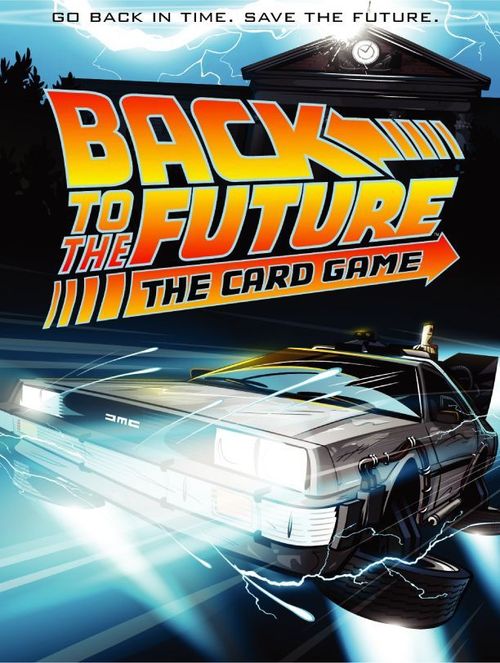
Back to the Future: The Card Game
Back to the Future: The Card Game Rulebook
Table of Contents
Table of Contents
Overview
The game is played with cards alone, but gives the feeling of a board game, because the important events are set out on a special table of 24 cards called the Timeline.
Setup
- Divide the cards into 3 stacks: Timeline cards, ID cards, and play cards.
- Lay out the Timeline cards in the center of the table as a table of 4 rows of 6 cards. Use the time index value (in the upper right corner) to determine the row and column. All Timeline cards are placed with the blue or purple side face up.
- Note that there are 5 nearly identical B-1 cards. They are shuffled purple side up and placed as a pile on the B-1 location of the Timeline.
- Shuffle the play deck and deal 3 cards to each player. Place the deck where everyone can reach it.
- Shuffle the ID cards and deal 1 to each player. A player must not let others see his cards, especially the ID.
Who Goes First?
The player who most recently watched "Back to the Future" goes first. In case of a tie, the player who has watched the film the most times goes first.
How to Play
Players take turns, doing the following:
- Draw 1: take the top card of the main deck into your hand.
- Play 1: play any card from your hand.
Draw Twice
If you must play a card and do not want to, you may instead draw a second card into your hand. You can use this option any time you are required to play a card, even on an extra turn gained by using a fantastic time machine.
About Time Travel
The past is full of important events that a traveler can change, plus other Dependent events affected by the changes. The Timeline contains 9 Primary events, each marked with a unique icon. Note that these icons come in two colors: black and red. Black marks a Primary event, red marks a Dependent event.
Three types of cards help you change history ("flipping" one of the Primary cards): "Time Machine", "Double Back" (Запутать след), and another type of action called "Hitch a Ride".
- A "Time Machine" lets you change the outcome of any Primary event.
- "Hitch a Ride" lets you change the Timeline if the previous player changed it.
- "Double Back" cards are more limited but can be more powerful: used alone, they let you change one specific Primary card, but they can be combined with specific Items to change history twice in a turn.
When you play a card that changes history, you flip a Primary card and then tidy up the events that are affected. Each Primary event affects at least one Dependent event. Look at the list of events given on the Primary event card.
In three cases a Dependent event is changed by a pair of Primary events rather than by one. Sometimes it can be changed when both events are changed, and sometimes the events are more fragile and change if even one of the influencing Primary events is changed. Pay attention to the words AND and OR that appear in events A-5, C-3 and D-6.
Note: You may change only Primary events (Dependent events can only be changed indirectly).
Card Types
The deck contains 5 types of cards:
Item (a useful thing)
When playing an Item, place it face up in front of you. These are important objects that you need in the right place at the right time. Some Items are useful on their own, while others are useful only in combination with "Double Back" or "Time Machine" cards. Many Items contain a description (in small print) of various special abilities. Usually, using an Item's special ability does not count as a turn.
Time Machine (how to change history)
When you play it, you may flip a Primary card on the Timeline. But note the small print: some cards have additional bonuses, while others have restrictions. A Time Machine is not kept like Items, but is discarded immediately after use.
Actions (one-shot event cards)
When you play an Action, do what is written on the card and discard it.
Power Actions (high-power actions)
Power Actions are much like ordinary Actions, except that many of them can be played out of turn (this is stated on the cards), and in addition you cannot use these Power Actions while the Power Actions "Rewind" and "Quick Trip Into The Future" are being used.
Double Back (change history twice)
There are 8 "Double Back" cards in total, and each is tied to a specific Primary event and a specific Item. Played alone, a "Double Back" card lets you only flip a Primary event. But if the corresponding Item is laid out in front of you on the table, you may discard it to change one more Primary event this turn.
How to Win
Your goal is to change history until the vital headlines on your ID card match the Timeline. As soon as you achieve this, cancel the invention of time travel by changing event B-1 on the Timeline (Doc Brown independently invents the Flux Capacitor, which makes time travel possible).
At the end of your turn you may only CLAIM victory.
End of the Game
To win, you must fix YOUR history, then cancel the invention of time travel. This last step is hard, because invisible forces will try to stop you, even if the other players cannot. This is done with a set of 5 cards that are shuffled and placed on the B-1 location of the Timeline.
Each time someone tries to change this Primary event (and is not stopped by other players' Memos), the top card on B-1 is flipped. If you see "Mysterious forces have prevented you...", the card is set aside and the game continues. If the text says "Emmett Brown hung the clock", the game ends!
Before attempting to change B-1, make sure others are not using a Memo to stop you (see the section "About Memos" below).
Timeline Examples
To understand how time travel works, consider a part of the Timeline.
Example A. This shows the initial position. In the original history, Clara Clayton dies on the day she arrives in town, falling into the ravine during an accident. The next day a criminal kills the town blacksmith. The town holds a double funeral.
Example B. The same part of the Timeline after someone has changed event A-2, that is, prevented Clara Clayton from falling into the ravine. After flipping card A-2, the player must flip card A-6, because the ravine will now be renamed not in her honor but in honor of someone else who fell. Note that changing A-2 is the only way to change A-6.
Example C. The same part of the Timeline at another moment of the game. As you can see, the original course of history is restored in A-2 and A-6, history is changed in A-3, which also affected A-4. Note that A-5 remains unchanged through all these changes in history, because it is the funeral of the new schoolteacher, or the blacksmith, or both of them. In Hill Valley there are still funerals.
Example D. The Timeline at another moment of the game. Now events A-2 and A-3 are changed, and, since the teacher and the blacksmith are alive, there are no funerals in town. Instead there is a wedding party of a new loving couple. (Nevertheless, the criminal is convicted of a lesser offense.)
Your ID Card
Your ID card lists the events that define YOUR reality. One of them will be an original event, while the other two will be changed ones. To win, you must change the Timeline so that all the required events are in place, and then successfully flip event B-1.
Events that are not shown on your ID card do not affect your victory conditions.
Changing Your ID
If you drew a character you have just played, or have played often, or are not interested in, try drawing a new one. But don't whine the second time!
About Memos
Players may play cards only on their own turn, except for various time-changing cards such as "Memo From Your Future Self" and three Item cards that do the same thing. (We write "Memo" for all types of cancelling actions.)
This card may be played at any time to cancel a card played by another player. Note that a "Memo" cancels and discards the played card, but does not change the turn order.
- Be punctual: Remember that a "Memo" is used to cancel a played card. Obviously it takes a little time to think about another player's move and decide whether to play a "Memo" against it, but do not wait too long. It will be too late if another card has been played or drawn.
- Memos are not retroactive. Since some cards allow you to play more than one card in a row, note that Memo cards cancel only the last card played.
- If you play a "Memo" at the moment another player lays out a "Double Back", the whole card is cancelled, and the other player cannot even lay out the second card he planned to use. But if you wait until the player has carried out the first action of the "Double Back" and lays out the second action, then only the second change of the Timeline is cancelled, and the first remains. (But the Item must be discarded.)
- End of the game: As soon as the red reverse side of event B-1 (the game-ending event) is revealed, the game stops and it is too late to use a "Memo". (A "Memo" cannot interrupt a victory.) Therefore, when you are about to cancel the invention of time travel, state your intentions clearly and let the others think about whether they want to stop you with a "Memo" before you flip card B-1.
Frequently Asked Questions
Q: What happens if the victory conditions of two players are met when the invention of time travel is cancelled? A: The player who cancelled the invention wins.
Q: What happens if a player cancelled the invention of time travel, but his victory conditions are not met? A: If there is one player whose conditions are met, that player wins. Otherwise, shuffle the B-1 pile (not including the cards set aside earlier) and continue play with the next player. (Mysterious forces prevented everything that happened this turn.)
Q: How do I flip a Dependent event? A: Only indirectly. Dependent events change as a result of changing Primary events.
Q: Can a Memo (Fax, Telegram, Newspaper) be used to cancel another Memo? A: Yes.
Q: Can the Fax, Telegram, or Newspaper be used to cancel the stealing of a claimed card? A: No.
Q: What if the play deck runs out? A: Shuffle the discard pile and continue the game. But do not shuffle early! The discard pile is kept until someone needs a card and the play deck is already empty.
Q: Does it count as a change of the Timeline (for the "Hitch a Ride" card) if a "Mysterious Forces" card was drawn from B-1? A: Yes.
Q: Can I play "Rewind" to replay a time travel, as an extra turn, when making a time travel? A: Yes.
Q: What if I do not want to play any of my cards? A: There is an option for that: "draw twice". It is sometimes forgotten, but is very useful when you do not know what to play.
Components
The game contains the following cards:
- 28 Timeline cards
- 10 character cards (ID)
- 62 play cards
- 17 Items
- 6 Time Machines
- 8 Double Backs
- 17 Actions
- 14 Power Actions
Timeline (28 cards)
- A-1: Hill Valley Still Needs a New Blacksmith
- A-2: Clara Clayton Falls into Ravine
- A-3: Buford Shoots the Blacksmith
- A-4: Buford Tannen Arrested for Murder
- A-5: Hill Valley Holds Funeral(s)
- A-6: Chasm Renamed Clayton Ravine
- B-1: Emmett Brown Invents the Flux Capacitor
- B-1b: Emmett Brown Invents the Flux Capacitor, with "Mysterious Forces" on back (4 copies)
- B-2: Biff Tannen Behaves Like a Jerk As Usual
- B-3: George Doesn't Confront Biff
- B-4: George McFly Kisses Lorraine
- B-5: Biff Tannen Turns 21
- B-6: Lorraine and George McFly Become Parents
- C-1: George McFly gets a job, Biff Tannen is his boss
- C-2: George McFly Honored
- C-3: Lorraine and George McFly's 15th Wedding Anniversary
- C-4: Biff's Auto Detailing Opens
- C-5: Emmett Brown Commended
- C-6: Emmett Brown Murdered by Libyan Terrorists
- D-1: Marty Injured in Car Crash
- D-2: Marty & Jennifer Get Married
- D-3: Marty McFly Jr Says "Yes"
- D-4: Youth Jailed
- D-5: Marty McFly Gets Fired
- D-6: Marlene McFly Goes to Prison
IDs (10 cards)
Marty McFly III; Tiffany Tannen; Buffy Tannen; Verne Brown; Marlin Berry; Darlene Needles; Electra McFly; Clara Wilson; Jules McFly; Clay Strickland.
Double Backs (8 cards)
- A-2 / Hoverboard
- A-3 / Metal Pie Pan
- B-2 / Sports Almanac
- B-3 / George's First Novel
- B-4 / McFly Family Photo
- C-6 / Bullet Proof Vest
- D-1 / Fax From The Future
- D-3 / Futuristic Clothing
Time Machines (6 cards)
- Time Car v1 (Requires: Plutonium)
- Time Car v2 (Requires: Lightning)
- Time Car v3 (Fully-Equipped)
- Time Car v1 (Old & Cranky)
- Time Car v1 (Requires: Locomotion)
- Time Train (Fully-Equipped)
Actions (17 cards)
Don't Be So Gullible, McFly! (4 copies); Hitch a Ride (3 copies); Discontinuity (2 copies); You Are Fading Away...; Not Yourself Today; Save the Clock Tower!; Shopping Spree at Blast From the Past; Trade Hands; Erased From Existence; It's a Sleep-Inducing Alpha Rhythm Generator!; Time Vortex.
Power Actions (14 cards)
Rewind (5 copies); Quick Trip Into The Future (3 copies); Memo From Your Future Self; Look Out For That Truck Full of Manure!; It's Your Lucky Day; You Steal My Stuff?; Engine Trouble; It's a Science Experiment!
Items (17 cards)
Hoverboard; Metal Pie Pan; Gray's Sports Almanac; The Dust Jacket from Gray's Sports Almanac; George's First Novel; McFly Family Photo; Bullet Proof Vest; Fax From The Future; Futuristic Clothing; Telegram from a Future Friend; Emergency Cash; Overpowered Locomotive; Mr. Fusion; Tomorrow's Newspaper; Lightning Prediction; Pellet of Plutonium; Case of Plutonium.