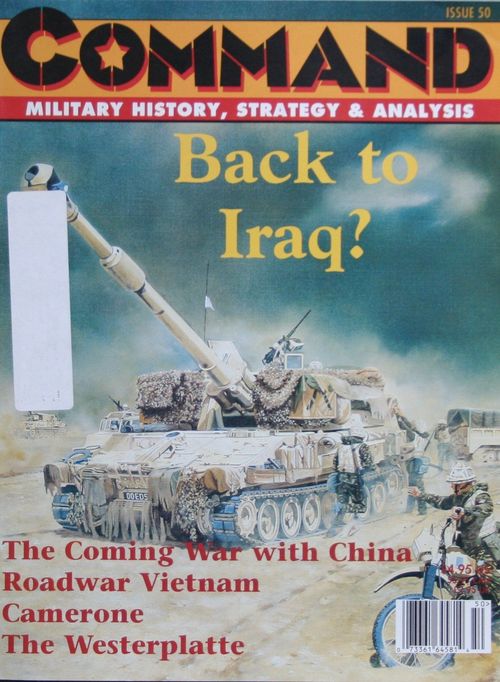
Back to Iraq
Back to Iraq Rulebook
Table of Contents
Table of Contents
- 1.0 Introduction
- 2.0 Game Components
- 3.0 Set Up & Scenarios
- 4.0 How to Win
- 5.0 The Turn Sequence
- 6.0 Stacking
- 7.0 Coalition Zones of Control
- 8.0 Supply
- 9.0 Reconstitution & Recovery
- 10.0 Movement
- 11.0 Combat
- 12.0 US 101st Airmobile Division
- 13.0 Optional Rules
- 14.0 Charts & Tables
- Advanced Game
- Unit Counter Errata
- Transcriber's Notes
1.0 Introduction
1.1 Back To Iraq, 3rd Edition (B2I3e) is a "what-if" simulation of the fighting that might occur across the northern littoral of the Persian Gulf if the US-led anti-terrorism Coalition decides on a ground war to finally settle with the Baghdad regime.
B2I3e is a two-player wargame of low-to-intermediate complexity that posits this might-be war lasting about a month. We believe that is about the maximum time before the Coalition ground force's diminishing supplies, coupled with a loss of the domestic political will necessary to continue the fighting, would bring about a settlement if victory were not achieved in the field. Rules for the Advanced Game follow the main body of these rules.
1.2 Game Scales
Each hex equals 17 miles (27.54 km.) from side to opposite side. Each game turn represents two days. The units of maneuver are mostly brigades and divisions, each with about 1,000 to 15,000 men and up to 350 or so armored fighting vehicles. Coalition air supremacy is built into several aspects of the rules and is therefore not represented by separate aircraft unit-counters.
1.3 Some Definitions
If a rule is said to apply to "all Coalition units," that means it applies to all units in the game opposed to the Iraqis and the Iranians. That is, Coalition units are all those unit-counters not marked with "IQ" or "IR" nationality identifications.
If a rule applies to only one or some of the nationalities opposing the Iraqis/Iranians, the specific names of those nationalities will be used in that rule.
If a rule is said to apply to Coalition "Great Powers" units, that means it applies to Coalition units belonging to the US, UK and France.
If a rule is said to apply to Coalition "Minor Powers" units, that means it applies to all Coalition units other than those belonging to the US, UK and France.
If a rule is said to apply to all "Militant Islamic" units, it applies to all Iraqi and Iranian units. If a rule applies only to Iraqi units, or only to Iranian units, those specific nationality names will be used.
2.0 Game Components
2.1 In General
The components to a complete game of B2I3e include these rules, the map sheet and 176 die-cut counters (also called "units" and "unit-counters"). Players must provide themselves with a standard (six-sided) die to resolve combat and other probabilistic events that occur during play.
2.2 The Game Map
The game map represents the militarily significant terrain in the Iraq theater of operations and its environs when portrayed at this scale. A hexagonal ("hex") grid is printed over it to regulate unit placement and movement. A unit is always in only one hex at any one instant.
Each hex contains natural and/or manmade terrain features that may affect movement and combat. The map's terrain representations have been altered slightly from their real-world configurations in order to make them conform to the hex-grid. But the terrain relationships from hex to hex are accurate to the degree necessary to present players with the same space/time problems that would be faced by their real-world counterparts if this war were to actually take place.
Each hex on the map has a unique four-digit number printed in it. It is provided to help you find any specific locations referred to in the rules (for example, the city of Basrah is in hex 3429), and to allow you to record unit positions if a match has to be interrupted and taken down before it can be completed.
2.3 The Counters
There are 176 counters in the game, most of which represent combat units. Others are provided as informational markers and memory aids. After reading through these rules at least once, carefully punch out the counters. Trimming the "dog ears" from their corners with a fingernail clipper greatly facilitates handling and stacking during play and also enhances their appearance. Each combat unit-counter displays several pieces of information: nationality, type, combat strengths, reinforcement status, specific identification and mobility class.
2.4 Sample Combat Unit
This unit is the US 1st Armored Division. It has an attack factor of nine, a defense factor of eight, and a movement factor of nine. Because it has printing on both sides, it is said to be a "two-step" unit (see 2.10).
2.5 Sides & Abbreviations
Unit nationality, and therefore the side each is on, is indicated by their color schemes and abbreviations to the left of their unit-type-boxes. Other abbreviations, used to facilitate the specific identifications of some units, also appear to the right of the unit-type-boxes.
Coalition Color Schemes
- United States units: black on olive drab
- United Kingdom units: black on khaki
- French units: black on light blue
- Coalition "Euro Corps": gold on light blue
- Kuwaiti army: black on green
- Turkish units: black on gray
- Syrian: green on yellow
- Joint Forces Command: white on olive drab
- Israeli: blue on white
- Al-Qaeda: black on orange
Militant Islamic Color Schemes
- Iraqi Republican Guard: white on red
- Iraqi regular army: black on red
- Iranian Revolutionary Guards: white on black
- Iranian regular army: black on gray
Design Note. At the time we're going to press, it looks as if Syria would not play an active part in this ground war if it occurs. The Damascus regime is claiming to have gotten completely "on board" with the US anti-terrorism Coalition, but their heart surely isn't in it, to say the least. So we doubt their army would be either. We've therefore included counters for their 1st and 2nd Corps, which would represent the maximum limit of their participation in a ground war here, no matter on what side. Instructions are not given, however, for those units' inclusion in the two scenarios presented in this simulation. Just keep the Syrians off to the side and feed them into your games later on, as the unfolding of actual world events may dictate.
The situation is similar with the two Turkish units included in the counter-mix. At press time, it seems fairly certain Ankara would allow its territory to be used as a base of attack by other Coalition forces, but it seems doubtful the Turkish army would actively participate. Players should again make rules and set up adaptations as events unfold in reality.
2.6 Unit Identities & Abbreviations
Unit nationalities and the specific formations within each national force are further identified by numbers and abbreviations. Those abbreviations are as follows:
- AA: Al-Abyed
- AC: Armor Command
- AD: Adnan
- ADC: Air-Defense Command
- AN: Al-Nidah
- AQ: Al Queda
- BG: Baghdad
- C: Cavalry
- Co: Commando
- EC: Euro Corps
- F: France
- GSS: General Security Service
- HM: Hammurabi
- IQ: Iraq
- IR: Iran
- K: Kuwait
- KCG: Kuwait City Garrison
- L: Light
- MIR: Military Intelligence Service Rapid Intervention
- NB: Nebuchadnezzar
- MD: Medina
- MEF: Marine Expeditionary Force
- NT: NATO
- PG: Presidential Guard
- RI: Rapid Intervention
- RSV: Reserve
- SAIR: Supreme Assembly of the Islamic Revolution
- SBM: Security Battalion of Military Intelligence
- SdFe: Saddam's Fedayeen
2.7 Unit Sizes
Units' organizational sizes are indicated by the symbol atop their unit-type boxes. From largest to smallest they are: XXXX-Army, XXX-Corps, XX-Division, X-Brigade, II-Battalion. If the size symbol of a unit is bracketed, that formation is ad hoc or irregular, meaning it is not normally a part of its army's order of battle and was organized specifically for this campaign.
2.8 Unit Types & Mobility Classes
All ground combat units in the game belong to one of four basic mobility types. They are either mechanized ("mech"), non-mechanized ("non-mech"), airmobile or static. Mechanized ground units are those whose primary means of moving is provided by wheeled or tracked motorized vehicles. Non-mechanized units' primary means of locomotion is provided by legs. Airmobile units are heliborne, while static units, as the term implies, never move after being placed on the map. These mobility distinctions are important for movement and combat (see sections 10.0 and 11.0).
Mechanized
- Armor (or Tank)
- Combined Arms (or US "Medium Division")
- Mechanized Infantry
- Motorized Infantry
- Motorized Marines
- Motorized Paratroopers
- Motorized Special Forces
- Headquarters (Advanced Game only)
- Special Operations Forces or SOF (Advanced Game only)
Special Operations Forces have their factors highlighted, indicating that these units have special capabilities. Note that these are distinct from other types of Special Forces/commandos.
Non-Mechanized
- Mountain Infantry
- Special Forces
- Paratroops
Airmobile
- Air Assault
Air Units
- Conventional Airstrike (Advanced Game only)
- STEALTH Airstrike (Advanced Game only)
- Surveillance (Advanced Game only)
- Special Operations Aviation (Advanced Game Experimental Rule only)
Static
- Garrison
- Air Defense Artillery & Rockets
2.9 Attack & Defense Factors
These numbers, referred to collectively as "combat factors," are measures of each unit's relative ability to attack and defend (see section 11.0). If a unit has three numbers across its bottom edge, the first number is always its attack factor, followed by its defense factor, followed by its movement factor.
2.10 Movement Factor
This is a measure of each unit's ability to move across the hex field printed on the map. Units pay different movement costs to enter or cross the different types of terrain in and around the hexes into which they move (see section 10.0).
2.11 Step Strength
All ground units in the game contain one or two "steps" (also called "strength steps"). That is an arbitrary term used to show the ability of units to absorb certain amounts of casualties and equipment losses before becoming entirely ineffective. Those ground units with printing on only one side of their counters are "one-step" units. Those Coalition units with a stripe running across their reverse sides are said to be "two-step" units. On the Militant Islamic side all units are one-steppers. See section 11.0 for more details.
2.12 Other Counters
The uses of the following counters are explained at appropriate points throughout the rest of the rules.
- Game Turn Indicator (see section 5.0)
- Militant Islamic Prestige Point markers (MIPPs, see 4.2)
- Weather Indicator (see 13.1)
- Coalition Aerial Supply marker (see 8.13)
- Nuclear Detonation marker (see 13.8)
- Chemical Warfare marker (see 13.4)
- Coalition Reconstitution marker (see section 9.0)
- Coalition Heavy Strike Marker (see 13.16)
- Naval Gunfire marker
- Strategic Target markers (Advanced Game only)
Important note: The Strategic Target, Airstrike, Headquarters, Israeli and Al-Qaeda units are used only when playing the Advanced Game.
3.0 Set Up & Scenarios
3.1 Choose Sides & Set Up
Players first choose which side each will control, the Coalition side or the Militant Islamic side, which of the two scenarios they will play, and the optional rules (see section 12.0) and advanced game rules (see section 14.0) they will use. All units of both sides appropriate to the scenario being played are available at the start of play and begin at their full step-strength. Stacking rules (see section 6.0) must be observed by both players when setting up. There are no reinforcements for either side in either scenario.
3.2 Scenario One: On To Baghdad
This is the standard "Gulf War II" scenario, wherein we're assuming President George W. Bush decides not to be prudent. That is, he cites Saddam's possession of WMDs (weapons of mass destruction) and uninterrupted support of terrorist organizations as rationales for extending the war on terrorism into a second phase: the invasion, conquest and probable national dismemberment of Iraq.
Unlike the corresponding scenario in the earlier editions of this game, there is now no chance for Iranian intervention on either side. That is because it now seems probable, that during the build up for such a campaign great diplomatic pains would be taken to keep the Iranians sidelined, most likely by assuring them any other course of action on their part would result in massive retaliation from the Coalition. Or perhaps a "carrot approach" would be used, trying with economic aid, etc., to continue the recent trend of relative deradicalization within the Tehran regime.
3.3 Coalition Set Up in Scenario One
The Coalition player sets up first in this scenario. He takes all the units marked with an asterisk (*) in their upper-left corners and sets them up in Kuwait, Saudi Arabia or Turkey, generally where he desires but with some exceptions. The exceptions are that the KCG unit may begin only in that city (3634), and the Kuwaiti and Saudi armies may set up only within their respective countries.
3.4 Iraqi Set Up in Scenario One
The Iraqi (Militant Islamic) player takes all the units in the counter mix belonging to that nation and sets them up anywhere in Iraq, except he may not place any units in any of the rough or mountain hexes in northern Iraq (the "Kurdish territory" area is delineated on the map), and his ADC unit must be set up in 2517. Further, all white-on-red Iraqi units of other than division size must all be set up in Baghdad or hexes adjacent to that city.
Within those restrictions, Iraqi units may be set up in Coalition zones of control (see section 7.0). Note that there is never any restriction in either scenario on the ability of Iraqi regular army units stacking, moving or attacking with Iraqi Republican Guard or Special Republican Guard units. Any mix of those three forces is allowed.
3.5 Scenario One No-Go Areas & Movement Restrictions
In this scenario neither side's units may move, attack, retreat- or advance-after-combat into hexes of Iran or Syria. Iraqi units may attack into, but not move, advance- or retreat-after-combat into, Turkish hexes. Similarly, Iraqi units may move or attack into Kurdish territory only via road hexes. The Saudi army is allowed to move and attack only into hexes within its own country and Kuwait.
If a unit or stack is forced to retreat after combat (see 11.22) and the only hex open to it is one prohibited to its side in this scenario, that unit or stack is eliminated in place if Iraqi. If the force in that situation is Coalition, it remains in place but suffers one step loss (total) for doing so.
Note that the refurbished "Saddam Line" is completely without effect in this scenario. It comes into play only in Scenario Two.
3.6 Scenario Two: The United Islamic Federation
In this scenario the assumption is those running the Tehran regime witness the start of the Coalition turn against Iraq and realize they can only be next once their erstwhile enemy in Baghdad is overturned. They therefore perform a "diplomatic revolution," proposing a full-blown alliance with Saddam, forming a mutual defense pact called the "United Islamic Federation." Their allied armed forces then overrun Kuwait before significant Coalition ground forces can arrive there. Their strategy is to "fight forward" as much as possible from their own key areas, thereby hoping to run out the logistical and domestic political clocks on the Westerners before they (the Militant Islamic side) can be pulled down.
Thus the game begins with the UIF forces in occupation of all Kuwait except the capital city, into which the defending army has retreated. Further, lacking any better ideas, the UIF commanders order their units to do the best they can to refurbish the once-vaunted "Saddam Line."
Design Note. We held back the UIF forces from also rolling into Saudi Arabia for two reasons: 1) we doubt they have the logistical capability to project their armed forces much beyond the southern border of Kuwait; and 2) given that Saudi Arabia, unlike the much smaller territory of Kuwait, couldn't be taken in one rush, there would be time for the Coalition to issue a stern warning that any move into the larger country would be met with unremitting use of US and Coalition WMDs.
3.7 Coalition Set Up in Scenario Two
The Coalition player sets up first in this scenario. He takes all the Coalition units included in the counter mix and sets them up in Saudi Arabia and/or Turkey, generally where he desires but with some exceptions. The exceptions are that the KCG and Kuwaiti army unit begin in Kuwait city (3634), and the Saudi army may set up only within its own country. (Again, leave out the Turks and Syrians unless real-world events dictate otherwise. See the "Design Note" after rule 2.5.)
Design Note. As you can see by the Coalition order of battle, in this much larger war scenario we're assuming the US would concentrate virtually the entire active duty component of its Army in order to be able to fight and win decisively within a reasonable time. That means other potential global hot spots would be left on their own, or to reinforcement, if needed, by mobilized Reserve components or to strictly NATO auspices in places such as the Balkans.
3.8 UIF Set Up in Scenario Two
The UIF (Militant Islamic) player takes all Iraqi and Iranian units in the counter mix and sets them up within Iran, Iraq or Kuwait, generally as he pleases. In this scenario he may set up in the Kurdish territory from which he was restricted in Scenario One, and at least 11 units must be set up in Kuwait, with one each starting in hexes 3534 and 3635. Further, all white-on-red Iraqi units of other than division size must all be set up in Baghdad or hexes adjacent to that city.
The Kurdish territory area has no special significance here, since it is assumed that the internal security forces of the two dictatorships quickly moved to wipe out all resistance from those people as soon as their alliance was formed. Note, though, that the Iraqi ADC unit must still set up in hex 2517.
Note that Iranian and Iraqi units may never move, stack or participate in the same attack. Further note that within the overall structure of the Iranian ground forces, that nation's regular army and Revolutionary Guards units are also prohibited from moving, stacking or attacking together.
3.9 Scenario Two No-Go Areas & Movement Restrictions
In this scenario, neither side's units may move, attack, retreat, or advance-after-combat into any hexes of Syria. UIF units may attack into, but not move, advance- or retreat-after-combat into, Turkish hexes. The Saudi army is allowed to move and attack only into hexes within its own country and Kuwait.
If a unit or stack is forced to retreat after combat (see 11.22) and the only hex open to it is one prohibited to its side in this scenario, that unit or stack is eliminated in place if UIF. If the force in that situation is Coalition, it remains in place but suffers one step loss (total) for doing so.
Note that the refurbished "Saddam Line" is in effect in this scenario (see 11.15).
4.0 How to Win
4.1 In General
The winner of most matches of both scenarios of B2I3e will be determined by the number of Militant Islamic Prestige Points (MIPPs) scored by that player. Only the Iraqi/UIF player accrues MIPPs. The Coalition player tries to conduct his operations in such a way as to minimize his opponent's ability to earn MIPPs prior to the end of play. In both scenarios the Iraqi/UIF player starts with zero MIPPs, gaining them according to the methods described below. The Iraqi/UIF player never loses MIPPs. Each point is permanently his once has been tallied for any reason.
4.2 Generating MIPPs
The Iraqi/UIF player earns one, two or three MIPPs every time any of the following take place. Each MIPP-generating type of event may take place any number of times during a match; each time one does take place, the Iraqi/UIF player earns a new haul of MIPPs.
- Make a MIPPs check each time an Iraqi/UIF force launches an attack that achieves a combat result marked with an asterisk on that side's Combat Results Table (see section 11.0 & 14.3).
- Make a MIPPs check each time Coalition forces make an attack that achieves a combat result marked with an asterisk on that side's Combat Results Table (see section 11.0 & 14.2).
- Make a MIPPs check each time the Iraqi/UIF player regains control (see below, 4.8) of a city hex that had previously been captured by the Coalition.
- The Militant Islamic player is awarded one MIPP, but no further MIPPs check is made for that battle, whenever a combat result on his CRT is followed by a (+) plus sign.
4.3 Accruing MIPPs
Each time a MIPP-generating event occurs, the Iraqi/UIF player immediately rolls a die and halves that result, rounding up any remainder. That halved result is the number of MIPPs awarded to the Iraqi/UIF player for that one incident. Thus one, two or three MIPPs will be generated per incident. Keep track of the MIPP tally by using the track printed on the map sheet and the two markers provided in the counter mix.
4.4 Winning & Losing Scenario One With MIPPs
Scenario One ends at the conclusion of Game Turn 15, or when one player concedes defeat. At the end of Game Turn 15 the Coalition player is declared to have won the war if he fulfills all three of the following conditions: 1) he controls Kuwait City; 2) he controls any three or more of the five Iraqi city hexes on the map; and 3) he has also kept the Iraqi player from accruing more than 30 MIPPs. Any other situation is an Iraqi victory.
Design Note. The five Iraqi city hexes on the map are: 2105, 2509, 2516, 2517 and 3429. The three Iranian city hexes (see 4.5 below) on the map are: 3610, 3725 and 3729.
4.5 Winning & Losing Scenario Two With MIPPs
Scenario Two ends at the conclusion of Game Turn 15, or when one player concedes defeat. At the end of Game Turn 15 the Coalition Player is declared to have won the war if he fulfills all four of the following conditions: 1) he controls Kuwait City; 2) he controls three or more of the five Iraqi city hexes on the map; 3) he controls two or three of the three Iranian cities on the map; and 4) he has also kept the UIF player from accruing more than 30 MIPPs. Any other situation is a UIF victory.
Design Note. The MIPP victory determination rules are based on the fact the Militant Islamic player's chances of winning a conventional military victory in the field are slim. MIPPs therefore represent the propaganda triumphs and myths generated among the Islamic world's poor, militant, fundamentalist masses. The higher the end score in MIPPs, the more likely some future Saddam or Mullah will again plot similar wars.
A Militant Islamic victory means Coalition forces failed to perform well enough to both win this war and keep post-war legends of falsified fundamentalist glory from growing up around its name. To win, the Coalition player must not only defeat the Iraqi/UIF armies, he must do it so decisively and efficiently that not even the most fanatic true believer can later twist the story of the fighting's course into anything representing a fundamentalist victory.
The asterisked combat results on the combat results tables represent rewards for Militant Islamic tactical successes, or the registration of what would be perceived by the Western media as too high a casualty price to justify the result of some Coalition tactical achievement.
Viewed more conventionally, we can estimate the loss of the required urban areas, along with the casualties the Iraqi/UIF armed forces would be certain to suffer during their defense, would be enough to ensure the Baghdad and Tehran regimes are overthrown.
4.6 Iraqi/UIF Sudden Death Victory
In both scenarios play stops and the Iraqi/UIF player is declared the winner the instant he gains control of Kuwait City (hex 3634). In such situations the MIPP total is irrelevant.
Design Note. Supply states (see section 8.0) are irrelevant in terms of adjudicating victory in both scenarios.
4.8 City Hex Control
"Control" is the word used to describe which side owns a particular hex at each instant during play. Hex control is important for judging victory. At the start of Scenario One, the Iraqi side controls all the hexes in that country except for the non-road hexes of Kurdish territory, while the Coalition side controls all the hexes of the countries in which its forces are allowed to set up as well as the non-road hexes within Kurdish territory. At the start of Scenario Two, the UIF side controls all the hexes in Iran, Iraq and Kuwait except for Kuwait City (hex 3634), while the Coalition side controls all the hexes of the countries in which its forces are allowed to set up, other than in Kuwait, where it only controls Kuwait City.
The control status of a hex changes the instant a unit from the other side enters and/or moves through it. The mere projection of a Coalition zone of control into a hex is not enough to trigger control status change; actual unit entry must take place (see section 7.0). The control status of every hex may change back and forth any number of times during a game.
5.0 The Turn Sequence
5.1 In General
After choosing sides, scenarios and setting up as described in section 3.0, place the Game Turn marker provided in the counter mix in the "1" box of the Game Turn Record Track printed on the map sheet. At the end of every complete game turn, advance the marker one space along the track toward 15.
Every game turn of B2I3e is divided into two "player turns." Each player turn is further divided into a series of steps (or "phases"). Every action taken by a player must be carried out in the appropriate phase as described below. Once a player has finished a particular phase he may not go back to perform some forgotten action or redo a poorly executed one unless his opponent graciously permits it.
5.2 The Turn Sequence
The game turn sequence is given below in outline. The rest of the rules are organized, as much as possible, to explain things in the order they're encountered as you go through each turn's sequence.
I. Coalition Player Turn
- A. Weather & Reconstitution Determination Phase
- B. Coalition Movement or Combat Phase
- C. Coalition Combat or Movement Phase
II. Militant Islamic Player Turn
- A. Militant Islamic Movement Phase
- B. Militant Islamic Combat Phase
III. Coalition Recovery Phase
Design Note. For the rules concerning weather, see 13.1.
5.3 Coalition Player Turn Sequencing
Except for the weather checks, which always come first, the Coalition player may decide the sequence of the phases within his turn sequence. That is, immediately after making the weather check, the Coalition player should announce whether he will use a combat/movement or movement/combat sequence that turn.
The sequencing choice is always up to the Coalition player, decided on a turn by turn basis. Note, though, that during player turns in which he chooses a movement/combat sequence, his minor powers units are considered to have attack factors of just one. (Their defense remains unaffected.) Also, on turns he chooses the combat/movement sequence, all Coalition attacks gain a one column rightward odds shift.
The Militant Islamic player turn is always second in every game turn, and that side's phase sequence is always movement phase followed by combat phase.
Design Note. For details on Coalition reconstitution and recovery, see section 9.0.
6.0 Stacking
6.1 In General
"Stacking" is the term used to describe the piling of more than one unit into a hex at the same time. The general rule is the Coalition player may stack up to three units of any sizes, types (including HQs) and nationalities in any one hex at any one time, while the Militant Islamic player may stack up to three divisions in any one hex at any one time. For stacking purposes, every unit in the Militant Islamic order of battle smaller than a division (see 2.7) equals one-third of a division, while the corps-sized SRG unit equals one division for stacking purposes. Also see rules 3.4 and 3.8.
6.2 Stacking & Movement
The stacking rule is in effect at all times throughout the game turn. That means players must pay attention to the sequence in which they move their units or risk having early moves block units moved later in the phase. Note there is no limit on the number of units that may enter and pass through a given hex over the course of a movement phase, as long as the three-unit stacking limit is met instant by instant.
Units beginning a movement phase stacked together need not remain together simply because they were stacked; they might be moved off individually or in smaller groupings.
Players should keep a constant eye on each other's stacking situations, preventing over-stacking at all times. And both should also check each other's stacks at the end of every phase in the turn sequence. If any hexes are found to be over-stacked at those times, the owning player must eliminate the excess units of his choice needed to bring each hex back within stacking limits.
6.3 No Fog of War
Both players are free to examine the units beneath the top units of his opponent's stacks at any and all times.
Design Note. The Coalition has excellent satellite reconnaissance available, while the Chinese, Russians or some private corporation are probably selling the same kind of information to the Militant Islamic side.
6.4 Free Stackers
None of the counters illustrated in rule 2.12 have any stacking value. That is, each may be added to any stack according to the specific rules governing their uses. Further, the two zero-attack factor units given in the counter mix the US KCG and the Iraqi ADC have no stacking values and are therefore never counted toward the stacking limit within their hexes of placement (3634 and 2537, respectively). Note, too, that when playing the Advanced Game, headquarters units do count for stacking.
7.0 Coalition Zones of Control
7.1 In General
"Zones of Control" ("ZOC") are an abstraction used to show how the large-size Coalition units, by using computerized artillery and aerial support systems, can project their power, inhibiting Militant Islamic movement, into areas adjacent to them.
With but three exceptions (see 7.2 below), all Coalition ground units exert "Zones of Control" into the six hexes surrounding their location hexes at all times. There is no difference in effect between a hex containing ZOC exerted there by one unit and a hex containing ZOC exerted there by more than one unit. Militant Islamic units never exert ZOC.
7.2 ZOC Limits
With three exceptions, Coalition ZOCs extend both into and out of all kinds of terrain.
The first exception is ZOCs of mechanized units never extend into mountain hexes, even if the mechanized unit being considered is in a mountain-road hex. A mechanized unit in a mountain road hex, though, does project ZOCs normally into all surrounding non-mountain hexes. Non-Mechanized, dismounted mechanized and airmobile ZOCs are unaffected by mountain terrain.
The second exception is that only airmobile and MEF ZOCs extend across all-reservoir, all-lake or all-sea hex sides. For example, a Coalition static unit in Kuwait City projects ZOC into 3534 and 3635, but not into any of the other surrounding hexes.
The third exception is that only airmobile ZOC extend across escarpment hex sides.
7.3 ZOC Effects
All Militant Islamic units must stop their movement for that movement phase in the first hex they enter containing a ZOC. They may not move any farther that phase. Militant Islamic units that begin their side's movement phase already in a ZOC may not move at all that phase, though they can still attack (and may possibly advance after combat, see 11.23).
7.4 ZOC Loss
Out of Supply (OOS) Coalition units do not project ZOCs.
7.5 No ZOC Negation
The presence of a Militant Islamic unit in a hex containing a Coalition ZOC in no way negates that ZOC for any other Militant Islamic units. Thus, once in a ZOC a Militant Islamic unit may escape it only by destroying the ZOC-projecting Coalition units or by waiting until the ZOC-projecting Coalition units are OOS or going through a mandatory reconstitution turn.
Note that the movement-inhibiting effects of ZOCs work only against Militant Islamic units, never against Coalition units. That is, a Coalition unit beginning its side's movement phase with Militant Islamic units in its ZOC isn't pinned by their presence. Such Coalition units may move, provided only that one or move adjacent hexes is empty of Militant Islamic units.
7.6 ZOC & Militant Islamic Supply Lines
Militant Islamic units may trace their supply lines into, but never through, hexes containing ZOC. And, as given in 7.5 above, the presence of a Militant Islamic unit in a ZOC in no way negates that ZOC for other Militant Islamic units for any purposes.
8.0 Supply
8.1 In General
Units require supply to operate at their full (printed-on-the-counter) potentials for movement and combat. There are no counters representing the supplies actually consumed by units. Instead, that process is represented abstractly, through "supply line tracing."
8.2 Supply States
There are two supply states and every unit in the game always exists in one or the other of them. A unit is "in supply" if it can trace a supply line to an appropriate supply source hex. A unit is "out of supply" whenever it is unable to trace a complete supply line. Units may exist indefinitely in the OOS supply state. No unit is ever eliminated simply for being OOS.
8.3 When to Check Supply
The supply status of each of each side's units is checked at the instant the player begins its movement during his movement phase. Units found to be OOS at that instant have their movement factor halved for that player turn. Round up remainders. For example, "half" of a printed movement factor of "3" is "2."
Check the supply status of all units of both sides involved in each given battle at the start of each fight's resolution process. Any units of either side found to be OOS at that instant have their appropriate combat factors halved for that battle. When halving more than one combat factor, add together all those to be halved on the same side, then divide just once. No unit or attacking force ever has its combat factor reduced below one for any reasons.
Also check the supply status of ZOC-projecting Coalition units at the start of every Militant Islamic movement phase. Any Coalition units found to be OOS at that time lose their ZOC for that phase (see section 7.0).
8.4 How Units Are Supplied
Units are supplied when they are able to "trace a supply line" (a path of contiguous hexes) to an appropriate "supply source" hex.
8.5 Iraqi Supply Source Hexes
Iraqi supply sources are both Baghdad hexes (2516, 2517). Once a Baghdad hex has been occupied, even if just temporarily, by a Coalition ground unit, that hex loses its supply capacity for the rest of the game, even if retaken by the Militant Islamic side.
8.6 Iraqi Limited Supply Source Hexes
Provided no Coalition ground unit has yet entered those hexes, Iraqi units in Mosul (2105), Kirkuk (2509) and Basrah (3725) are supplied while in those hexes. Iraqi units outside those hexes may not trace supply to them as if they were Baghdad source hexes (though supply lines going to Baghdad may certainly be traced through Mosul, Kirkuk and Basrah). Once enemy occupied, Mosul, Kirkuk and Basrah lose their limited supply capacity for the rest of the game.
8.7 Iranian Supply Source Hexes & Limited Source Hexes
Iranian supply source hexes are all the map edge road exit/entry hexes that lie inside Iranian territory (for example: 4228, 4227, 4225, etc.). Those road hexes lose their supply capacity when occupied by Coalition ground units, but regain it as soon as Coalition occupation is ended (decided on a hex-by-hex basis any number of times per game).
Provided no Coalition ground unit has yet entered those hexes, Iranian units in Iranian city hexes are supplied while in those hexes. Iranian units outside those hexes may not trace supply to them as if they were map edge source hexes (though supply lines going to map edge Iranian supply source hexes may certainly be traced through Iranian city hexes). Once enemy occupied, Iranian city hexes lose their limited supply capacity for the rest of the game.
Design Note. If the evolving real-world situation would bring Syrian and/or Turkish units into play, their supply source hexes would be the map edge road entry/exit hexes within their respective countries.
8.8 Coalition Supply Source Hexes
Coalition supply source hexes are Kuwait City and the map edge road entry/exit hexes in Saudi Arabia and Turkey. All the map edge road hex supply sources lose their supply capacity when occupied by Militant Islamic units, but regain it as soon as that enemy occupation is ended. (In both scenarios, Coalition loss of Kuwait City results in instant Militant Islamic victory, see 4.6). There are no nationality distinctions when tracing supply to Coalition units from Coalition sources.
8.9 No Dual-Nationality Militant Islamic Supply Sourcing
In Scenario Two there is never any dual-nationality Militant Islamic supply sourcing. That is, Iranian and Iraqi units may trace only to sources specific to each one's own nationality. The supply lines of both Militant Islamic nations may co-exist in and through the same hexes at the same time.
8.10 Tracing Supply Lines
Supply lines consist of two portions: the non-road portion and the road/highway portion. Tracing is done from a unit or stack to a supply source. The non-road portion of a supply line may be up to four hexes long, from the unit or stack tracing the supply line to a road or highway hex. Don't count the hex in which the tracing unit or stack is located; do count the hex in which the road or highway being traced to is located. For example, a unit in 1722 is "four hexes away" from the 1718 road hex and is "five hexes away" from the 1220 road hex.
Once a supply line has reached a road or highway hex (belonging to the road or highway that is actually to be used for the rest of supply line tracing), it may not leave that road and/or highway path again. From that road or highway hex, trace a path of connected (contiguous) road and/or highway hexes — of any length — to an appropriate supply source for that unit or stack. Note that the path of a road/highway supply line portion may contain both road and highway hexes.
It's permitted for the road/highway portion of a supply line to be traced across river hex sides with roads or highways leading up to both river banks as if the bridge there is intact. (All bridges are considered unable to support normal unit movement without causing delays, see 10.15)
Units located in road or highway hexes need not bother tracing a non-road portion for their supply line; they may simply trace along the road or highway to an appropriate supply source hex. Similarly, units within four hexes of an appropriate supply source needn't make use of a road/highway supply line portion. They may simply trace the non-road portion of their supply line directly to that supply source. Finally, of course, units located directly in appropriate supply source hexes needn't do any supply line tracing at all. They are automatically in supply in those hexes.
8.11 Supply Line Limits
Neither portion of any supply line may be traced into or through hexes occupied by any enemy ground unit. Similarly, the non-road portion of a supply line may not be traced into or through hexes or hex sides containing natural terrain prohibited to the movement of the tracing unit. For example, a mechanized unit could not trace the non-road portion of its supply line into or through a non-road marsh hex (see 10.14).
Supply lines may not be traced into or through the territory of any nation not involved in the scenario being played (see section 3.0). Nor may supply normally be traced across all-sea, all-reservoir or all-lake hex sides, but see 8.14 for an exception. Both portions of all supply lines may be traced across river hex sides.
Militant Islamic supply lines may be traced into, but not through, hexes containing Coalition ZOC.
Within the limitations above, supply lines may be traced into and through hexes empty of enemy ground units, even though such hexes may have been occupied or passed through last by enemy units.
8.12 Supply Hex Capacity
Except as described above, there are no limits on the number of appropriate units that may trace supply to a given supply source hex during the course of a player turn, game turn and the entire game.
8.13 Coalition Aerial Supply
Once per good weather game turn, at any time during the game turn sequence, the Coalition player may declare one hex anywhere on the map to be receiving aerial supply. A Coalition unit in a hex so supplied is considered to be fully supplied for the rest of that game turn, but only while in the aerially supplied hex. The aerial supply marker may not be placed on bad weather game turns, but is otherwise indestructible. (And, yes, aerial supply may be used to escape the strictures of 8.11.)
The marker may be placed once at any time during a good weather game turn. Once placed it remains in effect in that hex for the rest of that game turn. At the end of the game turn, retrieve it and hold if for possible use again in later game turns.
8.14 USMC Coastal Supply
The US MEF unit is always in supply while in coastal hexes. Further, the MEF may trace the non-road portion of its supply line across all-sea, all-lake and all-reservoir hex sides.
8.15 Willful OOS
Both players may deliberately move their units into hexes where they will, or likely will, become OOS.
9.0 Reconstitution & Recovery
9.1 In General
The 15 game turn limit approximates the maximum amount of time before the Coalition forces engaged here would have to pause to conduct general rest and regrouping efforts that would mark the end of the war or at least its initial campaign. But current US Army doctrine also calls for tactical pauses at the end of individual battles, which are referred to in game terms as "reconstitution phases." Since the US Army would be providing the single largest component of the entire Coalition force, it is likely its approach to these matters would also come to govern the pace of the entire Coalition campaign. Accordingly, all Coalition units must pause for occasional reconstitution turns throughout the game, either at that player's discretion or when required by die roll.
9.2 Procedure
At the start of play put the "Reconstitution" counter on the Game Turn Record Track in the box for Game Turn 4. As the last step of Game Turn 4's Weather & Reconstitution Determination Phase (see 5.2), the Coalition player rolls a die. If the result is a five or six, Game Turn 4 becomes a mandatory reconstitution game turn. In that case immediately move the reconstitution marker forward four boxes on the Turn Record Track to Game Turn 8. The Coalition player need not make another reconstitution check until the start of Game Turn 8.
On a die roll of one through four, there is no mandatory reconstitution that turn. Move the marker ahead on the track just one box. In that case the Coalition player will have to check for mandatory reconstitution again at the start of the very next game turn (5). Every time a reconstitution turn is required by die roll, move the marker ahead four turns and make no more checks until the start of that game turn.
9.3 Mandatory Reconstitution Effects
When a reconstitution turn has been mandated for the Coalition side by die roll, which in reality would mean it has been "mandated" by the growing lack of supply and the fatigue of the soldiers in the field, the resultant turn of inactivity is called a "mandatory reconstitution game turn." On such game turns no movement or attacking is allowed for any Coalition units. Coalition units still defend normally (taking supply into account, etc.), and there is no direct effect on Militant Islamic operations. Also note that when playing the Advanced Game, no air or SOF missions may be run during mandatory reconstitution turns.
Design Note. Yes, in reality, Militant Islamic units also become disorganized and tired; but it is the Coalition that is setting the tempo of this war. The greater restrictions on Militant Islamic mobility built into their low movement factors, one step-organization and lesser combat power account for that side's always-slower pace of operations.
9.4 Discretionary Reconstitution
On any game turn during which the Coalition player is obligated by the rules above to make a reconstitution die roll check, he may instead announce, prior to rolling that die, that he will instead call a "discretionary reconstitution." In that case move the marker ahead four turns on the track. A discretionary reconstitution is the same as a mandatory one except Coalition units still can, within normal terrain-prohibition and turn sequence rules, move one hex (still not attacking, but they do defend normally). Again, Militant Islamic operations are not directly affected. Also note that when playing the Advanced Game, no air or SOF missions may be run during discretionary reconstitution turns.
Design Note. The advantages of calling a discretionary reconstitution turn are twofold: 1) the Coalition player can use the limited movement it allows to ensure, in most situations, the Militant Islamic player won't be able to take advantage of the reconstitution to launch powerful attacks; and 2) in picking an opportune time to reconstitute, three turns of uninterrupted operations are guaranteed during a period of his own choosing.
9.5 Recovery
At the end of every game turn in which the Coalition forces went through a reconstitution phase, mandatory or discretionary, the Coalition player may turn all of his reduced units back to their full-strength sides, provided they remained stationary and were in overland supply (not OOS or aerially supplied) throughout that game turn. A Coalition unit that was already reduced at the start of a reconstitution turn and that was attacked during it is still eligible for flipping, provided only that it held its ground (remained in the same hex) throughout the game turn. Coalition units that begin a reconstitution turn at full-strength, but are then reduced during combat any time that game turn, are not eligible for rebuilding that turn.
10.0 Movement
10.1 In General
Every ground unit in the game has a "Movement Factor" printed in its bottom-right corner. That movement factor is the number of "Movement Points" (also referred to as "MPs" and "MFs") available to the unit to use in moving across the map during its side's movement phase every game turn.
10.2 Movement Strictures
MPs may not be accumulated from turn to turn or phase to phase, nor may they be loaned or given from one unit to another. A player may move all, some or none of his units in each of his movement phases throughout the game, within the limits given in this section and the rules above, at his own discretion. Units that move are not required to expend all their MPs before stopping. The movement of each individual unit or stack must be completed before that of another is begun. A player may only change the position of an already moved unit or stack if his opponent agrees to allow it.
Units move from hex to adjacent hex, no "skipping" of hexes is allowed, and they pay varying costs to do so depending on the terrain in the hex being entered and along its hex sides. The movement of one side's units takes place only during its own player turn. No enemy movement takes place during its player turn.
10.3 No Minimum Movement Ability
No unit may enter a given hex unless it has available sufficient MP to pay for all the involved movement costs.
10.4 Stack Movement
To move together as a stack, units must begin their movement phase already stacked together. But units are not required to move as a stack simply because they started their movement in the same hex. In such situations those units might be moved together, individually or in smaller sub-stacks. Note that in Scenario Two, Iranian and Iraqi units may not move, stack or attack together, but there are never any such nationality restrictions on the Coalition side (but see 11.24).
10.5 Splitting Stacks
When moving a stack a player may halt it temporarily to allow a unit or sub-stack to split off and move away on a separate course. The units left behind in the original (or "parent") stack may then resume their own movement, even splitting off more sub-stacks and lone units if desired. But once a player begins moving an entirely different parent stack, he may no longer resume the movement of earlier stacks without his opponent's permission.
10.6 Stack MF
If units with different movement factors are traveling together in a stack, the stack must use the movement factor of the slowest unit. Of course, as the slower units exhaust their MPs, the owning player may leave them behind to continue moving with the faster units.
10.7 Enemy Units
Units may not enter hexes occupied by enemy units.
10.8 Terrain
There are two general classes of terrain on the map: natural and manmade. Each class is divided into several different types (see below). There is never more than one type of natural terrain in any one hex, but more than one type of manmade terrain may exist in one hex along with the natural terrain.
10.9 Natural Terrain
There are nine types of natural terrain and water bodies on the map: clear, rough, mountains, dunes, escarpment, marsh, salt pans, rivers and lakes/seas/reservoirs. The effects these terrain types have on the movement of ground units are described below and are also summarized on the Terrain Effects Chart (see 14.1) for quick reference.
10.10 Clear
Clear terrain is the "base" terrain of the game; it contains no elevations over 500 feet or slopes over 10 percent. That is, hexes with only clear terrain in them represent areas devoid of any natural features that would significantly enhance defense or slow movement at this scale of simulation. Each clear hex costs all units one MP to enter. All cities are considered to exit in clear terrain hexes.
For a hex to be considered clear terrain, that must be the only kind of natural terrain shown within it. For example, hex 2316 is clear terrain. Hexes containing natural terrain types other than clear, or in addition to some clear terrain, are identified by the predominant terrain pictured within them. For example, hex 3029 is marsh, hex 2637 is rough, hex 3215 is mountain, and 3236 is salt pan.
10.11 Dunes
Mechanized units may not enter dune hexes. Non-mechanized units pay two MP per dune hex entered, while airmobile units pay one MP.
10.12 Rough
Rough hexes represent topographically more rugged areas with elevations varying from 500 to 2,000 feet above the surrounding base terrain and containing slopes of between 11 and 30 percent. All non-mechanized and airmobile units pay one MP to enter each rough hex, but mechanized units pay three MP.
10.13 Mountains
Mountain hexes are topographically the most rugged areas on the map, projecting more than 2,000 feet above surrounding base areas and containing slopes of more than 30 percent. Mountain hexes are prohibited to all mechanized units except when traveling along roads (see 10.19) or dismounted (see 10.21). Mountain infantry and airmobile units pay only one MP per mountain hex entered, while all other types of non-mechanized units pay two MPs.
If a hex has both mountain and rough terrain within it, that hex is considered to be mountain.
10.14 Marsh & Salt Pans
Marsh is a catch-all term for several kinds of wet ground, varying from coastal salt marshes and tidal flats to river flood plains. Mechanized units may enter marsh hexes only on roads or when dismounted (see 10.21). Non-mechanized units pay two MP for each marsh hex entered; airmobile units pay just one MP.
Salt pan hexes are treated as clear terrain in good weather and as marsh during bad weather. If a mechanized unit is in a salt pan hex when the weather goes bad, it is immobilized there until good weather returns. It defends normally, as if on a marsh hex with a road, but may not attack in any way.
10.15 River Hex Sides
Rivers run between hexes, along the hex sides, rather than lying in-hex.
Whenever a mechanized unit crosses a river hex side, even if on a road or highway, the moving player should first roll a die. In a situation with a crossing stack, roll just one die for the entire stack. Add that die roll result (from +1 to +6) to the entry cost for the hex being moved into. Do take the existence of a highway or road in the hex being crossed into when adding that die roll result.
Whenever a non-mechanized unit or stack crosses a river hex side, no die roll is made; simply add an addition MP (+1) to the entry cost of the hex being moved into, even if on a road or highway.
In cases of mixed mechanized and non-mechanized cross-river movement, make a die roll for the mechanized units and one +1 addition for the non-mechanized units. Airmobile unit movement is not affected by rivers in any way.
10.16 All-Lake, Reservoir & Sea Hex Sides
No mechanized or non-mechanized ground unit movement is allowed across these types of hex sides. Airmobile unit movement is unaffected by such hex sides, but an airmobile unit may not end its move in any kind of all-water hex.
10.17 Escarpment
No mechanized or non-mechanized ground unit movement is allowed across this types of hex side. Airmobile unit movement is unaffected by such hex sides.
10.18 Manmade Terrain
Manmade Terrain exists in six types: roads, multi-lane highway, cities, towns, fortifications and international borders.
10.19 Road & Highway Movement
Roads and highways can be used to enhance movement and negate normal terrain effects on movement. Roads allow mechanized units to move along their paths, from road hex to contiguous road hex via the exact course of the road, at a cost of only one-half (0.5) MP per hex, no matter what other terrain types are in the hexes. When moving along road paths in that same way, non-mechanized units pay one MP per road hex, no matter what other terrain types are in the hexes. Highway travel is the same as road travel, except mechanized units pay only 0.25 (one-quarter) movement point per hex.
Units may combine road, highway and cross-country movement during the same movement phase, in any combinations within the limits of the traveling unit's overall movement factor.
Airmobile unit movement is not in anyway enhanced (or hindered) by roads or highways.
10.20 Cities, Towns, Fortifications & Borders
Units entering city hexes when not using road or highway movement do so at the cost of one MP per city hex.
Units entering hexes containing a town, fortification or international border have their movement costs determined by the other terrain features in or around that hex. These features by themselves have no effect on unit movement.
10.21 Dismounting Coalition Mechanized Units
The Coalition player may use the following procedures to temporarily dismount one, some or all of his US, UK and French mechanized units (most likely in order to campaign in mountains).
At the start of each of his movement phases throughout the game, the Coalition player may declare he is converting any of his US, UK, or French mechanized units into non-mechanized infantry.
The unit(s) selected must be in overland supply and not adjacent to any Militant Islamic units at that instant. Note the chosen units are "dismounted" on a piece of scrap paper. Such units may not move or attack in any way that turn.
A dismounted unit is considered non-mechanized infantry with a movement factor of four. It may operate in the dismounted mode as long as the Coalition player desires, but its combat factors are halved while doing so.
Remounting (converting back to mechanized status) takes place as in step two above. Similarly, such units may not move or attack during the player turn of remounting.
10.22 Coalition Airpower & Militant Islamic Movement
During bad weather turns all movement factors of all Militant Islamic mechanized units are increased by two MP, while those of non-mechanized units are increased by one MP (continue to take into account supply status, etc.).
11.0 Combat
11.1 In General
During a player's side's combat phase he may attack all enemy units adjacent to your units across playable hex sides. The player whose player turn it is is considered "the attacker," and the other is "the defender," no matter what the overall situation across the map. Attacking is always voluntary.
11.2 Multi-Hex & Multi-Unit Attacks
An enemy occupied hex may be attacked in one battle by as many of eligible units as the player can bring to bear from the surrounding hexes; however, no single attack may have as its objective more than one hex.
Not all the units stacked in a given hex need to participate in the same attack. Some could attack into one adjacent defender-occupied hex while others attacked into another hex or simply did not attack at all. No defending unit, however, may ever refuse combat.
11.3 Indivisibility of Units
No single attacking unit may have its combat factor divided and applied to more than one battle. Likewise, no defending unit or stack may have part of its defense strength attacked by one or a few attackers while another part is attacked by others. Defending units stacked together are treated as if they constituted one combined unit. No attacking unit may attack more than once per combat phase and no defending unit may be attacked more than once per combat phase.
11.4 Attack Sequencing
Aside from the restrictions described above, there is no artificial limit on the number of attacks each player may set up during his combat phase. The attacker need not declare all his attacks beforehand and he may resolve them in any order he wishes, as long as the resolution of one is completed before that of the next is begun.
11.5 Combat Procedure
Normally the attacking player should strive to have more attack factors involved in a given battle than the defender has defense factors. Such attacks are called "high odds attacks." To resolve them, the attacking player must first calculate his "odds." Do that by adding up the combat factors of all the attacking units involved in a battle. Then determine the combat factors of the enemy units defending in the battle. Divide the attacker total by the defender total and round off (down) any remainder.
Example: 26 attack factors versus 7 defense factors yields an odds ratio of 3:1. That is: 26/7=3.71, which rounds down to 3. To turn that "3" into a ratio, you must set a "1" next to it on the right. Thus "3" becomes "3:1" (which is read "3-to-1"), which corresponds with a column heading on each the Combat Results Tables.
11.6 Poor Odds Attacks
Battles in which the attacking force has fewer combat factors than the defender are called "poor odds attacks." Procedures are modified in that now you divide the defender's total by the attacker's. Round remainders up, and set the "1" on the left side.
Poor Odds Example: A force with 5 attack factors is attacking a force with 11 defense factors. Divide 11 by 5 (11/5=2.2), and round up (2.2 becomes 3), then set the "1" on the left of that "3," yielding odds of 1:3.
11.7 Odds Limits
Note that the column headings on the CRT range from 1:2 to 5:1 on the Coalition CRT and from 1:1 to 6:1 on the Militant Islamic CRT. If the combat ratio obtained for a given battle is lower than that shown on the CRT in use for an attack, that battle receives automatic results of "AS" or "AS*." No die roll is made. If the combat ratio obtained for a given battle is greater than that shown on the CRT in use for an attack, that battle receives automatic results of "DE" if it is a Coalition attack, and "DL1*" if it is a Militant Islamic attack. No die roll is made.
The Coalition Player always uses the Coalition CRT for his side's attacks, and the Militant Islamic Player always uses the Militant Islamic CRT for his side's attacks.
11.8 Shifting Preliminary Odds
The odds ratio obtained after completing the steps described above is called the "preliminary odds ratio." That ratio may be shifted to the left or right on the CRTs by the things described below. When shifting, it is important to remember all odds shifters that apply in a given battle are cumulative in their effect.
11.9 Extreme Odds
It is possible to end up with an odds ratio that lies beyond either the highest or lowest CRT column heading, such as "1:3" or "7:1." Once all applicable odds shifters have been applied, if you do end up with odds off one end or another of the CRT in use for that battle, use the no-procedure described above in 11.7 to get your combat result.
11.10 Combat Resolution Die Roll
To resolve a battle, find the odds column of the proper CRT corresponding to its odds ratio and roll a die. Look down the proper odds column on the CRT until you cross-index with the number you just rolled. That is your "combat result" for that battle. For example, if you're the Coalition player and you're attacking at 2:1 and roll a "3," your result is "AS."
11.11 Coalition CRT Combat Results
The "DR" ("Defender Retreat") result on the Coalition CRT means the entire defending Militant Islamic force (unit or stack) must retreat-after-combat one hex (see 11.22). If this result is asterisked (*), the Militant Islamic player makes a MIPPs check (see 4.2).
The "AS*" ("Attack Stalled") result on the Coalition CRT means no step or unit losses are suffered by either side and no advance- or retreat-after-combat takes place. Note that this result is always accompanied by an asterisk on the Coalition CRT, which means every time it comes up the Militant Islamic player makes a MIPPs check (see 4.2).
The "DE" ("Defender Eliminated") result on the Coalition CRT means all units of the Militant Islamic side involved in that battle are permanently removed from play and put into the "dead pile." The participating Coalition units are allowed to make an advance-after-combat (see 11.23).
11.12 Militant Islamic Combat Results
The "DR*" ("Defender Retreat") result on the Militant Islamic CRT means the entire defending Coalition force (unit or stack) must retreat-after-combat one hex (see 11.22). Note this result is always accompanied by an asterisk (*) on this CRT, meaning every time it occurs the Militant Islamic player makes a MIPPs check (see 4.2).
The "AS" ("Attack Stalled") result on the Militant Islamic CRT means no step or unit losses are suffered by either side and no advance- or retreat-after-combat takes place.
The "DL1*" ("Defender Lose 1 Step") result on the Militant Islamic CRT means one strength-step (total) is removed from any one of the Coalition units involved in that battle. The choice of which Coalition unit will suffer the step loss is up to the Militant Islamic player. The participating Militant Islamic units are allowed to make an advance-after-combat (see 11.23) if the single step removal completely clears the defender hex of Coalition units. Note this result is always accompanied by an asterisk (*) on this CRT, meaning every time it occurs the Militant Islamic player makes a MIPPs check (see 4.2).
11.13 Terrain Effects on Combat
Both natural and manmade terrain types have effects on combat, which are usually shown by shifting the odds column used on the CRT in favor of the defender (to the left). For example, the combat effect for defending in rough terrain is "L1." That means if the defending force in a battle is in a rough hex, after the preliminary odds ratio is calculated, that ratio would be shifted one column leftward on the CRT. So if, say, the preliminary odds ratio was "3:1" here, the rough terrain in the defender's hex would change that to "2:1."
Only one type of in-hex natural terrain effect and one type of manmade terrain effect may ever be applied to any single battle, but the combat factor halving due to attackers coming across river hex sides are part of the calculation before figuring the shifts received for in-hex terrain (see 11.20 below).
11.14 Roads & Highways
Roads and highways don't work to negate any of the combat effects of manmade or natural terrain; they affect only movement, not combat. Note, though, that mechanized units may attack into or out of mountain or marsh hexes only if they do so along the course of a road running from their location hex into the hex being attacked (see 11.16 & 11.18 below).
11.15 Cities, Towns & Fortifications
Units defending in a city hex gain a three-column leftward odds shift. For example, what would otherwise be a 4:1 attack into clear terrain would be changed to 1:1 if the defending force were in a city hex.
Units defending in a town hex gain a one-column leftward odds shift. For example, what would otherwise be a 4:1 attack into clear terrain would be changed to 3:1 if the defending force were in a town hex.
In Scenario Two, Militant Islamic units defending in a refurbished Saddam Line hex gain a one column leftward shift for doing so. In Scenario One the Saddam Line is considered not to exist.
11.16 Mountains
Units defending in a mountain hex gain a two-column leftward odds shift. For example, what would otherwise be a 4:1 attack would be changed to 2:1 if the defending force were in a mountain hex. Mechanized units may attack into or out of mountain hexes only when located on a road hex that runs from their location hex into the hex being attacked, and even then their combat factor is halved (round up remainders) for all such attacks. Also note that mountain infantry units have no special combat properties in mountains, just a movement advantage (see 10.13).
11.17 Rough
Units defending in a rough hex gain a one-column leftward odds shift. For example, a 4:1 attack into would be changed to a 3:1 attack if the defending force were in a rough hex.
11.18 Marsh & Salt Pan
Mechanized units may attack into or out of marsh hexes only when located on a road hex that runs from their location hex into the hex being attacked, and even then their combat factor is halved (round up remainders) for all such attacks. Non-mechanized and airmobile units attacking into a marsh hex do so without penalty. Further, if all the units involved in an attack into a marsh hex are non-mechanized and/or airmobile, that attack gains a one column rightward odds shift (in favor of those attackers). Remember, salt pans are treated as clear terrain in good weather and as marsh in bad weather (see 13.1).
11.19 Clear
Clear hexes have no combat effects in themselves.
11.20 River Hex Sides
Units other than the US MEF and 101st Airmobile Division that are attacking across river hex sides have their attack factor halved (round down all remainders). The MEF's and 101st's attack strengths are never affected by river hex sides.
11.21 Dunes
Mechanized units may not attack into dune hexes unless dismounted. Non-mechanized and airmobile units may attack into and out of such hexes without penalty.
11.22 Retreat After Combat
Whenever a "DR" or "DR*" result is obtained, the player owning the involved defending force in that battle must retreat that unit or stack one hex. In general, the exact direction of retreat is up to the owning player, but note the following exceptions.
No Militant Islamic unit or stack may ever retreat into a Coalition ZOC. The presence of other Militant Islamic units in a hex containing a Coalition ZOC in no way negates that ZOC.
If more than one hex is available to receive the retreating units or stack, the owning player must choose the one that takes the retreating force closer to a valid supply source. If more than one such hex exists, the choice is up to the owning player. (Also see rules 3.5 and 3.9.)
A retreating stack may not be broken up to retreat into more than one hex unless stacking terrain requirements dictate that be done.
Retreating-after-combat does not use up MPs. However, units are still not allowed to retreat into hexes where their entry would be prohibited using normal movement. For example, mechanized units may not retreat into mountain or marsh hexes except along the path of a road.
Whenever a one-step unit or force of either side is blocked from fulfilling a CRT-mandated retreat-after-combat, for any reason, that unit is instead eliminated in place. Whenever a two-step Coalition unit (or two- or multi-step stack of either side) is blocked from fulfilling a CRT-mandated retreat-after-combat, for any reason, that unit (or each two-step unit in that stack) is/are instead kept in place and reduced to one-step strength. The lose-a-step-and-stay-in-place is not a player option; if a CRT-mandated retreat-after-combat can be made, it must be made.
11.23 Advance After Combat
With one exception, whenever the defender's hex is cleared of all units by that fight's combat result, the victorious attacking units may advance-after-combat into that hex (stacking limits must be observed). Such advances are not considered part of normal movement and they don't cost any MPs, but advancing units must still observe normal terrain movement prohibitions. Victorious attackers may advance across river hex sides.
Advancing is an option. It is never mandatory, but the decision to advance or stay must be made immediately after the battle is resolved and before that of the any other is begun. An advancing attacker may send just one or a few units, if he wishes, rather than a full stack. Also note there is never any defender advance-after-combat; victorious defenders simply hold their ground.
The lone exception cited at the start of this rule is that the US 101st Airmobile Division never advances after combat.
11.24 Great Power Attack Participation Requirement
No Coalition attack may take place unless at least one Great Powers unit (US, UK or F) is involved in it.
11.25 Enveloping Attack
When a defender hex is attacked by units from hexes directly opposite each other, or by units in three hexes with one hex between each and the next, or by units from more than three hexes, shift those odds one column rightward if the attacking force is Militant Islamic, and two columns rightward if it's Coalition. The presence of other defender-side units in the hexes next to the defender hex being enveloped in no way serves to negate this shift. In the diagram, the defending unit is undergoing an enveloping attack.
12.0 US 101st Airmobile Division
12.1 In General
The 101st Airmobile (Air Assault) Division is unique in that:
- it is the only unit in the game that is not allowed to both move and fight during the same player turn;
- it never advances after combat;
- it can attack enemy units up to five hexes away from its location hex;
- when it attacks with one or more Coalition units, that attack is thereby automatically considered enveloping;
- it suffers unique effects during bad weather; and
- it can give defensive support to other Coalition units being attacked up to five hexes away from its location hex.
12.2 Move or Fight
The 101st is the only non-static unit in the game that cannot both move and fight (or fight and move) during a single player turn. It can do one or the other, but never both during the same player turn. It is the Coalition player's choice, decided on a turn-by-turn basis.
12.3 No Terrain Costs
When the 101st is moved, the unit (called the "base element") is understood to be "rebasing" by flying, in its organic air transport, to its new location hex. During such moves the 101st may enter all hexes at the cost of only one MP per hex, and it also ignores rivers and all-water hex sides. While rebasing it may fly over all terrain, water bodies and enemy unit but it may never end its moves in marsh or mountain hexes, even if those hexes contain roads or highways. Nor may it end a move in any hex containing any enemy units.
12.4 No Advance After Combat
The 101st never advances after combat, even if the enemy force it attacked was in a hex immediately adjacent to its location hex.
12.5 Combat
The 101st defends normally. When attacking it may project its combat factor against enemy units in hexes up to five hexes away from its base element's hex. Count from the base element to the enemy occupied hex. Don't count the base element's hex. Do count the enemy occupied hex. This attack range may be traced through all terrain types and enemy occupied hexes but may not go over any neutral nation's no-go territory (see 3.5 and 3.9).
When the 101st attacks, all terrain effects are still taken into account, except that the heliborne unit's attack factor is never affected by river hex sides. The 101st suffers combat losses in the same way as normal attacking units, in both ranged and adjacent attacks.
Whenever the 101st attacks an enemy occupied hex with one or more other Coalition units, that attack is automatically considered to be an enveloping attack.
The 101st may attack across the escarpment into marsh and mountains even though its base element may not occupy such hexes.
12.6 Defensive Support
Provided the 101st neither moved nor attacked during that game turn's Coalition player turn and no Militant Islamic units are in any hexes adjacent to its base element at that instant, the Coalition player may commit the 101st to provide defensive support to any other defending Coalition unit within its five hex range. To do so, the Coalition player simply announces the defensive commitment of the 101st after the Militant Islamic player has declared an attack, and then adds in its combat factor when calculating the defense strength of the hex being attacked.
12.7 Bad Weather & the 101st
During bad weather turns the attack and defensive support strength of the 101st is halved (round up remainders). Its range is also affected. Roll one die and subtract one from the result; to get its range for that bad weather game turn (0-5). The base element's defense strength of its own hex is unaffected by weather.
12.8 101st ZOC
The 101st base element projects ZOC normally into the hexes immediately around it, including mountain and marsh hexes, the escarpment, and all-water hex sides.
12.9 101st Supply
The 101st is required to trace a supply line like other ground units (which the 101st is considered to be). However, the non-road portion of its line may extend to 10 hexes.
13.0 Optional Rules
Design Note. Players should decide which of the rules from this section before they begin play. They add more realism at the cost of some simplicity.
13.1 Seasons & Weather
At this scale of simulation, weather comes in two types: good and bad. At the start of every game, before setting up, determine the season of the year during which the campaign will be fought by rolling a die. A result of one through five means the campaign will be fought in the dry season; a result of six means it will be fought in the wet winter months.
13.2 Determining Weather
The first game turn of all matches of both scenarios is automatically good weather. At the start of every game turn after the first, roll one or two dice to determine the weather as described below.
If the war is being fought in the dry months, roll two dice (or one die twice). A result of 2 or 12 means the weather is bad for that game turn. If the campaign is being in the winter, roll just one die. In that case a result of six means the weather is bad for that game turn.
13.3 Bad Weather Effects
Good weather has no effect; all the rules above were written describing good weather procedures. On bad weather game turns, the following apply: 1) treat salt pan hexes as if they were marsh, rather than as clear terrain, for all movement and combat purposes; 2) the Coalition player's aerial supply marker is not available; 3) all Militant Islamic mechanized MPs have two added to them, while all that side's non-mechanized MP have one added to them; and 4) there is a possible range-diminishing effect on the 101st (see 12.8).
Note that when playing the Advanced Game, bad weather doesn't ground SOF units.
13.4 Chemical Warfare (CW)
Each game turn, during either side's combat phase, the Militant Islamic player may declare that he is using chemical warfare to enhance one, some, or all of his attacks or defenses. The declaration is made on a case by case basis by that player. To register his use of CW in a battle, he takes the CW marker and places it atop any hex of Coalition units involved in the chosen battle. The effect on that unit or stack is reduce their combat factor by half (round up all remainders) for that one battle.
13.5 Coalition Response to CW
Every time the Militant Islamic player uses chemical warfare, the Coalition player rolls a die to determine if Washington decides to respond in a "limited" fashion (that is, in kind), or to use some form of massive retaliation. On a roll of one through three a limited response has been ordered, while a four through six brings a massive response.
13.6 Limited Response
When a limited response has been authorized, the Coalition player, during the rest of that Militant Islamic player turn or his own following player turn, make one use of chemical warfare exactly like that of the Militant Islamic use. Note, though, that he may not make use of it in the same battle that just triggered the authorization, nor may he use it against units in a town or city hex.
13.7 Massive Response
Here the assumption is the US Administration decides to respond with some weapon system, such as small tactical nukes, neutron bombs or some heretofore unsuspected new "wonder weapon" of great destructive power, far more potent in its effects than chemicals, with the idea being to "teach a lesson." If a massive response is authorized, the Coalition player may, as soon as the Militant Islamic player's triggering battle has been resolved, simply search the board, choose any one stack of enemy units and remove them to the dead pile. Again, though, he can't choose any town or city hexes.
13.8 Militant Islamic Nuclear Weapons
In Scenario Two, the Militant Islamic player may make use of a small stockpile of nuclear weapons. One Militant Islamic nuclear strike may be attempted each game turn. To make such an attempt, the Militant Islamic player announces it at the very start of a game turn, places the nuclear explosion marker atop any hex of Coalition units anywhere on the map, and rolls one die. Consult the table below. Note that a one is added to all die rolls made after the first game turn.
Nuclear Detonation Table
| Die Roll | Result |
|---|---|
| 1, 2, 3 | Hit on Target |
| 4 | Hit off Target |
| 5, 6, 7 | Strike Failed |
13.9 Hit on Target
If he obtained a "Hit on Target," the Militant Islamic player immediately rolls another die. That result is the total number of step losses that must be suffered by the Coalition units in the struck hex. If there is more than one unit in the hex, the Militant Islamic player apportions the step losses as he chooses. The he also makes a MIPPs check (see section 4.0).
The nuclear strike marker remains in the hex throughout the rest of the game turn. Normal terrain entry costs are doubled for all non-airmobile units entering that hex during the game turn. Remove the marker at the end of the game turn.
13.10 Hit off Target
If he obtained a "Hit off Target," the Militant Islamic player rolls another die. The result indicates the hex which has actually been struck by the errant strike. A one means the strike hit one hex directly to the "north" of the originally intended hex. (For these purposes, consider, for example, hex 4136 to be directly "north" of hex 4137.) A two means the detonation occurred one to the northeast of the intended hex (hex 4237 in our example here); a three means one hex to the southeast, etc. Once the actual strike hex has been determined, go through the procedure given in 13.8 if there are any units of either side in the final strike hex. Make a MIPP generation check regardless of the location and outcome of the final strike.
13.11 Strike Failed
A "Strike Failed" result means just that: there is no effect. The device wasn't successfully delivered or simply didn't go off. No MIPPs check is made.
13.12 Effects on Towns & Cities
If a town or city hex is struck on either kind of hit result, the additional effects there are: 1) if a town hex, that place is henceforth treated as if it no longer exists, but the natural terrain there does persist in its normal movement and combat effects; 2) if a city hex, that hex is considered rough terrain for the rest of the game, and the hex permanently loses any supply capacity it might have had. Note that a strike on Kuwait City does not generate a sudden death victory for the Militant Islamic player.
13.13 Coalition Response to Nuclear Attack
Whenever either kind of hit result is achieved by a Militant Islamic nuclear device, the Coalition player should immediately roll one die to determine Washington's response. If the result is one through five, the result is a tactical response. If the result is a six, the result is massive response. In the first case, the Coalition player is allowed to reply exactly as described above in 13.7. If the result is a six, some portion of the US strategic nuclear arsenal has been unleashed. In that case, play stops and the Coalition player is declared the winner of the game.
If the hex nuked by the Militant Islamic player contained a town, add one to the Coalition player's response die roll. If it was a city hex, add two.
13.14 Coalition Naval Gun Support
Once per game turn the Coalition player may call in naval gun support for use by any of his units attacking into, or defending in, a coastal hex. When figuring his combat factor in such a situation, he should roll a die and add that result to his supported force's attack or defense value. The limit is no supported force may receive more naval gun support factors than are contributed by the supported ground units themselves.
Support factors have no step or combat strength of their own. They may be used only in with attacking or defending Coalition ground units.
13.15 US 4th Mechanized Infantry Division
The US 4th Mechanized Infantry Division is the test unit for every new weapon, communications device and tactical scheme that comes along. Accordingly, in every battle in which it participates a one column odds shift is generated in favor of the Coalition side. There is an up-pointing arrow printed between that unit-counter's attack and defense factors as a reminder of this.
13.16 The Coalition Heavy Strike Marker
Once during each game turn, the Coalition player may, regardless of the weather, commit his heavy strike marker to support any one of his attacks or defenses. The effect of the marker is to shift the combat odds one column in his favor.
13.17 The MEF
The US Marine Corps MEF unit has riverine and amphibious movement and combat capabilities. That is, it can move across one all-sea, all-reservoir or all-lake hex side, provided that hex side was the first one crossed in its move that phase and that it moves no farther that phase after the crossing. Likewise, it can attack across such hex sides, as well as river hex sides, as if they were clear hex sides. Note too that MEF is always in supply when in coastal hexes.
14.0 Charts & Tables
Located at the end of the Advanced Game Rules.
Advanced Game
The Back to Iraq (3rd ed.) Advanced Game rules and units provide more depth to the simulation, as well as showing both sides the dilemmas and advantages posed by command control considerations, limited strategic intelligence, and the employment of special operations forces and terrorists. Advanced Game rules are prefaced by "AG."
AG 1.0 Strategic Targets
The Militant Islamic player has a set of Strategic Targets markers, which represent critical installations and other key targets. These markers are placed face down on the map and may be discovered and attacked by Coalition forces. The effects of these markers are detailed in the Strategic Target Markers Chart.
AG 1.1 Deploying Strategic Targets
The Militant Islamic player picks a designated number of Strategic Target markers and places them during initial setup. Strategic Target markers are picked and placed within the following restrictions:
Scenario 1
(1) The Militant Islamic player sorts through the markers and selects any four. He examines them and then places them face down in Iraq outside the Kurdish Zone. Following this: (2) He picks AT RANDOM six additional markers and does not examine them. He places them in Iraq outside of the Kurdish zone, face down. After they are placed, he may examine them.
Scenario 2
(1) The Militant Islamic player sorts through the markers and selects any five. He examines them and then places them face down in Iraq and/or Iran. Following this: (2) He picks AT RANDOM ten additional markers and does not examine them. He places them in Iraq and/or Iran outside of the Kurdish zone, face down. After they are placed, he may examine them. (3) At least ten Strategic Target Markers must be placed in Iraq, including all C4I Nodes picked in step (1).
Both scenarios: All Strategic Target markers must be placed in cities and/or towns, not more than one per hex.
Design note. The selection of Strategic Target markers at random represents the usual confused intelligence situation, as well as the impact of pre-game Coalition bombing.
AG 1.2 Strategic Target markers are not units, can not move or attack (unless otherwise stated), do not count against stacking, do not block enemy Lines of Supply, nor have any effect on the game other than those detailed in the Strategic Target Markers chart.
AG 1.3 Revealing and attacking Strategic Target markers
The Militant Islamic Player may always examine Strategic Target markers on the map. The Coalition player may do so only if they have been revealed and flipped face up. Strategic Targets may be revealed (and possibly attacked) by various game actions. Once revealed, a Strategic Target marker remains on the map, face up (unless the Chart indicates that it is removed from play). A face up Strategic Target may never be flipped face down.
AG 1.4 Certain Coalition actions can reveal or eliminate these markers:
(1) The Coalition player enters the hex with a land unit. At this point, the marker is flipped face up (if not already) and removed from the map. (2) The Coalition player conducts a successful SOF mission targeting a face down marker in an adjacent hex. At this point the marker is flipped face up (and take any action for flipping it face up, as detailed on the chart). (3) The Coalition player makes an Airstrike against the hex containing the Strategic Target marker. Depending upon the outcome of the Airstrike Table, this may cause the Strategic Target marker to be eliminated; however this does not necessarily reveal what the marker contained (keep the marker flipped face down off-map until after the game is over and then reveal it). See the Airstrike Table for results. Also, Surveillance Airstrikes may cause face down markers to be revealed. In this event, the marker is not eliminated. (4) If for any reason the Iraqi player decides to reveal the marker (he can do this at any time), the marker is flipped face up. Take any action for flipping the marker face up, as detailed on the chart.
AG 1.5 SCUD Attacks
SSM markers allow the Militant Islamic Player the opportunity to make "SCUD" attacks. These are explained on the Chart.
AG 1.6 Victory Conditions
(1) At the end of the game, the Militant Islamic player receives the following MIPPS: For each WMD still on the map: 2 dice roll, totaled, for each. (2) At the end of the game, the Coalition player receives extra victory points, as follows: Eliminate all Terrorist Bases and WMD: counts as one city for Victory determination purposes (that's one city for three or more total, not per marker). There must be at least one marker in the game for this to count. (3) To keep the game balanced, when using this rule: Increase the number of MIPPs the Militant Islamic Player needs for Victory by +10.
AG Strategic Target Markers Chart
- Air Defense Command. For each face up Air Defense marker on the map, the Coalition player deducts one counter from the total number of Airstrikes he receives each turn.
- C4I (Command-Control-Communications-Computers-Intelligence) Node: If all C4I Nodes have been eliminated, then Iraqi units may not advance after combat, regardless of Headquarters. One C4I Node provides all Iraqi units with advance after combat capability (the C4I Node may be face up or face down). Iraqi Headquarters do not have to trace a Line of Communications to C4I nodes to provide their usual functions, the C4I Node simply has to be on the map, somewhere. (Comment: the Iraqis are really centrally controlled and Saddam, needless to say, does not encourage initiative on the part of his subordinates.)
- Deception: (1) If attacked by Conventional or Stealth Airstrike, the marker is automatically revealed regardless of the combat results, and the Militant Islamic player gets 1 MIPP (propaganda about "inept" Coalition bombing and attacks on civilians). The marker is then removed from the map. (2) If attacked by a Surveillance Airstrike, it remains face down unless revealed by a Target Reconned result, at which point it is flipped face up and removed from the map (no MIPPs are gained in this event). (3) If a Coalition ground unit enters its hex, the marker is flipped face up and removed from the map (no MIPPs are gained in this event). If a Coalition ground attack is made against its hex, there is no effect on the marker unless the units advance after combat into the hex, at which point the marker is revealed and remove (no MIPPs are gained in this event). (4) If revealed by a SOF Mission, the marker is flipped face up and removed from the map (again, no MIPPs are gained in this event).
- Hostages: (1) If an Airstrike eliminates a Hostage maker, then roll one die and increase the MIPPs by that result. (2) If a SOF unit receives a Mission Successful result against a Revealed Hostage marker, then remove the marker from the map and reduce the MIPP total by 1 die roll (never to below 0). (3) If a ground unit enters a hex with a Hostage marker, then remove the marker from the map but do not reduce the MIPP total.
- InfoWar Facility (Information Warfare): Add +1 to the die roll each time a MIPP check is made if the InfoWar Facility is face up. (Comment: this marker represents media/PSYOP facilities used to amplify the political effects of actions.)
- Infrastructure: Any city hex containing a face up Infrastructure constitutes a Supply Source for that country's units (Comment: Infrastructure represents power grids, arms factories, depots, etc., which support military operations).
AG SCUD Attack Table
Roll two dice and total the results
- 2-3: Missiles expended: SSM marker is revealed and removed.
- 4-5: Launchers spotted: SSM marker is flipped face up (if not already); it remains in play.
- 6-8: City hit: the Militant Islamic player receives one die roll worth of MIPPs.
- 9: International Reaction: the Militant Islamic player rolls one die and must deduct that number of MIPPs from his current total; however, the total may never go below 0.
- 10: No effect.
- 11: Israel Intervenes: the Militant Islamic player rolls two dice and receives their total in MIPPs; Coalition receives additional units (see Additional Forces, Rule 5.2). If this result is rolled again, treat as "City Hit".
- 12: No effect.
AG 2.0 Airstrikes
AG 2.1 The Coalition player receives Airstrike counters. These are in addition to the Heavy Strike Marker used in the Basic Game. Airstrikes represent the operational and strategic level air missions against enemy C2 capabilities and Strategic Targets. There are four types of Airstrikes: Conventional, STEALTH, Surveillance and Special Operations Wing.
- The US Special Operations Wing is used only when playing with the experimental Special Operations Wing rule, so don't worry about it now. The Israeli Airstrike counters are used only if the Israeli Intervention event is triggered; see SCUD Attacks.
AG 2.2 Aircraft Availability
At the start of each Coalition player turn, the Coalition player determines the number of Airstrikes he will have for use that game turn.
(1) Scenario 1: Roll one die, add "4" to the result, and receive the total. (2) Scenario 2: Roll one die, add "2" to the result, and receive the total.
Thus the Coalition will end up with five to ten aircraft support counters (Scenario 1) or three to eight (Scenario 2) with which to conduct missions throughout that game turn. The Coalition player may select any mix of Conventional, STEALTH and Surveillance counters up to the counter limit. Israeli air units may be selected only if using the Additional Forces rule, and are in addition to the Coalition total. The Militant Islamic player never receives Airstrikes.
- For example, in Scenario 1, the Coalition player rolls one die and it comes up a "3"; he adds another "4" to it, and chooses seven Airstrikes: Four Conventional, two Stealth and one Surveillance.
AG 2.3 Airstrike Availability
Each Airstrike aircraft counter can perform only one mission per game turn. Airstrikes may never be eliminated or participate in ground combat. Note that each turn the Coalition player rolls anew, receiving the number indicated above for use throughout the turn. Unused Airstrikes may not be accumulated from turn to turn. All Airstrike counters are removed from the map upon completion of their missions; they do not remain in play and thus will not affect other types of combat. Airstrikes are not affected by bad weather.
AG 2.4 Targeting
The Coalition player has an Airstrike Sub-Phase. This occurs during the Coalition Combat Phase, prior to any ground combat taking place. The Coalition player resolves all airstrikes in his Airstrike Sub-Phase, in any order. He first places all available Airstrike markers on the map on any appropriate target hexes. The Coalition player may target the following counters (only):
(1) enemy Headquarters units (2) enemy Strategic Targets (face up or face down)
AG 2.5 Resolving Airstrikes
To resolve an Airstrike, the Coalition player rolls one die per target hex and checks the Airstrike Table.
(1) Each Airstrike may consist of only one type of air unit. Conventional, STEALTH, Surveillance and Special Operations Wing counters may not be placed in the same target hex in the same turn. Only one airstrike combat may be made against a single hex per turn, combining all Airstrikes against the hex into one attack. (2) More than one airstrike counter may be employed against the same target hex. For each airstrike counter after the first, +1 is added to the die roll (e.g., if three airstrikes were used against a target hex, then there would be a +2 die roll modifier). (3) Conventional Attacks must be resolved on the Conventional Table. Stealth attacks must be resolved on the Stealth Table. Surveillance attacks must be resolved on the Surveillance Table. Special Operations Wing attacks must be resolved on the Special Operations Wing Table.
AG Conventional Airstrike Table
- 1 (or lower): Collateral Damage: If the hex contains a city, then the Militant Islamic Player receives two (2) MIPPS. If it contains a town, the Militant Islamic player receives one (1) MIPP.
- 2: No effect
- 3: No effect
- 4: No effect
- 5: Suppression: Flip all Operational Headquarters units in the hex to their Suppressed sides.
- 6: Suppression AND Strategic: Same as Suppression, plus any Strategic Marker is the hex is eliminated.
- 7 (or higher): Suppression AND Strategic AND Collateral: Same as Suppression AND Strategic, but if the hex contains a city or town, add the effects of Collateral Damage (as above).
Die roll modifiers (cumulative):
- +1: per attacking air unit (after the first one).
- +2: the Coalition player can make any kind of Response against enemy use of Chemical or Nuclear weapons this turn and the target hex does not contain any city or town hex.
- -1: attack is against a hex containing any rough or city.
- -2: attack is against a hex containing mountain (supersedes any rough or city terrain in the hex).
AG STEALTH Airstrike Table
- 1: No effect
- 2: No effect
- 3: No effect
- 4: Strategic: Any Strategic Marker unit is the hex is eliminated.
- 5: Strategic: as above.
- 6: Strategic OR Suppression: The Coalition player has a choice: either inflict a Strategic result (as above) OR a Suppression result (flipping all Operational Headquarters in the hex to their Suppressed sides).
- 7 (or higher): Strategic OR Suppression: as above.
Die roll modifiers (cumulative):
- +1: per attacking air unit (after the first one).
- +1: the Coalition player can make any kind of Response against enemy use of Chemical or Nuclear weapons this turn and the target hex does not contain any city or town hex.
- -1: attack is against a hex containing any rough or city.
- -2: attack is against a hex containing mountain (supersedes any rough or city terrain in the hex).
AG Surveillance Airstrike Table
- 1: No effect
- 2: No effect
- 3: Target Reconned: Any Strategic Marker in the hex is flipped face up.
- 4: Target Reconned: as above.
- 5: Target Reconned: as above.
- 6: Target Reconned: as above.
- 7 (or higher): Target Reconned: as above.
Die roll modifiers (cumulative):
- +1: per attacking air unit (after the first one).
- -1: attack is against a hex containing any rough or city.
- -2: attack is against a hex containing mountain (supersedes any rough or city terrain in the hex)
Design Note. the Airstrikes represent operational and strategic level air warfare. Tactical close air support and battlefield interdiction are accounted for by overall cuts to Militant Islamic unit combat and movement factors. Each conventional Airstrike represents a wing's worth of sorties. The number of counters received is based on the proportion of operational-strategic sorties versus close air support/air superiority sorties conducted during the 1991 Gulf War air campaign. Conventional air units represent missions packages of fighters, bombers, electronic warfare, and other aircraft needed for each mission. Each STEALTH counter represents a squadron of Stealth aircraft or a salvo of cruise missiles. Since these excel in pinpoint attacks they have a higher chance of destroying Strategic Targets, but are less effective against area targets such as military units, hence the mix of Strategic versus Suppressed results. The Coalition gets more Airstrikes in Scenario 1 than in Scenario 2 as some of their airpower must be diverted to keeping the Iranian air force in check. Why are the die roll modifiers different for Conventional and Stealth attacks for Nuclear/Chemical Response? This reflects the Stealth's use of precision guided weapons, which carry a smaller payload.
AG 3.0 Special Operations Forces (SOF)
AG 3.1 Players have counters representing various types of unconventional forces, grouped together in the game as Special Operations Forces (abbreviated as "SOF"). SOF are used in the game to perform long range intelligence, raids, PSYOP, and (for the bad guys) terrorism. SOF units are treated as other ground combat units, except as noted.
- The SOF counters which this rule affects include all those with their combat and movement factors highlighted. All other special forces units are treated as normal combat units.
AG 3.2 Land Movement of SOF markers
SOF markers have a movement of four (4) hexes. They may move four hexes in any direction, regardless of the presence of terrain, hex sides, and/or enemy Zones of Control (ZOCs do not stop their movement). They may enter hexes containing enemy units by using Infiltration (see below). Coalition SOF may move across all sea hexes, but must end the move on land.
AG 3.3 Infiltration
SOF may enter hexes containing enemy ground units, but this costs them one (1) extra movement point for each occupied hex entered. Each time a SOF unit enters a hex containing an enemy ground unit, the owning player rolls one die. On a "6" the unit is eliminated. On any other result, the unit is not affected. The SOF unit may then continue moving. If for some reason, the SOF ends its movement in a hex containing an enemy unit, it is eliminated. Strategic Target markers by themselves cost no extra movement points to enter nor cause an elimination check die roll. Enemy units may not enter hexes containing SOF units.
AG 3.4 Stacking
A player may never have more than one SOF marker in a single hex. SOF markers do not count against stacking limits for non-SOF units.
AG 3.5 SOF Supply & Command
SOF markers are always in supply. If using the Command Control rule, they are always "In Command."
AG 3.6 SOF Missions
SOF Missions are conducted during the player' combat phase. A player may use his SOF units to conduct these missions against certain hexes called "SOF Target Hexes." A SOF Target Hex is a hex which the SOF unit is adjacent to and has a target described below. No more than one SOF unit may participate in any one Mission, and a single target within a single hex may be the subject of a maximum of one SOF Mission per player turn (i.e., no more than one SOF attack against a particular turn per hex, and if there is more than one target type in that hex, only one of them may be chosen). See the SOF Missions Table for results against each type of target. There are three types of Target Hexes, listed below:
(1) a hex containing an enemy Headquarters: this mission may cause an Operational Headquarters to become Suppressed. (2) a hex containing an enemy Strategic Marker: this mission may cause the Strategic Marker to be flipped face up or eliminated. (3) a hex containing a city in an enemy country that is not occupied by a unit that is on the attacking SOF's side: this mission may cause gain/loss of MIPPs. (for ex: A Coalition SOF could conduct this mission against an Iraqi city that was occupied by an Iraqi unit, but not against one that is occupied by a Coalition unit, the idea being that a captured city is no longer a viable target for special operations.)
AG SOF Missions Table
- 1: SOF unit is permanently eliminated *
- 2: SOF unit is permanently eliminated *
- 3: No Effect
- 4: No Effect
- 5: No Effect
- 6 (or higher): Mission Successful (see below)
Die roll modifiers (cumulative):
- +1: US or UK SOF unit conducting the mission
- +1: Target hex contains NO enemy ground unit or revealed Terrorist Base
- +1: Coalition SOF attacking a hex located in a Kurdish area, Kuwait, or Saudi Arabia
- +1: Iranian SOF attacking a hex in Iran
Mission Successful:
- Target is a Headquarters: Headquarters is suppressed and if the Militant Islamic player is making the attack, he makes a MIPP check.
- Target is a Strategic Marker: If the marker is face down, flip it face up (and take any action detailed on the Strategic Targets Chart for revealing it). If the marker is already face up, then it is eliminated.
- Target is an enemy city: The Militant Islamic player rolls one die and subtracts "3" from the total. If the outcome is positive, it is added to the MIPPs total; if it is negative, it is subtracted from the MIPPs total; if 0, there is no change to the MIPPs total (obviously; note the final range of results will be -2, -1, 0, +1, +2, +3). The MIPPs total may never be reduced to less than 0.
- *: If the Coalition is attacking, then the Militant Islamic Player makes a MIPP check.
AG 3.7 Attacking SOF units
A player may attack an SOF unit during the friendly combat phase. If the SOF unit is defending in the same hex as other ground combat units, then resolve the combat normally. If the SOF unit is defending in a hex with no other ground combat units, then:
(1) Non-SOF units have a combat strength of "1" when attacking an SOF unit, regardless of their printed combat strength or supply status. SOF units use their printed combat strengths when attacking enemy SOF. (2) Apply combat results normally, but a result which forces a SOF to retreat into an enemy unit or ZOC does not eliminate it. Instead, the unit is "Neutralized." Remove the SOF unit temporarily from the game. Roll one die. It is placed on the Turn Record Track that number of turns later and is received as a reinforcement at the start of the friendly Player Turn. Place it on any friendly Headquarters; "Al-Nida" units may also be placed on any Terrorist Base (revealed or not). If no hex is available for placement, the unit is eliminated instead of being replaced. (3) Apply defensive terrain effects normally, except that a SOF unit which is defending in a hex adjacent to a city hex receives the city defense bonus. (Why? Technically, they'd be operating within the city limits, but given the game scale this isn't shown on the map.)
AG 3.8 Coalition SOF
Coalition SOF have no ZOC and no reduced step.
AG 3.9 SOF Airborne Movement
Two Coalition SOF markers per turn may use airborne movement. Simply pick the unit(s) up and place them on any other hex(es) on the map. A SOF unit may not conduct any other movement in the turn it uses airborne movement. It may conduct SOF Missions in the same turn. Airborne movement may not be used to move from or land in a hex containing an enemy combat unit. Militant Islamic SOF units may never use airborne movement.
AG 3.10 Militant Islamic SOF substitution
The Militant Islamic player may, prior to start of play, replace the following combat units with one SOF marker each. Simply remove the unit from play and place a corresponding SOF marker on any valid deployment hex.
(1) Iraqi 999 brigade (Scenarios 1 and 2) (2) Iranian 29th Special Forces Division (Scenario 2 only)
AG 3.11 Al-Nida units
The Militant Islamic player receives one "Al-Nida" unit per Terrorist Base Strategic Target marker he picks during initial deployment (that's once per game, not turn). Al-Nida units are placed anywhere in the countries indicated by deployment instructions, not just on Terrorist Bases. These units are treated as other SOF.
Designer comments: The SOF markers in the game represent overall operational capabilities rather than specific special operations units per se. For example, a US SOF unit might represent a task force including one or more Special Forces detachments, a Ranger battalion, plus attached special operations aviation support and a PSYOP team. The missions of SOF units in the game represents pretty much the kind of operational-strategic missions which would be conducted in the course of a conventional campaign in the Persian Gulf. The game's scope precludes long term SOF support for insurgents and so forth. SOF interdiction of enemy movement and lines of supply are reflected in their ability to suppress Headquarters, which indirectly affect these other game functions. SOF attacks on cities represent terrorism as well as PSYOP and stirring up the locals to revolt. Note that the Militant Islamic player has an advantage in this regard, given the nature of the modified die roll results which are more likely to increase MIPPs. As for attacking SOF, this is difficult since the units are operating either or in clandestine mode, or are in the case of Coalition units, can be aerially inserted and extracted before the enemy can concentrate sufficient strength against them.
Design Note. When the Coalition player attacks any militant Islamic SOF unit and obtains a DE result, that defender is permanently eliminated.
AG 4.0 Command Control (C2)
AG 4.1 In General
Both sides have Headquarters units which represent centers of gravity for operational level command control as well as combat support formations (such as artillery and engineers) and logistics activities. Headquarters provide Command-Control support to other units in the game (Command-Control is abbreviated as "C2"). The number on the Headquarters counters is their "C2 Radius," the number of hexes from the Headquarters to the unit(s) being provided command control support. Headquarters units have two sides. The front is their "Operational" side; the reverse is their "Suppressed side." By attacking enemy Headquarters units, the player can seriously undermine their ability to support combat units. C2 status affects the following game functions (each explained in their own sections following):
(1) Supply status (2) Ability to advance after combat
- The Suppressed side of a Headquarters is used only as a result of the Headquarters being attacked by Airstrikes or SOF Missions; otherwise, Headquarters are one step units and are eliminated if take a single loss in ground combat.
- Headquarters are mechanized class units. Coalition Headquarters have no ZOCs.
AG 4.2 HQ C2 Support
Headquarters units provide C2 Support to units which are "In Command." In order to be "In Command," a unit must be able to trace a line of hexes (called a Line of Communications) from its own hex (exclusive) to any friendly Headquarters unit's hex (inclusive). The number of hexes in this Line of Communications may be no longer than the Headquarters' Support Radius. The Line of Communications may not be traced into an enemy unit, an enemy Zone of Control, or prohibited terrain. Units which cannot trace a Line of Communications are said to be "Out of Command." A unit's Command status is checked at the instant any game functions calls for it and may change during the turn owing to movement and combat.
For example: a Headquarters with a C2 Radius of "2" could provide C2 support to friendly units up to two hexes distant. Note that within the restrictions given above, any HQ unit can provide support to any unit(s) of its side, regardless of service branch, specific nationality, etc.
AG 4.3 National Restrictions
Any Coalition unit may use any friendly Coalition Headquarters to provide C2. Iraqi units may use only Iraqi Headquarters, and Iranian units may use only Iranian Headquarters for C2. (Exception: see Israeli and Al-Qaeda intervention units.)
AG 4.4 C2 & Supply Status
- All this replaces of the Basic Game Supply Line rule.
In order to be In Supply, a unit must be able to trace a Line of Communications to a friendly Headquarters unit, as defined above. In addition, the Headquarters unit itself must be within a number of hexes equal to its support radius (and within the above restrictions on tracing) of a friendly road hex which in turn traces back to a friendly supply source. Note that for Coalition units to Recover (rule 9.5), they would have to trace a LOS to a headquarters unit in addition to other provisions of the rule.
AG 4.5 C2 & Advance After Combat
(1) Iraqi units may advance after combat only if they are In Command. Otherwise, they may not advance after combat. Additionally, if all Iraqi C4I Node Strategic Targets have been eliminated, then no Iraqi unit may ever advance after combat, regardless if they are In Command or not. (Note: elimination of all C4I Nodes does not affect Iraqi supply status.) (2) Iranian and Al-Qaeda units may advance after combat only if they are In Command. Otherwise, they may not advance after combat. The status of Iraqi C2 Nodes does not affect them. (3) US, British, French, Euro-Corps and Israeli units may always advance one hex after combat, regardless of C2 status. Other Coalition units must be In Command to advance after combat. (4) Additionally, US, British, French, Euro-Corps and Israeli mechanized class units may, if In Command, advance TWO hexes after combat. The first hex must be the hex vacated by the defender. The second hex can be in any direction, as long as it is a playable hex. (5) SOF units follow normal advance after combat provisions for their side. They may advance after combat only during normal combat, not after SOF Missions.
Design Note. The restrictions on advance after combat represent the real world inflexibility of third world armies, as well as the superior mobile warfare doctrine of Western forces. And yes, I know, there are no Israeli mechanized units in the counter mix, but the provision is there for completeness.
AG 4.6 Suppression of Headquarters Units
A Headquarters unit may be Suppressed (flipped to its Suppressed side) as a result of the following game actions:
(1) Airstrikes (see Airstrike rule). (2) Special Operations Forces attack (see SOF rule).
A Suppressed Headquarters may not be used to trace Lines of Communications. If a Suppressed Headquarters is Suppressed again, there is no further effect.
AG 4.7 Recovery From Suppression
All Headquarters, Coalition and Militant Islamic, automatically recover from Suppression during a Reconstitution phase, mandatory or discretionary (but only in those turns in which a Reconstitution Phase occurs). All Suppressed Headquarters returned to their Operational sides if they are in an overland supplied position and have remained stationary throughout that game turn. (Comment: OK, so why do Militant Islamic Headquarters recover at the same time as Coalition? Because the pressure is off for a couple of days, so they have a chance to get things together.)
AG 5.0 Additional Forces
AG 5.1 In General
Players may bring in Israeli and Al-Qaeda forces at a political cost.
AG 5.2 Israeli Intervention
If a SCUD attack results in Israeli Intervention, then the Coalition player receives Israeli forces. These include:
(1) On all turns following, when the Coalition player determines its total airpower for the turn, he rolls one additional die to receive Israeli Airstrikes: on a "1-3" one Israeli Airstrike is received for the turn; on a "4-6" two Israeli Airstrikes are received for the turn. A new die roll is made every turn for the remainder of the game. (2) Additionally, the Coalition player may at his option bring in the Israeli airborne division as a reinforcement at any time following intervention being triggered. The Israeli Airborne division is initially placed on any hex containing clear or clear/town hex in Iraq that does not contain a Militant Islamic unit (it may contain a Strategic Target only). Placement uses up the unit's movement for the entire turn, but it may attack normally if using the Move-Fight sequence.
AG 5.3 Israeli Airborne Uint
The Israeli airborne unit functions in all respects as a Coalition unit, with the following exceptions:
(1) It may only enter hexes in Iraq and (Scenario 2) Iran (it may attack across borders). If forced to retreat into other countries, it is removed from play permanently (not considered eliminated, just withdrawn for diplomatic reasons). (2) It may never stack with any Coalition unit other than US, United Kingdom, French or Euro-Corps. (3) If it is involved in a combat, then any MIPPS that the Militant Islamic player gains for that combat are increased by "1." This applies only to asterisked and plus sign results on the CRT. (4) It may use only US Headquarters as a C2/Supply source. It may use Coalition airborne supply. (5) If the Israeli airborne division enters the game, then no Coalition Saudi, Kuwaiti or Syrian unit may ever attack into hexes in Iraq and Iran for the remainder of the game. This is so even if the Israeli unit is eliminated. (Why? Because no one in the Muslim world is going to participate in an attack on another Islamic state alongside the Israelis.)
AG 5.4 Al-Qaeda Intervention
There are four possible Al-Qaeda units which possible may be deployed in the game (Al-Qaeda, or "The Base," is Osama Bin Laden's organization). These units include the 55th Brigade, the Islamic Volunteer Division ("IVD") and two "Al-Nida" SOF units (the latter being the terrorist organization set up in the 1990s in conjunction with Saddam Hussein; "Al-Nida" means "The Call"). These units are deployed as follows:
(1) "Al Nida" units: see the Strategic Targets rule. (2) During initial setup, the Iraqi player rolls one die. Results are as follows: "1-2" no effect; "3:" receive the 55 Brigade; "4-5:" receive the "IVD" division; "6" receive both the 55 Brigade and the "IVD."
*Alternatively, players can use current information torn from the headlines to determine which Al-Qaeda units will be in play.
During initial setup, the Militant Islamic player may place Al-Qaeda units on any hexes he could normally deploy his land units. These units function as a Militant Islamic unit, with the following exceptions:
(1) They may not stack with Iraqi or Iranian units. (2) If an AL-Queda unit is involved in a combat or SOF mission, then any MIPPS that the Militant Islamic player gains for that combat/SOF Mission are increased by "1" (that's 1 MIPP, not one die roll). (3) Each time an Al-Qaeda unit is destroyed, then the Militant Islamic player deducts 2 MIPPs from his current total (to a minimum of 0). (4) Al-Qaeda units may use any Islamic C2 and Supply sources.
AG 5.5 Additional US Airmobile Capacity
The US maintains a considerable fleet of helicopters at division and higher levels. When using this rule, the Coalition player may have any one US light infantry, mountain, marine or airborne unit conduct one "Airmobile Move" per turn. This is done by picking the unit up and placing it on any other land hex on the map within 10 hexes of its starting hex. The 101st Airborne Division may not attack in the same turn that an Airmobile Move is being conducted.
An Airmobile move is conducted as follows: the unit must start in a position from which it could draw overland supply, or which is being airborne supplied. It is then moved up to 10 hexes over any type of terrain or enemy units. It may not land in hexes containing all-sea or enemy units. If may start and end in hexes adjacent to enemy units. It may not attack in the same turn it conducted an airmobile move. A qualified unit may use either Airmobile or normal movement in the same turn, not both.
SOF units may not use Airmobile movement (they use their own Airborne Movement rule instead).
AG 5.6 US Special Operations Wing (Experimental Rule)
The Special Operations Wing unit represents aircraft capable of employing strategic PSYOP and assorted hi-tech information warfare stratagems. The unit is in the game to allow players to experiment with various breakthroughs in information warfare, cyberwar, and such. Players should feel free to add to or change the Special Operations Airstrike Table results in accordance with whatever is going on in the headlines.
(Tactical level PSYOP is built into the combat results table, and special operations aviation insertion/extraction and fire support missions are built into the SOF unit capabilities.)
The Special Operations Airstrike is treated exactly as other Airstrikes, except that:
(1) Its targets are ground units, cities and Strategic Target markers. (2) The combat is resolved on the Special Operations Airstrike Table.
AG Special Operations Airstrike Table
- 1: No effect
- 2: Political Reaction: The Militant Islamic Player makes a MIPPS check.
- 3: No effect
- 4: No effect
- 5: No effect
- 6: Operation Effective: See target list, below, and apply one of the options.
- 7+: Operation Effective: as above.
Die roll modifiers (cumulative):
- +1: 10 or more Militant Islamic units (not Strategic Targets) are in the deadpile.
- +1: Coalition currently occupies at least two Militant Islamic cities with ground units.
Target is a hex containing ground units: Mass Surrenders. Roll one die for each Militant Islamic unit in and adjacent to the target hex AND which are adjacent to at least one Coalition land unit. On a 1-4 there is no effect. On a 5-6 the unit is immediately eliminated (exceptions follow); Special Operations Forces, Republican Guards and Revolutionary Guards are eliminated only on a 6; Al-Qaeda units are never eliminated.
Target is a Revealed Strategic Marker: Neutralization. The marker may not conduct any of its functions until "un-Neutralized". Rotate the marker sideways to indicate this. The marker becomes un-Neutralized at the end of the next Reconstitution Phase.
Target is a Baghdad hex that is not currently occupied by Coalition units: Major Political Cascading Effects: The Coalition player rolls two dice and subtracts "9" from the total. If the outcome is positive, it is added to the MIPPs total; if it is negative, it is subtracted from the MIPPs total; if 0, there is no change to the MIPPs total (note the result ranges will be from -7 to +3). The MIPPs total may never be reduced to less than 0.
Target is any other enemy city: Minor Political Cascading Effects: The Coalition player rolls one die and subtracts "4" from the total. If the outcome is positive, it is added to the MIPPs total; if it is negative, it is subtracted from the MIPPs total; if 0, there is no change to the MIPPs total (obviously). The MIPPs total may never be reduced to less than 0.
AG 6.0 Advanced Game Order of Battle
AG 6.1 Scenario 1
Coalition: add to initial deployment:
- 3 x US Headquarters (anywhere in Saudi Arabia or Kuwait)
- 1 x JFC Headquarters (anywhere in Saudi Arabia or Kuwait)
- 5 x SOF markers (place anywhere in Saudi Arabia or Kuwait)
- 1 x Airmobile Move marker
See Airstrikes and Special Operations Wing rules for Airstrike availability.
Coalition: add to reinforcements:
- 1 x Israeli airborne division (see Israeli Intervention rule)
Militant Islamic: add to initial deployment:
- 8 x Iraqi Headquarters (anywhere in Iraq)
- 10 x Strategic Targets (picked at Random, see rule for placement)
- May substitute 1 x SOF for the Iraqi 999 brigade (anywhere in Iraq)
- 1 x 55 Brigade (see Al-Qaeda rule)
- 1 x Al-Qaeda 55 Brigade, 1 x Islamic Volunteer Division (anywhere in Iraq; see Al-Qaeda Intervention rule)
- 1 x Al-Qaeda SOF for each Terrorist Base picked (anywhere in Iraq)
AG 6.2 Scenario 2
Coalition: add to initial deployment:
- 4 x US Headquarters (anywhere in Saudi Arabia and/or Turkey)
- 2 x JFC Headquarters (anywhere in Saudi Arabia or Turkey)
- 5 x SOF markers (place anywhere in Saudi Arabia or Kuwait)
- 1 x Airmobile Move marker
See Airstrikes and Special Operations Wing rules for Airstrike availability.
Coalition: add to reinforcements:
- 1 x Israeli airborne division (see Israeli Intervention rule)
Militant Islamic: add to initial deployment:
- 8 x Iraqi Headquarters (anywhere in Iraq or Kuwait)
- 4 x Iranian Headquarters (anywhere in Iraq or Iran)
- 15 x Strategic Targets (picked at Random, see rule for placement)
- May substitute 1 x SOF for the Iraqi 999 brigade and 1 x SOF for the Iranian 29th Special Forces Division (anywhere in Iraq, Iran or Kuwait except Kuwait City)
- 1 x Al-Qaeda 55 Brigade, 1 x Islamic Volunteer Division (anywhere in Iraq, Iran or Kuwait; see Al-Qaeda Intervention rule)
- 1 x Al-Qaeda SOF for each Terrorist Base picked (anywhere in Iraq, Iran or Kuwait except Kuwait City)
AG 6.3 Unit Abbreviations
- IVD: Islamic Volunteer Division
- JFC: Joint Forces Command
- MEF: Marine Expeditionary Force
- RG: Republican Guard
- SOCPG: Special Operations Command, Persian Gulf
- SAS: Special Air Service
- SOW: Special Operations Wing
14.1 Terrain Effects Chart
L/R = shift odds left or right that number of columns on the CRTs. OTiH = Movement cost determined by Other Terrain in the Hex. P = Prohibited. NE = No Effect.
| Terrain Type | Mech | Non-Mech | Combat Effects |
|---|---|---|---|
| Clear | 1 | 1 | NE |
| Rough | 2 | 1 | L1 |
| Mountain | P except Roads | 2 (Mtn Inf 1) | L2. Mech 50% on roads, otherwise P |
| Escarpment | P | P | P |
| Dunes | P | 2 | NE for non-mech; P for Mech |
| Town | OTiH | OTiH | L1 |
| City |
Terrain effects as printed in the source; the Mech value for Rough (2) differs from rule 10.12 (three MP), see the Transcriber's Notes.
14.2 Coalition Combat Results Table
Final odds greater than 5:1 have automatic DE results. Final odds less than 1:2 have automatic AS* results. An asterisked (*) result means a MIPPS check is made.
| Die Roll | 1:2 | 1:1 | 2:1 | 3:1 | 4:1 | 5:1 |
|---|---|---|---|---|---|---|
| 1 | DR* | DR | DE | DE | DE | DE |
| 2 | AS* | DR | DR | DE | DE | DE |
| 3 | AS* | DR* | DR | DR | DE | DE |
| 4 | AS* | DR* | DR* |
14.3 Militant Islamic Combat Results Table
Final odds greater than 6:1 have automatic DL1* results. Final odds less than 1:1 have automatic AS results. An asterisked (*) result means a MIPPS check is made. A plus sign (+) after a result means the Militant Islamic player receives one MIPP, though no actual MIPPs check is rolled.
| Die Roll | 1:1 | 2:1 | 3:1 | 4:1 | 5:1 | 6:1 |
|---|---|---|---|---|---|---|
| 1 | DR* | DL1* | DL1* | DL1* | DL1* | DL1* |
| 2 | AS+ | DR* | DR* | DL1* | DL1* | DL1* |
| 3 | AS+ | AS+ | DR* | DR* | DL1* | DL1* |
| 4 | AS | AS+ |
Unit Counter Errata
The two AQ/AN units should have circled combat factors; they are SF units.
The yellow counters with question marks on one side and blank reverse sides are the "Deception" counters.
There should be an Iraqi regular army 4th Infantry Division included in the counter mix. It's factors should be 1-3-2.
Transcriber's Notes
Judgment calls and source anomalies, left as printed unless noted:
- Section 4.7 is not printed in the basic rules. The source runs from 4.6 directly to 4.8. The numbering is kept as printed.
- Rule 10.12 says mechanized units pay three MP per rough hex. The Terrain Effects Chart (14.1) prints 2 for Mech in Rough. Both are as printed in the source .doc; the rules text and the chart disagree.
- Rule 10.21 refers to "step two above" for remounting, but the dismounting procedure in the source is not numbered.
- Rule 13.3 cites "see 12.8" for the 101st's bad-weather range reduction; the range rule is 12.7 (12.8 is 101st ZOC).
- The CRT, Terrain Chart and Nuclear Detonation Table were flattened tab-separated text in the source .doc too; the columns were checked against the .doc text and match. The Nuclear Detonation Table is rendered as a two-column table here.
- Typographical errors in the source (for example "The he also makes", "player' combat phase", "Uint", "thisis") are transcribed as printed.
- Credits and copyright lines are omitted as credits. The rules text, tables and Unit Counter Errata are kept.