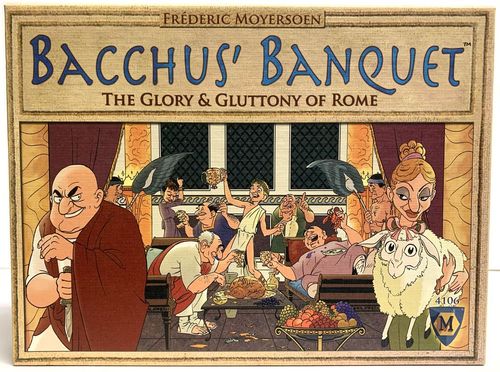
Bacchus' Banquet
Bacchus' Banquet Rulebook
Table of Contents
Table of Contents
Contents
- 93 Action Cards
- 9 Guest Cards
- 8 Privilege Cards
- 5 Player Displays
- 5 Wooden Buckles
- 1 Rulebook
Basic Concepts
You start the game with an empty stomach. When eating dishes and drinking wine, your stomach becomes full. This is visualized by adjusting the buckle on your belt. Your buckle is represented by a wooden disk with a hole in its middle.
The values on the belt indicate the fullness level. You start with a buckle showing the 0 value (this is also the lowest position on your belt). During play, your buckle will move left or right, according to the actions taken by your character. A belt/buckle can display a value up to 10.
When you exceed your stomach's capacity (when your buckle exceeds the 10-value on your belt), your belt tears open. Your character is incapacitated and is out of play. However, you may continue to play with a new character.
Character Objectives
There are 9 different characters (i.e., guests). Each character has his personal objective. Since most players' characters are secret, their objectives are secret too.
- Caligula — He wants to eat any 2 dishes and drink a total of 5 wine points (in no specific combination). He is the only character whose identity is not secret. Caligula can also win when 3 other characters are incapacitated through overeating (and poisoning)!
- Octavius, Septimus, and Cassius — These conspirators have a common objective: they want to eliminate Caligula, either by having 3 daggers in play (see Special Action Cards List), or by incapacitating Caligula with dishes, wine, and poison.
- Claudius, Vespasianus & Messalina — Each of these characters wants to eat a number of dishes and drink a number of wine points.
- Caesonia & Agrippina — Each of these characters wants to collect 3 different presents. There are 6 types of presents available.
Game Setup
Take a player display and a buckle. Place your player display in front of yourself and place your buckle so that the 0 value shows through the hole in the middle.
Place the "Caligula" Guest card temporarily aside. Shuffle the other 8 Guest cards and draw, without looking, as many cards as there are players minus one. Then, shuffle the "Caligula" card with the drawn cards and distribute one card face down to each player. The player with the "Caligula" card flips his card face up. The other players keep their cards secret. The remaining Guest cards are placed face down in a stack on the table.
Caligula randomly distributes 1 Privilege card to each player, and takes 2 cards for himself. Discard the remaining cards. Place your Privilege card(s) face down next to your player display.
Shuffle the Action cards and stack the cards face down in the center of the table. Draw 7 Action cards from the top of the stack and place them face up in a circle around the Action card stack.
The table layout for each player consists of: a Player Display (with the buckle showing the current value), the secret Guest Card, the Privilege Card, and an area for accepted Action Cards. The center of the table holds the Action Card Stack, the circle of Available Action Cards, and the Action Card Discards.
Sequence of Play
The player who is Caligula starts the game, and becomes the active player (the person choosing cards from the center) for the first turn.
As the active player, you select three Action cards from the 7 face-up cards. Show your selections so that everyone knows what cards have been chosen.
Then mix the 3 cards so that only you know which is which. Finally, play the cards face down in the following way:
- Discard — Discard one card. Place the card on the discard stack.
- Keep — Keep one card front of you. This card will be revealed and its effects resolved at the end of the turn.
- Gift — Give one card to another player.
Resolving the Gift Card
A gift card is always kept face down and secret until it is accepted. A player who is given the gift card must decide either to accept the card or to give it away to yet another player.
If you accept the gift card, flip it face up and apply its effect to yourself. Keep your accepted cards face up next to your player display. Your accepted cards are never discarded unless your character becomes incapacitated.
In case of a card with a value (positive or negative), adjust the buckle of the belt as appropriate (see Adjusting the Buckle).
If you do not accept the gift card, give it to another player who has not already been given the gift card this turn. (The gift card may not be given back to the active player until all of the other players have rejected it.) Each player receiving the gift card has the same 2 options: accepting the gift card or giving it away.
If nobody accepts the gift card, it returns to the active player (i.e., the player who initially selected the card and gave it away). The active player must accept it, flip it face up, and apply its effect to himself.
Initiative
The player accepting the gift card becomes the active player for the next turn. Therefore, if you want to become the active player, you need to accept a gift card.
If you accept a Doze card, or any card that incapacitates you (see Incapacity), the player on your left becomes the active player.
If you have at least two or more face-up accepted cards fewer than each of the other players at the table, you may claim and accept the gift card immediately upon its selection by the active player. If you choose not to claim the gift card, play proceeds normally.
End of Turn
After resolving the gift card, the current active player flips his keep card face up, applies its effect to himself, and places it with his accepted cards.
Note: If the gift card returns to you (the active player), you must apply its effect before revealing your face-down keep card. If the gift card incapacitates you, you cannot apply the keep card.
Draw three new cards from the top of the Action card stack and place them in the empty spots around the stack—in order to once again have 7 face-up Action cards available.
The new active player (the player who last accepted the gift card) starts a new turn by selecting 3 new cards. This procedure continues until the game ends.
Adjusting the Buckle
When you accept a card with a positive value (dishes, wine, poison), you move your buckle that number of spaces to the right (revealing a higher number).
When you accept a card with a negative value (Dance, Bill & Coo, Feather, Doze), you move your buckle that number of spaces to the left.
Note: If a card would take the value of your buckle below 0, the buckle stays at 0. If a card would take the value of your buckle above 10, you are incapacitated.
When you accept a card without a value (a present, Dagger, Umbra, Food Taster, Hymn to Bacchus), your buckle is not moved at all.
Privileges
You may use a Privilege card only once. Discard the card after use.
You may only play a Give Back or a Special Gift Privilege card immediately upon being given the gift card—resolve the Privilege card and then the gift card.
You may only play a Claim or an Exchange Privilege card when a gift card is given to a player, but before that player makes his decision on accepting the card. Place the Privilege card face down in front of you. The Privilege card remains secret as long as the gift card has not been accepted. Once the gift card is accepted, flip the Privilege card face up and apply its effect—then resolve the gift card.
Only one Privilege card may be played each turn. If more than one player wants to play a Privilege card at the same time, the active player or the player closest (clockwise) to the active player gets to play a Privilege card.
A description of each Privilege card is provided in the Privilege Cards List below.
Deduction
As all applied cards remain face up next to the appropriate player displays, each player has the opportunity to deduce the different objectives of the other players.
Example: If a player starts collecting presents, he or she might be Caesonia or Agrippina.
Players should try to conceal their objectives in order to avoid being hindered or targeted by other players.
Incapacity
If you are incapacitated by dishes, wine, and/or poison (i.e., your buckle is pushed above the 10 value), your character falls in a deep sleep and is out of play.
Reveal your character by showing and discarding your Guest card. You immediately rejoin the game by drawing a new Guest card. Discard all your face-up Action cards and move your buckle back to value 0. You do not get a new Privilege card; but if you have not played your original Privilege card, you keep it for later use.
If Caligula is incapacitated, all conspirators (Octavius, Septimus, and Cassius) must reveal their characters and claim victory (even players not directly involved in the incapacity). If no conspirators are revealed, the game continues without the Caligula character. Remove any conspirator Guest cards from the replacement stack before drawing a new Guest card.
End of Play
Once you reach your objective, reveal your Guest card to prove that you have fulfilled the objective of your character. You have won the game!
You can claim victory:
- By having the right accepted cards and not being incapacitated, or
- By being Caligula when three other characters are incapacitated, or
- By being a conspirator when Caligula is incapacitated, or
- By being a conspirator when three Dagger cards are "accepted" and in play.
Note: As the conspirators have a common objective, total the number of Dagger cards placed in front of ALL players, even those in front of Caligula himself. A conspirator can only win individually when the other conspirators are out of play.
If the third guest is incapacitated and Caligula has been incapacitated without the conspirators winning, the game ends in a draw.
Special Action Cards List
You may not have more than one special card of the same type next to your display. If you get a 2nd special card identical to one next to your display, discard it.
- Food Taster: This card allows you to discard any card before it takes effect. You must also discard the Food Taster. (Very useful against poison and daggers!)
- Hymn to Bacchus: When you drink wine (by accepting a wine card), all players drink with you. Each other player adds one point to his or her belt!
- Umbra: This card allows you to discard any dish before it takes effect. You must also discard the Umbra.
Privilege Cards List
- Claim (3 versions): Take and accept (unseen) either of the two cards indicated. You must then apply the effects of card to yourself.
- Exchange (3 versions): Swap 2 cards in the positions indicated (e.g., the gift card is swapped with the discard card). Then resolve the cards normally.
- Give back: When a player gives you a gift card, you immediately give the card back to the same player, who must accept and apply the effects of the gift card.
- Special Gift: When you are given a card, you immediately give it to another player, who must accept and apply its effects. You may even give the gift card to the active player or to a player who has already been given the gift card this turn.
Designer's Notes
Caligula is an interactive, subtle game, where you need to take calculated risks and make fine observations.
One problem is to get the initiative. As this is only possible by accepting a card, you have to observe carefully which cards the active player selects. Is there any card that could incapacitate you or another player? Is there any card that particularly interests you?
At the end of the turn, observe which card the active player has kept for himself. Could he need this card to win the game? Also observe which card he has discarded.
When you have the initiative, you have to evaluate if you want to keep it and how you can do it. If you select cards with no or low values, there is a big chance that another player accepts the card that you give away. If you select at least one dangerous card (e.g., a poison), there is a good chance that nobody will accept your card.
Changing your tactics frequently is a good way to confuse your opponents and force them to make mistakes.
Caligula has two Privilege cards instead of one. Keeping these cards as a permanent threat can be a successful strategy.
When you are almost incapacitated, you have only a small margin to remain in play. As any mistake can be fatal, you should not take anymore risks, unless it is necessary to prevent another player winning the game.