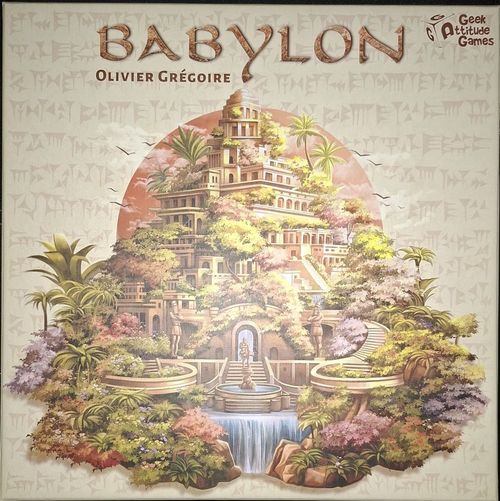
Babylon
Babylon Rulebook
Table of Contents
Table of Contents
Components
- 4 player boards
- 4 starting Terrace tiles
- 48 Terrace tiles
- 14 Round tokens
- 1 Game End token
- 1 score pad
- 148 single pillars
- 60 double pillars
- 38 belvederes
- 15 stairways
- 15 fountains
- 38 statues
- 15 bridges
Note: the box may contain a few more plastic elements, this has no impact on the game.
Terrace Tiles
Each Terrace tile has a Material side and a Garden side.
Terrace tiles contain 2 pieces of information: building symbols and flowers that match the different player boards.
Both sides of a tile show the same symbols and the same flower.
The 4 starting Terrace tiles do not have a Material side; they show the player's flower type instead.
There are 3 types of Material side: Clay, Granite, and Basalt. Clay tiles have 2 symbols, Granite tiles 3, and Basalt tiles 4.
There are 4 Garden sides, corresponding to the 4 player boards.
Player Boards
Player boards are divided into 2 areas:
- The building area has 64 notches in which to place pillars, so they remain stable and upright. This is where you build your garden.
- The storage area has 6 spaces for storing single pillars, and a slot for storing a Terrace tile for later use.
The top-right of each board features the player's own flower.
Setup
- Place the box in the center of the table; this will form the supply and quarry.
- Lay out the single and double pillars in the supply, along with the belvederes, stairways, fountains, statues, and bridges.
- Set up the quarry by placing the 48 Terrace tiles - Material side up - in 3 different layers:
- First, randomly spread the 16 Basalt tiles across the bottom of the quarry.
- Then randomly spread the 16 Granite tiles on top of the Basalt tiles.
- Finally, randomly spread the 16 Clay tiles on top of the Granite tiles.
- Choose a player board and place it in front of you. Then pick up the corresponding starting Terrace tile (matching flowers) and place it in the slot of your board's storage area.
- Shuffle the Round tokens face down and select 14/12/10 at random, if playing with 2/3/4 players, respectively. Without revealing them, stack them on the Game End token. Remove any unused Round tokens from the game. Choose any player to go first and place the stack of Round tokens in front of the player to their right.
- Adjust the quarry to the number of players:
- In a 3-player game, remove 3 Clay tiles from the quarry: starting with the first player and moving clockwise, each player removes 1 tile of their choice.
- In a 2-player game, remove 6 Clay tiles from the quarry: starting with the first player, each player removes 1 tile of their choice. Repeat this step twice.
How to Play
The game plays over a number of rounds depending on the number of players: 15 rounds with 2 players, 13 rounds with 3 players, and 11 rounds with 4 players.
Starting with the first player and moving clockwise, during their turn each player:
- A. must perform a digging action;
- B. may perform a building action;
- C. must store and/or discard any unused items.
A. Digging
Take a visible Terrace tile from the quarry. A tile is deemed to be visible when it is not covered by another tile.
You immediately receive 1 single pillar:
- for each tile edge bordering 1 visible tile on the same level or lower.
- for each tile edge bordering the edge of the quarry.
- for each tile edge bordering the bottom of the quarry.
- if the flower on the Terrace tile matches the one on your player board.
Example: Linda (white flower) takes Granite tile A, and immediately receives 3 single pillars: 1 for the bordering Granite tile on the same level; 1 for the bordering Basalt tile on the level below; 1 for the bottom of the quarry. Linda receives no pillars for the bordering Clay tile since it is on a higher level.
John (pink flower) takes Basalt tile B, and immediately receives 3 single pillars: 1 for the edge of the quarry; 1 for the Basalt tile on the same level; 1 because the tile John chose matches the flower type on his board. John receives no pillars for the bordering Clay and Granite tiles since they are on higher levels.
B. Building
1. Terrace Tiles
After digging, you can place the Terrace tile you just chose AND/OR the Terrace tile in your storage area.
You must place pillars before placing a Terrace tile. A (single or double) pillar must be placed on an empty space on a player board or a Terrace tile. The building area on your player board has 64 notches for placing pillars. The Garden side of Terrace tiles has 4 spaces for placing pillars (with or without symbols). You can swap 2 single pillars for 1 double pillar at any time. However, a double pillar cannot be swapped for 2 single pillars.
Once your pillars are in position, place your Terrace tile, following these rules:
- A Terrace tile may be placed Garden side up on 3 or 4 pillars. If you only use 3 pillars, place a Belvedere immediately on the corner of the tile not resting on a pillar.
- 2 Terrace tiles may never overlap completely.
- A Terrace tile may rest entirely or partially on double pillars when it is placed. For example, a tile can rest on 2 single pillars placed on a first-level tile and 2 double pillars placed on the player board.
Note:
- A statue can be used as a pillar to support a Terrace tile, after which it is no longer considered a statue.
- You must build your garden one level at a time. For example, you may only place a Terrace tile on the third level if you have a Terrace tile on the second level, even if they are far apart.
- All pillars placed must be covered by a Terrace tile.
2. Building Decorative Items
After placing a tile, check if you can build 1 or more decorative items (stairway, fountain, bridge, or statue). Taking a decorative item from the supply is free. These items must always be placed, either entirely or partially, on at least 1 tile placed during this round.
Decorative items must be placed on empty spaces with the corresponding symbols, and never diagonally to the tiles.
Each item has its own rules when being placed:
- Stairway: a stairway must connect 2 stairway symbols situated directly adjacent to each other on 2 tiles separated by 1 level.
- Fountain: a fountain must connect 2 fountain symbols situated directly adjacent to each other on 2 tiles on the same level.
- Bridge: a bridge must connect 2 bridge symbols directly opposite each other on 2 tiles on the same level separated by an empty space.
- Statue: you can place your first statue on any statue symbol. Thereafter, each statue must be in a straight line with a previously placed statue, regardless of the distance and levels between them.
Example:
- The first statue can be placed on any statue symbol.
- The second statue is placed in a straight line with the first.
- The third available space is not aligned with another statue, so you cannot place a statue there.
- A third statue may be placed here because the space is aligned with another statue. Although the space on the previous tile is now aligned with a statue, you can no longer put a statue there as the tile was placed during a previous round.
Reminder: A statue can then be used as a pillar to support a subsequent Terrace tile, after which it is no longer considered a statue.
Important: When viewed from above, any spaces hidden by a tile can no longer be used. This means you can no longer place a pillar or decorative item there.
C. Storage/Discarding
If you do not use 1 or more of the pillars you receive during a round, you can keep them in the storage space of your player board. The storage space of your board can hold up to 6 single pillars but no double pillars. Any extras must be returned to the supply.
Similarly, if you do not wish to place the Terrace tile you have just picked up, you can either discard it or store it in the slot on your player board. If there is already a tile in this slot, you can discard it and replace it with the new one.
You do not necessarily have to place the starting Terrace tile in your storage space at the start of the game during the first round. However, you cannot store another tile until it has been placed or discarded.
End of the Round
When the last player has completed their turn, they reveal the first Round token in the stack. If this Round token has a special effect, it will apply to every player on their next turn. The first player then begins the next round.
Special Effects of Round Tokens
- Take 1 single pillar from the supply.
- Take 1 double pillar from the supply. As a reminder, a double pillar cannot be stored at the end of a turn.
- You can turn a symbol on the Terrace tile you place on this turn into another symbol.
- If the Terrace tile you place on this turn has a space without a symbol, you can turn it into the symbol of your choice.
- If the Terrace tile you have just picked up matches the flower on your player board, you receive 2 single pillars instead of 1.
- Each player receives 1 single pillar fewer when they pick up their Terrace tile.
End of the Game
The game ends when the last player has no more Round tokens to reveal. It is then time for the final scoring.
Final Scoring
At the end of the game, look at your board from above. Each tile or decorative element that is partially or completely visible earns victory points (VP). However, any tiles or decorative elements that are completely hidden do not earn VP.
- Statues: each statue is worth 1 VP multiplied by the level on which it is built. For example, a statue built on the third level is worth 3 VP. A statue used as a pillar is hidden and is worth 0 VP.
- Fountains: each fountain is worth 3 VP multiplied by the level on which it is built. For example, a fountain built on the second level is worth 6 VP.
- Bridges: as with fountains, each bridge is worth 3 VP multiplied by the level on which it is built.
- Stairways: each stairway is worth a total number of VP equal to the sum of the levels it connects. For example, a stairway between the first and second levels is worth 3 VP; a stairway between the second and third levels is worth 5 VP, etc.
- Diversity of decorative items: each set of 4 different decorative items (1 statue + 1 fountain + 1 bridge + 1 stairway) is worth 4 VP.
- Flowers: each set of 4 tiles with different colored flowers is worth 4 VP.
- Belvederes: each Belvedere is worth 1 VP (regardless of the level).
- Highest point: you receive VP equal to the double of the level with the highest Terrace tile (first level = 2 VP, second level = 4 VP, third level = 6 VP, etc.). Reminder: you must build your garden one level at a time.
The player with the most victory points wins the game. In case of a tie, the player with the largest garden surface is declared the winner (count the pillar spaces on the player board still visible from above; the one with the fewest wins the game). If there is still a tie, tied players share the victory.
Tip: At the end of the game, sort your building items and Terrace tiles as described in points 2 and 3 of the setup. You can skip these steps the next time you play the game.