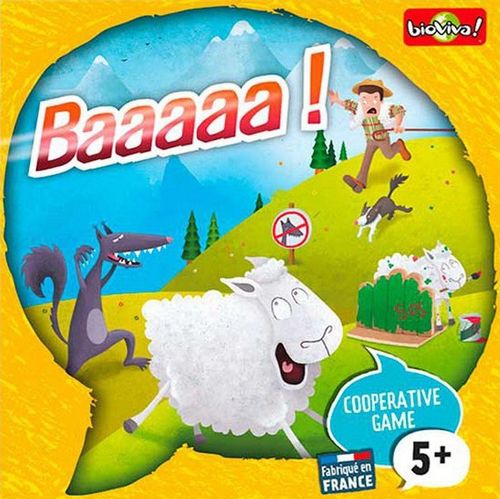
Baaaaa!
Baaaaa! Rulebook
Table of Contents
Table of Contents
Game Rules
Contents
- 2 "mountain" plates, 1 "low" plate (the largest), 1 "middle" plate (medium-sized) and 1 "high" plate (the smallest)
- 1 rectangular "pastures" tile (with the sheep in the meadow)
- 1 rectangular "larder" tile (with the sheep tied up)
- 10 sheep, 1 wolf, 1 shepherd and 1 wooden shepherd's hut
- 10 "sheep" cards (green back) and 14 "wolf" cards (red back)
Assembling the Mountain
Diagram labelled A and B (see the printed rulebook).
- A. Fit the 2 "mountain" plates into each other so that they cross, taking care that the drawings line up continuously at each corner.
- B. Slide the "low" plate on from the top so that it rests gently on the base of the mountain. Then slide the "middle" plate onto the mountain until it sits on the notch provided for it. Finally, slide the "high" plate onto the mountain in the same way as the previous ones.
Once assembled, the mountain is divided into twelve spaces. It can turn on itself so that everyone can see the whole game from their own seat.
Setup
- Place the 10 sheep, all together, on one of the 4 spaces at the bottom of the mountain.
- Place the wolf on the space opposite the bottom of the mountain.
- Place the shepherd's hut and the shepherd on the top floor of the mountain, 2 floors above the wolf.
- Lay out the "sheep" cards (green back) face up on the table.
- Shuffle the "wolf" cards (red back) and place them in a face-down pile.
- Place the "pastures" and "larder" tiles beside the mountain, face up.
Goal of the Game
Bring more sheep to the shepherd's hut than the wolf has taken. If so, the players have won the game together. Otherwise, the players have lost the game together.
Start of the Game
The players take turns in clockwise order. The player who most recently saw a sheep begins. Their turn consists of 2 steps.
- They choose a "sheep" card and carry out the action shown (see the section "The Sheep Cards"). Then the card played is set aside and cannot be used again until all the other "sheep" cards have been played once.
- They then turn over the top card of the "wolf" pile and carry out the action shown (see the section "The Wolf Cards"). The card played is set aside and cannot be used again until all the other "wolf" cards have been played once.
Therefore, there are fewer and fewer "sheep" and "wolf" cards as turns go by.
It is then the turn of the player on their left, who carries out the same 2 actions, and so on.
When all the "sheep" cards have been played, all the "sheep" cards in the game are laid out face up again. This way, certain directions of movement become available again...
When the "wolf" pile is exhausted, all the "wolf" cards in the game are shuffled and placed again as a face-down pile.
The Sheep Cards
Movements. These cards are used to move a sheep up, left or right. The move is one space if the card shows one arrow, and exactly two spaces if the card shows two arrows.
The Trio. This card makes it possible to move one, two or three sheep that are on the same space up by one space.
The Shepherd. The player must move the shepherd piece to another space (of their choice). All the sheep on that space are protected from the wolf's movements, and the wolf cannot eat them if it goes there. Warning: the shepherd does not protect against the "disguised wolf" or "the lightning" (see "The Wolf Cards").
When a sheep arrives on the space of the shepherd's hut, it is saved and placed on the "pastures" tile.
The Wolf Cards
Movements. The wolf moves one space in the direction indicated. If a sheep is on the arrival space, it takes that sheep with it. The sheep is removed from the mountain and placed on the "larder" tile. If the wolf arrives on an empty space, nothing happens.
The Disguised Wolf. The wolf takes the sheep that is closest to it on its floor and places it on its space. If several sheep are at equal distance from the wolf, the players agree on which sheep is taken from the mountain. If there are no sheep on its floor, it does not move.
The Sated Wolf. The wolf is immobilised on its space and cannot take any sheep during this turn.
The Escaped Sheep. One sheep is taken from the wolf's "larder" tile and repositioned on the space occupied by the shepherd.
The Lightning. It electrocutes the highest sheep on the mountain. The wolf takes advantage of this to carry the stunned sheep off to the larder and moves onto its space. If several sheep are at the highest point of the mountain, the players agree on which sheep is taken.
The Eagle. A sheep is taken from the "meadow" tile and repositioned on the space occupied by the shepherd.
Note (translator's): the printed text names the tile for the eagle card "prairie" (translated here as "meadow"), while the component list and setup call the same-looking tile "pastures". The source is inconsistent here and is transcribed as printed.
Important points:
- If several sheep are present on a space visited by the wolf, the wolf takes two of them. It cannot take more than two sheep.
- When a sheep passes through a space occupied by the wolf, or stops on it, it is carried off to the "larder".
Ending the Game
When there are no sheep left on the mountain (all the sheep are on the "pastures" tile or have been carried off to the "larder" by the wolf), the game ends. Then count the number of saved sheep on the "pastures" tile and the number of sheep taken by the wolf on the "larder" tile.
- If there are more saved sheep than sheep taken, the players have won the game together.
- If there are more sheep taken than sheep saved, the players have lost the game together.
- In case of a tie (5 sheep on each tile), nobody has won: neither the wolf nor the players. Start a new game straight away!
It is possible to play Sauve Moutons alone using these same rules, except the rule about changing players.
Alternative Rule
One of the players plays the wolf against all the others.
The wolf places the "wolf" cards in a face-down pile in front of them. On their turn, they turn over the top two cards of the pile and decide which one to play. The other card is discarded.
The wolf can take at most one sheep, and the shepherd protects against all dangers (including the "disguised wolf" and "the lightning").
The other rules are unchanged.