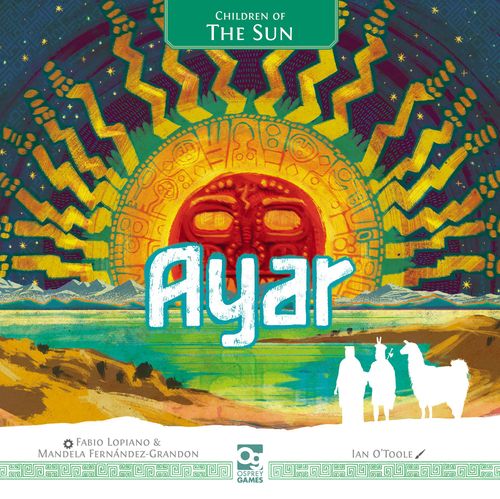
Ayar: Children of the Sun
Ayar: Children of the Sun Rulebook
Table of Contents
Table of Contents
Game Components
- 1× Main board
- 1× Lake board
- 30× Pots
- 40× Llamas
- 4 pairs of Ayar (Female Ayar and Male Ayar)
- 8× Raymi tiles
- 40× Viracocha
- 64× Textiles
- 1× First Player token
- 4 sets of Player Components
- 4× Bonus markers
- 1× Inti dial
- 4× Temples
- 2× VP tokens
- 6× Islands
- 1× Reference card
- 1× Step tile
- 1× Player board
- 1× Boat
- 16× Tambos
- 2× Score markers (1× Sun and 1× Moon)
- 22× Maize
- 5× Step markers (4× Ayar colours and 1× Wild)
Solo Game: 4× Solo boards (on the reverse of the Player boards), 5× Activity tokens, 1× Bag
Game Setup
Player boards
- Give each player all pieces of one colour, along with a Player board, 1 Step marker of each colour, and a Reference card.
- Place the 16 Tambos on their grid on your Player board.
- If playing with fewer than four players, take your Step tile and use it to cover up the steps next to the Tambo grid on your board, with the side matching the number of players face up.
- Place the 22 Maize and 6 Islands on their matching slots.
- Place the 4 Temples, 5 Step markers, 4 Bonus markers, Inti dial, and Reference card next to your Player board.
- Give a player the First Player token.
Main board
- Place the Main board in the centre of the play area.
- Place each player's Moon and Sun Score markers on the 0 space of the scoring track.
- Place each male Ayar onto the first movement space of the path matching their colour.
- Randomising their positions, place each female Ayar on a slot to the left of the Temple area. Place a Viracocha on the slot next to each.
- Randomising their positions, place the Raymi tiles on the slots on the Main board matching their letter, with the letter side face up.
- Place the Viracocha and Llamas in separate supplies next to the board.
Lake board
- Place the Lake board to the right or left of the Main board.
- Split the Textiles into four sets by power number, and stack them next to the corresponding numbered slots on the Lake board.
- Place the stack of Pots face down next to their slot on the Lake board. Draw Pots until you have found four without Viracocha icons. Place these next to the four empty slots, and shuffle the rest back into the stack.
- Place the specified number of Viracocha in the slots on the lake that match the number of players.
- Place each player's Boat in the starting space at the bottom of the lake.
You are now ready to play!
Gameplay
You will play the game over four rounds, each with two phases:
- Day phase: Players perform activities in turn order.
- Night phase: One Ayar retires and players simultaneously score their Moons and Suns.
After the fourth night phase, players score the lowest of their two Score markers (Moon or Sun). Whoever has the highest score wins.
Score markers: You will only move your Score markers during the night phase.
Day Phase
Starting with the player with the First Player token, each player completes all of the following 5 steps.
Play continues clockwise until every player has placed all their available Step markers. At this point, you will enter the night phase.
- Place a Step marker
- Move the Ayar
- Choose and place a Tambo
- Perform the activity
- End-of-turn checks
0. Starting Activity
At the start of the first day phase only, each player performs one activity. Starting with the first player and moving clockwise, each player must place a Tambo from any slot on their Player board into the first building slot on any path (as long as it is still empty). Perform the corresponding activity with a power of 1. See the Activities section for details on activities.
1. Place a Step Marker
Choose one of your available Step markers. The colour chosen affects which Ayar will move in step 2.
Place it laid down in any empty slot next to the Tambo grid. The row or column in which you place the Step marker must have at least one Tambo in it.
Step markers: Step markers stood up are available, while those laid down have already moved for this round. You will stand them back up at the end of each night phase. In day phases 2 to 4, the Step markers that were placed the previous day will block some of the slots, further limiting the options for placing a Step marker.
2. Move the Ayar
Move the male Ayar matching the colour of the placed Step marker along its coloured path. If you placed the gold Step marker, you decide which Ayar to move. The number of arrows next to the marker's slot indicates the exact number of movement spaces that the Ayar travels.
If the Ayar reaches the end of their path, they will not move further. Ignore any subsequent steps the Ayar would take. You may continue to place Tambos and perform the activities along their path as normal.
3. Choose and Place a Tambo
Take any Tambo from the row or column where you placed your Step marker. Place it on any empty building slot on the path behind the Ayar you just moved – that is, anywhere between the Ayar and Tiwanaku. You must place the Tambo on a slot that indicates an activity you can perform (meaning you have the pieces and slots available to do the activity).
Historical note
The Inca oversaw the building of thousands of tambos (way stations) along the roads of Tawantinsuyu. These were equally distanced to match one day's travel and had many uses, including storage and resting places for travelling state functionaries.
4. Perform the Activity
Perform the activity matching the icon on the slot where you placed your Tambo. All activities take place on the Lake board. The four activities are Pottery, Weaving, Terrace Farming, and Reed Bundling.
Each activity has a power from 1 to 4. To determine the power available for your activity, count the number of empty Tambo slots in the row or column where you placed your Step marker. The higher the power, the more opportunities you have for the activity. You may always choose to perform an activity using less power than you have available.
Suns and Moons
With each activity you perform, you may increase your available Suns or Moons as the gods reward your toil and observation of a good Andean life.
You will check your total number of Suns in step 5 of the day phase, when Personal bonuses and Raymi tiles may increase your Inti devotion on your dial (see the Personal Bonuses and Raymi Tiles sections). Your Inti devotion then becomes Sun points on the scoring track in the 'Dawn' step of the night phase.
Your available Moons will translate directly into Moon points on the scoring track during the 'Score Temples' and 'Score Step marker' phases of the Night phase.
You never score your Suns and Moons during this Perform the activity step.
Activities
Pottery
Take any number of Pots from the Lake board whose total power value matches or is less than your power. You may split your power between two Pots. For example, with a power of 3, you can take either a single 3-power Pot or both a 1-power Pot and a 2-power Pot.
Do not turn the pots over when you take them. You may take Pots from the top of the stack without turning them over. These Pots are wild, and count as any colour for scoring.
If you take a Pot showing a Viracocha, immediately take a Viracocha from the supply and add it to your Player board (see the Viracocha section).
After taking Pots, slide all the remaining Pots downwards, flipping over Pots from the stack to fill any empty slots.
Add your new Pots to the pottery area of your Player board, filling the slots from left to right. You may not replace Pots that have already been placed.
Inti Devotion (Day Phase: Step 5): If increasing Inti devotion, count the total number of Suns above slots filled with Pots. Advance your Inti dial by that amount.
Moon Scoring (Night Phase): Your Moon score is determined by how many Pots you have in each of the five Pot colours. Sets of 1/2/3/4+ Pots of the same colour are worth 1/4/9/16 points as indicated on the Player board. To get your Moon score, add together the points for each set.
Wild Pots (those face down) count as any colour for scoring, but each wild Pot cannot count towards more than one set.
Scoring example: Pottery
White currently has 6 Pots. When scoring Inti devotion (triggered in step 5 by Personal bonuses or Raymi tiles), they would count all 4 Suns above their Pots. When scoring Moon points during the night phase, they would group the Pots into sets: 3 green, including the wild (9 points), 2 pink (4 points), and 1 Blue (1 point), for a Moon score of 14 points.
Weaving
Take any number of Textiles from the Lake board whose total power value matches or is less than your power. You may split your power between two Textiles, but you may not draw more than one Textile from each stack.
If you take a Textile showing a Viracocha, immediately take a Viracocha from the supply and add it to your Player board (see the Viracocha section).
Add your new Textiles to the weaving area on your Player board. You may rotate and flip the Textile freely before placing it. You may place a Textile anywhere in the weaving area, as long as it covers exactly two empty slots.
Inti Devotion (Day Phase: Step 5): If increasing Inti devotion, count the total number of complete Suns visible on your Textiles. Advance your Inti dial by that amount.
Moon Scoring (Night Phase): Your Moon score is the value shown below the rightmost consecutive completed column of Textiles in your weaving area. All columns to the left of the completed column must also be complete in order for it to score.
Scoring example: Weaving
Purple has placed 7 Textiles so far. If increasing Inti devotion in step 5, they would gain 5 points, because there are five complete Suns. When gaining Moon points in the night phase, Purple would gain 10 points – they do not score for the column worth 21 because it has uncompleted columns to the left of it, so they score for the column worth 10 instead.
Terrace Farming
Place Maize equal to your power in the first available slots in the terrace farming area of the Lake board, starting from the top left.
You can take Maize from any box on your Player board, but within each box you must take the leftmost Maize. When you empty a box showing a Viracocha, immediately take a Viracocha from the supply and add it to your Player board (see the Viracocha section).
Inti Devotion (Day Phase: Step 5): If increasing Inti devotion, count the total number of visible Suns revealed by removing Maize from your Player board. Advance your Inti dial by that amount.
Moon Scoring (Night Phase): Your Moon score is the total number of Moons revealed by emptying boxes on your Player board.
Scoring example: Terrace Farming
Pink has planted 12 Maize so far. In doing so, they have revealed 4 Suns and 14 Moons which will translate into Inti devotion and Moon points in later steps. They also gained a Viracocha when they emptied the largest box.
Reed Bundling
Move your Boat along the paths on the Lake board such that the total power of the spaces it enters does not exceed your power. You may retrace your steps, but you may only continue from where your Boat currently is.
When you enter a square slot where you do not already have an Island, build one there by placing the leftmost Island from your Player board. The yellow Island slots can contain only one Island and one Boat. For all other Island slots, any number of Islands or Boats may share the slot.
When placing an Island from a slot showing a Viracocha (slots 2, 4, and 6), immediately take a Viracocha from a lake section adjacent to the Island you just built and place it on your board (see the Viracocha section). If there are none available, do not take a Viracocha.
Entering a space with an Island does not cost any power. Entering a space with a Boat does not change the power cost.
Inti Devotion (Day Phase: Step 5): If increasing Inti devotion, count the total number of visible Suns revealed by removing Islands from your Player board. Advance your Inti dial by that amount.
Moon Scoring (Night Phase): Your Moon score is the highest number next to an Island you have on the Lake board.
Play and scoring example: Reed Bundling
Blue is completing a reed bundling activity with a power of 2. They move their Boat along these spaces, entering the Island slot for free because there is a Red Island there. They place the second Island from their Player board, which allows them to take a Viracocha from an adjacent area of the lake.
They would gain 8 points when scoring their Moons, because this is their highest-value Island. If increasing Inti devotion, they would increase their devotion by 2 for the 2 visible Suns.
Historical note
One of the dozens of ethnic groups subjugated by the Inca were the Uru, who constructed boats and floating islands from the reeds that grew in Lake Titicaca. The Uru have continued this way of life, with over 120 islands existing today as a collectivist society.
5. End-of-Turn Checks
Check if you have triggered any of the following. You may resolve these triggers in your preferred order.
Placing a Temple: Player boards have a Temple icon in each quadrant of the Tambo grid. In step 5 of a turn when the fourth Tambo of a quadrant has been removed such that the quadrant is empty, you must place a Temple of your choice.
Take any Temple from your supply. Place it in the Temple area of the Main board, onto the leftmost empty slot of the row matching the Ayar colour you activated this turn.
When that colour Ayar retires, these Temples will provide Moon points for the depicted activity.
In each row, the first three slots can have only one Temple, but the final slot, with its special icon, can hold any number of Temples.
Play example: Placing a Temple
By removing the last Tambo from the bottom right quadrant, White unlocks the Temple there. Because they moved the teal Ayar this turn, they add the Temple to the row with the teal Ayar. As it is in the first column, it will be worth 6 additional points when scored.
Temples: Temples will score Moon points in one night phase during the game, when the Ayar they are aligned with retires. The longer that Ayar survives, the more opportunities you will have to improve the Moon value of your Temple.
You will place exactly 15 Tambos during the game: 1 for your starting activity, 5 in round 1, 4 in round 2, 3 in round 3, and 2 in round 4. This means you will be able to place exactly 3 Temples.
Personal Bonuses: If you have emptied a row and/or column of Tambos, you will gain the bonus(es) indicated on your Player board.
- If the bonus is a Llama, take one from the supply and place it next to your board.
- If the bonus is a Viracocha, take one from the supply and place it on one of the nine Viracocha slots on your board.
- If the bonus shows a Sun with one of the four activities, increase the number on your Inti dial according to that activity's Inti devotion rules. When you score one of these Inti personal bonuses, place a Bonus marker on the icon to keep track.
Play example: Personal Bonuses
By removing the last Tambo of the row, Purple triggers the personal bonus for their pottery. During step 5, they increase the devotion on their Inti dial according to the Suns available from their pottery. This devotion will turn into Sun points in the dawn step of each night phase. They finish by placing a Bonus marker on the icon to mark that it has been completed.
Llamas: At the end of the game, you can use the Llamas you have collected to increase your points for Suns, Moons, or a mixture of both.
The number of Llamas you allocate to Sun and to Moon will determine how many points you will add to each, as shown in the key on the Main board. Because your score at the end of the game will be the lower of your two Score markers, keeping your Sun and Moon scores as close as possible is crucial.
Viracocha: Viracocha can unlock permanent or one-use bonuses. For details on each bonus, see the Viracocha Bonus Reference.
When you gain a Viracocha, immediately place it on one of the bonus slots on your Player board. Once placed, Viracocha may not be moved.
When you have placed the number of Viracocha indicated to the right of the slot, the bonus is immediately available to you. Place the Viracocha with its completed side face up to make this clear. You may not add any more Viracocha to the slot.
Raymi Tiles
At the end of a turn in which an Ayar lands on, or passes, a movement space linked to a Raymi tile, all players will gain Inti devotion for the depicted activity.
Each player counts their current Suns for that activity and increases the value on their Inti dial by this amount.
If they have at least as many Suns in that activity as the number shown at the bottom of the Raymi tile, they also gain a Llama.
Once all players have scored, flip the Raymi tile. It will now show a higher Sun value for the Llama. If a second Ayar reaches the Raymi tile, use this side to score.
If both Ayar along the corresponding paths have already passed the Raymi tile or retired, it will not be activated again, and you may remove it from the board.
Timing retirement
When deciding which Ayar to move, look ahead to see which ones will pass the Raymi tiles that score your most valuable activity. You do not want these Ayar to retire early, so make sure they are not in last place at the end of the day phase.
Historical note
Similar to other Andean cultures' solstice festivals, Inti Raymi was an annual festival organised by the Inca to celebrate the Sun. It is still celebrated by indigenous Andean cultures on the 24th of June every year. Llama statuettes may be carried at these festivals – gold ones to represent the sweat of Inti, and silver ones to represent Mama Quilla's tears.
Reaching Fertile Ground
At the end of a turn where an Ayar reaches movement space 30, a shared scoring takes place. This scoring uses the Raymi tile printed on the board. Each player chooses any two different activities and adds the Suns from those activities to their Inti dial.
Players also gain a Llama for each of these activities that they have at least six Suns in.
The Inti Dial
During step 5 of the day phase, you may increase the number on your Inti dial due to personal bonuses or Raymi tile scorings. This dial tracks your devotion to the Sun god.
This devotion will be added to your Sun points on the main scoring track during the dawn step of each night phase.
Your Inti dial does not reset when you do this, so Sun points are cumulative over the course of the game. This means getting them early is extra lucrative.
Play Example: Day Phase
- Place a Step marker: Pink places the teal Step marker on the second row of their Tambo grid.
- Move the Ayar: They move the teal Ayar 2 movement spaces, as determined by the arrows on their Player board.
- Choose and place a Tambo: Pink then takes a Tambo from the row where they placed their marker. They place it on the empty terrace farming slot behind the teal Ayar.
- Perform the activity: They perform a terrace farming activity with a power of 2 due to the two empty slots in their selected row. They place 2 Maize in the terrace farming area of the Lake board. In doing so, they reveal a new Sun on their Player board, which would improve any terrace farming Inti devotion gained from future personal bonuses and Raymi tiles.
- End-of-turn checks: They do not place any Temples because the quadrant still has Tambos in, and they trigger no personal bonuses this turn. However, the teal Ayar has passed a Raymi tile that scores for weaving. Each player increases the devotion on their Inti dial according to the number of visible Suns in their weaving area. Because Pink has at least one Sun in this area, they also take a Llama. They then flip the Raymi tile, and play passes to their left.
Night Phase
After all players have used all their available Step markers, they will enter the night phase, where Moon points are scored for Mama Quilla and Sun points for Inti. This phase has 6 steps:
- An Ayar retires
- Harvest Maize
- Score Temples
- Score Step marker
- Dawn
- Prepare
1. An Ayar Retires
First, check how far each Ayar has travelled by looking at the number on their movement space. The Ayar that has travelled the least (the one on the lowest number) will retire. In the final night phase, the last remaining Ayar will retire.
In the case of a tie, look at the position of the female Ayar in the Temple area. The tied Ayar whose female partner is in the row furthest down in the Temple area will retire.
Place the retiring male Ayar in the Temple area, on the rightmost Ayar slot of the row that contains their partner.
2. Harvest Maize
The player who planted the most Maize in the terrace farming area of the Lake board this round will gain the Viracocha next to the female Ayar in the Temple area whose partner is retiring.
In the case of a tie, the tied player who planted any Maize first will get the Viracocha. If none of the players planted any Maize, return the Viracocha token to the supply.
Then remove all the Maize from the terrace, returning it to the game box.
3. Score Temples
Before scoring Temples, any players who have unlocked the pictured Viracocha bonus will now gain 2 Moon points for each Temple they have in the Temple area.
The female Ayar whose partner is retiring then walks along the row from left to right, scoring every Temple on the way. The owner of each Temple immediately scores Moon points for the Temple's activity, along with any bonus Moon points shown above the column, by moving their Score marker on the main track.
After scoring the Temples, return them all to the box. The Ayar couple then reunites in the Ayar slot at the end of the row.
4. Score Step Marker
In clockwise order from the player with the First Player token, each player places the Step marker matching the retired Ayar onto one of the remaining empty slots above the Tambo grid on their Player board. This marker no longer counts as one of your available Step markers, and it will not move for the rest of the game.
Score your Moon points for the activity shown on the slot where you placed the marker.
Moon scorings
You may want to save scoring Moons for your highest-scoring activities until a later round. Don't be afraid to score zero in round 1!
5. Dawn
All players now look at the current value on their Inti dial and gain that many Sun points on the main scoring track.
Inti devotion
The Inti dial stays at its current value, so you will score those points again in each future Dawn phase.
6. Prepare
Stand up all remaining Step markers in their current slots next to the Tambo grid.
The First Player token then passes to the next player moving clockwise, and a new day phase begins.
Play Example: Night Phase
- An Ayar retires: At the end of the first day phase, the grey Ayar and the teal Ayar have travelled the least (5 steps each). The teal Ayar is in a lower row in the Temple area, so the teal Ayar retires and is placed to the right of the Temple area.
- Harvest Maize: Blue and Pink both planted 2 Maize each, tying for majority. However, Blue planted Maize first, winning the tie and gaining the Viracocha for this round. They take the Viracocha next to the teal Ayar.
- Score Temples: The female teal Ayar now walks down the row of Temples. White scores their Moons for reed bundling and gains a bonus of 6 points for being in the first slot.
- Score Step marker: Each player now places their teal Step marker into one of the Moon slots on their Player board. Pink decides they want to gain some Moons early, so they score for pottery and gain 6 points. All other players want to save their higher-scoring activities for later Moon scorings, so they each place their teal marker in a spot where it gains 0 points.
- Dawn: All players translate their Inti devotion into Sun points.
- Prepare: All players stand up their remaining Step markers, the First Player token passes to Blue, and they start the second round.
Game End
After the fourth night phase, the game will end.
You may now use the Llamas you acquired over the course of the game to earn additional Sun and Moon points. Each player can split their Llamas between Sun and Moon as they choose, adding points to the respective Score markers as indicated by the conversion chart shown below.
All players then score only for the lowest of their two Score markers (whether it is Sun or Moon). The player with the highest score of these is the winner.
In the case of a tie, the tied player whose other Score marker is the closest to the former is the winner. If there is still a tie, the tied players share the victory.
Solo Mode
In the solo mode of Ayar, you will play against one of the Ayllu. In these rules, 'you' or 'yourself' refers to the human player, and 'it', 'they', or 'the Ayllu' refers to your automated opponent.
Playing the solo mode of Ayar requires you to be familiar with the main rules.
Historical note
In the Andes, the Ayllu are a social group larger than the household yet smaller than the ethnicity or polity. Ayllus are kin-based communities, each of whose members claim descent from a common ancestor.
Setup
- Choose a difficulty level and find the appropriate Solo board. The difficulty level is shown on each Solo board by the number of stars.
- Choose a player colour for the Ayllu, and give them all pieces of their colour.
- Place the Maize and Islands on the matching slots of the Solo board. Any spare Maize can be returned to the box.
- Place the Boat on the start space of the reed bundling track on the Solo board.
- Place the 16 Tambos, 4 Temples, and 4 Bonus markers next to the Solo board.
- Shuffle the 5 Activity tokens and place them in a face-down stack next to the board.
- Place the gold Step marker back in the box (it won't be used by the Ayllu) and put the 4 coloured Step markers in the cloth bag.
- Set up the Main board, supplies, and your Player board as you would for two players.
- Give the First Player token to yourself.
You are now ready to begin!
Activity Tokens
During an Ayllu's turn, they will draw 1 Activity token, which helps dictate their turn. The Activity tokens show a power level based on the round number; one token is removed in round 1.
The Ayllu places a Temple at the end of a turn in which they draw the token with a Temple icon. To decide which Temple to place, identify which activity with a remaining Temple the Ayllu currently has the most Moons for. If there is a tie, choose the available Temple whose activity is topmost on the Solo board.
Place the chosen Temple on the row of the Temple area with the Ayar that matches the drawn Step marker.
Viracocha: Every time the Ayllu would gain a Viracocha, it gains a Llama instead.
Placing Tambos
When placing a Tambo and more than one building slot of different activities are available, the Ayllu follows these tiebreakers:
- If the Ayllu has already reached the maximum on the Solo board for any activity, they ignore all related building slots. Terrace farming and reed bundling are at maximum when all pieces of that type have been placed, whereas weaving and pottery have reached maximum when all slots of that type on the player board are full.
- Pick the building slot whose activity matches the first unscored Raymi tile for the Ayar on this path. If the Ayar's movement this turn took it past a Raymi tile, the Ayllu will still choose a building slot matching that tile's activity, as it hasn't scored yet.
- If there are no available building slots for that Raymi tile's activity, check the next closest Raymi tile on the same path, and so on.
- If there are no available building slots for the remaining Raymi tiles, or if there are no more Raymi tiles, pick the activity of the topmost unscored personal bonus on the Solo board with available building slots.
- If there is still no matching building slot, pick the topmost activity with available building slots that has not had its night phase Moons scored.
- If there is still no matching building slot, pick the building slot closest to the Ayar.
During any of these tiebreakers, if there is more than one possible building slot for the chosen activity, pick the one closest to the Ayar.
Day Phase (Solo)
Refer to the main rules for how to take your turn. On the Ayllu's turn, follow these 4 steps.
0. Starting Activity: At the start of the first day phase only, you complete the starting activity as normal by placing one Tambo from your board and performing the activity at power 1. The Ayllu places their Tambo on the slot whose activity matches the activity on one of the two Raymi tiles linked to the '8' movement spaces. If there is still a choice of slots, they choose the one whose Ayar in the Temple area is in the topmost row.
- Flip the top Activity token from the stack and randomly draw a Step marker from the cloth bag. If the bag is empty, first put all the markers back into the bag. Then draw one as usual for the Ayllu's last turn of the round.
- Move the Ayar whose marker was drawn by the number of steps indicated by the arrows on the Activity token.
- Place a Tambo on that Ayar's path, following the rules in 'Placing Tambos'.
- Resolve the activity with a power equal to the current round plus any modifier shown on the Activity token. For example, if the Ayllu draws a tile with a "+2" modifier on the first round, the activity will have a power of 3.
- Resolve any Raymi scorings as in the multiplayer game. The Ayllu may place a Temple if it drew the appropriate Activity token (see above).
You and the Ayllu will both have the same number of turns each day phase.
Play example: Placing Tambos
The Ayllu moves the teal Ayar forward by 2 movement spaces as indicated on the activity token.
They have not reached the maximum on the Solo board for any activity, so are choosing between all available building slots. The closest Raymi tile scores weaving, but there are no available weaving building slots behind the teal Ayar. The Ayllu then looks at the next-closest Raymi tile, which scores pottery. There are two available building slots for this activity, so they place a Tambo on the one closest to the Ayar.
Activities (Solo)
Pottery: The Ayllu takes the highest quantity of Pots compatible with their power. If they have a choice, they will choose to take Pots with Viracocha icons. If they still have a choice, they take from the lower slot.
After taking Pots, slide all the remaining Pots downwards, flipping over Pots from the stack to fill any empty slots. Place all Pots on the pottery track on the Solo board, filling the slots from left to right.
Inti Devotion: Count the Suns above each Pot. Moon Scoring: Use the value above the rightmost Pot.
Weaving: The Ayllu takes different Textiles depending on their power. With a power of 1 or 2, they take the top Textile from the corresponding stack. With a power higher than 2, they take the top Textile from stack 1 and the top Textile from stack N-1, where N is their power.
Place the Textiles in the weaving area on the Solo board, filling the slots from left to right.
Inti Devotion: Count the Suns above each Textile. Moon Scoring: Use the value below the rightmost Textile.
Terrace Farming: The Ayllu places Maize equal to the current power into the terrace area of the Lake board. They take this Maize from the Solo board, taking from left to right. The Ayllu will take a Viracocha from the supply when placing Maize from the slots with a Viracocha icon above it.
Inti Devotion: Count the visible Suns. Moon Scoring: Use the rightmost visible value in the terrace area.
Reed Bundling: The Ayllu moves their Boat along its track by the number of spaces equal to their power.
When the Ayllu enters one of the sections on their Boat track, they place the Island from that section on the Lake board space whose Moon value matches the value indicated on the highest space reached within that section. If the Ayllu moved through a section during their turn, they use the highest value of that section for placing the Island.
The Ayllu cannot place an Island in a yellow slot where you already have an Island. If they would do so, instead place the Island on the empty yellow Island slot with the next highest value. If there are no available slots of this type, place it instead on the empty yellow Island slot with the next lowest value.
If the Island placed has a Viracocha icon next to it on the Solo board, take a Viracocha from an adjacent lake area as usual. When choosing between two or more lake areas, the Ayllu picks the area with the lowest number on their highest-valued adjacent Island.
Inti Devotion: Count the visible Suns uncovered by the Islands. Moon Scoring: Use the highest value of a placed Island.
Play example: Ayllu Reed Bundling
The Ayllu has already placed their first two Islands on the Lake board slots worth 4 and 8 Moon points. They now do a reed bundling activity with a power of 3, moving their Boat 3 spaces along its track.
As they pass through their third track section, they place the Island there on the slot with the higher of the two Moon values shown: 12. They also place their fourth Island on the 16 Moon slot because their Boat lands there.
Placing the Island from the fourth slot requires the Ayllu to take a Viracocha from an adjacent lake area. They have a choice of two, and pick the bottom one, as the highest value of its Islands adjacent to this area (12) is lower than the highest adjacent to the top area (16). As per the solo rules, the Ayllu discards that Viracocha and takes a Llama from the supply instead.
Night Phase (Solo)
Proceed to the night phase when you have played all your Step markers, and the Ayllu has completed the same number of turns as you. Complete the night phase as normal, with the following changes:
- In the 'Score Step Marker' step, place the Step marker on the empty slot for the activity that the Ayllu has the most Moons for. In the case of a tie, choose the activity that is topmost on the Solo board. The Ayllu then scores that activity's Moon points.
- In the 'Dawn' step, place a Bonus marker on the empty slot for the activity that the Ayllu has the most Suns for. In the case of a tie, choose the activity that is topmost on the Solo board. Increase the Ayllu's Inti dial by this amount. Then perform the normal dawn step, moving the Ayllu's Sun marker on by the amount on the Inti dial.
- In the 'Prepare' step, put all remaining Ayllu Step markers in the bag. Remove the Activity token displaying the number of the current round, then shuffle the rest back into a face-down stack. Pass the First Player token in the Prepare step as normal.
Game End (Solo)
To calculate the Ayllu's score, assign the Llamas to their Sun and Moon markers to maximise their final score. The Ayllu uses the Llama conversion printed on their board.
Viracocha Bonus Reference
Viracocha can unlock permanent or one-use bonuses. When you gain a Viracocha, immediately place it on one of the bonus slots on your Player board. Once placed, Viracocha may not be moved.
When you have placed the number of Viracocha indicated next to the slot, the bonus is immediately available to you. Place the Viracocha with its completed side face up to make this clear. You may not add any more Viracocha to the slot.
- Placing 2 Viracocha in one of these slots permanently gives you 1 extra power for all activities of that type. If you gain this bonus during an activity, you may immediately apply it. The bonus enables you to reach a maximum of 5 power for an activity.
- Placing 1 Viracocha here immediately gains you a Llama.
- Placing 2 Viracocha here permanently increases the number of Moons gained during each night phase. Before you score Temples during step 3 of the night phase, gain 2 Moon points for each Temple you still have on the board.
- Placing 3 Viracocha here permanently gives you 1 extra Sun whenever you gain Inti devotion from any activity. This counts for Raymi scoring and when scoring personal bonuses.
- Placing 3 Viracocha here immediately allows you to move one of your retired Step markers to a different slot, making the slot available again for future Moon scoring.
- Placing 4 Viracocha here immediately adds 6 to your Inti dial for each Inti personal bonus already scored (tracked using markers).
Cultural Historical Reference
In the fifteenth and early sixteenth centuries, the Inca created the most extensive and powerful empire in pre-Columbian South America. Before it collapsed as a result of European-introduced diseases, a bloody civil war, and, ultimately, the Spanish conquest, this empire – Tawantinsuyu – spanned a vast area from southern Colombia to central Chile. From his capital in Cusco in the southern Peruvian highlands, the Inca emperor ruled over some 10 million people belonging to dozens of ethnic groups. As one way to validate their rule, the Inca employed a complex system of elaborate myths and lavish religious ceremonies. A central component of Inca religion was their origin myth, some 40 versions of which were written down in the sixteenth and seventeenth centuries. According to most versions, the first eight Incas – the Ayar siblings – emerged into the world from the cave of Pacaritambo, located some 30 kilometres from Cusco. In other important versions of the myth, however, the Ayar siblings were created in the Lake Titicaca region, where the influential Tiwanaku polity had flourished in the second half of the first millennium of the Common Era. This intriguing and lavishly illustrated game takes this second narrative as its starting point.
~ Antti Korpisaari