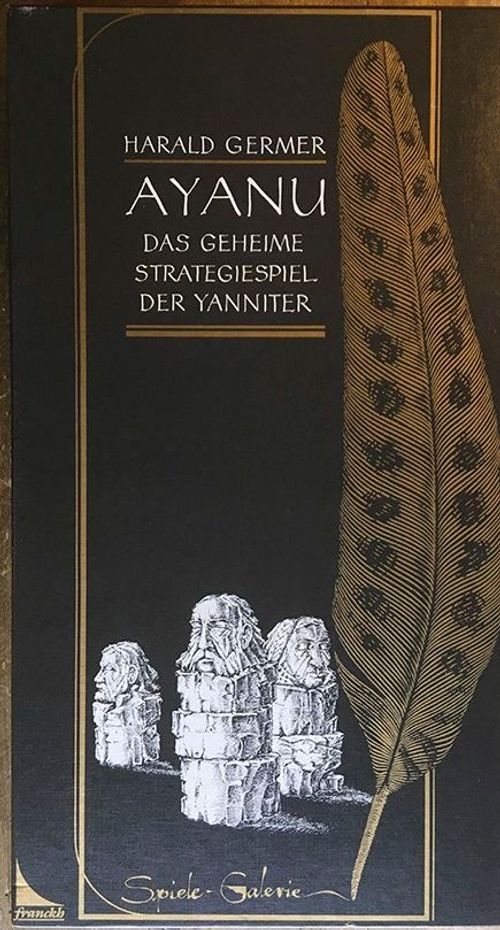
Ayanu
Ayanu Rulebook
Table of Contents
Table of Contents
Unda and Liero's First Conversation
Liero: Dear Unda, of all children from the three sunny years, you have been chosen to become one day our wise and far-sighted ruler. Your tasks will be difficult, and you'll learn many needed skills. We both know your teachers in art and sciences. I need to supervise your training but also I'll introduce you to the art of the AYANU.
Unda: What is this AYANU? I never heard of it!
Liero: AYANU is a game. The secret game of rulers and guides. But it's more than a game, because it sharpens the mind and prudence.
Unda: Then, show it to me so I can learn to play it.
Liero: The rules are easily explained. This map is the world of AYANU, a 9x9 square grid. No two pieces can simultaneously occupy a given field. There are two additional fields that are the objective fields. Your goal is behind your opponent's castle (fields marked with 'X'). Your opponent's goal is protected by your castle. The winner is the first player to reach his goal.
Unda: Easy. And how do the pieces move on the fields?
Liero: Each figure consists of two parts: body and head. The body determines the movement strength, the head determines its quality, i.e., the direction of movement.
Unda: I can see three base types. What do they do?
Liero: Yes, each player has three small, three medium, and three large bases. The base height determines the range of movement. The figures with a small base move one field, those with medium bases move up to two fields, and figures with large bases move up to three fields.
Unda: It's simple. But what about the direction of movement? And what are the heads needed for?
Liero: Slowly, slowly! The head indicates the direction of movement and, as you can see, there are five head types.
Unda: The heads fit on the bodies!
Liero: Of course! I explain it to you:
- This is ONNU, the force. A figure with this head moves horizontally or vertically, not diagonally. While moving, ONNU cannot change directions.
- This is ITTA, the elegance. A figure with this head moves diagonally. While moving, ITTA cannot change directions.
- This is ESSA, the power. A figure with this head moves horizontally, vertically, and diagonally.
- This is URUM, the persistence. A figure with this head can't move, but can't be beaten by an enemy figure. URUM may never set foot in his own castle.
- This is AYANU, the spirit. It moves like ESSA, but it can jump over other pieces and change the direction of movement. When placed on a large body, it's the strongest figure and usually decides the game.
Unda: Well, I know how to move the figures now.
Liero: No! A crucial rule is still missing. Whenever a figure is moved, the player must exchange this figure's head for a different head taken from another figure.
Unda: Oh, I understand. So even URUM can change its position.
Liero: Right! You're almost ready to start playing. You only need to know that an opponent's piece can be defeated by occupying the field in which it stands.
Unda: Who wins the game?
Liero: The player who first reaches his goal field, or else forces his opponent to move URUM to its castle.
Unda: Is a draw also possible?
Liero: Yes, when no one can reach his goal field.
Unda: Then, let's play!
Liero: Good, you'll learn a lot to think about. Yet another advice: the center is important. The middle figures are the fighters. URUM must be besieged. The little figures are tough defenders, when one of them has the power (ESSA). But AYANU usually decides the game.
Now place your pieces as I'm doing here (see figure) and start the game, because you play with the grey pieces - the day comes before the night.
Game Summary
The winner is the player who moves one of his pieces into the semi-circular field behind his opponent's castle, on the opposite side of the board. Also, if a player is forced, during the course of the game, to place his URUM piece into his own castle, this player has lost the game.
On the game board, each player's castle is marked as 2x3 crossed squares. Behind each castle lies a semi-circular field, the goal field of the opponent.
The game figures consist of two parts: a base and a head.
Initial Configuration
The board is a 9x9 grid with columns 1-9 and the rows nearest each player labelled a, b, c. At the start, the figures (bases plus heads) must be placed in the following fields:
- 5c: URUM + middle base
- 1a, 9a: ONNU + high base
- 2a, 8a: ITTA + middle base
- 4b, 5b, 6b: ESSA + low base
- 5a: AYANU + high base
The base height determines each figure's range of movement:
- low base: 1 space
- middle base: 1 or 2 spaces
- high base: 1, 2 or 3 spaces
The heads determine the figures' direction of movement:
- ONNU: moves horizontally or vertically
- ITTA: moves diagonally
- ESSA: moves horizontally, vertically or diagonally
- URUM: cannot move and can't be beaten.
- AYANU: moves like ESSA but it can, however, change the direction of movement while on the same turn, and it can also jump over other pieces (no matter which color). Jumped fields count towards the figure's range of movement.
Except AYANU, no other figure can change direction while moving or jump over other pieces. All figures but URUM can be beaten.
The active player must move one of his figures according with the limitations imposed by the chosen figure's base and head. Then, he must exchange this figure's head for a different head taken from another figure.
If URUM's head is exchanged, it must never be placed on a base in his own castle. Otherwise, this player loses the game at once.
An opponent's figure can be beaten by occupying the field in which it stands. The captured figure (base and head) is removed from the game.
A piece can't continue its movement after capturing another figure. And the head exchange rule applies: at the end of the turn, even if a piece has been captured, the moved figure must exchange its head for a different head.
The game ends when one of the goals mentioned at the beginning is reached.