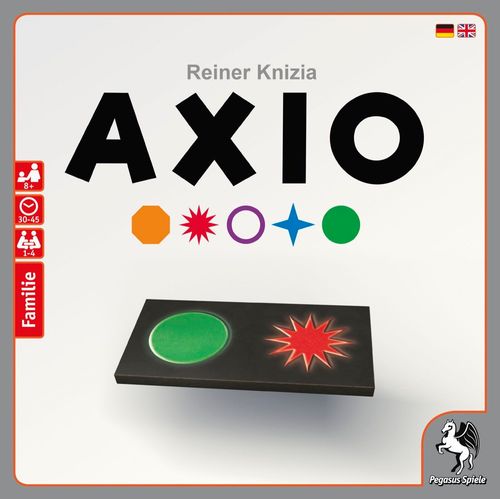
Axio
Axio Rulebook
Table of Contents
Table of Contents
Components
- 1 game board
- 4 scoreboards
- 20 score markers (4 sets)
- 100 tiles (8 each of the two-color tiles, 4 each of the matching-color tiles)
- 4 tile racks
- 1 tile bag
- 20 pyramids
Preparation
-
Place the game board in the middle of the playing area.
-
Place the pyramids next to the game board so they are easily accessible.
-
Each player takes
- 1 tile rack,
- 1 scoreboard,
- 5 score markers – 1 each in red, green, blue, orange and purple.
Players should place their tile rack and scoreboard next to one another in front of them. Then place each score marker on the matching colored start space (0). The scoreboards must remain easily visible to all players during the game.
When playing with fewer than 4 players return any unused components to the box.
-
Put all the tiles in the bag. Then each player draws 5 tiles and places them in their tile rack. Take care that opponents cannot see the colors on your tiles.
Goal of the Game
In turn order players place 1 tile on the game board. Players then score points for all tiles with identical colors in unbroken rows from the placed tile, tracking each color on their scoreboard. At the end of the game, players will compare scores for their lowest scoring color. The winner is the player with the highest points for that color. Therefore always work on improving your lowest scores.
Game Play
Summary of Play
The youngest player starts the game by placing 1 of his 5 tiles on the game board. He then calculates his score and adds it to his scoreboard. He ends his turn by drawing 1 tile from the bag. Play now continues with the next player in clockwise order until there are no legal tile plays left on the game board. Then determine the winner.
Detailed Sequence of Play
On your turn follow this sequence of play:
- Place 1 tile on the game board.
- Score the placed tile.
- Place possible pyramids.
- Draw back up to 5 tiles.
1. Place 1 tile on the game board.
Play area to use for each number of players:
Depending on the number of players, you may only use a restricted area of the game board.
- 2-Player Game: Use only the white 9x9 area in the center of the game board.
- 3-Player Game: In addition to the central white area, add the light gray spaces. This provides an 11x11 play area.
- 4-Player Game: Add the dark gray spaces so that the entire 13x13 play area is available for play.
The first tile placement of each player:
Select 1 of the 5 tiles from your tile rack. Place it on 2 empty spaces in the play area. The first tile for each player must be adjacent to 1 side of 1 of the 5 printed color spaces on the game board. Players must each place their tile adjacent to a different color space. Hence, after each player has placed their first tile, there may not be more than 1 tile adjacent to any of the 5 color spaces on the game board.
All further tile placements:
Select 1 of the 5 tiles from your tile rack. Place it on 2 empty spaces in the play area. (The 5 color spaces on the game board do not count as empty spaces.) There are no additional restrictions for laying the tiles. (It is even possible to place a tile such that it is not adjacent to any other tile or color space.)
Try to place the tiles so that you collect as many points as possible. Also, try to block your opponents from scoring points too easily.
2. Score the placed tile.
Each tile consists of 2 halves. First score 1 of the colors on the tile, then the other. (It makes no difference for scoring whether the tile has 2 different colors or 2 matching colors.) Both scores are carried out independently as follows:
You always calculate points from the placed tile in the 3 directions shown in the example. The fourth direction, leading to the other half of the placed tile, is not scored.
In each direction score 1 point for each matching color symbol, regardless of wether they appear on other tiles or printed color spaces. Never count any color on the placed tile itself. Stop counting as soon as you reach a different color, an empty space, or the edge of the play area.
Then add your points for all 3 directions to the corresponding colored score marker on your scoreboard.
Note: Sometimes you will only score points for 1 half of your tile.
Examples: 1 point in blue. — 3 points in blue and 2 points in red. — 4 points in blue and 2 points in red.
3. Place possible pyramids.
You may create 1 or more isolated spaces by your tile placement. These consist of a single empty space that is completely surrounded by tiles (or possibly by 1 of the 5 printed color spaces or by the edge of the play area). Immediately place 1 pyramid on each isolated space and score 1 point for each color symbol that is adjacent to the pyramid.
Example: After placing her tile, Anne scores 3 points in blue. With her placement Anne created an isolated space and places 1 Pyramid there. This scores her 1 point each in green, blue and red.
Note: If all of the pyramids are already on the game board, move 1 of the previously placed pyramids to the newly created isolated space. Empty spaces resulting from this movement remain empty for the rest of the game.
4. Draw back up to 5 tiles.
At the end of your turn refill your tile rack to 5 tiles again by drawing 1 tile from the bag.
Exchange option:
Before you draw new tiles at the end of your turn, check your exchange option: If you do not have any tiles showing your currently lowest scoring color(s) on your tile rack, you have the option to exchange your tiles as follows:
Place all of your tiles face up next to your tile rack so your opponents can verify they show none of your lowest scoring color(s). Then draw 5 new tiles from the bag and place them in your tile rack. Finally put the revealed tiles back into the bag.
Call out "AXIO" if you reach 18 on a track on your scoreboard and receive 1 extra turn
You may not score more than 18 points for any color on your scoreboard. If you reach a score of 18 points for a color, stop scoring that color. (Any leftover points are lost.) Call "AXIO" and finish the scoring for that tile and/or pyramids. Then receive 1 extra turn. Place 1 extra tile from your tile rack on the game board and score it as usual (see points 1.-3. above).
Once you have completed all extra turns, draw back up to 5 tiles and end your turn.
Game End
At the beginning of their turn, if a player cannot place a tile on the game board in the play area, the game ends immediately. Now, determine the winner:
Players compare scores for their lowest scoring color. The winner is the player with the highest points for that color. (The specific color does not matter.)
Example: In a 2-player game, Anne has scored the fewest points in red. Her red score marker shows 11 points. Kate has scored the fewest points in blue. Her blue score marker shows 8 points. Therefore Anne is the winner.
In case of a tie, the tied players compare points for their next lowest scoring color. The winner is the player with the highest points for that color, and so on.
Example: In a 3-player game, the lowest score for all 3 players is tied at 9. Therefore the next lowest score must be compared to determine the winner. Anne has scored 11 points, but both Kate and Julia have scored 12 points. Now the third lowest score for both tied players must be compared for the victory. Kate again has 12 points but Julia has 15. Julia wins the game.
In the very rare case that 2 (or more) players tie for all 5 scoring colors, they share the victory.
In the rare instance that a player reaches 18 points for all five colors, they win immediately.
Rules for 1 Player
All rules apply without change except as follows:
You do not need a tile rack.
As in a 2-player game, you only use the white 9x9 area of the game board.
Place 2 scoreboards next to each other in front of you. As soon as a color has scored 18 points on the first scoreboard, the scoring for that color stops here. (Any leftover points are lost.) Instead, immediately shift the score marker to the start space for that color on the second scoreboard to enable additional scoring later.
Always draw 1 tile and immediately place it on the game board according to the usual rules. Now score the tile on your scoreboard. Then draw the next tile. (Note you do not get an extra turn on either of the two scoreboards when you reach a score of 18 in a color.)
At the end of the game, determine the score of the color with the lowest points. (Remember you must add 18 points to any score marker on the second scoreboard.) Try to achieve a better score in future games. What is the highest score you can achieve?