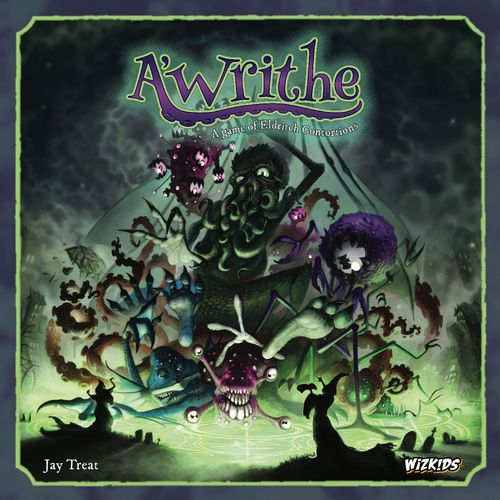
A'Writhe: A Game of Eldritch Contortions
A'Writhe: A Game of Eldritch Contortions Rulebook
Table of Contents
Table of Contents
Overview
In A'Writhe, players form teams of two. One player on each team writhes like the tentacled, eldritch monstrosity they are, while their mortal partner plans, adapts, and makes humble suggestions. When a Cultist gets the appendages from any combination of Great Old Ones to form a pattern of corruption in Arkham matching the one shown on their current Sigil card, they complete it. The first team to complete three Sigil cards wins.
Setup
-
Form teams of two: one player starts as a Great Old One and the other as a Cultist. Great Old Ones, remove your footwear, if you're comfortable doing so.
-
Choose a game mode. For your first game, and for the most strategic experience, play the turn-based Ritual Mode. For a faster game, play the real-time Chaos Mode. For the sweet spot in between, play the Rhythm Mode. And if you're short on players or brain power, try Last Great Old One Standing.
-
With six players, set out all 20 locations in a 5x4 grid, with matching terrain types (colors) in columns and matching energies (symbols) in rows. With four players, choose a terrain type to exclude and set out the remaining 16 locations in a 4x4 grid. Space the mats about ½" apart. For a slightly easier game, put them right next to each other (but never overlapping), and for a harder game, space them up to 1½" apart.
This play area is called Arkham. All players begin outside of Arkham and Cultists will never enter it. Great Old Ones will be putting their hands and feet (appendages) on various locations in Arkham during the game (thus corrupting that location while it is occupied by an appendage), but should not touch the play area with appendages they haven't used to corrupt a location, or with other body parts. You can rest other parts of your body outside Arkham.
You can refer to a location in Arkham anyway you like. The easiest way for your Great Old One to find it, though, will be to name its terrain—Woods (green), River (blue), Earth (brown), Mist (grey), or Field (yellow)—and its energy—Death (skull), Night (moon), Sight (eye), Magic (pentagram): "Mist Death," "Earth Sight," etc. "Blue Moon" is fine too, as is just naming the location, "Police Station."
-
Determine a turn order, perhaps matching how evil and alien each Great Old One can sound.
-
In turn order, each Great Old One chooses an identity card. Choose a side with a power that has a symbol that matches your game mode (the Ritual/Rhythm symbol for Ritual or Rhythm, the Chaos symbol for Chaos). Read your special power for all to hear. Check the glossary for details on each power.
-
Shuffle the deck of Sigil cards and deal one to each Cultist. Leave the deck where all Cultists can find it.
-
Your team wants all five of the spaces marked by green runes on your Sigil card to be corrupted (occupied by any Great Old One's appendage) simultaneously. With 3 teams, you also need the two spaces marked by red runes to be corrupted. Empty spaces on your Sigil card don't have to be uncorrupted locations in Arkham, they just have to exist in the play area.
How do you corrupt five locations when your Great Old One only has four appendages? By using other Great Old Ones! Any corruption fulfills your requirements, regardless of whose it is.
Cultists can orient their Sigil card however they like, whenever they like, and can align it to any of Arkham's borders, but all 16 spaces on the card must be contained within the play area, including empty rows/columns. Cultists cannot flip their Sigil card to its other face except when other rules or powers explicitly allow that. Never look at the other face of your Sigil card.
Example: Meena has this Sigil card in a two-team game, and can score it when five locations are corrupted in Arkham matching the pattern of green runes on the card.
Example: Ben has this Sigil card in a three-team game, and can score it when seven locations are corrupted in Arkham matching the pattern of all runes on the card.
Example: Jess has this Sigil card and can orient it in any of these 4 rotations relative to Arkham. In a game with a 5x4 play area, she can also decide whether to align it to the leftmost column or the rightmost column.
Note: the example diagrams are printed as images in the rulebook; the figures above describe them as the printed captions do.
Play (Ritual Mode)
On your team's turn, the Cultist recommends a move for the Great Old One to make, and the Great Old One moves any one of their appendages to any unoccupied location, corrupting it. The Cultist always addresses their Great Old One with an ominous honorific or true name of their making. There are samples on the Sigil cards.
Great Old Ones corrupt an uncorrupted location with one of their appendages, moving a hand or foot onto that location. If all their appendages are already corrupting locations, they will have to move one of them, leaving a previously corrupted space uncorrupted.
In Ritual Mode, all turns end after 10 seconds.
If a Cultist intentionally takes a long time (more than 10 seconds) in order to gain an advantage, skip their team's turn. Not cool, Howard.
In Chaos Mode, there are no turns. Cultists can recommend moves as often as they like and Great Old Ones can move as fast as they please.
In Chaos Mode, Great Old Ones can't undo their last move. If you move your right arm to the green eye location from the blue moon location, your next move cannot be to return your right arm to the blue moon. You could move another appendage there.
If no Great Old Ones move for a long time (10 seconds) in Chaos Mode, all Cultists flip their Sigil cards to their other face.
Rhythm Mode is identical to Ritual Mode, except there is a strict time limit of 10 seconds for each Cultist to make a suggestion to their Great Old One each turn. If they miss it, the Great Old One can move arbitrarily or stay where they are.
If a Great Old One ever touches Arkham with a body part that isn't an appendage corrupting a location, they have fallen.
When a Great Old One falls, they are banished from Arkham, and their Cultist flips their Sigil card to its other face. The Great Old One switches roles with their Cultist, unless that player doesn't want to writhe or can't writhe safely.
Officially, if a Great Old One ever stops touching a location they're corrupting, apart from moving that appendage to another location (or removing it because of a power), that's falling too, but your group is encouraged to discuss the option of leniency with this rule, especially if Cultists are taking longer than 10 seconds or so to make suggestions.
Scoring a Sigil Card
When a Cultist believes they've fulfilled the conditions of their Sigil, loudly declare "SUCCESS." All play stops while you show the Sigil to another Cultist to confirm it's completed. If it is, score it face-up and draw a new one. If not, play continues. Either way, Great Old Ones remain where they are.
Whenever a team completes a Sigil, the Cultists not on that team may choose to flip their current Sigil card to its other face.
If you draw a Sigil card or flip it to its other face and find it's already completed, don't score it. Instead, put it on the bottom of the deck and draw a new one. There are no free passes when summoning the end of the world.
Tim & Ben's Sigil Card
We see Tim—the Great Old One—is on Mist Magic, Earth Magic, and Earth Sight. Another Great Old One, Meena, is on Woods Magic and Woods Sight. The third Great Old One, Jess, is on Earth Night and Woods Night.
Tim's loyal Cultist Ben is eager to complete this Sigil card. Five of the seven runes of his Sigil are corrupted in Arkham, but he knows Tim only has one appendage left and it doesn't seem like Meena or Jess are going to be moving to his locations soon. He rotates his card to see if there are other options. Ben realizes that if he rotates his Sigil 180° from how he's been looking at it and aligns it to the right column, that there's only one location Tim needs to corrupt: "Limitless Plague of Torment," Ben says to Tim, "if you corrupt the Earth Death location, we'll break the final seal and you'll be free!"
Note that Ben can align this Sigil to the left 4 columns of Arkham (leaving Field unmatched) or to the right 4 columns (leaving River unmatched), but he couldn't align it one column further to the right even though that column in his Sigil is empty, because all 16 spaces on the Sigil card must be within the play area of Arkham.
Note: the scoring diagrams (Edge aligned to left column, Edge aligned to right column, and the Field and River columns not used) are printed as images.
Players, please respect each other's bodies and boundaries: Don't make other players uncomfortable. Do not touch another player in a way that they're not okay with. Ask, if you're unsure.
If you violate another player's boundaries, they can and should eliminate you from the game (or more, depending on the severity and intention of your action).
If you fall because you're bumped, you may decide you're not okay with being bumped, in which case you resume your place; If you feel the bump was unkind, you can and should eliminate the disrespectful player from the game.
End
The first team to score 3 Sigils wins the game.
Last Great Old One Standing (No Teams) for 2-4 Players
In this simplified variant, all players are Great Old Ones, writhing and striving to be the last One standing.
With three or four Great Old Ones, make Arkham 5x4. With two, make it 4x4.
There are no powers in this variant, though players can still choose which Great Old One they'd like to be.
Determine a turn order, perhaps from most fit and flexible to least.
On your turn, choose a row or column and call it out by its terrain/color or energy/symbol.
Every player must then corrupt an uncorrupted space in that row/column (placing a hand or foot there). If two players try to corrupt the same space, the faster player succeeds.
If there are no uncorrupted spaces, then corrupt a location next to the row or column.
When a Great Old One falls, they are out of the game. When only one remains, they win.
If a player intentionally takes a long time to gain an advantage (10 seconds or so), skip their turn.
Game Contents
- 20 Location Mats
- 18 Sigil Cards (Double Sided)
- 8 Great Old One Role Cards (Double Sided)
Note: the component list is printed as an image with the location mats grouped by terrain (Field, Mist, River, Earth, Woods); only the counts are given above.
Glossary
- Ritual/Rhythm symbol: Powers marked with this symbol can only be chosen in turn-based Ritual and Rhythm Modes.
- Chaos symbol: Powers marked with this symbol can only be chosen in real-time Chaos Mode.
- Appendage: One of a Great Old One's arms, legs, or tentacles.
- Arkham: The play area, comprised of 16 or 20 location mats.
- Banish: If an appendage is banished, stop touching the location that appendage was corrupting. That location is now uncorrupted. If a Great Old One is banished, they remove all their appendages from all locations they were corrupting, exiting the play area.
- Corrupt: When a Great Old One puts an appendage on a location, they corrupt it.
- Cultist: A human in league with an unthinkable cosmic horror. This player is free to move outside of Arkham so they can see the play area and advise their partner how to move in order to complete their Sigil.
- Great Old One: An evil alien entity from another plane of existence. This player will be stretching over Arkham in an attempt to corrupt the locations their partner needs to complete their Sigil.
- Location: Arkham is comprised of 16 or 20 locations, a grid of mats.
- Power: Each Great Old One has one of two unique powers chosen at the start of the game. Some are used by the Cultist in the team. Read the power from the Great Old One's perspective.
- A location that has never been corrupted, or that a Great Old One has vacated, is uncorrupted.
Explanation of Powers
Note: each power's mode symbol (Ritual/Rhythm or Chaos) is printed as an icon on the power card and is not reproduced in this text.
Bokrug — Immovable: Normally, if a Great Old One touches Arkham other than corrupting a location with an appendage, they fall. You can rest any part of your body anywhere, so long as you're not blocking access to locations, or obscuring exactly which locations you're corrupting and which you aren't.
Bokrug — Compelling: Whenever you corrupt one of the four river (blue) locations, you can force another Great Old One to choose an unoccupied river and corrupt it. If there are no unoccupied rivers, your power has no effect.
Cthulhu — Cunning: Great Old Ones are normally restricted to using their hands and feet as appendages, but you have the option of using your head as an appendage as well. No powers can force you to use your head, though they might force you to move it or remove it once it's in Arkham. You can banish your own head from Arkham at any time without falling.
Cthulhu — Eldritch: Once per game, instead of completing a Sigil card by corrupting all the required locations, you may complete the card by corrupting the four locations most distant from each other in Arkham, the corners. But those four locations must be corrupted by Cthulhu and none other.
Ghatanothoa — Amorphous: At any time, you can redistribute your appendages between the locations you are corrupting.
Ghatanothoa — Hideous: During your turn, you can choose a location you are corrupting and a location another Great Old One is corrupting. Move the appendage corrupting your location to the other location as the opposing Great Old One does the opposite.
Gol-Goroth — Incomprehensible: At any time, your Cultist can choose to flip your current Sigil card to its other face. Use this power only once until you score. (As usual, if it would score immediately, replace it.)
Gol-Goroth — Vexing: Whenever a Sigil is completed, opposing Cultists normally have the option to flip their current Sigil card to its other face. This power allows your Cultist to force any of them to do so at that time.
Hastur — All Seeing: It's not uncommon for a Great Old One's appendage to meander slightly from the location it's corrupting and normally we ignore that. With this power, if you see an appendage touching a location other than the one it's corrupting, or not touching the one that it is, you can banish that appendage.
Hastur — Untouchable: If another Great Old One moves and that movement causes physical contact with you, you can banish one of that Great Old One's appendages. If your movement causes physical contact, nothing happens. Please check the rules for more information about violating players' boundaries.
Nug & Yeb — Cruel: Once per game, at any time a Sigil card's success isn't being evaluated, banish a Great Old One from Arkham.
Nug & Yeb — Awful: During your turn, you can banish a Great Old One from a location horizontally or vertically (not diagonally) adjacent to one you corrupt. You can do this only once until your Cultist draws a new Sigil card.
Rhan-Tegoth — Dreaming: Cultists need to speak in strange voices. Anything distinctly unusual for that player is fine. Great Old Ones must ignore any suggestions they hear spoken in a normal voice.
Rhan-Tegoth — Harbinger: Normally, Cultists are advised to address their Great Old Ones with an honorific. You enforce this etiquette. Whenever you hear another Cultist address their Great Old One without an honorific, your Cultist looks at their Sigil card and may swap yours for theirs.
Yig — Forboding: During your turn, you can name one specific location that is currently uncorrupted. No Great Old Ones can corrupt that location until your next turn. You can forbid the same location next turn, or a different one. If you don't expressly forbid something, nothing is forbidden.
Yig — Puppet Master: Whenever you move, you can choose to banish one of your appendages corrupting a location in Arkham. If you do, banish the same appendage of all other Great Old Ones who are corrupting a location with that appendage.