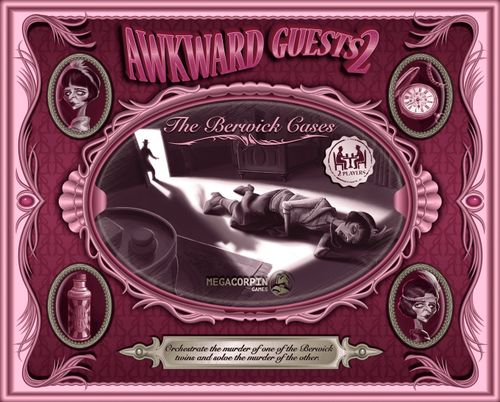
Awkward Guests 2: The Berwick Cases
Awkward Guests 2: The Berwick Cases Rulebook
Table of Contents
Table of Contents
Game Description
Awkward Guests 2: The Berwick Cases is a game of dice, mystery and deduction that offers you the challenge of not only solving the homicide of one of the Berwick twins… but also of orchestrating the murder of the other one.
In each of the cases you will lead a different role. In one case you will be the mastermind that ORCHESTRATES the murder of one of the twins, while in the other case, you will be the investigator that tries to SOLVE the murder of the other twin.
The first investigator to answer these questions correctly:
- WHO killed Beatrice/Berenice Berwick?
- WHY did they do it?
- HOW did they end her life?
...wins the game.
2 players, ages 12+, 30-40 minutes.
Game Contents
- This rulebook.
- 3 inquiry dice.
- 6 suspect cards.
- 1 notebook with tracking sheets (double sided).
- 1 inquiry board (double sided).
- 2 screens to prevent "awkward glances".
- 60 game cards, divided into two sets, one for each case:
- 10 forensic sign cards per case.
- 18 connection cards per case.
- 1 "I'll keep investigating" card per case.
- 1 "I resolve" card per case.
Each inquiry die has the following sides: forensics, evidence, testimonies, interrogations, the help, the help (this side appears twice).
The Tracking Sheet
Each side of the AWKWARD GUESTS 2: The Berwick Cases tracking sheet represents one of the murder cases of the Berwick sisters: Beatrice and Berenice. Both cases have exactly the same elements except for the blueprints of the mansions, which are mirror images of each other.
Each side of the tracking sheet has these areas:
- Role Area — to mark your role in this case: mastermind or investigator.
- Failed attempt checkboxes — used to keep track of your failed attempts to solve this case.
- Case header — specifies what case (Beatrice or Berenice) this side of the board corresponds to.
- Solution Area — to write the solution for this case: killer, motive, and weapon.
- Suspects Area — to register information about the suspects' motives and their favorite types of weapons. Each suspect entry shows: the suspect's name, a motive identifier number, the testimony boxes (indicating whether or not testimonies associated with a certain motive have been made — for example, a suspect could testify against another suspect by declaring that they had a certain motive to commit the crime), the evidence boxes (indicating whether or not the evidence associated with a motive has been found — evidence of a motive can be found in a specific room), and the favorite type of weapon boxes (indicating a suspect's favorite type of weapon: the only weapon they would use if they committed the murder).
- Map of the mansion — to jot down the information provided by the help and the alibi rooms used by the suspects.
- Forensics Area — to keep track of information regarding the crime weapon. Each weapon entry shows a weapon type and identifier number, an illustration of the weapon, and the signs the weapon leaves on the corpse when used. The possible signs are: strong odor, heavy bleeding, oily substance, signs of a fight, attacked from behind, burn marks, cyanosis or bruises, defensive wounds, rictus grin, and torn clothing. The possible types of weapons are: blunt, firearms, blades, poisons, and suffocating.
Blueprint of the Mansion
- Each room has a distinctive symbol assigned to it.
- The bedroom is the Crime scene, the room where both Beatrice and Berenice were killed.
- Walk-in rooms: Greenhouse, Gallery, Dining room, Study, Bathroom.
- Starting rooms (the only ones the suspects can identify as their alibi rooms): Guest house, Porch, Tea Room, Vestibule.
- The connections between rooms are the possible paths the killer could have taken to cross from one room to another.
- Footprints marked with the suspects' initials are crossed out during the game to mark what suspects did not pass through that room. They are only present in walk-in rooms.
- Numbers in a room represent the weapons found in that room. To identify them, see the Forensics Area.
- A suspect's alibi room is where they say they were at the time of the murder. For the murderer, it is the room from which they began their journey to the bedroom. During the investigation, the suspects' alibi boxes are where you write the initials of the suspects who say they were in that room at the time of the murder. The murderer's alibi box is where, when orchestrating the murder, you write the murderer's initial to identify it as their alibi room.
Game Objective
The goal of the game is to solve the murder orchestrated by your opponent before they solve the one you orchestrated for them. The solution must answer the following questions correctly:
- WHO killed Beatrice/Berenice Berwick?
- WHAT WAS THE MOTIVE?
- WHICH WEAPON was used to end their life?
Game Setup
- Sit facing each other at the game table.
- For each case, assign a role to each player. If you are the investigator for the Beatrice case, your rival will be the mastermind; it will be the other way around for the Berenice case — you will be the mastermind and they will be the investigator.
- Place the Inquiry board between the two of you face up, showing the side of the Beatrice case. Place it so the arrows point to the player with the correct role.
- Leave the suspect cards next to the inquiry board.
- Take a screen and one tracking sheet each. You will also need pencils to write with.
- Place your tracking sheets showing the side of the case of which you are each investigators. In the Role Area, circle the Investigator box. Take the "I resolve" and "I'll keep investigating" cards that correspond to each of your cases.
- Then flip over your tracking sheet. Circle the mastermind box in the Role Area on this side of the sheet. On this side you are going to orchestrate the crime that your rival will try to solve. Victory will depend on your deduction skills and also on how well you design your rival's challenge. Take the connection and forensic sign decks that correspond to each of your cases.
- Let the game begin!
Game Setup Example: Paz and Ron are going to play a game of Awkward Guests 2: The Berwick Cases. The first thing they have to do is assign the roles for each case. In the Beatrice case, Paz will be the investigator and Ron the mastermind. Then in the Berenice case, Ron will be the investigator and Paz the mastermind. The inquiry board is then placed between them, with the Beatrice case side facing up. In the Berenice case, the roles are switched and the sheets and board are flipped to the other side.
Orchestrating the Murders
As the mastermind, follow these 8 steps to orchestrate the murder that your rival must solve.
- Choose a MURDERER from among the 6 suspects. Write their initial in the designated space in the Solution Area.
- Choose the CRIME MOTIVE among the 3 possible options available for that suspect. Use a checkmark to verify the two testimony boxes and the evidence box that belong to that crime motive.
- Designate one of the starting rooms as the murderer's ALIBI ROOM. This is the room they will say they were in at the time of the murder. Write the murderer's initial in that room's murderer's alibi box and cross out one of the suspects' alibi boxes. No more than 3 suspects can be placed in the same room (2 if the killer claims to be in it).
- Trace the PATH followed by the murderer, starting from their alibi room and ending in the bedroom (the crime scene). The path must fulfill these conditions: it MUST use EXACTLY 4 connections, and it CANNOT pass through the same room twice. Check the boxes of the connections used by the murderer to get to the crime scene and circle their footprint in the walk-in rooms they have crossed. Then, take that case's connection deck and return the 4 cards (face down) that correspond to the connections used by your killer to the game box — they will not be used in the game. Shuffle the rest and place them face down next to the inquiry board on your rival's side of the table.
- Choose the CRIME WEAPON among those available in the rooms crossed by the murderer on their path to the crime scene. Write the identifier number of the chosen crime weapon in the space designated for it in the Solution Area. In the Suspects Area, in the killer's profile, mark that type of weapon as their favorite. Find the crime weapon in the Forensics Area and circle its identifier number, then draw a checkmark inside the boxes of the two signs it leaves on the corpse. Then, take the deck of forensic sign cards of the case you are orchestrating and remove the 2 cards that correspond to the signs left by your crime weapon — place them face down inside the game box, they will not be used in the game. Shuffle the rest and place them face down next to the inquiry board, on your rival's side of the table.
- Add false clues to mislead your rival. Mark 5 testimony and 3 evidence boxes related to motives different from the actual crime motive. If you like, you can mark boxes from the other 2 motives available in the murderer's profile. IMPORTANT: No suspect, including the murderer, can have more than one motive fully checkmarked (2 testimonies and 1 evidence).
All set to go! You have now finished orchestrating the murders. Double check everything because from this moment on, it is strictly forbidden to make any modifications. You'll find a summarized help guide of this whole process on the player screens.
IMPORTANT: Once you have finished orchestrating the murder, all remaining boxes without a checkmark are considered crossed out. Place both of your tracking sheets with the Beatrice case facing up and you are now ready to start the game rounds.
Worked Example: Paz follows these steps while designing Berenice's murder (Ron simultaneously follows the same steps to plan Beatrice's murder). (1) Paz chooses Yoriko Yagami (Y) as the murderer. (2) Yoriko Yagami's possible motives are #13, #14 and #15; Paz picks motive #15 as the crime motive. (3) Paz designates the tea room as the murderer's alibi room. (4) Paz traces the murderer's path following the restrictions, requiring her to remove 4 connection cards from the game. (5) Taking into account the rooms crossed by Yoriko Yagami, the available weapons are numbers 1, 3, 5, 7, 10, 14, 16 and 18; Paz chooses the revolver (weapon 7) found in the Study, marks that type of weapon as Yoriko's favorite in her profile, and removes the 2 forensic sign cards for the revolver's signs from the game. (6) Paz marks 5 testimony and 3 evidence false clues to mislead Ron. (7) Paz assigns a favorite type of weapon to all the other innocent suspects. (8) Paz distributes the innocent suspects among the 4 starting rooms.
The Round Sequence
Once both murders have been planned out, the investigations begin. These are played out over an undetermined number of rounds until one investigator (or both) solves their case. Each round consists of the following phases:
- Investigation phase of the Beatrice case.
- Investigation phase of the Berenice case.
- Resolution Phase.
Investigation Phases
The investigation phases for both cases are carried out similarly. In each investigation phase the investigator takes action while the mastermind provides them with information. At the beginning of any investigation phase, it is ESSENTIAL that the inquiry board and the tracking sheets all show the side of the case being investigated.
As the investigator, you must perform the following actions:
- Roll the 3 inquiry dice and reserve, if you like, the ones with results that interest you.
- (Optional) Re-roll all the dice you did not reserve. You may do this only once.
- (Optional) Discard an inquiry die to modify the result of another die.
- Raise queries. With the results obtained in the roll, the investigator will formulate up to 3 queries. To do this, they must place the dice on spaces of the inquiry board that match the results obtained (see the Inquiries section below).
- Solving queries. The investigator chooses the order in which the queries are resolved and writes the information obtained on their tracking sheet. When required to intervene, the mastermind must always share TRUTHFUL information about the murder they orchestrated.
- Flip over the inquiry board and the tracking sheets. Once the queries are resolved, the dice are set aside and the inquiry board and tracking sheets are flipped over, ready for the investigation phase of the other case.
Worked Example: (1) Paz has obtained her dice results after rolling and decides to reserve one of the results. (2) Paz rerolls the dice she had not reserved, obtaining new results. (3) Paz has 3 available dice to use, but decides to discard one of them in order to change the result of another, leaving her with 2 available dice.
Inquiries
To raise a query, the investigator must place an inquiry die in one of the spaces of the inquiry board that matches the symbol obtained on the die. The die results are: testimonies, evidence, interrogations, the help, and forensics.
Testimonies
The investigator, in addition to placing the die on a space, also picks 2 suspect cards that they have not yet used in any other query of that turn.
- How are they useful? They reveal if the chosen suspects have testified against each other regarding any of their motives.
- How is it played out? The mastermind will reveal whether or not the chosen suspects have testified against each other: meaning, which of the boxes under their motives that show each other's initials have a checkmark and which ones do not. If there is more than one box with the other suspect's initial, the mastermind is obliged to reveal the information in each one of those boxes.
Evidence
- How are they useful? They reveal if there was evidence found in the chosen room, related to specific motives.
- How is it played out? After the investigator places the die in a room, the mastermind will reveal whether or not evidence was found in that room associated with any of the suspects' motives. In other words, which of the evidence boxes with a matching icon have a checkmark and which ones do not.
Interrogations
The investigator, in addition to placing the die on a space, also picks 2 suspect cards that they have not yet used in any other query of that turn.
- How are they useful? They reveal the chosen suspects' favorite type of weapon or alibi rooms.
- How is it played out? The investigator chooses between favorite type of weapon or alibi room, and the mastermind will reveal that information for both suspects.
The Help
How this query works depends on the space where the investigator places the die:
- If the investigator places it in the connections space, they draw, face down, 2 connection cards of the case they are investigating and cross out those corresponding connections on their tracking sheet.
- If they place the die in a room, the mastermind will then reveal the names of 3 suspects who did not pass through that room. The second time this result is used in the same room, the mastermind will reveal the names of 2 other suspects who did not pass through that room. This result CANNOT be used more than 2 times in the same room.
Optional rule: The investigator, in addition to placing the die on a space, may also play 2 suspect cards that they have not yet used in any other query of that turn so the mastermind reveals which of them did not pass through that room. The cards of suspects that have already been determined to have not passed through that room cannot be used.
Forensics
- How are they useful? They reveal signs that were NOT found on the corpse and therefore help rule out weapons that are not the murder weapon.
- How is it played out? The investigator secretly draws 1 forensic sign card of the case they are investigating and discards all the weapons associated with the sign shown on the card.
Resolution Phase
At this phase of the game you will decide whether to solve the case orchestrated by your rival or continue investigating. Throughout the game, each investigator will have only 3 attempts to solve the murder. If a player fails to solve the case on their third attempt, they automatically lose the game.
During this phase, you will both take your "I resolve" and "I'll keep investigating" cards, and secretly choose the one that matches your intentions before simultaneously revealing them to each other.
- If you both decide to continue investigating, start a new round as described earlier.
- If at least one of you decides to resolve, that player (or players) must write their hypothesis in the Solution Area of their tracking sheet. This is composed of: MURDERER'S INITIAL, MOTIVE IDENTIFIER NUMBER, AND WEAPON IDENTIFIER NUMBER. They will then reveal their hypothesis to their opponent.
- If all 3 pieces of information are correct, and ONLY then, will the mastermind say: "The case has been solved." The player acting as the investigator wins and the game ends. If both players resolve correctly during the same resolution phase, the one who has used the least attempts wins. If they have both used the same number of attempts, whoever drew the least number of cards (adding connection and forensic signs) wins. If they both drew the same number of cards, whoever can reveal the correct path followed by the murderer wins. If the tie still persists, both players share the victory.
- Every time a player fails to solve, they must cross out one of the failed attempt boxes on their tracking sheet. When they cross out the third box, they automatically lose the game.
- In any other case, the mastermind will say: "Keep investigating!", without providing any additional information. Then start a new round as described earlier.
What's the penalty for answering incorrectly when trying to resolve?
- If both investigators try to solve and both fail, they will both cross out a failed attempt box on the investigator side of their tracking sheets.
- If only one of the investigators attempts to resolve and fails, only they will cross out a failed attempt box on the investigator side of their tracking sheet. Their rival will then immediately receive a bonus query in which they will roll 3 inquiry dice and ONLY USE THE RESULT OF ONE of them. After that, they will be given the option to try to solve their case. If they take it and fail, they will cross out a failed attempt box on the investigator side of their tracking sheet.
- After no one resolves correctly, start a new round.
Reference: Suspects, Motives, Signs, and Weapons
The reference card lists the 6 suspects, their 3 possible motives each, and the signs and weapon types found in the Forensics Area.
Suspects and Their Possible Motives
- Desmond Duncan
- Ancestral affront: Mr. Duncan had never gotten over the ridicule his ancestor had suffered from one of the Berwick sisters' ancestors.
- Compromised honor: Senator Duncan's political career was in jeopardy because of a certain piece of information held by the Berwick sisters.
- Psychedelic migraines: Mr. Duncan never forgave the Berwick sisters for providing his wife with illegal medication.
- Emily Eckhart 4. Profitable kidnapping: One of Mrs. Eckhart's sons was "retained" by the Berwicks in order to extort her. 5. Convicted witness: Mrs. Eckhart held a grudge against the Berwicks for testifying against her during a trial. 6. Congregation threat: Mrs. Eckhart was irritated by the Berwicks' lack of contributions to her fundraisers.
- Quinton Quills 7. Avenged pets: Mr. Quills blamed the Berwicks for the disappearance of his kittens. 8. Gastronomic outrage: The Berwicks had had the audacity to make culinary changes to Mr. Quill's favorite dish. 9. Wounded heart: Mr. Quills was spiteful towards the Berwicks because of his unrequited love towards them.
- Remedios del Real 10. Culinary espionage: Ms. del Real accused the Berwicks of stealing her secret recipes to write a book. 11. Perverse blackmail: Ms. del Real was suspicious that the Berwicks had leaked compromising photos of her. 12. Lethal jealousy: Ms. del Real couldn't stand seeing the Berwicks wooed by other suitors.
- Yoriko Yagami 13. Narcotic competition: Mrs. Yagami had lost her monopoly over "recreational medicine" because of the Berwicks. 14. Insurmountable debt: Mrs. Yagami claimed payment from the Berwicks over many of her artistic creations. 15. Compromising sect: Mrs. Yagami wanted to punish the Berwicks for leaving her collective meditation group.
- Zachariah Zilber 16. Sickening completism: Mr. Zilber obsessed over a collection piece in the Berwicks' possession. 17. Crushed pride: Mr. Zilber did not tolerate how the Berwicks constantly mocked him. 18. Fatal property: Mr. Zilber longed to get ahold of some real estate that belonged to his deceased wife, aunt of the Berwicks.
Signs and Types of Weapons
- Signs a weapon leaves on the corpse: strong odor, heavy bleeding, oily substance, signs of a fight, attacked from behind, burn marks, cyanosis or bruises, defensive wounds, rictus grin, torn clothing.
- Types of weapons: blunt, firearms, blades, poisons, suffocating.
Rooms
- Crime scene room: Bedroom.
- Walk-in rooms: Greenhouse, Gallery, Dining room, Study, Bathroom.
- Starting rooms: Guest house, Porch, Tea room, Vestibule.