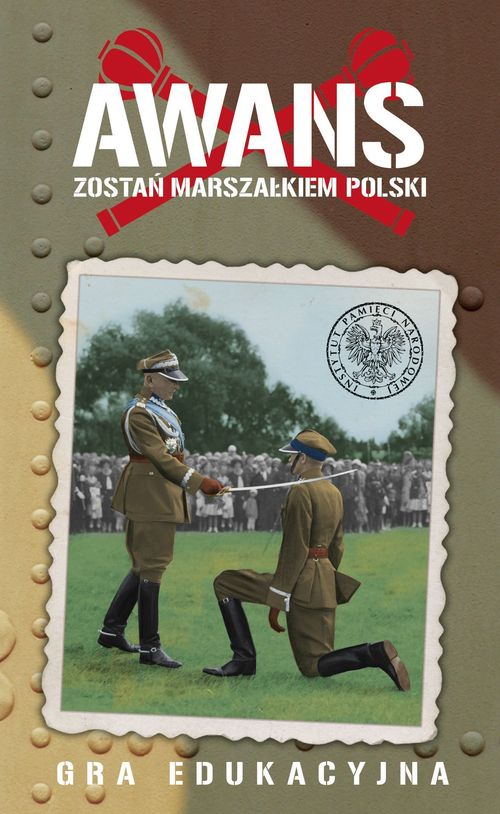
Awans: Zostań Marszałkiem Polski
Awans: Zostań Marszałkiem Polski Rulebook
Table of Contents
Table of Contents
Components
- A two-sided board showing the hierarchy of military ranks.
- 54 cards, divided into 3 decks of 18 cards: Land Forces (sił lądowych), Air Forces (sił lotniczych), and Navy (marynarki wojennej).
- 1 help card with a summary of the rules.
- 3 soldier pawns in colours matching the uniforms of the respective branches of the armed forces.
- This booklet with instructions and historical notes.
*Insignia and other uniform elements shown in the game that are digital reconstructions are marked with an asterisk (*).
* The Marshal of Poland (Marszałek Polski) was commander of all armed forces, land, air and naval alike. For that reason he is the highest card in all three decks.
Setup
- At ease!
- Place the board on the table.
- Divide the cards into three separate decks: Land Forces, Air Forces and Navy.
- Choose a soldier in your favourite colour and place it on the "Start" space.
- Take the deck in the colour of your pawn, shuffle it and place it face down (eagle side up) in front of you. In a two-player game, the unused pawn and deck are returned to the box.
- Draw 3 cards from your deck into your hand, and place the fourth card face up on the table in front of you.
Course of Play
The game is played in successive turns until the game ends. Each turn consists of three phases:
- Clash (Starcie),
- Promotion (Awans),
- Replenishment (Uzupełnienia).
1. Clash
All players simultaneously choose one card from their hand and place it face down (eagle side up) in front of them. Then they simultaneously reveal these cards.
The player who played the card with the highest rank wins the clash and proceeds to the promotion phase.
Example: A Commander (komandor) outranks a Corporal (kapral), so the player using the Navy deck wins the clash and is promoted.
Tie: If there is a tie, the clash must be repeated. The cards played (from this turn and earlier) remain on the table! They are only moved aside, because they will no longer be considered when resolving the next clash, but they may be used in the promotion phase.
Each player again chooses a card from their hand and places it face down in front of them. Then everyone reveals their cards simultaneously and compares ranks again. The clash is repeated until the duel is decided.
Example: If the Corporal of the Land Forces and a Mate (mat) are revealed, the clash must be repeated, because no winner can be determined (1).
In the second attempt, the cards played in the first attempt are moved aside (2), then each player selects a new card from their hand and places it face down on the table in front of them. On a signal, both players turn over the newly played cards (3).
Example: In the second attempt, the Lieutenant (porucznik) of the Land Forces and the Boatswain's Mate (bosmanmat) are revealed. The player playing the infantry wins the clash and is promoted.
During a clash, cards are not drawn, unless players have run out of cards in hand. Only then, before the next clash that resolves a tie, does each player draw 1 card from their deck. If, in a tie, the clash cannot be completed because of a lack of cards, the clash remains unresolved and the game ends.
Note! All cards played so far are revealed on the table and will be used in the promotion phase.
2. Promotion
The clash winner may now combine all the cards laid on the table into one or more formations. Each valid formation gives a promotion of one or more ranks.
The following card formations are scored:
- pair (para): 2 cards with the same military rank;
- run (szereg): a sequence of at least 3 cards with consecutive ranks.
Runs and pairs may be formed from cards of all branches of the armed forces, not only the deck of the player who advanced to the promotion phase.
The same card may be used at the same time in several combinations, for example in a pair and a run.
Note! Formations may be made only from cards that were laid on the table!
Example: A run is allowed: Captain (kapitan) of the Air Forces, Major (major) of the Land Forces, Lieutenant Colonel (podpułkownik), Commander (komandor) (1); or a pair: Admiral (admirał) and General of Arms (generał broni) of the Air Forces (2).
For each formation collected, the player is promoted and moves their pawn on the board by the corresponding number of spaces (see the box below).
| Formation | Promotion |
|---|---|
| Pair | one rank |
| Run of 3 cards | three ranks |
| Run of 4 cards | four ranks |
| Run of 5 (or more) cards | five (or more) ranks, one more rank for each card beyond five |
Each card that was used in at least one formation must be discarded (e.g. to the box). Discarded cards may not be looked at during the game, except at the moment a Military Police card is used (see below).
Example: Cards used in formations are discarded. The Lieutenant and the Major of the Land Forces remain on the table, and they may be used to form formations in the next promotion phase.
Note! The clash winner may skip the promotion phase. Holding a strong card, it is sometimes worth taking a risk so as to gain a larger promotion in the next turn.
The promotion phase is skipped if the face-up cards on the table make it impossible to form any formation.
Example: On the table are a Lieutenant and a Major of the Land Forces. To form the smallest run of 3 cards, a Captain (or a Navy Captain, kapitan marynarki) is missing.
3. Replenishment
After the promotion phase, players draw cards from their own deck until they have 3 cards in hand, as at the start of the game.
If a deck has too few cards to refill the hand, players draw as many as they can. If the decks are exhausted, players continue the game with the cards they hold in hand.
After replenishment, a new turn begins, starting with the clash phase.
Note! If no card at all is face up on the table after the promotion phase, before the new turn begins each player lays 1 card from their own deck face up on the table.
End of Game
The game ends immediately when one of the following conditions is met:
- one of the players is promoted to Marshal of Poland (Marszałek Polski);
- the players have used all the cards they held in hand, and cannot draw cards because their decks are exhausted;
- during the replenishment phase, players must lay 1 card each on the table, but their decks are exhausted.
The player who has been promoted to the highest rank wins.
Military Police (Żandarmeria)
The new feature of the third edition of Awans is the Military Police card (karta żandarmerii), which is present in every deck.
This card loses all clashes (it has no military rank), but in exchange it allows the player to take back into hand one of the previously played cards that has been discarded.
After playing a Military Police card, in the replenishment phase the player chooses 1 card belonging to their deck from among the discarded cards and takes it back into hand. Then they discard the Military Police card.
Note! If a Military Police card was drawn into hand during setup, the player may exchange their 3 starting cards for other cards. In that case they must show their cards to the opponents (the Military Police card and the two others), set them aside, and draw 3 new cards to form a new starting hand. The remaining cards (together with the Military Police card) are then combined with the rest of the deck and shuffled to form a new draw pile.
Translator's note: the printed text does not make entirely clear which cards are returned to the deck in this case; it is transcribed as printed.
Similarly, if a Military Police card was laid in front of the player before the game began, it is set aside, a new card is laid on the table, and the Military Police card is combined with the rest of the deck and shuffled.
Three-Player Game: Ties
In a three-player game:
- in every clash all players take part, not only those who tied;
- a clash may be won by the player who, the first time, played the lowest card, if in the repeated clash their card is the highest;
- a tie for second place may occur; it has no effect on the result of the clash and is ignored.
Example of a three-player game: If during a clash the Corporal (kapral) of the Land Forces, the Commander (komandor) and the Colonel (pułkownik) of the Air Forces are revealed, the clash must be repeated, because no winner can be determined.
In the second attempt, the players reveal the Lieutenant Colonel (podpułkownik) of the Land Forces, the Mate (mat) and the Corporal (kapral) of the Air Forces. The player playing the infantry wins the clash. The tie for second place is ignored.
Variants
"War" for the Youngest (Wojna dla najmłodszych)
Players have no cards in hand. The game is maximally simplified.
- Clash: each turn, every player reveals 1 card from their deck and lays it face up in front of them, covering the card from the previous turn. The higher rank wins. In case of a tie, another card is revealed.
- Promotion: the player who won the clash moves their pawn one space on the board.
- Replenishment: skipped.
The game ends when the decks are exhausted. The winner is the player who has the highest rank after the last clash.
"Mat" Variant (2–8 players)
At the start of the game, the oldest player combines all the decks and shuffles them, then lays out 15 cards face up (shoulder boards facing up) in a 3 × 5 rectangle.
Place the board beside the cards, with the navy ranks side facing up.
On a signal, all players simultaneously look for a formation of exactly 3 cards, which is either a run (szereg) or a set of three (trójka: 3 cards of equal rank). As in the basic rules, formations may be made from cards of different branches of the armed forces.
The first player to spot a run or a set calls out loudly "Mat!" and takes the cards forming the scoring formation. Empty spaces must be refilled immediately with new cards from the deck.
Note! If there is no run or set among the face-up cards, or the players have been unable to find any formation for a long time, lay out 3 more cards. Once a run or set has been found among the 18 cards, do not add cards to the remaining 15 unless, again, no run or set can be found.
A player who makes a mistake and indicates an invalid formation loses their turn and may not call formations until one of the other players finds a valid run or set. Then they return to the game.
The game ends when, after the last cards from the deck have been laid out, no formation can be made. The winner is the player who found the most 3-card formations.
Example: A player notices 3 cards of equal rank: General of Arms (generał broni) of the Air Forces, Admiral (admirał), and General of Arms of the Land Forces. They shout "Mat!", point to the cards of equal rank, take them from the table and place them on the pile in front of them.