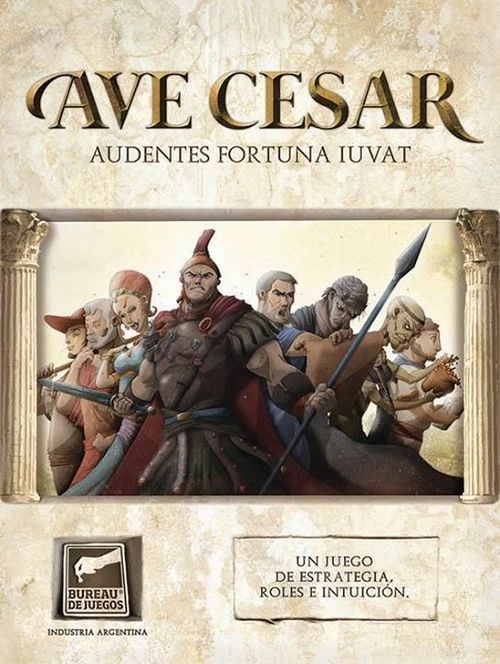
Ave Cesar
Ave Cesar Rulebook
Table of Contents
Table of Contents
Components
- 8 Character cards (silver back)
- 113 Building cards (gold back)
- 31 score tokens
- 1 rulebook
- 1 Procurator token
- 1 Starting Player token
Object of the Game
In AVE CESAR the players aim to build a city in honor of Caesar.
At the end of the game, players add up the points they obtain from their buildings, military might and political influence, as well as those earned during the game. The player with the most points wins the favor of Caesar, winning the game and making his family's name endure forever.
Game Setup
Each player takes a card at random from the Character deck. The player with the Character with the lowest play-order number is the Starting Player.
Then each player receives 4 cards from the Building deck, of which he chooses 2 to keep, returning the other 2 to the bottom of the deck.
Course of the Game
The game is divided into Rounds, each made up of 2 phases: the Character Selection Phase and the Construction Phase.
1. Character Selection Phase
During this phase, each player secretly chooses a Character according to the following method:
5-PLAYER GAMES: The Starting Player shuffles the Character deck and sets 2 cards aside at random (without looking at them), placing them face down. Then he looks at the 6 Characters left in his hand, secretly chooses one, and hands the rest to the player on his left, who in turn chooses one and passes on the rest. The process repeats until reaching the last player, who will choose between 2 cards. The remaining card is set aside face down with the other 2.
6-PLAYER GAMES: in this case, the Starting Player sets aside only one card at the beginning.
7-PLAYER GAMES: since only one card reaches the last player, he may choose between the card that reached him and the one that was set aside face down at the beginning of the phase.
4-PLAYER GAMES: the Starting Player sets aside only one card at the beginning. From the remaining 7, besides choosing a Character for himself, he must choose another that will be discarded face up and cannot be chosen by any other player during this Round. The last player may choose between the card that reached him and the one that was placed face down at the beginning of the phase. The remaining card is placed face down.
NOTE: when, in a 4-player game, the Philosopher is among the Characters discarded face up, the Starting Player token passes to the player on the right for the next Round.
2. Construction Phase
Once the choice of Characters is finished, the Construction Phase begins.
The play order of each player during this phase is determined by the play order indicated on the Character card he chose (see Characters).
The Starting Player begins by asking whether anyone has the Assassin (1st in play order). If a player chose it, he must "reveal" himself and play his Construction Phase. Once that phase is finished, or if nobody has the Assassin, the Spy is called, and so on until all players have finished their Construction Phase.
The first thing a player must do during his Construction Phase is take 2 cards from the Building deck and, where applicable, one for each "sown" Building (see Farmer).
Then he may perform the following actions in any order he wishes:
Use his Character's ability: following the instructions on the card.
NOTE: Players are NOT obliged to use their Character's ability.
Build a Building: build a Building card from his hand. To do so he must "pay" its value by discarding as many cards as the card's construction cost indicates. The cards used to pay go to the discard pile, while the Building is placed face up in his play area.
A city cannot contain 2 identical Buildings, unless the card being built indicates otherwise.
NOTE: Building is NOT mandatory.
IMPORTANT: The abilities of Buildings take effect at the moment they are built.
Card layout: each Building card shows its construction cost, its Victory Points, and (where applicable) Military Might, Political Influence and Sowing Capacity symbols.
Construction Phase Summary
- Reveal Character
- Draw 2 cards from the Building deck
- "Harvest" his sown Buildings (if applicable)
- Build a Building and/or use the chosen Character's ability (in any order)
End of the Game
When, at the end of a Round, one or more cities have reached 8 Buildings, the game ends and scoring begins.
Scoring
Once the game is over, each player adds up his score:
- The Victory Points shown on his Buildings.
- The Victory Points he obtained during the game.
- 2 extra Victory Points for each adjacent player whom he exceeds in Military Might.
- The Victory Points for Political Influence: 6 VP for the player with the most Influence, 4 VP for the second and 2 VP for the third.
NOTE: In case of a tie between 2 or more players, all tied players receive the corresponding points. E.g.: If 2 players tie for first place, both score 6 VP, but the next player scores only 2 VP since he is not second but third.
- 3 extra Victory Points for all players who have reached 8 or more Buildings.
Character Abilities
1st ASSASSIN: Instead of playing normally, the player who has the Assassin must only announce another Character aloud. As the Round continues, when the announced Character is revealed, the player who has it must yield his ability to the Assassin, who now can play his Construction Phase and also use the ability of the Character he announced.
After the Assassin finishes his Construction Phase, the player who had to yield the ability may play his own Construction Phase but may NOT use that ability.
If nobody chose the announced Character, the Assassin loses his Construction Phase for this Round.
NOTE: The Assassin, like all Characters, may decide NOT to use his ability. In that case, instead of announcing another Character, he plays his Construction Phase.
2nd SPY: the player who has the Spy may announce aloud another Character that has not yet been revealed and then plays his Construction Phase normally. If, as the Round continues, the announced Character is revealed, the Spy may steal half of the cards in that player's hand, of his choice (if the number of cards is odd, he may steal half plus one). If nobody has the announced Character, the Round continues normally.
3rd PHILOSOPHER: the player who has the Philosopher may choose a player (or himself) to be the new Starting Player, who receives the corresponding token. The chosen player must give the Philosopher a card from his hand of his choice.
NOTE: The new Starting Player may NOT be the same as the current one.
4th PROCURATOR: the player who has the Procurator may take an extra card from the Building deck and also receives the Procurator token.
PROCURATOR TOKEN: When a player has the Procurator token at the beginning of his turn, he may draw an extra card from the deck.
5th ARCHITECT: the player who has the Architect may look at the top 5 cards of the Building deck and keep one (the other 4 are placed in the discard pile). In addition, the Architect may build up to 2 Buildings during his Construction Phase.
6th CENTURION: the player who has the Centurion may compare his Military Might with that of the neighboring cities (the 2 adjacent players). For each player he exceeds (has more symbols), he may look at that player's hand and steal 1 card of his choice.
7th SENATOR: the player who has the Senator receives 1 Victory Point. In addition, he compares his Political Influence with the neighboring cities (the 2 adjacent players) and receives 1 extra Victory Point if he has the most Political Influence (most symbols) of the three.
8th FARMER: the player who has the Farmer may "sow" all his Buildings with the sowing symbol, provided they are empty. To do so, he places 1 card from the Building deck for each sowing symbol on the card(s) to be sown. The cards are sown on top of the Building, face down.
Frequently Asked Questions
When does the Spy steal the cards? The exact moment is when the targeted Character is revealed. This means he steals BEFORE that player takes the 2 cards at the start of his Construction Phase.
May I choose as the Spy's target the same target chosen by the Assassin? Yes. Hence the importance of making no comment if you were the Assassin's victim until your turn comes.
Are all cards worth the same when used to pay? Yes. When building, each card used to pay is worth 1.
Do cost reductions accumulate? Yes. For example, a player with Stables and Mint pays a cost of 3 cards to build the Port (whose original value is 5).
What is the maximum number of Buildings I can build in a game? Although the game ends at the end of a Round in which one of the players has achieved 8 Buildings, it is possible that, having the Architect in the last Round, a player reaches 9 Buildings.
What happens if at the end of the game 2 players have the same score? The tie is broken in favor of the player with more cards in hand. If they have the same number of cards, it is considered a tie.