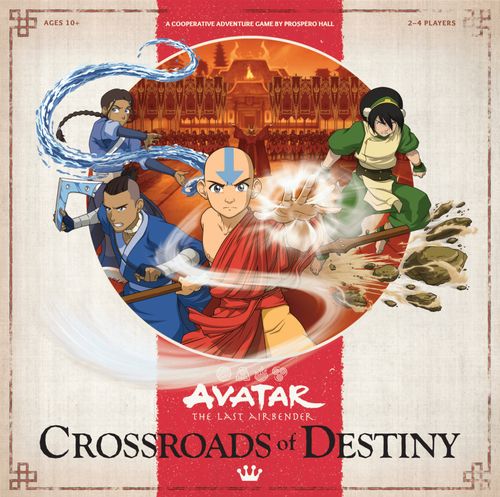
Avatar: The Last Airbender – Crossroads of Destiny
Avatar: The Last Airbender – Crossroads of Destiny Rulebook
Table of Contents
Table of Contents
- Meet Team Avatar
- Components
- Setup
- Playing a Challenge
- Enemy Strength and Defeat
- Ending Your Turn
- Element Tiles
- Enemy Turn
- Hero Strength
- Wounds
- Ending the Challenge
- Prepare for Your Journey
- After Each Challenge
- Encounters
- Continuing the Journey
- Sample Challenge: The Crystal Catacombs
- Playing a Single Challenge
- Frequently Asked Questions
Meet Team Avatar
AANG The current incarnation of the Avatar and the last surviving Air Nomad, Aang is a master of airbending at just 12 years old. His specialty is evasive maneuvering and a defensive style, although he can summon powerful bursts of air to attack enemies or aid an escape.
KATARA The only Waterbender in the Southern Water Tribe, Katara is driven by her belief in the Avatar, standing up for what's right, and mastering her bending. She can adapt to any situation, supporting her friends or leading the charge herself.
SOKKA As Katara's older brother, Sokka is always thinking ahead and watching out for enemies. He pushes himself to be a strong, reliable warrior, and likes to think outside the box with his clever attacks and trusty boomerang.
TOPH Although born into a protective noble family, Toph prefers to get her feet dirty. She always tackles issues — and enemies — head on. As a blind Earthbender, she uses her connection to the earth to unleash large attacks and block incoming damage.
Components
Book of Challenges and Book of Challenges clip
Journey Tracker, with 2 Journey Tracker clips
4 Hero Mats (Aang, Katara, Sokka, Toph), with 4 Hero Mat clips
4 Acrylic Hero Movers (insert into bases)
88 Action Cards (22 per Hero)
12 Element Tiles: Water (3), Air (3), Earth (3), Fire (3)
10 Objective Tokens
6 Challenge Tokens
8 Enemy Cards
12 Wound Cards
9 Ally Cards
4 White Lotus Tokens
15 Encounter Cards
14 Enemy Movers (insert into bases): Fire Nation Bender (2), Fire Nation Soldier (2), Dai Li Agent (2), Azula, Mai, Ty Lee, Prince Zuko, Admiral Zhao, Combustion Man, Long Feng, Fire Lord Ozai
3 Enemy Strength Cubes
Placing Enemy Movers:
- The color and shape of the symbol indicates the color and shape of the mover.
- The number indicates how many there are. If there's no number, there's only one.
- The name on the track matches the name on the mover.
- Place the mover(s) on the matching symbol(s) on the right page of the Book.
Setup
-
Place the Book of Challenges in the middle of the play area. For your first game, open the Book to Escape Prince Zuko (pages 2-3). Challenges are played directly on the Book.
After the Escape Prince Zuko Challenge, you may continue on a Journey, as explained on pages 13-14. Or, instead, you may play any single Challenge, as explained on page 19.
-
Place one cube on the topmost space of each Enemy Strength track on the left page of the Book. In a two-player game, place them on the spaces marked "2P" instead.
-
Take the Enemy movers for the Challenge, as indicated by the Enemy Strength tracks. Then place one on each matching space of the Book.
-
Place one Element tile on each matching space on the right page of the Book. Keep the extra Element tiles nearby.
-
Place the 12 Wound cards in a face-up stack to the left of the Book.
-
Mix up the six Challenge tokens and place them face down to the right of the Book.
-
Shuffle the eight Enemy cards and place them in a face-down stack below the Challenge tokens.
-
Each player chooses a Hero and takes the matching mat, clip, mover, mover base, White Lotus token, and 22 Action cards. Your cards have a Hero symbol in the bottom left that matches the symbol in the top right of your Hero mat. Return any unused Hero components to the game box.
-
Place your Hero mat in front of you showing the side matching the number of players in your game. (One side is for two or three players, and the other is for four players.) Slide your clip onto the topmost Strength number along the left edge.
-
Take your 10 starting cards, marked with a star in the bottom right, and shuffle them. Place them in a face-down deck to the left of your mat, and draw five cards from your deck to form your hand.
Note: If you are playing a more difficult single Challenge, or you are further into a Journey, you may have more cards in your starting deck, as explained later. Otherwise, you can return your remaining 12 Action cards to the game box for now.
Example — Glider: Place Aang on top of any Air tile.
-
Place your White Lotus token face down above the Challenge tokens. Place your Hero mover on any starting space (outlined in green) on the right page of the Book. Movers cannot share a space.
-
Read the Challenge's Introduction, Objective, Bonus Objectives, and Special Rules aloud. Complete any special setup, such as placing Objective tokens. (There is no special setup for Escape Prince Zuko.)
Playing a Challenge
Each Round
- Determine Hero Order: Mix up and reveal White Lotus tokens.
- First Hero's Turn: They do actions using cards from their hand.
- End Turn: Redraw hand, flip White Lotus token, flip a Challenge token.
- Other Heroes' Turns: Take turns as above, in order of White Lotus tokens.
- Enemy Turn: Flip an Enemy card and all Enemies do an action.
Start of Round
A Challenge is played over several rounds. At the start of each round, mix up the White Lotus tokens, arrange them in a column next to the Book, then flip them all face up. Each Hero will take a turn in the order of the tokens, from top to bottom. After all Heroes have gone, the Enemies will take a turn.
On Your Turn
Do the following any number of times, in any order:
- Do a Basic Action on your mat by discarding that number of cards from your hand.
- Play an Action card from your hand to do its action. Then discard the card.
After doing actions, complete the steps for ending your turn.
Basic Actions
Each Hero can do three Basic Actions, as shown on your Hero mat. Not all Heroes have the same Basic Actions. Each Basic Action has an icon and a number below the icon, which indicates the number of cards required to do that action.
To do a Basic Action, discard the number of cards shown from your hand, ignoring any actions on those cards.
Your Hero's Basic Actions are shown on the right side of your mat. Not all Heroes have the same Basic Actions. Additionally, each Hero has a unique ability explained at the bottom of their mat. This is available to use whenever the ability specifies.
MOVE Move 1 space in any direction, including diagonally. You cannot stop in a space with a Hero or Enemy, or an impassable space (outlined in red). If you do several Basic Action Moves in a row, you may Move through other Heroes. You cannot Move through Enemies or impassable spaces.
Heroes may Move through and stop on spaces with any number of tiles or tokens, including Element tiles. If you move into a space with a Fire tile, it does 1 damage to you.
Whenever damage is done to a Hero, lower your Strength by that amount on the Strength track of your Hero mat.
Move Example: Katara cannot Move into the impassable space or the space with an Enemy. She can Move in any other direction. If she does a Move 2 action, or two Basic Action Moves, she can Move through Aang's space to the space past him.
CLOSE ATTACK Something is close to you if it is on your space or on any of the eight spaces surrounding yours. Tiles and tokens under your Hero mover are considered close to you. Many actions refer to close Heroes, Enemies, tiles, or tokens.
A Close Attack action does 1 damage to an Enemy close to you. Lower the Enemy's Strength by 1 on their Strength track.
Close Attack Example: Toph can damage either one of the Enemies close to her. She cannot damage the Enemy who is not close to her.
RANGE ATTACK Do 1 damage to an Enemy that is not close to you in a straight line that passes through the center of the space(s) between you. You may Range Attack through tiles, tokens, and other Heroes, but not through Enemies or impassable spaces.
Range Attack Example: Aang can damage either one of the Enemies in a straight line from him, including through Katara. He cannot damage the Enemy close to him, the Enemy not in a straight line from him, or the Enemy through another Enemy.
INTERACT To Interact with something, it must be close to you (on your space or on a space next to yours). The effect of an Interact action is unique to each Challenge, as explained in the Book of Challenges.
Playing Action Cards
Instead of discarding cards for Basic Actions, you may play an Action card to do what it says. You may do any or all parts of an Action card, but each part must be done in order. After playing a card for its action, discard the card.
Many Action cards allow you to Move and Attack just like Basic Actions, and often in more powerful ways. These actions are followed by a number to indicate their effect. For example, Move 3 allows a Hero to Move up to 3 spaces, and Close Attack 2 does 2 damage to a single Enemy close to you.
BURST ATTACK Damage all Enemies on spaces close to you. The listed number after Burst Attack is the damage done to each Enemy.
Burst Attack Example: Katara can damage all the Enemies close to her. She cannot damage the Enemy who is not close to her.
HEAL Increase your Strength by the listed number. You may only Heal yourself, unless an action says otherwise. Your Strength may never exceed the topmost number on your Hero mat.
DRAW CARDS Add the listed number of Action cards from the top of your deck to your hand. You may use those cards this turn. If you ever need to draw a card and your deck is empty, shuffle your discard pile to reform your deck.
PLACE, MOVE, AND REMOVE ELEMENT TILES When you place an Element tile, you may take a matching tile from any space in the Book, or one of the extra tiles kept nearby during setup. When you remove an Element tile, you may take it off any space and add it to the supply near the Book. (See Element Tiles below for more details.)
FREE BASIC ACTION Do one of the Basic Actions on your Hero mat without discarding any cards.
Other Action Details
- Hero actions are optional, and may be done to any degree. For example, with a Move 2 action, you can Move 2 spaces, 1 space, or not Move at all.
- An entire card is considered one "action," even if it consists of multiple parts.
- Hero actions can never damage other Heroes. Enemies cannot damage other Enemies, unless an action says otherwise.
- When any Hero, Enemy, tile, or token moves, it may not leave and return to the same space within one action (i.e. double back).
- Any number of tiles and tokens may be on the same space. Heroes and Enemies may move through that space, and any one may stop on it.
- Wound cards can't be discarded to do Basic Actions, but can be discarded in any other way. This includes actions on Hero's Action cards, Enemy actions, Challenge Special Rules, and when ending your turn.
Move Action Examples
MOVE AWAY When moving "away," each space moved to must be further than the previous space. For example, the Bender can do the action "Move 2 away from the closest Hero" in any way that satisfies this. Actions where something moves away will specify a Hero, Enemy, or space(s) to move away from.
MOVE TOWARD When moving "toward" something, each space moved to must be closer than the previous space. For example, the Bender can "Move 2 toward" Aang in any way that satisfies this. If an Enemy's Move action does not specify a direction (for example, Move 2), they Move toward the closest Hero.
MOVE THROUGH Something has "moved through" a space if it touched that space during the action. When the Water tile moves from Katara's space to Aang's space, it moves through all the spaces in between, including the ones it started and stopped on.
Enemy Strength and Defeat
Whenever you damage an Enemy, lower the cube down that Enemy's Strength track in the Book. If there are multiple Enemies of the same type, they share one Strength track. Any time you damage an Enemy, the Strength is lowered for all Enemies of that type.
To defeat an Enemy, you must lower their Strength to 0. When an Enemy is defeated, remove all movers of that type from the Book. If an Enemy has an infinity symbol instead of a 0 at the bottom of their track, they cannot be defeated, and remain until the Challenge ends.
Ending Your Turn
When you finish doing actions, do the following in order:
- If you have any cards left in your hand, choose any that you want to keep for the next round, and discard the rest.
- Draw from your deck until you have five cards in your hand. If you ever need to draw a card and your deck is empty, shuffle your discard pile to reform your deck.
- Flip your White Lotus token face down.
- Flip one of the Challenge tokens face up. If you flip the Draw symbol, all Heroes draw a card. If you flip a Special Rule symbol, follow the matching instructions in the Book. If you flip a blank, do nothing. Leave the token face up. If all Challenge tokens are now face up, follow the instructions below.
When all six Challenge tokens are face up, take one of the blank Challenge tokens and place it on the highest empty space of the Challenge track in the Book. After placing the token, if all the spaces of the track are full, the Challenge ends and the Heroes lose. Otherwise, flip all remaining Challenge tokens face down and mix them up.
Then it's the next Hero's turn, in order of the White Lotus tokens. After all Heroes have taken a turn, the Enemies do actions.
Element Tiles
- Heroes and Enemies can do actions that move Element tiles. However, tiles never move automatically — only when actions say they do.
- Tiles may be placed, moved through, or stop on any space that is not impassable. Any number of Element tiles (and/or other tokens) can be in the same space.
- When you place an Element tile, you may take one from any space, or take a tile that was kept aside during setup. Tiles you remove during a Challenge may also be placed this way.
- Fire tiles do 1 damage to a Hero when one moves into the other's space, unless a Hero is moving the Fire tile. Fire tiles are not considered Enemies.
- The numbers on Element tiles are only used for Encounters. While playing a Challenge, leave the tiles number side down.
Enemy Turn
After all Heroes take a turn, all Enemies do actions. Enemy actions work like Hero actions, as described previously, or are explained on Enemy cards.
To start the Enemy turn, flip over the next Enemy card and do the actions from top to bottom. Starting with the first type of Enemy, as shown by the symbol(s), all Enemies of that type do the action, one at a time. If there are multiple movers of one type, you choose the order each mover does the action. Ignore Enemies that have been removed.
Most Enemy actions say which Heroes they affect. If they don't, or if multiple Heroes could be affected, the action affects the Hero closest to that Enemy. If multiple Heroes are equally close, the Heroes choose which one is affected.
When Enemies Move toward a Hero, or move a Hero toward them, the movement stops either at the listed number of spaces, or when they are close to that Hero — whichever comes first. When Enemies move Heroes or Fire tiles toward each other, the movement stops if one moves into the other's space. Fire tiles can only move once per Enemy card (not per mover). If an Enemy action could move anything several different ways, following these rules, the Heroes choose.
After all Enemies do their actions, discard the Enemy card. Then start the next round by mixing up the White Lotus tokens.
Hero Strength
Enemy attacks damage Heroes in the same way Hero attacks damage Enemies. When you are damaged, lower the clip down the Strength track on your mat. If you Move through a Fire tile, or an Enemy moves a Fire tile through your space, lower your Strength by 1.
If any Hero's Strength reaches 0, the Challenge ends and the Heroes lose.
Wounds
The first time in a Challenge that a Hero's Strength reaches 4 or lower, they take one Wound card from the stack and place it face down on top of their deck. Wound cards cannot be discarded to do Basic Actions, but can be discarded in any other way. This includes actions on Hero's Action cards, Enemy actions, Challenge Special Rules, and when ending your turn.
Example — Element of Clarity: After Katara moves a Water tile through a Hero or Enemy, she may place them on top of that tile.
Ending the Challenge
At any time, if the Challenge's Objective is complete, the Challenge ends immediately and the Heroes win! This can happen in the middle of a round or the middle of a Hero's turn.
If any Hero's Strength reaches 0, or if a Challenge token is placed on the last space of the Challenge track, the Challenge ends immediately and the Heroes lose.
Whether you won or lost the Escape Prince Zuko Challenge, you may continue Team Avatar's adventures by playing a Journey. A Journey is a series of Challenges alternating with story Encounters and ending with a final battle against Fire Lord Ozai. How well you face each Challenge and Encounter will affect the skills, experience, and allies you'll have in the final battle. To win a Journey, you must defeat Fire Lord Ozai.
Prepare for Your Journey
- Place the Journey Tracker above the Book of Challenges, and slide a clip onto each Start space: 0 for Team Avatar Experience and 20 for Fire Nation Dominance.
- Take the 15 Encounter cards and place them in a stack nearby with the pictures facing up. Make sure they are in numerical order with The King of Omashu (Card 1) on top.
After Each Challenge
If you won the Challenge, Team Avatar gains 1 experience for each empty space on the Challenge track in the Book. Move the clip on the Journey Tracker and check for rewards, as explained under Challenge Rewards below.
If you won, you also lower Fire Nation Dominance by the number next to the Objective. If you completed any Bonus Objectives before the Challenge ended, lower Dominance for these as well. Move the clip on the Journey Tracker and check for rewards, as explained under Challenge Rewards below.
Example — Escape Prince Zuko: Objective: Remove all Soldiers and Benders. -1. Bonus: Defeat 2 Soldiers and Benders. -1. Lower Prince Zuko's Strength to 0. -2.
If you lost the Challenge, don't adjust the Journey Tracker or gain any rewards. Instead, all the Heroes can remove all the Wounds from their decks, discard piles, and hands, returning them to the stack.
Whether you won or lost the Challenge, read the "After the Battle" options in the Book of Challenges. Together, choose where Team Avatar should go next. Usually this will be an Encounter.
Example — After the Battle (Escape Prince Zuko): Choose one to continue your Journey: Will you visit Kyoshi Island, a secluded place known for warrior women and giant elephant koi fish? Turn to pages 4-5. Or, will you sneak into the Fire Nation so that Aang may speak with Avatar Roku at the Fire Temple? Turn to pages 6-7.
Challenge Rewards
GAIN AN ACTION CARD Whenever a clip reaches a green space (1, 10, or 20 on Team Avatar Experience and 15 or 5 on Fire Nation Dominance), all Heroes get to add a new, more powerful Action card to their deck.
Take your Hero's remaining Action cards from the game box, shuffle them, and draw two. Then choose one to add to your deck, and return the others to the game box. Your new card will remain in your deck for the duration of the Journey.
Example — Snack Attack: This turn, discard only 1 card to do each Basic Action.
GAIN AN ALLY CARD Whenever a clip reaches a purple space (15 on Team Avatar Experience and 19 or 0 on Fire Nation Dominance), the Heroes gain a new Ally.
Take the Ally cards from the game box, shuffle them, and draw two. Then together, choose one to join Team Avatar, and return the others to the game box. Allies provide a special power that can be used once per Challenge.
At the start of each Challenge, place all your Allies face up near the Book. On any Hero's turn, they may flip an Ally card face down to use their power. There is no limit to the number of Allies you can use at once. Face-down Allies can't be used again in that Challenge, but they'll be available to use again in the next Challenge.
REMOVE A CARD Whenever a clip reaches a gray space (5 on Team Avatar Experience and 10 on Fire Nation Dominance), all Heroes may remove one card from their deck, discard pile, or hand. If you remove a Wound, return it to the stack. If you remove a Basic Action card, return it to the game box.
Encounters
After most Challenges, you'll be directed to an Encounter. Encounters are tests of Team Avatar's memory, dexterity, and logic using the Element tiles. They provide another opportunity to gain experience, lower Fire Nation Dominance, or remove Wounds.
If the "After the Battle" option you choose tells you to go to an Encounter, take the Encounter card indicated, read the introduction, and flip the card over. Complete the type of Encounter listed: Recovering, Uprising, or Focusing, as explained below. Each Encounter has a different way to win, as written on the card. After you complete the Encounter, whether you won or lost, read the Epilogue. Then continue your Journey with the next Challenge.
Recovering Encounter
Use memory and deduction to match the numbers on pairs of tiles. Heroes may not talk or communicate with each other during this Encounter.
Setup Mix up all twelve Element tiles with the number sides down. Arrange them into a 3x4 grid. It doesn't matter which tiles are where. Choose any Hero to take the first turn.
On Your Turn
- Flip any two tiles face up. If the numbers match, collect both tiles and set them aside in the team's Collection. If they don't match, flip those tiles face down again.
- Remove any one tile from the grid, flipping it face up and setting it aside in a Removed area. This tile cannot be used to match or collect tiles.
- Now it's the next Hero's turn.
Example: After flipping two tiles, you collect a pair of 3s.
Example: You remove an Air tile, and flip it face up.
Continue taking turns until the team collects the required pairs, as listed on the Encounter card, or until you run out of tiles. Check the pairs you collected to see if you won the Encounter, and gain the rewards listed. Then continue your Journey.
Uprising Encounter
Use dexterity and judgment to stack tiles. Push your luck to stack higher for greater rewards. But if any tiles fall, the Heroes gain nothing.
Setup Take any six Element tiles to use for this Encounter (the type doesn't matter). Set the other six tiles aside. Choose any Hero to take the first turn.
On Your Turn
- Take one tile and place it upright (on its narrow side) on top of the stack. On the first turn, place it directly on the playing surface.
- Now it's the next Hero's turn.
Continue taking turns until the team agrees to stop stacking, or any tile falls. Check how many tiles you stacked and gain the rewards listed. If any tiles fell, gain no rewards. Then continue your Journey.
Example: You stack the fifth tile and no tiles fall. You decide to stop the Encounter and lower Fire Nation Dominance equal to the reward listed on the Encounter card.
If this Encounter proves difficult, try new techniques. Rotating the tiles by a half turn may give better balance.
Focusing Encounter
Use logic and deduction to pair up tiles so that your side is higher. Heroes may talk and help each other during this Encounter.
Setup Mix up all twelve Element tiles with the numbers face down. Arrange them into two lines, with Air and Water tiles in one line and Earth and Fire tiles in the other. The line with Air and Water tiles is considered "your side" for this Encounter. Then flip over any two tiles — it doesn't matter which lines they are in. Choose any Hero to take the first turn.
On Your Turn
- Flip any one tile face up.
- Choose one tile on your side (the Air and Water line), and one tile on the other side. These two tiles will be paired against each other. You do not have to choose a tile you just flipped. Either or both tiles can be face up or face down.
- Set the two tiles aside in a conflict. Those tiles cannot be chosen for another conflict.
- Now it's the next Hero's turn.
Continue taking turns until every tile is in a conflict. Then flip all the tiles face up. If the tile on your side (Air or Water) is higher than the tile it was paired against, you've overcome that conflict! If the tile on your side is lower, or the numbers are the same, you lost the conflict. Check the conflicts to see if you won the Encounter, and gain the rewards listed. Then continue your Journey.
Example: You choose to pair the face-down Air tile, which you know is a 3, against the face-up Earth 2 tile. You know you'll overcome this conflict!
Continuing the Journey
After each Encounter, the card will direct you to your next Challenge. Return the Encounter card to the stack and choose whether to continue right away, or save your progress for later.
If you continue, clear all the pieces from the Book so you can set up the next Challenge, following the setup steps above. All Heroes reset their Strength to the topmost number on their mat and shuffle their Action cards. Be sure to include your deck, hand, and discard pile from the previous Challenge, as well as any new Action cards you gained from rewards. If the team has any Allies, place them all face up next to the Book.
When you decide to stop playing, you can save your progress using the Book of Challenges clip. Slide the clip onto the Book to mark your next Challenge, or onto the Encounter card where you'll begin next time. Leave the clips on the Journey Tracker in place, to keep track of Team Avatar Experience and Fire Nation Dominance.
When you put the game away, store the Action cards that make up your deck (including ones gained from rewards) separately from other cards. Similarly, keep any Allies you've gained on your Journey separate from those you haven't yet.
Sample Challenge: The Crystal Catacombs
Introduction Azula and her new loyal followers, the Dai Li, confront Aang and Katara in the Crystal Catacombs beneath Ba Sing Se. Zuko joins Azula and the Dai Li in their attempt to bring down Team Avatar.
Objective Lower Prince Zuko's Strength to 0, and defeat all Dai Li Agents. -1
Bonus Remove all Wells. -1 Lower Azula's Strength to 0. -1
Special Rules Setup: Randomly place the numbered Objective tokens on the matching spaces, number side up. These tokens are Wells.
Heroes can Interact with Wells to Heal. After Interacting, do a Heal action equal to the Well's number, then remove the Well.
When Prince Zuko or Azula do Attack actions on Enemy cards (not Challenge tokens), add 1 to each Attack.
After the Battle Choose one to continue your Journey: Uprising — will you attempt to lower Fire Nation Dominance by hosting a secret dance party? Go to Encounter 10.
Playing a Single Challenge
Instead of playing a Journey, you may play any single Challenge in the Book. Choose which one you want to play, setting it up as explained in Setup above. In addition, each Hero starts with more Action cards in their deck based on the Challenge's difficulty.
After taking your 10 starting cards, shuffle your remaining 12 Action cards. Draw and choose a certain number of cards to add to your deck, as listed below, according to the Challenge's difficulty shown in the Book. Shuffle your chosen cards into your deck before drawing your hand of five cards.
| Difficulty | Cards |
|---|---|
| Difficulty 0 | No extra cards. |
| Difficulty 1 | Draw two, choose one. |
| Difficulty 2 | Draw three, choose two. |
| Difficulty 3 | Draw four, choose two. |
| Difficulty 4 | Draw five, choose three. |
| Difficulty 5 | Draw six, choose four. |
When playing a single Challenge, don't use the Journey Tracker or any Encounter cards or Ally cards. To win the game, complete the Challenge's Objective before any Hero's Strength reaches 0, or before a Challenge token is placed on the last space of the Challenge track.
Frequently Asked Questions
What do I do if a card or the Book of Challenges would break a rule in the instructions? Do what the card or special rule says. The text on game components takes precedence over these instructions.
If a Hero or Enemy moves when an Element tile is underneath them, does the tile move too? The tile doesn't automatically move with them, unless a specific ability says it does.
Can my Hero do a Range Attack if an Enemy is close to me? You cannot damage an Enemy close to you with a Range Attack. However, you may Range Attack a different Enemy if one is close to you.
Can we continue playing after winning a Challenge, so we can get the Bonus Objectives? No. The Challenge ends immediately when you complete its Objective. If you want to get the Bonus, be sure to complete its requirement before (or at the same time as) the Objective.
If my Strength reaches 4 again in the same Challenge, because I Healed and then took more damage, do I take another Wound? No. You only take one Wound this way per Challenge.
Can we gain multiple Action card rewards from one Challenge? Yes. If the Heroes reached multiple spaces of the same color on the Journey Tracker, complete the steps to gain that reward for each matching space you reached.
What does "remove" a card mean? Take it out of your deck for the rest of the game or the duration of the Journey. If it's a Wound, return it to the stack. If it's a Basic Action card, return it to the game box.
If my Action card says to Heal, can I Heal another Hero? No. You can only Heal another Hero if the card specifically says so.
Can multiple Element tiles be on the same space? Yes. Any number of tiles and tokens can share a space with one mover. However, only one mover (Hero or Enemy) can stop on a space.
Can I move back and forth between two spaces? No. When anything moves, it may not leave and return to the same space within one action (i.e. double back). However, you may do another action on the same turn that returns to spaces from a previous action.
Do Enemies damage other Enemies? Do Heroes damage other Heroes? No. Enemies and Fire tiles cannot damage Enemies, unless specified by a Challenge's Special Rules. Heroes can never damage other Heroes, even by moving a Fire tile through their space.